Best Voice AI Platforms for Building Phone Agents in 2026: Vapi, Retell, ElevenLabs, LiveKit and More
Best Voice AI Platforms for Building Phone Agents in 2026: Vapi, Retell, ElevenLabs, LiveKit and More
October 16, 2026· min read·#AI#Tech·Reviewed by Plavno AI Engineering Team
The best voice AI platforms are the ones matching your latency, SIP, language, compliance, pricing, and lock-in needs. This roundup compares 10 vendors for production phone-agent use cases, from hosted launch speed to custom infrastructure control.
Share this post
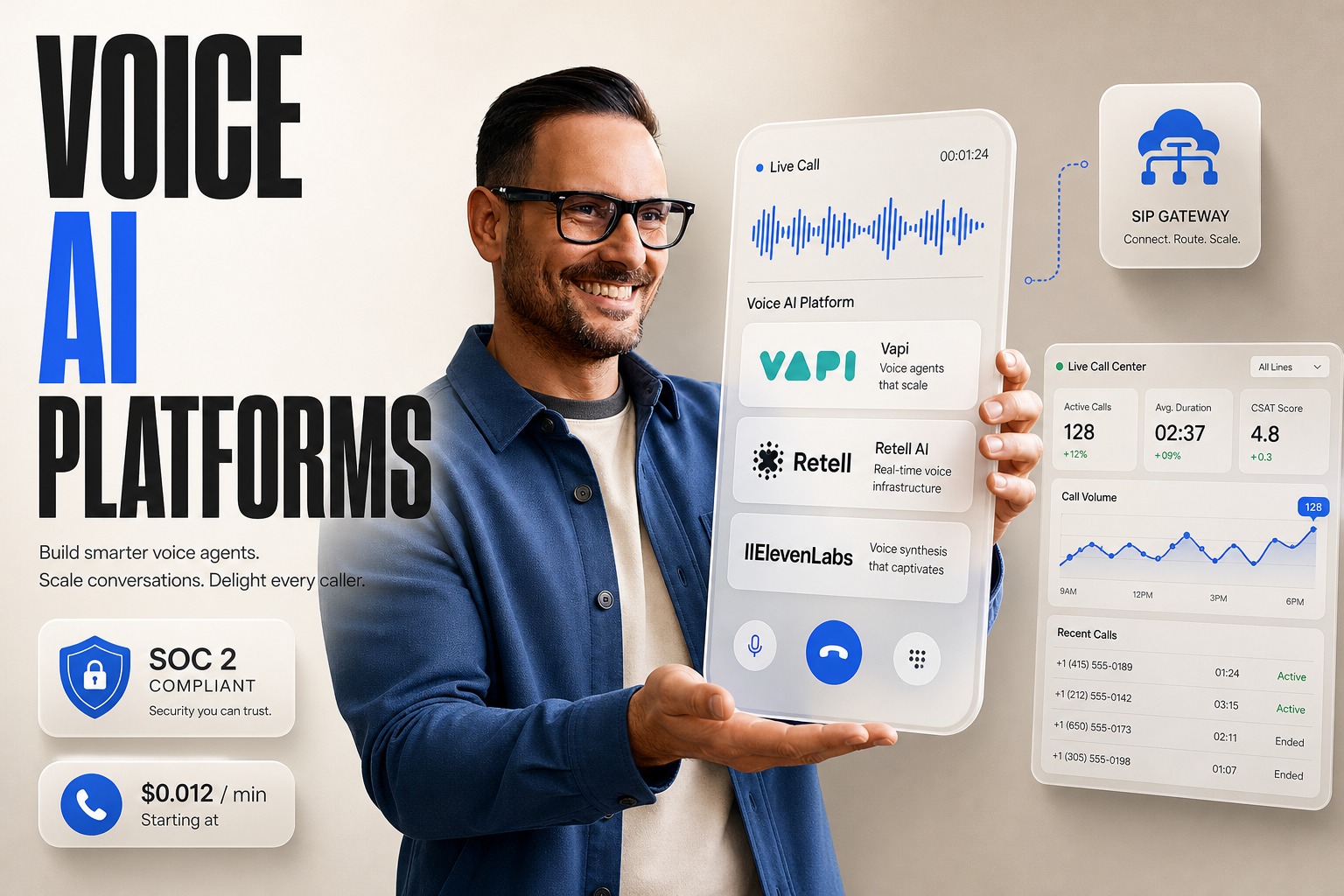
The best voice AI platforms in 2026 help teams launch low-latency phone agents without rebuilding telephony, speech, and orchestration from scratch. This ranked guide is for product, operations, and engineering leaders comparing Vapi, Retell, ElevenLabs, LiveKit, and related voice stacks for an AI phone agent platform.
We focus on practical buying criteria: latency, SIP support, interruption handling, languages, pricing per minute, compliance posture, and platform lock-in.
QUICK ANSWER
The best voice AI platforms in 2026 are led by Vapi for fast production launches, Retell for call-center workflows, ElevenLabs for natural voices, LiveKit for custom real-time architecture, and Twilio for enterprise telephony. Choose hosted platforms for speed, and lower-level APIs when latency, compliance, or lock-in matter.
We evaluated the best voice AI platforms by how reliably they support real phone-agent workloads, not just demo conversations. The ranking weighs launch speed, audio quality, developer control, SIP readiness, and the operational risk of depending on one vendor.
Production readiness for inbound support, outbound sales, appointment booking, and ai receptionist workflows.
Stack depth across STT, TTS, LLM orchestration, RAG, call recording, analytics, and human handoff.
Compliance posture, including SOC 2 signals, HIPAA options, data retention controls, and auditability.
Pricing transparency around $/min usage, telephony, transcription, synthesis, and model costs.
Team support, documentation quality, observability, sandboxing, and incident response for production calls.
1. Vapi
Best for: Teams launching production phone agents quickly
Vapi is the strongest overall choice for developers who want a hosted voice agent API with telephony, model selection, tool calls, and call analytics in one place. It supports practical agent patterns such as appointment scheduling, call qualification, CRM updates, and escalation to humans. Its main limitation is that deeper customization still depends on Vapi’s orchestration layer, so regulated enterprises should evaluate data retention and fallback design carefully.
2. Retell AI
Best for: Call-center style sales and support automation
Retell AI is a polished AI phone agent platform for structured business calls, especially when teams need dashboards, test calls, campaign logic, and call transcripts. In a Vapi vs Retell comparison, Retell often feels more workflow-oriented, while Vapi feels more developer-native. Retell is less ideal when you need full ownership of the media layer or highly custom SIP routing.
3. ElevenLabs
Best for: Brands where voice realism matters
ElevenLabs stands out for natural TTS, expressive voices, and multilingual audio quality, which makes it attractive for customer-facing AI receptionist and commerce flows. Its Conversational AI tools reduce the need to assemble separate voice components. The tradeoff is that teams choosing ElevenLabs primarily for voice quality may still need additional engineering around telephony, CRM sync, RAG, and monitoring.
4. LiveKit Agents
Best for: Engineering teams building custom low-latency voice infrastructure
LiveKit is the best fit when you want WebRTC-grade media control, open architecture, and the freedom to choose STT, LLM, and TTS providers. LiveKit Agents can power real-time voice agents with SIP ingress, custom routing, observability, and lower lock-in than most hosted tools. It demands more engineering effort, so it is not the fastest path for a nontechnical team.
5. Bland AI
Best for: High-volume outbound calling teams
Bland AI focuses on phone automation for outbound calls, qualification, surveys, reminders, and sales operations. It gives business teams a faster route to calling campaigns than composing a stack from Twilio, STT, TTS, and an LLM. Its limitation is that highly differentiated voice UX, complex compliance rules, or multi-system workflows may outgrow a hosted campaign platform.
6. Twilio
Best for: Enterprises that already run programmable voice infrastructure
Twilio remains a core telephony layer for teams that need global numbers, SIP trunking, IVR, call recording, routing, and contact-center integration. It is not a complete agent brain by itself, but it pairs well with OpenAI, Deepgram, ElevenLabs, or custom orchestration. The downside is implementation complexity: latency, interruption handling, and dialogue state become your responsibility.
7. Deepgram
Best for: Speech-heavy products needing API-level control
Deepgram is a strong speech infrastructure choice for teams that care about fast STT, endpointing, diarization, and voice analytics. Its voice agent API direction is useful for builders who want modular control rather than a fully opinionated call platform. It is usually not enough alone for a full ai receptionist because you still need telephony, business logic, CRM actions, and post-call workflows.
8. OpenAI Realtime API
Best for: Multimodal agents with strong reasoning
OpenAI is compelling when your agent needs real-time audio, tool use, semantic reasoning, and multilingual understanding from the same model family. It can support phone agents through Twilio, SIP bridges, or WebRTC infrastructure. The limitation is operational: you must design call routing, telephony compliance, prompt safety, recovery from hallucinations, and cost controls.
9. Daily Bots
Best for: WebRTC-first voice and video agent experiences
Daily is useful when the voice agent lives inside real-time web, app, or video experiences rather than only PSTN phone calls. Daily Bots help teams assemble low-latency conversational agents with media pipeline control and provider flexibility. For traditional inbound phone automation, it may require more integration work than Vapi, Retell, or Twilio-based stacks.
10. Synthflow AI
Best for: No-code ai receptionist setup for SMBs
Synthflow AI is designed for business users who want to configure call flows, calendar booking, lead capture, and support scripts without heavy engineering. It is a practical choice for clinics, agencies, local services, and smaller sales teams asking how to build an ai receptionist quickly. The tradeoff is lock-in: advanced integrations, custom latency targets, or proprietary dialogue logic can become difficult outside the platform.
EXAMPLE USE CASE
A logistics company deployed an AI phone agent automating inbound and outbound logistics calls to streamline logistics communication and reduce manual workflows and delivery delays. After integrating Plavno's solution, the team achieved 65% faster response time and achieved 40% cost optimization.
When a Voice Agent Platform Is Enough vs When to Build Custom
The best voice AI platforms are enough when your use case is standard: booking, FAQs, reminders, lead qualification, or simple support triage. Build custom when calls affect revenue, compliance, brand trust, or complex operations across ERP, CRM, payments, and knowledge bases. Plavno’s view from voice projects is simple: hosted tools validate the workflow, while custom architecture gives you ownership of latency, data, integrations, QA, and long-term unit economics.
FAQ
What are the best voice AI platforms? → The best voice AI platforms for most teams are Vapi, Retell AI, ElevenLabs, LiveKit, Bland AI, Twilio, Deepgram, OpenAI Realtime API, Daily Bots, and Synthflow AI. The right choice depends on whether you need speed, voice quality, telephony depth, or custom architecture.
How Do You Choose Voice AI Platforms? → Start with the call type, then compare latency, SIP support, barge-in, languages, compliance, analytics, pricing per minute, and lock-in. Run a pilot with real call recordings before scaling.
What Is an AI Receptionist? → An AI receptionist is a voice agent that answers calls, understands caller intent, books appointments, answers routine questions, transfers calls, and logs outcomes in business systems.
What Are Common AI Receptionist Use Cases? → Common ai receptionist use cases include appointment scheduling, missed-call follow-up, lead intake, order status, service reminders, routing, surveys, and after-hours support.
What Is AI Receptionist Development Cost? → AI receptionist development cost ranges from a low monthly platform fee for no-code setups to a larger custom build when you need integrations, compliance, QA, and dedicated infrastructure.
AI AUTOMATION
Need Production Voice Agents?
Design, integrate, and scale a reliable AI phone agent with custom workflows, telephony, analytics, and human handoff.
The best voice AI platforms can shorten time to market, but the winning stack depends on whether you value speed, control, voice quality, or compliance most. If your phone agent must connect to proprietary workflows and perform reliably under real traffic, Build a production voice agent with architecture you can measure, govern, and improve.