In 2026, the definition of software has shifted from static logic to dynamic autonomy. We are no longer building simple scripts that process inputs and return outputs; we are building systems that perceive, reason, and act. For CTOs and founders, the pressing question is not just "can we build this?" but "what is the actual price tag for a system that can operate with partial autonomy?" The market has moved past the hype cycle of 2023, and the reality of AI agent development cost is defined by complexity, integration depth, and the rigor of the underlying infrastructure. A simple wrapper around GPT-4 is cheap, but an enterprise-grade agent that can reliably interact with your internal ERP, adhere to strict governance, and operate at scale is a significant engineering investment.
Industry challenge & market context
The rush to deploy AI has exposed critical bottlenecks in traditional software delivery. Enterprises are finding that off-the-shelf models cannot simply be "plugged in" to legacy systems. The friction arises from the gap between probabilistic LLM outputs and deterministic business requirements. Organizations face high failure rates not because the models lack intelligence, but because the surrounding architecture lacks resilience.
- Legacy integration debt: Most enterprise data resides in monolithic SQL databases or mainframes that do not offer the API-first interfaces required for real-time agent interaction.
- Data fragmentation: Critical context is often siloed across disparate SaaS platforms (Salesforce, ServiceNow, Slack), requiring complex ETL pipelines to unify data for retrieval-augmented generation (RAG).
- Hallucination risks: In high-stakes domains like fintech or healthcare, a 1% error rate is unacceptable, necessitating expensive guardrails, validation layers, and human-in-the-loop workflows.
- Security and compliance: Data residency requirements (GDPR, SOC2) make it difficult to rely on public model endpoints, driving up the cost of self-hosted or private cloud deployments.
- State management complexity: Unlike stateless HTTP requests, agents maintain long-term conversation history and execution state, which introduces new challenges in memory management and session persistence.
Technical architecture and how AI agent development cost works in practice
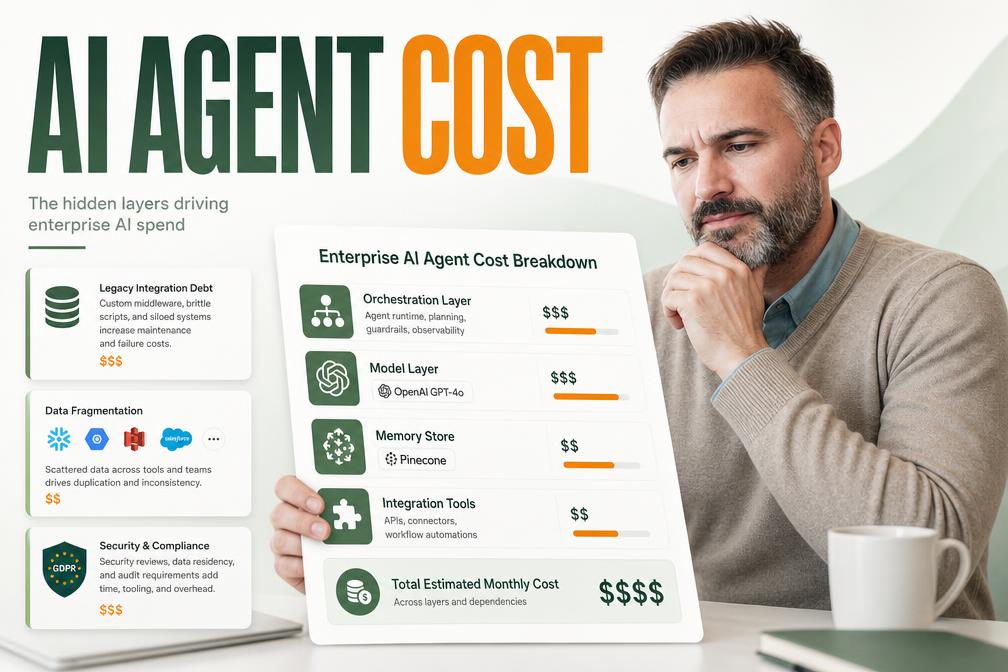
Understanding the cost requires dissecting the architecture. An AI agent is not a single binary; it is a distributed system composed of an orchestration layer, a reasoning engine, a memory store, and a toolkit of integrations. The AI software development cost is driven by how tightly these components are coupled and how much custom engineering is required to make them reliable.
The Core Stack Components
- Orchestration Layer: This is the brain's manager. Frameworks like LangChain, LlamaIndex, or AutoGen manage the agent's lifecycle. They handle prompt chaining, routing user queries to the correct sub-agent, and managing the context window. If you need multi-agent collaboration (e.g., one agent researches, another writes, a third critiques), the complexity of this layer explodes, requiring sophisticated state machine management.
- Model Layer: The choice of model dictates both performance and price. GPT-4o or Claude 3.5 Opus offer high reasoning but high latency and cost. Smaller models (Llama 3, Mistral) are cheaper and faster but require fine-tuning to perform well on specific tasks. A robust architecture often uses a router: small models for simple classification, large models for complex reasoning.
- Memory and Context: Agents need to remember. Short-term memory is handled via in-memory stores like Redis for low-latency access to recent conversation turns. Long-term memory requires vector databases (Pinecone, Milvus, Weaviate) to store embeddings of past interactions and documents. The cost here scales with the volume of data indexed and the frequency of vector similarity searches.
- Tool Use & Integrations: An agent is useless if it cannot act. This layer connects the LLM to the outside world via REST APIs, GraphQL endpoints, or webhooks. For example, to "process a refund," the agent must call an internal billing API. This requires strict schema definition, function calling capabilities, and robust error handling (circuit breakers, retries) to ensure the agent doesn't get stuck in a loop.
- Infrastructure & Deployment: Running this in production requires a containerized environment. Docker and Kubernetes are standard for orchestrating the microservices that support the agent. For high-throughput scenarios, serverless functions (AWS Lambda) can handle event triggers, but cold starts can be an issue. Real-time streaming responses require WebSockets or gRPC.
Data Pipelines and Retrieval (RAG)
In a typical enterprise scenario, the agent needs to answer questions based on private data. This requires a RAG pipeline. Raw documents (PDFs, Confluence pages) are ingested, chunked, and converted into embeddings using models like OpenAI text-embedding-3 or HuggingFace transformers. These vectors are stored in a vector database.
When a query comes in, the system performs a semantic search to retrieve relevant chunks, injects them into the prompt as context, and sends them to the LLM. The cost driver here is the ETL process: cleaning unstructured data is labor-intensive. Furthermore, ensuring retrieval accuracy requires re-ranking strategies (e.g., Cohere Rerank) to filter out noise, adding another API call and latency layer.
The most expensive part of AI agent development is rarely the model API itself; it is the engineering required to build a deterministic, reliable system around a probabilistic model. You pay for the glue code that prevents the agent from hallucinating API calls or leaking sensitive data.
Security and Governance
Enterprise agents require a security mesh. Every request must pass through an authentication gateway (OAuth2, JWT). PII (Personally Identifiable Information) must be scanned and redacted before hitting the LLM using tools like Microsoft Presidio or regex filters. Audit trails must be logged to a data lake (e.g., S3 + Athena) for compliance reviews. If the deployment is on-premise due to data sovereignty, you must factor in the cost of GPU clusters (NVIDIA A100s/H100s) and the MLOps stack (Kubeflow, MLflow) to maintain them.
Business impact & measurable ROI
While the upfront custom AI agent cost can be substantial, the ROI is realized through operational leverage and deflection. The value is not just in automation, but in handling workflows that were previously impossible due to cognitive load.
- Deflection rates: A Tier-1 support agent capable of resolving 60-70% of incoming tickets without human intervention directly reduces headcount costs or reallocates staff to high-value tasks.
- Velocity of knowledge retrieval: Agents that index internal documentation allow engineers and sales teams to find answers in seconds rather than hours. This reduces "context switching" costs and accelerates development cycles.
- Error reduction: In data entry or contract review tasks, agents programmed with strict validation rules can achieve near-zero error rates compared to human baselines, significantly lowering risk and rework costs.
- 24/7 availability: Unlike human workflows, agents scale horizontally. During peak load (e.g., Black Friday), the infrastructure scales via Kubernetes autoscaling, handling spikes without degradation in service quality.
- Token optimization: By implementing semantic caching (storing responses to similar queries), businesses can reduce LLM API calls by 30-50%, directly impacting the bottom line of the operational budget.
A well-architected AI agent turns variable human labor costs into fixed infrastructure costs. The financial model shifts from paying for hours worked to paying for throughput and compute, which scales predictably with business volume.
Implementation strategy
Deploying an AI agent is not a "big bang" project. It requires a phased approach that mitigates risk and validates utility at each stage. A common pitfall is attempting to boil the ocean—trying to automate every process at once. Instead, focus on high-impact, narrow domains first.
The Roadmap to Production
- Discovery and Scoping: Identify a specific workflow with clear inputs and outputs (e.g., "Generate SQL queries from natural language"). Define success metrics (latency < 2s, accuracy > 95%).
- Data Readiness Assessment: Audit the data required for the agent. Is it clean? Is it accessible? If the data is trapped in PDFs, budget for OCR and parsing pipelines immediately.
- MVP Development (The Pilot): Build a Minimum Viable Product focused on the "happy path." Use managed services (OpenAI API, Pinecone) to speed up development. The goal here is to validate the reasoning capability, not to build perfect infrastructure.
- Hardening and Integration: Once the pilot proves value, refactor for production. Move from prototype code to a modular architecture. Implement the security layer, rate limiting, and observability (Datadog, Prometheus). Connect to real backend APIs via a robust API Gateway.
- Fine-Tuning and Optimization: If the model lacks domain knowledge, invest in fine-tuning a smaller model on your proprietary data. This reduces token costs and latency compared to relying solely on massive context windows in general models.
- Scale and Governance: Roll out to wider user groups. Establish a feedback loop where user corrections are fed back into the system (RLHF - Reinforcement Learning from Human Feedback) to continuously improve performance.
Common Pitfalls to Avoid
- Ignoring the "cold start" problem in vector databases where retrieval is poor until sufficient data is indexed.
- Over-reliance on the context window, which leads to high token costs and "lost in the middle" phenomena where the model ignores instructions buried in long prompts.
- Neglecting idempotency in API calls, causing the agent to execute the same action (like a refund) multiple times if a network retry occurs.
- Underestimating the need for a "kill switch"—a manual override to disable the agent instantly if it starts behaving erratically.
Why Plavno’s approach works
At Plavno, we do not treat AI as a magic box. We treat it as an engineering discipline. We understand that the AI MVP cost is just the entry fee; the real value lies in building an evolvable system. Our approach is grounded in custom software development principles applied to neural architectures.
We specialize in navigating the complexities of the modern AI stack. Whether it is designing a multi-agent system using CrewAI for complex supply chain logistics or building a secure, RAG-based knowledge assistant for a legal firm, we prioritize data sovereignty and architectural resilience. We don't just build prompts; we build pipelines. We leverage our expertise in AI agents development to create solutions that integrate seamlessly with your existing infrastructure via REST, GraphQL, or event-driven queues.
Our team operates at the intersection of business logic and machine learning. We ensure that your agents are not only smart but also compliant, secure, and cost-efficient. By utilizing robust orchestration frameworks and cloud-native infrastructure, we deliver systems that are ready to scale from day one. If you are looking to move beyond prototypes and deploy AI that drives tangible business outcomes, our AI consulting and development teams are ready to architect the solution you actually need.
The cost of building an AI agent in 2026 varies wildly—from a $30k MVP wrapper to a $500k+ enterprise-grade autonomous system—but the difference is not just hype. It is the difference between a demo that breaks under load and a production asset that transforms your operations. To understand exactly what your solution will cost and how to architect it for success, connect with our engineering team today.