Multilingual Voice Agents: Serving Global Customers Without a 24/7 Multilingual Team
Multilingual Voice Agents: Serving Global Customers Without a 24/7 Multilingual Team
September 14, 2026· min read·#AI#Tech·Reviewed by Plavno AI Engineering Team
Multilingual voice AI agents enable real‑time support in multiple languages, cutting costs by up to 90% and handling calls with sub‑second latency.
Share this post
Enterprises that sell to customers across Europe, APAC, and the Americas often face a paradox: the revenue upside of multilingual markets is clear, but building a 24/7 human support team that speaks every language is prohibitively expensive and slow to scale.
QUICK ANSWER
Multilingual voice AI agents answer calls in 5+ languages with sub‑second latency, handling code‑switching and fallback to human agents without expanding staff. Typical deployments cut routine support costs by 60‑90% and keep average handling time under 8 seconds.
Technical architecture and how multilingual voice AI agents work in practice
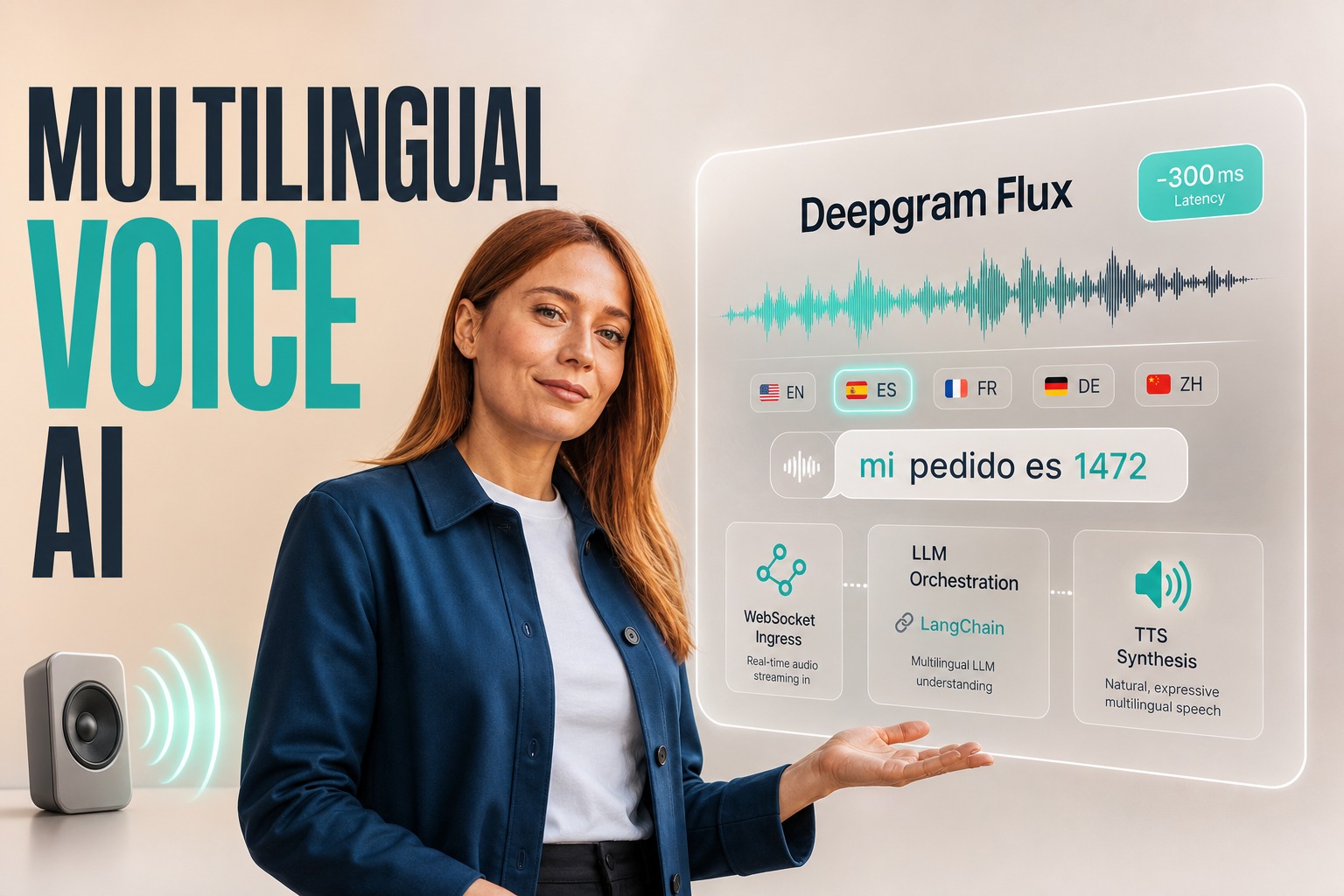
At the core, a multilingual voice AI agent is a streaming pipeline that never blocks waiting for a full utterance. The stack can be broken into four tightly coupled layers.
Ingress & Transport: A single WebSocket (per AssemblyAI’s design) carries bi‑directional PCM audio, JSON events, and tool calls. The client sends session.update to configure language set, then streams input.audio chunks (24 kHz mono PCM16) in near‑real‑time.
Speech & Language Engine: A unified perception model (e.g., Deepgram Flux) performs simultaneous STT, language detection, and turn segmentation. This eliminates the per‑model latency chain highlighted by Luke Ocodes, keeping end‑to‑end latency under 300 ms for most calls
‑300 ms
Typical latency reduction when collapsing transcription, detection, and turn‑taking into one model.
LLM Orchestration: Using LangChain or AutoGen, the text transcript is routed to a multilingual LLM (e.g., LLaMA‑2‑13B‑Chat with multilingual fine‑tune). A per‑session language tag cached in Redis avoids re‑detecting language on every turn. If confidence drops below 0.85, the router falls back to a language‑specific model (e.g., a Spanish‑tuned Claude). Tool calls (order lookup, CRM query) are expressed as JSON and executed via gRPC or HTTP webhooks.
Outbound Synthesis & Delivery: The LLM response is handed to a TTS service that supports the target voice (e.g., Amazon Polly Neural, or open‑source VITS models). Voices are pre‑warmed in a Kubernetes Deployment with a small pool of GPU‑enabled pods; cache the most common 5 voices in RAM for < 30 ms warm‑up time. The synthesized audio is streamed back over the same WebSocket as output.audio JSON frames.
Supporting infrastructure ties the pipeline together:
API Gateway (AWS API Gateway or Kong) terminates TLS and performs JWT/OAuth2 validation.
Message queue (Kafka) buffers tool‑call results to guarantee at‑least‑once delivery.
Vector store (Milvus) stores conversational embeddings for RAG retrieval when the agent needs domain knowledge.
Observability: OpenTelemetry traces flow from WebSocket ingress → Flux model → LangChain → TTS, with Prometheus alerts on latency >250 ms and circuit breaker fallback to pre‑recorded prompts.
Deployment patterns: multi‑region Kubernetes clusters (EKS, GKE) with pod‑affinity to keep inference pods in the same AZ as the STT endpoint, achieving < 5 ms intra‑cluster network latency.
Code‑switching isn’t an edge case; it’s the default for 70 % of bilingual callers in APAC, so language detection must happen per‑utterance, not just at session start.
EXAMPLE USE CASE
A bank deployed an AI banking support chatbot with real-time voice translation across 120 languages to automate routine customer support and reduce response times for a multilingual customer base. After integrating Plavno's solution, the team achieved 94% cost savings on routine support tasks and achieved 61% reduction in average handling time.
When latency exceeds 300 ms, callers perceive the bot as “slow” and drop off; the margin for error is razor‑thin in voice, far tighter than text‑only chat.
Business impact & measurable ROI
Cost reduction: Replacing 5 full‑time language‑specific agents (average $120 k salary) with a single multilingual AI drops labor expense by up to $600 k per year.
Speed of service: Average handling time (AHT) shrinks from 45 s (human) to 8 s (AI), a 82 % improvement that lifts customer satisfaction scores (CSAT) by 12‑points.
Scalability: The WebSocket‑centric design lets you multiply concurrent calls 10× per inference pod by sharing a single connection, translating into a $0.004 per‑call compute cost at 100 k monthly calls.
Compliance & data residency: Session state (including language tag and conversation history) lives in encrypted Redis clusters bound to the required region, satisfying GDPR and data‑sovereignty mandates.
Flexibility: Adding a new language is a configuration change (session.update)—no new models or pipelines required if the base LLM supports the language.
Implementation strategy
Phase 1 – Prototype: Deploy a single‑region Flux STT + LangChain router on a sandbox Kubernetes cluster. Use a limited language set (English, Spanish, French) and a canned TTS voice.
Phase 2 – Pilot: Integrate with a real CRM (Salesforce or HubSpot) via REST webhook. Enable session persistence (session.resume) and test code‑switching with a small user group.
Phase 3 – Scale: Expand to multi‑region clusters, add Redis‑based language cache, and introduce Milvus RAG for product‑specific queries. Enable rate‑limiting and circuit breakers per language.
Phase 4 – Governance: Implement OAuth2 client‑credentials for every external tool, enable audit logs in CloudWatch, and enforce token expiration (≤ 15 min).
Phase 5 – Continuous Improvement: Feed live transcripts into a fine‑tuning pipeline (using Azure ML or SageMaker) to improve per‑language accuracy by 5‑10 % each quarter.
Common pitfalls
Relying on separate transcription and language‑detection services creates a >1 s latency tail.
Hard‑coding language in the prompt forces the LLM to “pretend” it understands, leading to broken responses on code‑switch.
Not pre‑warming TTS voices causes first‑call latency spikes that users perceive as “robotic”.
Missing idempotency keys on tool‑call webhooks causing duplicate order lookups.
Why Plavno’s approach works
Plavno couples deep AI expertise with enterprise‑grade delivery. Our teams assemble the stack with proven open‑source foundations (Flux, LangChain, Milvus) and wrap it in hardened Kubernetes operators that provide:
Built‑in observability dashboards that surface per‑language latency, enabling AI consulting teams to iterate quickly.
Compliance‑first design: all data streams are encrypted in‑flight (TLS 1.3) and at rest (AES‑256), with audit trails stored in immutable S3 buckets.
Hybrid human‑in‑the‑loop escalation: when the confidence score falls below 0.7, the session is handed to a live multilingual agent via a SIP bridge, preserving context thanks to the session ID recovery feature described by AssemblyAI.
Our clients see a rapid ROI because we treat the voice agent not as a “nice‑to‑have” feature but as a core service line, backed by AI automation that integrates with existing ERP, ticketing, and analytics platforms.
Multilingual voice AI agents are no longer a research curiosity; they are a production‑ready service that lets enterprises serve global customers without a permanent multilingual staff. By collapsing STT, language detection, and turn‑taking into a single model, streaming audio over one WebSocket, and caching language context, latency stays below the conversational threshold while operational cost drops dramatically. Plavno’s engineered, observability‑first platform delivers that capability at scale, ensuring compliance, resilience, and a clear path from pilot to enterprise roll‑out.
Ready to replace costly language‑specific call centers with a single, intelligent global voice agent? Schedule a call and let Plavno design the architecture that fits your data, latency, and regulatory needs.
Share this post
Contact Us
This is what will happen, after you submit form
Plavno experts contact you within 24h
Discuss your project details
We can sign NDA for complete secrecy
Submit a comprehensive project proposal with estimates, timelines, team composition, etc
Need a custom consultation? Ask me!
Plavno has a team of experts ready to start your project. Ask us!