Voice AI Agents for Customer Support: From Call Deflection to Revenue Growth
Discover how voice AI agents transform customer support from a cost center into a profit engine by handling complex workflows, reducing costs, and driving revenue.
The phone is still the primary channel for high-value customer interactions, yet it remains the most expensive and inefficient bottleneck in modern support stacks. Legacy IVR systems frustrate users with rigid menu trees, while human agents are overwhelmed by repetitive Tier-1 queries that drain resources and kill margins. The shift isn't just about automating noise anymore; it is about deploying intelligent voice AI agents that can handle complex workflows, update CRMs in real-time, and drive revenue rather than just deflecting calls. This transition moves contact centers from cost centers to profit engines, but only if the underlying architecture is built to handle the stochastic nature of LLMs while maintaining enterprise-grade reliability.
Enterprise contact centers are facing a perfect storm of rising customer expectations and shrinking operational budgets. Traditional automation failed because it relied on deterministic decision trees that broke the moment a user deviated from the script. Today, the challenge is integrating conversational AI into legacy telephony infrastructure without introducing latency, hallucinations, or security vulnerabilities. Organizations are struggling to move beyond simple "chatbots on a phone" to true AI phone agents that possess context awareness and the ability to execute business logic.
Building a production-ready voice AI agent requires more than just wrapping an LLM API; it demands a sophisticated, event-driven architecture that manages low-latency audio streaming, stateful conversations, and deterministic tool execution. At Plavno, we architect these systems using a microservices approach typically deployed on Kubernetes, separating the telephony layer from the intelligence layer to ensure independent scaling and fault isolation.
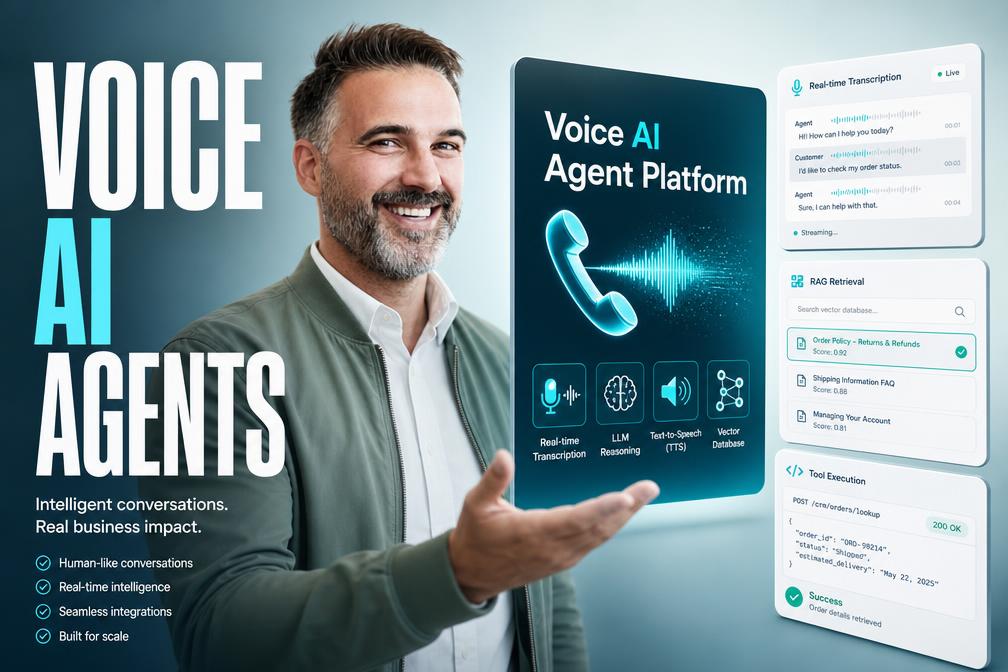
The core pipeline begins with the Telephony Gateway, often using SIP trunking providers like Twilio or SignalWire, which streams raw audio via WebSocket or RTP. This audio is immediately passed to a Transcription Service—commonly powered by Deepgram Nova or OpenAI Whisper—which performs streaming Speech-to-Text (STT) with low latency (targeting <300ms). The resulting text tokens are fed into the Orchestration Layer, the brain of the system, usually built with frameworks like LangChain or LlamaIndex running on Python or Node.js runtimes.
Within the orchestration layer, the system manages the conversational AI flow using an Agent-based architecture. We utilize frameworks like AutoGen or CrewAI to manage multi-agent reasoning, where a primary agent handles the dialogue while specialized sub-agents are invoked for specific tasks like checking order status or verifying insurance coverage. This layer implements Retrieval-Augmented Generation (RAG) to ground the LLM in company data, querying vector databases like Pinecone, Milvus, or Weaviate for relevant knowledge base articles. Crucially, the orchestration layer maintains conversation state in a fast store like Redis to track context, user authentication status, and pending tasks across turns.
Once the LLM generates a text response, the system performs a safety check using guardrail models (like NeMo Guardrails or custom classifiers) to prevent PII leakage or toxic outputs. The approved text is then sent to the Text-to-Speech (TTS) engine—such as ElevenLabs or Azure TTS—to generate high-fidelity audio that is streamed back to the user. Throughout this process, an Event Bus (Kafka or RabbitMQ) publishes transcripts and metadata to downstream systems for analytics, CRM updates, and audit logging.
In practice, when a customer calls to ask, "Why is my shipment delayed?", the AI voice assistant transcribes the audio, retrieves the customer's profile via a secure API call using their phone number (ANI), queries the logistics database for the latest tracking event, and synthesizes a natural response: "I see your package is currently held in Memphis due to weather; it's expected to resume transit tomorrow." Simultaneously, the system logs this interaction in the CRM and tags the ticket for follow-up if the user expresses frustration.
Implementing voice AI agents delivers immediate and quantifiable value across the organization. The most visible impact is the drastic reduction in call handling costs. A human agent interaction typically costs between $2.50 and $5.00 per minute, whereas an automated AI interaction can cost less than $0.10 per minute. However, the ROI extends beyond simple arbitrage; effective support automation increases containment rates for Tier-1 issues to 40-60%, freeing human agents to focus on high-value, revenue-generating activities like upselling or complex problem resolution.
From a revenue perspective, intelligent agents do not just deflect calls; they capture intent. By analyzing the conversation in real-time, the system can identify cross-sell opportunities. For example, if a customer calls to cancel a subscription because of a specific missing feature, the AI can instantly offer a discount or highlight a relevant upgrade path, recovering revenue that would otherwise be lost. Furthermore, the 24/7 availability of these agents ensures that international time zones and after-hours spikes no longer result in lost opportunities or poor customer satisfaction scores.
Deploying voice AI agents is not a "plug and play" operation; it requires a phased approach that prioritizes specific use cases to build trust and refine the models. We recommend starting with a "walled garden" pilot focused on high-volume, low-complexity workflows, such as password resets or order status checks. This allows the engineering team to fine-tune the prompt engineering, test the RAG retrieval accuracy, and establish latency baselines without risking critical business processes.
Once the pilot demonstrates a containment rate above 40% and a customer satisfaction parity with human agents, the strategy shifts to expansion. This involves integrating deeper into the tech stack—connecting to billing systems for refunds, scheduling APIs for appointments, and legacy mainframes for account updates. The team must implement robust CI/CD pipelines for model updates and prompt versioning to ensure that improvements do not regress existing capabilities. Governance becomes critical here; establishing a "Human-in-the-Loop" (HITL) protocol where the AI seamlessly escalates to a human agent upon detecting confusion or anger is essential for maintaining trust.
Common pitfalls to avoid include neglecting the "turn-taking" latency, which makes the conversation feel robotic, and failing to implement idempotency in API calls, which can lead to duplicate refunds or updates if the network retries a request. Additionally, do not underestimate the importance of "barge-in" functionality—users will interrupt the AI, and the system must handle overlapping speech gracefully without crashing the session.
At Plavno, we do not treat voice AI agents as a novelty or a simple wrapper around ChatGPT. We approach them as distributed systems that require rigorous software engineering practices. Our architecture prioritizes determinism where it matters—database transactions, security auth, and API integrations—while leveraging the generative power of LLMs for natural language understanding. We build custom solutions tailored to your specific data landscape, whether that involves on-premise deployments for data residency requirements or hybrid cloud setups for low-latency edge processing.
Our expertise in AI agents development ensures that we design systems capable of handling complex multi-turn reasoning and tool use. We don't just build a chatbot; we build an AI voice assistant that integrates deeply with your existing CRM, ERP, and telephony infrastructure. By leveraging our experience in AI automation, we ensure that your workflows are not only automated but optimized for speed and accuracy.
We understand that the success of these projects hinges on the synergy between business logic and machine learning. Our AI consulting services help you navigate the complexities of model selection, data governance, and compliance. Whether you need a custom software development partner to retrofit legacy systems or a team to build a next-generation contact center from scratch, Plavno provides the engineering rigor and strategic insight required to turn voice AI into a competitive advantage.
The transition to intelligent voice support is inevitable. The question is whether your architecture will be robust enough to handle the load. By combining state-of-the-art conversational AI with enterprise-grade infrastructure, Plavno delivers voice agents that don't just talk—they act, they learn, and they drive revenue. Ready to transform your customer support operations? Get a project estimate today and let's build the future of your contact center together.
Contact Us
Plavno experts contact you within 24h
Discuss your project details
We can sign NDA for complete secrecy
Submit a comprehensive project proposal with estimates, timelines, team composition, etc
Plavno has a team of experts ready to start your project. Ask us!

Vitaly Kovalev
Sales Manager
