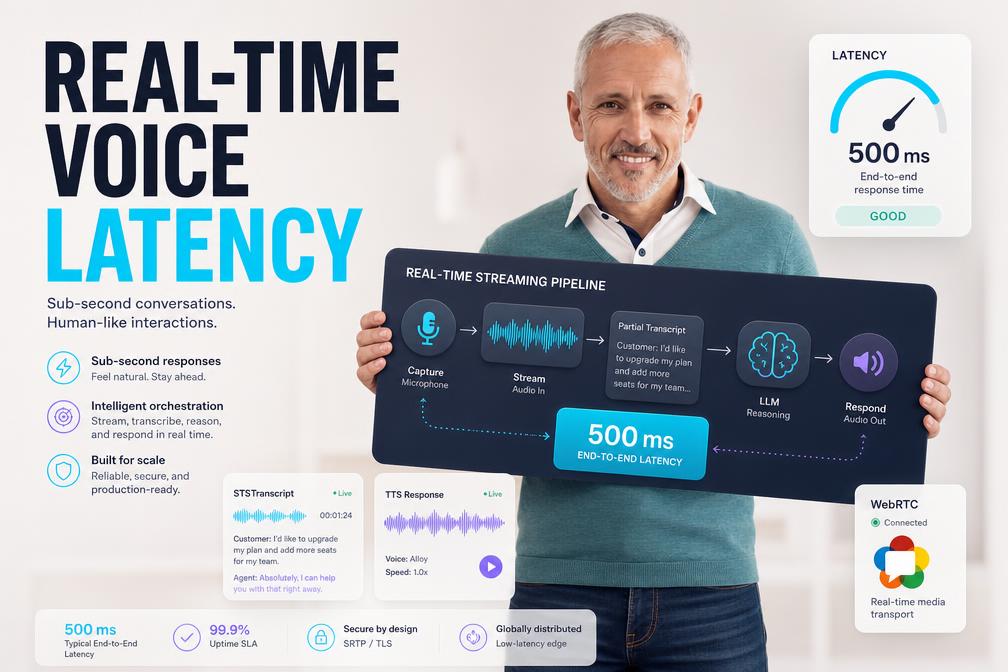
The difference between a robotic IVR system and a truly conversational agent is measured in milliseconds. When a user speaks, they expect a response within 500 to 750 milliseconds. Anything over a second feels like lag; anything over two seconds feels broken. Building a system that listens, understands, generates a response, and speaks back within that tight window is an engineering nightmare involving streaming protocols, deep learning models, and stateful orchestration. This is the frontier of real-time voice AI, and it requires moving beyond simple request-response architectures to complex, event-driven pipelines.
Industry challenge & market context
Enterprises are rushing to deploy voice agents to reduce support costs and capture 24/7 revenue, but most attempts fail because they treat voice like text with an audio wrapper. The market is flooded with "chatbots with voices" that suffer from unacceptable latency, inability to handle interruptions (barge-in), and a lack of contextual memory. Legacy telephony infrastructure cannot support the bi-directional streaming bandwidth required for modern AI, while cloud-only solutions introduce latency spikes that kill the user experience.
- Latency accumulation: The "turn-around" latency—the time from the user stopping speech to the AI starting audio—often exceeds 2 seconds in poorly architected systems due to sequential processing (STT -> LLM -> TTS) without streaming or parallelization.
- Interruption handling: Humans interrupt naturally. Most voice bots lock the audio channel while generating a response, forcing the user to wait, or they fail to detect the "end of speech" (VAD) accurately in noisy environments.
- Context fragmentation: Maintaining conversation state across distributed microservices is difficult. If the STT service, LLM orchestrator, and TTS engine are loosely coupled via REST, managing the session context and ensuring idempotency becomes a major bottleneck.
- Infrastructure costs: Running high-fidelity TTS and fast LLM inference 24/7 is expensive. Without intelligent routing (e.g., using smaller models for simple queries and reserving GPT-4 class models for complex intent), operational costs spiral out of control.
- Integration debt: Connecting modern AI pipelines to legacy SIP/PSTN systems requires complex media gateways (like RTP engines) that often introduce jitter and packet loss, degrading audio quality before the AI even processes it.
Technical architecture and how real-time voice AI works in practice
Building a low-latency conversational system requires a shift from synchronous REST APIs to asynchronous, event-driven streaming architectures. We generally utilize WebRTC for the transport layer because it provides low-latency, peer-to-peer audio streaming directly in the browser or mobile app, bypassing the overhead of traditional SIP signaling. The architecture must be designed to minimize "time-to-first-byte" for the audio response.
A robust real-time voice AI system typically consists of five distinct layers: the Client Interface, the Media Gateway, the Intelligence Layer (STT/LLM/TTS), the Orchestration Layer, and the Data/State Layer.
- Client Interface (Web/Mobile): Runs a WebRTC client (using libraries like Aiortc or simple-peer) to capture audio streams. It handles Voice Activity Detection (VAD) locally to determine when the user stops speaking, sending a "speech_ended" event immediately to the server to shave off milliseconds.
- Media Gateway (Signaling & Transport): Manages WebRTC signaling (via WebSocket or Socket.io) and establishes peer connections. It routes raw audio packets to the STT service and return audio packets from the TTS service. This layer must handle jitter buffers and packet loss concealment.
- Speech-to-Text (STT) Service: Uses streaming models (e.g., Deepgram, Whisper Turbo, or Google Cloud STT) that return partial transcripts as the user speaks. This allows the Intelligence Layer to pre-compute intent or start drafting a response before the user finishes their sentence (speculative execution).
- Orchestration & Intelligence Layer: The brain of the system. Usually built with frameworks like LangChain or LlamaIndex running in Node.js or Python. It receives the transcript, manages the conversation history (stored in Redis or a fast KV store), and queries the LLM. It handles tool use (e.g., checking a database for order status) and manages the flow logic.
- Text-to-Speech (TTS) Service: Must support streaming synthesis (e.g., ElevenLabs, Azure Neural TTS, or Cartesia). Instead of waiting for the full LLM response, the orchestrator streams text chunks to the TTS engine, which streams audio back to the client incrementally.
The data flow is continuous. When a user asks, "What is my balance?", the audio flows via WebRTC to the STT service. As words are recognized, they are pushed to the Orchestrator. The Orchestrator classifies the intent using a lightweight model or semantic routing. If it requires a database lookup, it calls a tool (FastAPI endpoint) while the LLM generates the filler text ("Let me check that for you"). The final text is streamed to the TTS engine, which pushes audio back through the WebSocket.
The biggest architectural mistake is treating the voice pipeline as a linear chain. To achieve sub-second latency, you must overlap STT, LLM inference, and TTS generation, streaming tokens and audio chunks through the pipeline like water through a pipe, not moving buckets one by one.
State management is critical. The conversation history, including user metadata and previous turns, must be stored in a low-latency store like Redis or DynamoDB. The orchestrator retrieves this context to maintain continuity. For enterprise deployments, we often implement a "hot swap" mechanism where a smaller, faster model (like Llama 3-8b or GPT-3.5-Turbo) handles the initial greeting and simple queries, while a circuit breaker pattern routes complex emotional queries to a larger model (like GPT-4o) to balance cost and latency.
Security involves authenticating the WebSocket connection (OAuth2/JWT) and ensuring PII redaction happens either at the STT layer or within the orchestrator before logging. Observability tools like Datadog or Prometheus must trace the latency across every hop—network, STT processing, LLM time-to-first-token, and TTS synthesis—to identify bottlenecks.
Business impact & measurable ROI
Implementing a high-performance voice system is not just a technical upgrade; it is a revenue lever. The immediate business value is deflection. A voice bot that handles 40-60% of Tier 1 support calls reduces the need for human agents, directly lowering operational expenditure (OpEx). However, the ROI extends beyond cost savings into customer experience and revenue capture.
- Containment Rate: A well-tuned system with low latency and high accuracy can achieve containment rates of 50%+ for routine tasks like password resets, order tracking, or appointment scheduling. Every automated call saves an average of $3-$5 in contact center costs.
- Revenue Recovery: Unlike IVR systems that cause high abandonment rates, conversational AI keeps users engaged. In sales scenarios, voice bots can qualify leads 24/7, ensuring no potential customer is lost due to time-of-day constraints.
- Data Granularity: Every conversation is structured data. Enterprises gain 100% analytics coverage on customer interactions, extracting sentiment, intent, and product feedback that is usually lost in unrecorded or unanalyzed phone calls.
- Scalability: Cloud-native voice systems scale horizontally. During peak traffic (e.g., Black Friday or product launches), you can spin up additional Kubernetes pods to handle load, a feat impossible with traditional, hardware-based call centers.
Latency is the primary driver of trust in voice AI. If the system responds naturally under 800ms, user trust increases significantly, leading to higher containment rates and better data quality. Slow responses destroy trust instantly.
Implementation strategy
Deploying these systems requires a phased approach to manage technical risk and ensure adoption. We recommend starting with a pilot focused on a narrow, high-volume use case, such as "check order status" or "reset password," before expanding to complex, multi-turn negotiations.
- Phase 1: Discovery & Architecture: Map the integration points with your CRM or ERP. Define the conversation flows and identify the tools/APIs the AI needs access to. Select the stack (e.g., Deepgram for STT, ElevenLabs for TTS, LangChain for orchestration).
- Phase 2: MVP Development (The "Sandbox"): Build the core pipeline in a controlled environment. Focus on the "happy path." Implement WebRTC connectivity, basic STT/TTS streaming, and a simple LLM chain. Measure baseline latency.
- Phase 3: Integration & Hardening: Connect the backend tools (APIs). Implement robust error handling, retry logic, and fallback mechanisms (e.g., transfer to a human agent if confidence score drops below a threshold). Add security layers (auth, encryption).
- Phase 4: Pilot & Optimization: Release to a small percentage of live traffic. Use observability platforms to analyze latency spikes and failure modes. Fine-tune the VAD sensitivity and the LLM temperature to balance creativity and consistency.
- Phase 5: Scale & Expansion: Move to a multi-region deployment for redundancy. Expand the knowledge base using RAG (Retrieval-Augmented Generation) to handle more topics. Optimize costs by implementing model routing strategies.
Common pitfalls to avoid include ignoring the "silence" problem (users need to know the bot is listening), failing to handle interruptions (the bot must stop speaking immediately if the user starts), and neglecting the "long tail" of edge cases where the AI hallucinates policies. Governance is essential; establish a human-in-the-loop review process for the first few thousand interactions to refine the system prompts and safety guardrails.
Why Plavno’s approach works
At Plavno, we don't just wrap APIs; we engineer systems. We understand that voice bot development is fundamentally a distributed systems problem compounded by probabilistic AI models. Our approach is infrastructure-first. We design the data pipelines to ensure that the speech-to-text and text-to-speech components are tightly coupled with the orchestration layer to minimize network hops.
We leverage our expertise in custom software development to build bespoke orchestration layers that manage complex business logic, ensuring that the AI can actually perform actions, not just chat. Whether it is integrating with legacy banking mainframes or modern e-commerce APIs, we ensure the voice agent has the tools it needs to resolve queries. Our experience with AI voice assistant development allows us to navigate the trade-offs between latency, cost, and model intelligence effectively.
We prioritize ownership and data sovereignty. We deploy solutions on your cloud (AWS, GCP, Azure) or on-premise, ensuring that your audio data and conversation logs remain secure and compliant with regulations like GDPR or HIPAA. By using containerized deployments (Docker/Kubernetes), we ensure that your real-time voice AI solution is portable, scalable, and resilient to failures.
For enterprises looking to move beyond prototypes, we offer a rigorous engineering discipline. We implement circuit breakers to prevent cascading failures, idempotency keys to handle network retries safely, and comprehensive logging to audit every decision the AI makes. We don't just build bots; we build reliable, enterprise-grade AI employees.
Building a low-latency voice system is complex, but the competitive advantage is undeniable. If you are ready to architect a solution that actually listens and responds in real-time, hire developers from Plavno to bridge the gap between AI research and production reliability. For a deeper consultation on your specific architecture needs, contact us today.
The future of enterprise interaction is voice, but only if it works faster than a human can hang up. By mastering the intricacies of WebRTC AI, streaming inference, and stateful orchestration, we help you deliver that experience today.