Industry challenge & market context
Enterprise sales teams are drowning in a silent tide of inbound calls, voicemail digests, and half-filled CRM records. Even with sophisticated CRMs, the manual hand-off from lead capture to qualification can consume 30-45 minutes per prospect, inflating cost-per-lead and eroding pipeline velocity. Legacy IVR systems are rigid, speech-only, and lack contextual awareness, while human SDRs are forced to triage low-quality leads, leading to missed opportunities and compliance gaps.
- Fragmented data sources: web forms, outbound dialers, email signatures, and third-party intent signals are siloed.
- High churn in SDR staffing: avg 12-month tenure, causing onboarding costs of $18k+ per rep.
- Inconsistent CRM hygiene: duplicate contacts, missing qualification fields, and delayed activity logging.
- Regulatory exposure: GDPR, CCPA, and industry-specific consent requirements are often overlooked in ad-hoc call handling.
- Scaling paradox: adding headcount increases cost linearly, but lead volume grows exponentially during campaigns.
Technical architecture and how AI voice agents for sales works in practice
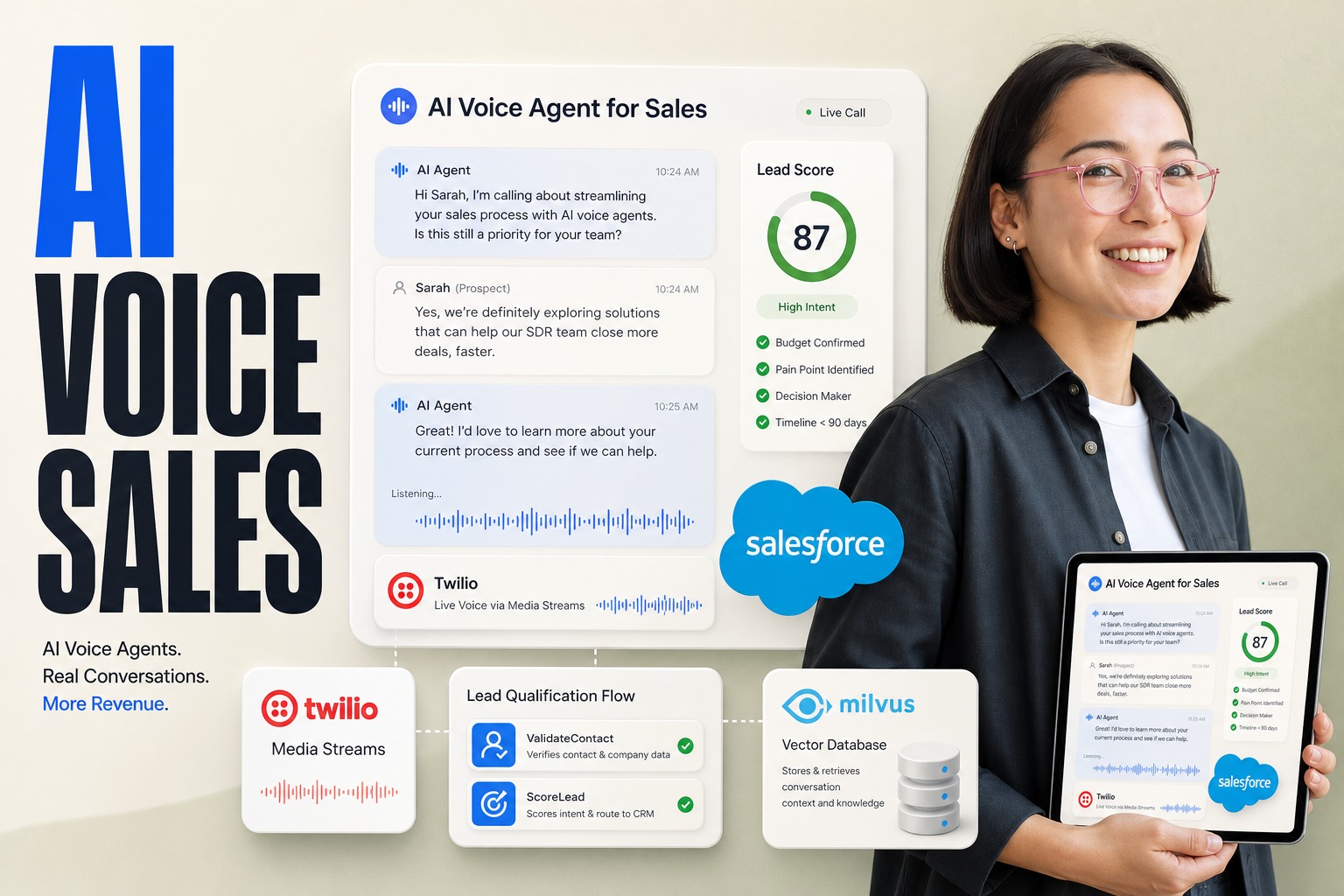
At its core, an AI voice agent for sales is a composition of LLM-driven agents, speech pipelines, and event-driven integrations that turn every inbound conversation into a qualified, CRM-ready lead. The stack below is a battle-tested reference that can be deployed on AWS, Azure, or on-prem Kubernetes clusters.
- Speech front-end: Twilio Media Streams or Vonage Voice API captures the caller audio, streams it via gRPC to a
Speech-to-Text microservice (Whisper, Deepgram, or Azure Speech). Transcripts are chunked into 2-second frames to keep latency < 300 ms. - Orchestration layer: FastAPI (Python) or NestJS (Node) acts as the API gateway, handling auth (OAuth2 + client-credentials) and routing calls to the
Agent Engine. Helm charts deploy the gateway with Istio sidecars for mutual TLS and tracing. - Agent Engine: Built on LangChain + CrewAI, the engine creates a lead-qualification agent that:
- retrieves call context from a Redis cache (last 5 turns)
- uses a retrieval-augmented generation (RAG) step with LlamaIndex against a Milvus vector DB that stores product FAQs and compliance scripts
- decides next action via a policy model (OpenAI function-calling or Azure OpenAI tool use)
- Tool suite (exposed as LangChain tools):
ValidateContact – checks phone/email syntax, runs a real-time security lookup against watchlists.ScoreLead – runs a fine-tuned XGBoost model (features: intent score, firmographics, call sentiment) and returns a 0-100 qualification score.UpdateCRM – posts to Salesforce / Dynamics via REST or GraphQL, idempotently upserting the lead record.ScheduleFollowUp – enqueues a message in Kafka with a 24-hour delay queue for a human SDR or a second-stage voice bot.
- Data store & persistence: PostgreSQL holds structured lead metadata; MongoDB stores raw transcript blobs; Milvus (or Pinecone) provides vector similarity for RAG; Redis Cluster serves as a low-latency session store.
- Event-driven backbone: Kafka topics –
incoming.calls, lead.qualified, crm.updates – guarantee eventual consistency. Each consumer implements a circuit-breaker (Resilience4j) and retries with exponential back-off to tolerate downstream throttling. - Observability: OpenTelemetry agents ship traces to Jaeger; Prometheus scrapes metrics (latency, token usage, error rates); Grafana dashboards alert on > 5% error spikes.
- Security & compliance: All APIs enforce OAuth2 scopes; secrets stored in HashiCorp Vault; audit logs sent to Splunk; data residency flags route EU calls to EU-region clusters only.
- Deployment model:
- Multi-tenant SaaS: shared Kubernetes namespace with per-tenant network policies.
- Single-tenant on-prem: Helm chart with air-gap PostgreSQL and offline LLM (e.g., Llama-2 70B) to meet data-sovereignty.
Mini-scenario 1 – Real-time qualification
A prospect dials the sales line and says, "I'm looking for a cloud-native CI/CD platform for our 200 developers." The audio stream hits Twilio, Whisper returns text, and the Agent Engine routes the intent to the ScoreLead tool. The XGBoost model outputs a 87% score, the bot replies, "Great, I'll create a record and send you a demo link. May I confirm your email?" The ValidateContact tool verifies john.doe@acme.com, the UpdateCRM tool patches Salesforce, and a ScheduleFollowUp event is emitted for a human SDR to close the loop.
Mini-scenario 2 – Post-call follow-up automation
After a 2-minute outbound prospecting call, the voice bot asks, "Would you like a copy of our pricing guide?" The prospect says "yes." The transcript is stored in MongoDB, the UpdateCRM tool adds an activity note, and a serverless function (AWS Lambda) pulls the latest PDF from an S3 bucket, emails it via SendGrid, and logs the transaction in CloudWatch. All steps complete within 0.8 seconds of the utterance.
Treating voice as just another channel misses the real advantage: the ability to embed context-aware intelligence directly into the call flow, turning a conversation into an executable workflow.
Business impact & measurable ROI
- Reduced qualification time: Automation cuts average SDR qualification from 35 minutes to under 2 minutes per lead (≈ 94% time saving).
- Higher lead quality: AI-driven scoring improves MQL conversion by 18% because only leads with a ≥ 70 score are handed off.
- CRM hygiene: Idempotent upserts and real-time logging eliminate duplicate records, reducing data cleanup costs by an estimated $45k per year for a 5,000-rep org.
- Operational cost: Serverless speech-to-text costs ~ $0.02 per 1k tokens; with 10k calls/day the incremental spend is <$20/day, far lower than a single SDR salary.
- Compliance confidence: Automated consent capture and audit-ready logs meet GDPR/CCPA with zero manual effort.
- Scalability: Kafka-backed pipeline sustains 10k concurrent calls with 99.95% availability; horizontal pod autoscaling adds pods at 70% CPU threshold.
The ROI comes not from replacing humans but from offloading the repetitive, high-volume voice tasks to an agent that can operate 24/7 with deterministic latency.
Implementation strategy
Deploying AI voice agents for sales is an incremental journey. Below is a pragmatic roadmap that aligns technical milestones with business checkpoints.
- Phase 1 – Discovery & data prep
- Map existing call flows, identify intent taxonomies, and extract a corpus of past call transcripts.
- Tag transcripts with qualification outcomes to train the scoring model.
- Set up a secure API gateway (FastAPI) and provision a dev Kubernetes cluster.
- Phase 2 – MVP voice bot
- Integrate Twilio Media Streams → Whisper STT pipeline.
- Build a LangChain agent with
ValidateContact and ScoreLead tools. - Connect to a sandbox Salesforce instance via REST for proof-of-concept updates.
- Run load tests targeting 200 RPS, measuring 95th-percentile latency < 400 ms.
- Phase 3 – RAG & context expansion
- Index product docs, compliance scripts, and past call embeddings into Milvus.
- Enable Retrieval-Augmented Generation for dynamic FAQ handling.
- Introduce event-driven Kafka streams for async follow-up scheduling.
- Phase 4 – Production hardening
- Implement OAuth2 client-credentials flow, rotate secrets via Vault.
- Add circuit-breaker patterns, exponential retries, and idempotent webhook endpoints.
- Deploy multi-region Helm releases with Istio for traffic mirroring and failover.
- Configure OpenTelemetry, Prometheus, and Grafana dashboards for SLAs.
- Phase 5 – Scale & continuous improvement
- Fine-tune the scoring model weekly using new labeled calls.
- Introduce AutoGen or CrewAI to orchestrate multi-step negotiations (e.g., price quoting).
- Explore serverless speech synthesis for outbound proactive outreach.
Common pitfalls
- Skipping data sanitization – leads to hallucinations in the LLM.
- Hard-coding API keys – breaks compliance and hinders secret rotation.
- Neglecting idempotency – duplicate CRM records when retries fire.
- Under-provisioning vector DB memory – causes degraded ANN search performance at scale.
Why Plavno's approach works
Plavno builds AI voice agents with an engineering-first, enterprise-grade mindset. Our teams leverage proven frameworks (LangChain, AutoGen), container-native pipelines, and a governance layer that satisfies audit and residency requirements out of the box. We don't hand over a prototype; we deliver a production-ready, observable service that can be extended to any CRM or telephony stack.
Conclusion
Deploying AI voice agents for sales transforms a noisy, manual intake process into a fast, data-rich, and compliant workflow that directly fuels revenue. By coupling speech-to-text, LLM-driven agents, and event-driven CRM automation, enterprises gain measurable ROI—cutting qualification time by over 90%, boosting lead quality, and lowering operational spend to a few cents per call. The architecture outlined above is production-ready, scalable, and secure, and Plavno's proven delivery model ensures you can move from pilot to full roll-out with confidence. Ready to let a voice-first AI do the heavy lifting while your SDRs focus on closing? Get in touch today.