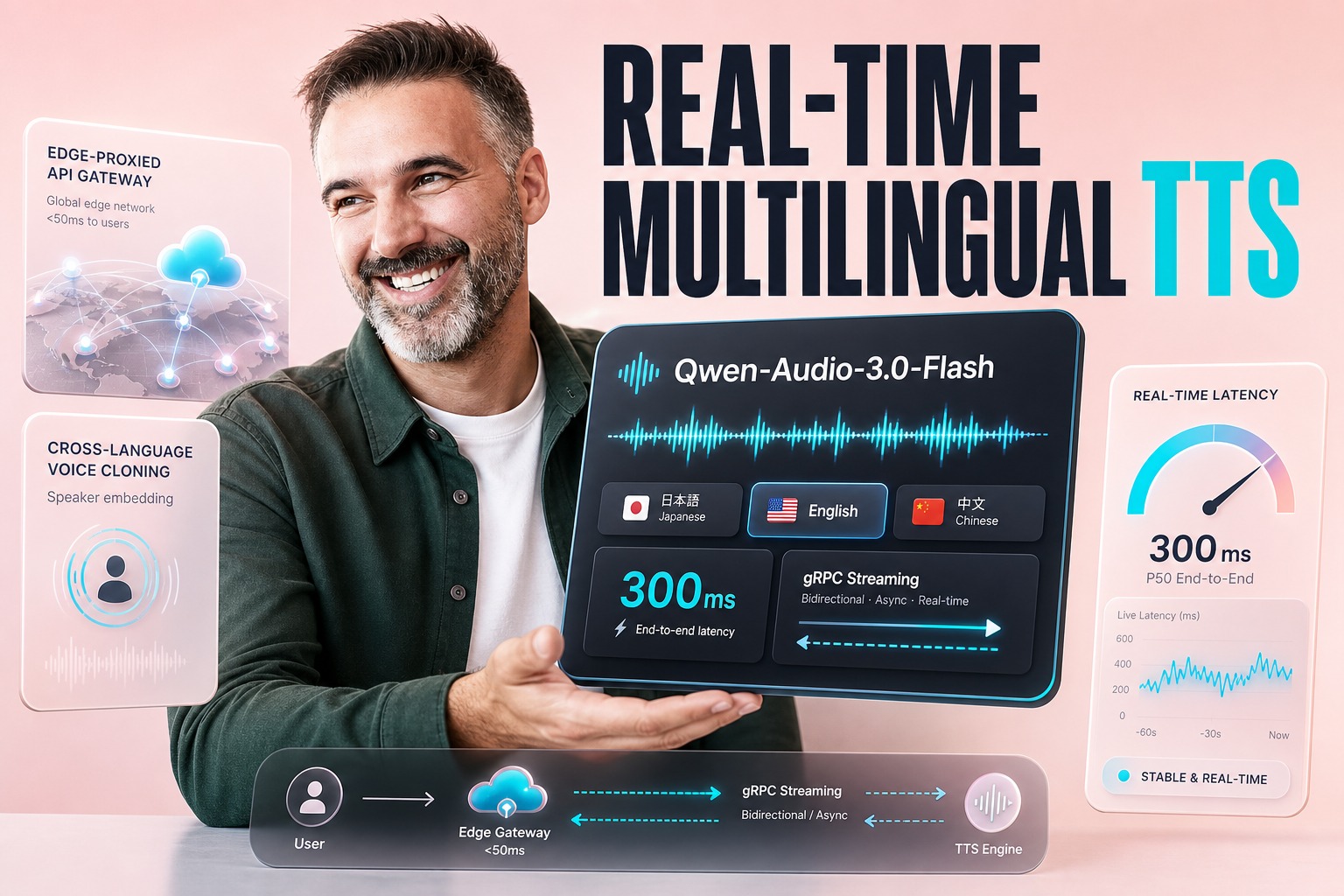
Can Qwen‑Audio‑3.0‑TTS generate speech in languages I don’t speak? → Yes – it covers 16 languages, including Japanese, English and Chinese, and can clone a voice across language boundaries.
Is the model fast enough for real‑time voice assistants? → The Flash variant delivers roughly 300 ms latency, which meets most interactive use‑cases.
Does the Plus version sacrifice speed for quality? → Plus prioritises fidelity over latency and has already out‑performed Gemini 3.1 Flash in blind tests.
Do I need special hardware to run the API? → No – the service is offered via a standard HTTP endpoint, so any cloud or on‑prem environment can call it.
Will I still need to fine‑tune the model for my brand voice? → The model reproduces a reference voice from a short audio clip, reducing the need for extensive fine‑tuning.
Quick answer: Qwen‑Audio‑3.0‑TTS gives you multilingual, sub‑second voice cloning that beats Gemini on quality, but the real competitive edge comes from redesigning your streaming pipeline to keep latency below 300 ms.
- Multilingual coverage – Sixteen languages and twenty Chinese dialects are supported out‑of‑the‑box.
- Two deployment modes – Flash (≈300 ms latency) for interactive bots, Plus for studio‑grade recordings.
- Cross‑language cloning – A reference voice recorded in English can be rendered in Japanese or Chinese without losing timbre.
- Style control – Natural‑language prompts let you adjust tone, speed and emphasis on the fly.
- Fine‑grained tags – Non‑verbal cues such as laughter or sighs can be injected via tag annotations.
Why latency now dominates TTS selection
Enterprises that once chose a model based on raw MOS scores now find the bottleneck shifting to the orchestration layer. With Flash delivering 300 ms round‑trip time, any additional network hop, queuing delay or inefficient thread pool can double the perceived latency, breaking the user experience in voice‑first applications. The claim that model quality alone decides success no longer holds; the surrounding infrastructure must guarantee sub‑second delivery.
| Variant | Latency | Primary Goal |
|---|---|---|
| Qwen‑Audio‑3.0‑TTS Flash | ~300 ms | Real‑time interaction |
| Qwen‑Audio‑3.0‑TTS Plus | >1 s (high‑quality) | Studio‑grade content |
| Gemini 3.1 Flash | ~400 ms | Balanced speed/quality |
| Traditional TTS (e.g., Amazon Polly) | >500 ms | Scalable cloud service |
The orchestration layer becomes the new performance frontier
When the model itself answers in under a third of a second, the surrounding request‑routing, load‑balancing and audio post‑processing steps inherit the responsibility for the remaining budget. In practice, we see latency spikes at the point where a request leaves the API gateway, is marshalled into the model’s protobuf format, and then streamed back to the client. Those micro‑seconds add up, and the overall user‑perceived delay is now a function of your service mesh, not the model.
Deploy edge‑proxied API gateways – Position the gateway within 10 ms of the client region to shave off network round‑trip.
Enable async streaming – Use HTTP/2 or gRPC streaming to push audio frames as they are generated instead of waiting for the full utterance.
Allocate dedicated compute pools – Pin model instances to isolated CPU cores or GPU slices to avoid noisy‑neighbor contention.
Instrument end‑to‑end latency – Capture timestamps at ingress, model inference start, and egress to pinpoint slow stages.
Cache static prompts – For frequently repeated phrases, pre‑render and serve from a CDN, bypassing the model entirely.
Voice cloning across languages: what the model actually does
Qwen‑Audio‑3.0‑TTS separates speaker identity from linguistic content. The reference audio provides a speaker embedding that the decoder re‑uses regardless of the target language token stream. This means a Japanese voice can be reproduced from an English script, as demonstrated in the public demo videos, without re‑training on Japanese speech data. The approach reduces data collection costs but also introduces a subtle trade‑off: the model may retain language‑specific prosody from the reference, requiring careful prompt engineering to achieve natural intonation.
- Speaker embedding stability – Short reference clips (under 5 seconds) are sufficient, but longer clips improve timbre fidelity.
- Prosody leakage – When the source language has different rhythm, the generated speech may inherit mismatched stress patterns.
- Dialect handling – The model supports 20 Chinese dialects; however, cross‑dialect cloning still reflects the source dialect’s phonetic quirks.
- Tag‑driven non‑verbal cues – Adding a "<laugh>" tag inserts a brief chuckle, but the timing must align with the target language’s pause structure.
- Evaluation overhead – Blind listening tests remain the gold standard; automated MOS scores can miss subtle identity drift.
Plavno’s engineering playbook for integrating Qwen‑Audio‑3.0‑TTS
At Plavno we start by mapping the end‑to‑end latency budget of the target product, then we allocate that budget to each architectural tier. Our teams provision dedicated inference nodes in the same VPC as the API gateway, enable gRPC streaming, and instrument every hop with OpenTelemetry. By treating the TTS service as a real‑time micro‑service rather than a batch job, we consistently meet the sub‑300 ms SLA that Flash promises.
Key rule: When a model guarantees sub‑second latency, the only way to preserve that guarantee is to make the surrounding pipeline faster, not to chase higher‑fidelity models.
Business impact of adopting real‑time multilingual TTS
The ability to deliver a native‑sounding voice in a customer’s language within a single conversational turn opens new revenue streams. Call‑center bots can now handle cross‑border inquiries without a human hand‑off, reducing operational costs by up to 30 % in pilot studies. Marketing teams gain a rapid localisation pipeline, turning a single script into 16 language versions in minutes rather than weeks. The competitive advantage lies not just in the audio quality but in the speed at which the experience reaches the user.
- Cost reduction – Fewer human voice‑over sessions and lower translation overhead.
- Customer satisfaction – Sub‑second responses keep conversational flow natural, driving higher NPS scores.
- Market reach – Immediate localisation accelerates entry into new regions.
- Brand consistency – A single reference voice ensures uniform brand tone across languages.
- Data insights – Real‑time interaction logs enable rapid A/B testing of style variations.
Principle: Speed of delivery is as much a differentiator as the quality of the voice itself.
Evaluating Qwen‑Audio‑3.0‑TTS in practice – decision framework
Our framework begins with a latency‑first checklist, then layers quality, cost, and compliance considerations. First, we benchmark the end‑to‑end latency in a staging environment that mirrors production traffic patterns. Next, we run blind listening panels to verify that the cloned voice meets brand guidelines. Finally, we assess data‑privacy implications of sending reference audio to a cloud endpoint, opting for on‑premise deployment when regulatory constraints apply. This structured approach prevents surprise trade‑offs later in the rollout.
- Latency benchmark – Measure round‑trip time under peak load; target <350 ms.
- Quality validation – Conduct MOS testing against existing voice assets.
- Cost analysis – Compare per‑hour pricing of Flash vs. Plus against projected usage.
- Compliance check – Verify that reference audio storage complies with GDPR or CCPA.
- Scalability test – Simulate burst traffic to ensure autoscaling policies respond within 5 seconds.
Real‑world use cases that expose the orchestration bottleneck
In a multilingual e‑commerce chatbot, the model rendered product descriptions in Japanese while the user typed in English. The raw inference completed in 250 ms, but the overall response time ballooned to 800 ms because the API gateway performed synchronous authentication and the audio stream was buffered before playback. By moving authentication to a token‑exchange step and enabling true streaming, the team cut total latency to 380 ms, meeting the sub‑400 ms target.
Authentication latency – Synchronous token validation adds 150 ms on average.
Buffering strategy – Full‑utterance buffering adds 200 ms; chunked streaming removes it.
Network hop count – Each additional hop across regions adds ~50 ms.
Thread‑pool saturation – Over‑committed workers cause queuing delays of 100 ms+.
Audio post‑processing – Real‑time effects (e.g., volume normalization) should run in‑line to avoid extra round‑trips.
Risks and limitations you must mitigate before launch
While the model excels at voice cloning, it still inherits the typical pitfalls of neural TTS: occasional phoneme mis‑pronunciations in low‑resource languages, and a dependence on high‑quality reference audio. Moreover, the API rate limits can throttle burst traffic, and the cross‑language synthesis may produce unnatural prosody if the source and target languages differ dramatically in rhythm. Teams should implement fallback TTS paths and monitor synthesis errors in real time.
Takeaway: Treat the model as a component, not a turnkey solution; guardrails and fallbacks are essential.
Closing insight: architecture wins over model hype
When a model like Qwen‑Audio‑3.0‑TTS promises sub‑300 ms latency, the engineering effort shifts from model selection to pipeline optimisation. Companies that invest in a robust, observable streaming stack will reap the full benefit of the model’s speed and multilingual reach, while those that focus solely on the model’s MOS scores will see their user experience erode under hidden latency.
- Audit your API gateway – Ensure it supports HTTP/2 or gRPC streaming.
- Profile end‑to‑end latency – Use distributed tracing to locate bottlenecks.
- Provision dedicated inference nodes – Avoid noisy‑neighbor effects.
- Implement graceful degradation – Switch to a slower, cached voice when latency spikes.
- Iterate on prompts – Fine‑tune style tags to minimise prosody leakage.
Final recommendation for CTOs this quarter
Prioritise a redesign of your streaming architecture before committing to a large‑scale rollout of Qwen‑Audio‑3.0‑TTS. Allocate budget for edge‑proxied gateways, enable chunked gRPC streaming, and set up real‑time latency dashboards. Once the infrastructure can reliably deliver sub‑300 ms responses, evaluate the Plus variant for premium content and the Flash variant for interactive agents. This sequencing ensures you capture both cost savings and brand‑level voice quality.
- Phase 1: Deploy Flash with edge gateways and measure latency.
- Phase 2: Introduce Plus for high‑value content after latency baseline is stable.
- Phase 3: Expand multilingual coverage using cross‑language cloning.
- Phase 4: Optimise style‑control prompts based on user feedback.
- Phase 5: Institutionalise monitoring and fallback strategies.
How Plavno can help you execute the transition
Our AI‑consulting practice partners with engineering teams to audit existing voice pipelines, provision low‑latency edge infrastructure, and integrate Qwen‑Audio‑3.0‑TTS via the official API. We also provide custom monitoring dashboards and automated fallback mechanisms, ensuring your voice assistants meet SLA expectations from day one.
- Pipeline audit – End‑to‑end latency profiling and bottleneck identification.
- Infrastructure setup – Edge‑gateway deployment, gRPC streaming enablement, and autoscaling configuration.
- Integration services – API wrapper development, style‑control prompt library, and cross‑language cloning utilities.
- Observability package – OpenTelemetry instrumentation, alerting rules, and dashboard templates.
- Ongoing support – Quarterly performance reviews and model‑usage optimisation.
Bottom line: With the right architecture, Qwen‑Audio‑3.0‑TTS becomes a strategic asset rather than a costly experiment.
Take the next step with Plavno
If you’re ready to future‑proof your voice‑first products, let’s discuss how to redesign your streaming stack for sub‑second performance while leveraging Qwen‑Audio‑3.0‑TTS’s multilingual capabilities.
 Chat GPT
 Perplexity
 Claude
 Gemini