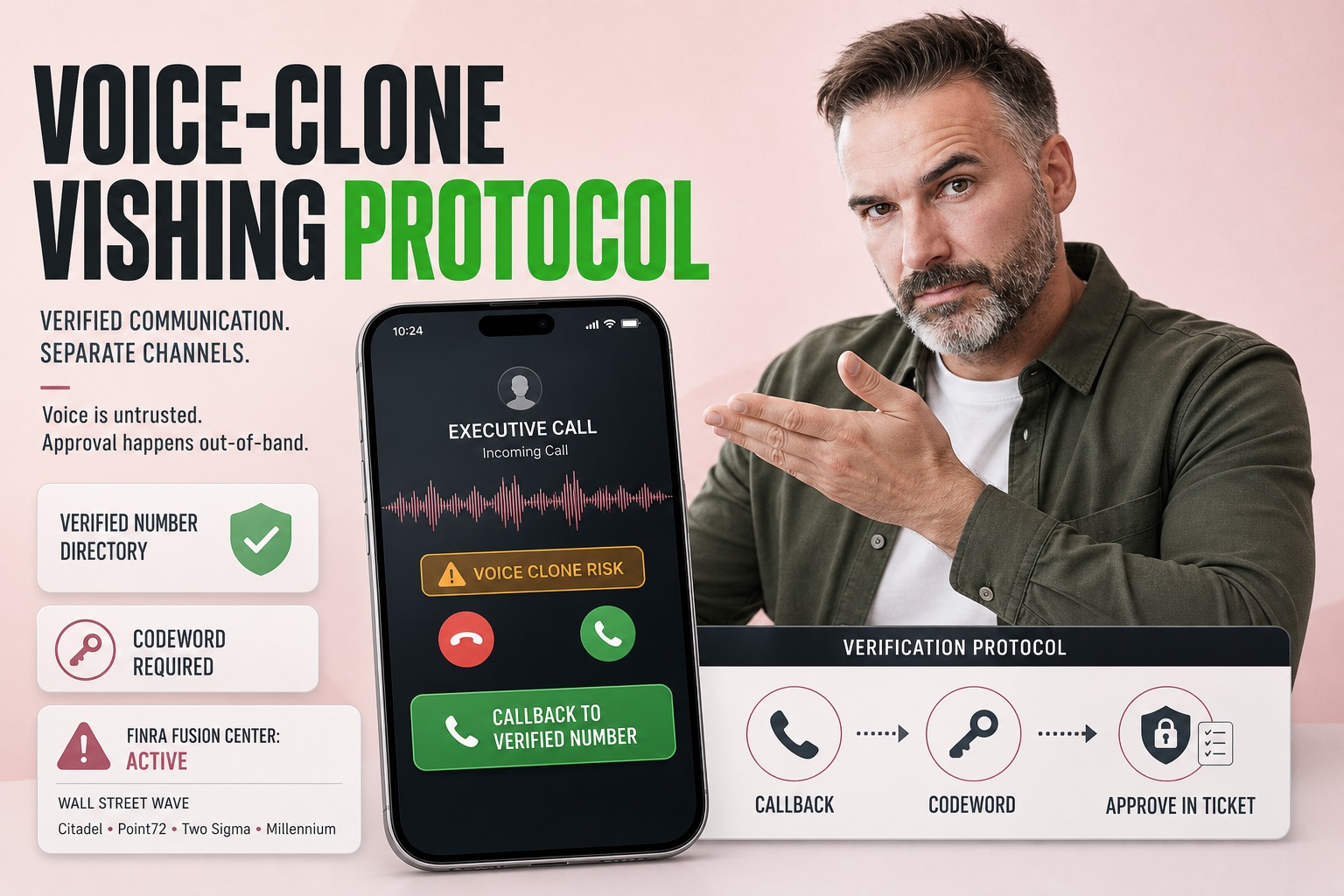
Did something materially change this week, or is this just another social-engineering story? → It changed: attackers hit multiple top hedge funds with AI-generated executive voices, proving voice-clone vishing is now scalable and coordinated, not a one-off stunt.
What’s the real search question CTOs and CISOs should be asking right now? → How do we prevent AI voice-cloning attacks from turning a single phone call into credentials, access, or urgent approvals?
Why didn’t “more security budget” automatically stop it? → Because the attackers didn’t exploit software; they exploited a human workflow where a phone call was treated as an authorization channel.
What’s the most actionable technical lever this quarter? → Move any sensitive request off the voice channel: enforce callback verification to known numbers, add shared secrets, and hard-ban access changes via voice alone.
What’s the unique angle we’re taking at Plavno? → The failure point is at orchestration boundaries between people and systems; the right fix is a verification architecture, not a better deepfake detector.
Quick Answer: how do we stop AI voice-clone vishing from becoming an access incident?
Treat the phone as an untrusted interface for any request that could change access, move money, or disclose sensitive information. The practical defense is a protocol: require a callback to a verified number, require a shared secret (codeword) for urgent requests, and enforce a policy that no system access or credential action happens over a phone call alone, even if the voice sounds exactly like an executive.
- Assume voice is forgeable: If a few seconds of audio from a public talk can be cloned, ‘sounds like the exec’ is not identity.
- Shift authorization out-of-band: A voice call can initiate a request, but approval must happen via a separate, controlled channel.
- Design for urgency pressure: Attackers succeed when staff are trained to move fast; the protocol must slow down only the sensitive step.
- Instrument the workflow: Log and route sensitive voice-initiated requests the way you would log privileged access events.
The dominant signal: voice phishing just jumped from ‘possible’ to sector-level coordinated
A coordinated wave of AI-generated voice phishing calls targeted Citadel, Point72, Two Sigma, and Millennium on August 5, 2026, and triggered the first real activation of FINRA’s Financial Intelligence Fusion Center, launched in March 2026 as a secure fraud-sharing channel. This matters because it demonstrates attackers can operationalize voice cloning at scale against high-security organizations by relying on a familiar voice and a fast-moving culture, not malware or email phishing.
If your access-control design still lets a phone call act as the final authorization step, you have a single-point-of-failure that modern voice cloning can reliably hit.
Central claim: deepfake voice breaks identity-by-voice, so the fix is to redesign authorization, not detection
What’s happening is simple: voice cloning is good enough and cheap enough that a few seconds of audio from an earnings call, podcast, or conference panel can be turned into a convincing executive voice. The engineering practice it breaks is the informal but pervasive habit of using a phone call as a privileged control plane: ‘I heard the boss, so I did the thing.’ When that habit exists, it doesn’t matter how strong your perimeter is, because the attacker is asking an employee to open the door.
The right response is not to gamble on whether you can detect synthetic audio in real time. The right response is architectural: the voice channel can initiate a request, but it cannot authenticate or authorize it. That means you design an out-of-band verification step that is harder to spoof than a voice, and you enforce it with process, tooling, and auditability the same way you enforce any other security control.
Why hedge funds were the perfect first mass target—and why your company is next
Hedge fund executives are unusually public, which means the raw materials for a convincing clone are often freely available online. The input reporting points out that audio from earnings calls, podcasts, or panels can be enough, and that this is easy to scrape from platforms like YouTube. Pair that with an operating model built on speed—teams conditioned to execute fast when a senior voice says something is urgent—and you get a predictable weakness: verification protocols built for email and login screens don’t naturally apply to a phone call that sounds completely real.
Source audio exists in public: Executives appear in interviews, earnings discussions, and conference sessions that provide clean voice samples.
Attackers call, not hack: The first move is a phone call using a synthetic voice to impersonate an executive or trusted colleague.
The ask targets a human-to-system bridge: The employee is pressured to provide credentials or grant internal access, effectively becoming the attacker’s automation layer.
Urgency is the payload: The caller pushes speed and secrecy so the employee bypasses normal verification habits.
Success is measured in workflow shortcuts: The attacker wins if the organization’s process allows voice-only authorization for sensitive actions.
The ‘trust shift’ you need: let voice start the workflow, but never finish it
In practice, most organizations already have a split between initiation and approval, but it’s informal. A phone call ‘from leadership’ initiates, and a human’s judgment becomes the approval. Voice cloning forces us to formalize this split so the approval happens elsewhere. Conceptually, voice becomes a ticket intake channel, not a privileged channel. That reframing lets you keep the efficiency of phone calls while removing the catastrophic failure mode.
The clean design is to route any voice-initiated sensitive request into a system that requires a second factor tied to something the attacker cannot easily spoof. The input reporting explicitly points to a callback number nobody can spoof and a codeword system built for the scenario. We typically implement this as a controlled verification workflow with clear ownership, logging, and escalation paths, and we often automate the routing and audit trail through AI automation so teams don’t rely on memory under stress.
A callback step is not ‘extra friction’; it is a deliberate channel switch that turns a deepfake problem into a routine verification problem.
Where AI voice attacks actually succeed: at the handoff between people and privileged systems
The reporting makes the key point: attackers weren’t exploiting code, they were exploiting an employee’s ability to translate a voice instruction into credentials or access. That means the critical vulnerability is the workflow boundary where humans can request or grant access ‘because someone said so.’ If your service desk, operations team, or executive assistants can trigger high-impact changes based on a voice conversation, you have an attack surface that looks nothing like a firewall rule but behaves like an admin API.
They win at the escalation boundary, not at the authentication boundary
Most enterprises focus on login surfaces, but the attack described doesn’t need to beat a login screen. It needs to beat a human escalation path: the moment someone decides to reset an account, share a one-time credential, add a user, grant access to an internal system, or approve an urgent change because a senior voice demanded it. Engineers should treat that moment as a privileged operation, because in effect it is one.
They exploit ‘exceptions’ as an unofficial control plane
Organizations often have strong policies until a leader needs something urgently. The attacker’s play is to invoke urgency and authority to force an exception: ‘I’m on a deadline, do this now.’ Hedge funds are a sharp example because speed is a cultural requirement, but the pattern appears anywhere staff are trained to optimize time-to-action. If your exceptions are handled by phone and memory rather than by systems and audit logs, that exception path becomes the attacker’s best API.
Familiarity beats training when the cue is a trusted voice
Phishing training commonly teaches employees to spot suspicious emails or login pages, but the input makes clear this attack used a voice that sounded like a trusted executive or colleague. That familiarity is the cue employees are trained to trust in day-to-day operations. Once voice can be convincingly forged, training has to shift from ‘spot the fake’ to ‘follow the protocol,’ because humans are not reliable detectors when the stimulus is designed to sound real.
| Control you rely on today | What it helps with in a voice-clone attack | What it does not solve |
|---|---|---|
| Employee judgment on a phone call | Catches obvious inconsistency or unusual phrasing | Fails when the voice sounds exactly like the expected person |
| Email and login verification protocols | Protects digital channels with established checks | Does not apply when the request arrives by phone |
| Callback to a verified number and codeword system | Forces a channel switch and secret knowledge check | Can fail if numbers are not controlled or secrets are poorly managed |
| Policy that no access request is completed by phone alone | Removes the single-step failure mode | Requires enforcement, ownership, and tooling to prevent informal workarounds |
What ‘caught it and shut it down’ really implies: preparedness is procedural, not mystical
Two Sigma told the reporting it caught the attempt and shut it down before any systems or data were touched, while Point72 acknowledged an attack and said its initial review found no client data stolen. We don’t need internal details to learn the engineering lesson: the difference between ‘attempt observed’ and ‘attempt progressed’ is almost always a precommitted protocol that employees can execute under pressure. The input itself highlights that funds with a callback verification step or a codeword system built for this scenario held.
At Plavno, when we help teams design this class of control, we treat it like a distributed system problem: humans are nodes, phone calls are an unreliable network, and ‘urgent requests’ are adversarial traffic. You don’t solve adversarial traffic by hoping nodes behave perfectly; you solve it by designing the protocol and making the safe path the easiest path. That’s typically the point where AI consulting becomes less about model choice and more about workflow engineering and enforcement.
- Protocol clarity beats ad hoc heroics: If employees must ‘decide’ in the moment, the attacker is already inside your decision loop.
- Ownership must be explicit: A callback step fails if nobody owns the verified directory of numbers or the shared secret lifecycle.
- Auditability changes behavior: When sensitive voice-initiated requests generate a trace, staff stop treating them as casual favors.
- Separation of duties reduces blast radius: The person who receives the call should not be the only person who can execute the sensitive action.
FINRA’s Fusion Center activation is a warning: your detection is only as good as your sharing latency
FINRA activated its Financial Intelligence Fusion Center in response to the multi-firm campaign, and the reporting describes this as its first real-world activation since launching in March 2026. For engineering leaders, the operational takeaway is that voice-clone campaigns will behave like sector-wide incidents, not isolated phishing. If multiple firms are targeted in the same wave, organizations that depend on internal-only indicators will learn too late, while organizations plugged into coordinated reporting can harden their protocols mid-incident.
- Attack patterns, not just artifacts: Share the social-engineering narrative and the ‘ask,’ because there may be no malware to exchange.
- Target roles and departments: In voice attacks, the victim is often an operations function that can translate speech into access.
- The verification method that worked: If a callback or codeword approach stopped progression, that’s actionable intelligence for peers.
- The failure point in workflow: When an attempt gets further, the useful lesson is which internal step treated voice as proof.
How we evaluate voice-clone vishing defenses this quarter without turning it into theater
A serious evaluation starts by mapping which teams can cause high-impact outcomes based on a phone call: credential recovery, access grants, urgent ‘temporary’ permissions, system changes requested by leadership, or approval of sensitive internal disclosures. Then we identify where the organization currently allows voice to function as identity. This is less about technology and more about identifying the unlogged, informal pathways that exist because the business values speed.
Next, we pressure-test the protocol under realistic conditions. The goal is not to ‘trick people for fun’; the goal is to see whether the safe path is executable when a trusted voice applies urgency. That often looks like a controlled social-engineering simulation paired with process telemetry, and it pairs naturally with cybersecurity and penetration testing because what you’re really validating is whether your organization can hold the line on a policy that forbids phone-only completion of sensitive requests.
- Can a call create access without a channel switch? If yes, you have a single-step failure mode that voice cloning targets.
- Do employees know the exact verification move? If the instruction is ‘be careful,’ you don’t have a protocol, you have hope.
- Is the verified callback directory controlled? A callback step is only as strong as the integrity of the ‘known good’ numbers.
- Are exceptions logged and reviewable? If urgent actions leave no trace, attackers can optimize for the dark corners.
Where this matters beyond hedge funds: the roles that can be socially engineered into being an admin API
The input notes that the attackers weren’t after code execution; they were after credentials and access via conversation. That pattern generalizes to any environment where a trusted-sounding voice can trigger privileged actions, especially where leadership is publicly visible and audio is easy to obtain. If you run any operation with high-speed execution and high privilege concentration—finance ops, IT operations, security operations, executive support—you should assume your ‘voice trust’ will be tested.
- IT and access operations: Password resets and access grants become the equivalent of handing out keys if voice is treated as identity.
- Finance and payments workflows: ‘Urgent’ requests can pressure staff into bypassing normal approval sequencing.
- Executive assistants and chiefs of staff: Their job is to unblock leadership quickly, making them natural targets for voice-based authority plays.
- Incident response coordination: Attackers can inject confusion by impersonating trusted internal voices during high-stress periods.
Plavno’s position: build verification workflows like systems, not like etiquette
We should be blunt: the organizations that lose to voice-clone vishing are the ones where security is implemented as advice and culture rather than as a hard boundary in the workflow. The input’s own contrast between ‘caught and shut it down’ versus ‘didn’t fully’ is the story of protocol versus improvisation. When the organization depends on recognizing a voice, the attacker’s best tool is the voice itself.
At Plavno, we recommend treating this as a workflow product: you define which actions cannot be completed by phone alone, you define the out-of-band verification step, and you make it operationally cheap to comply. For teams that need to go further, we also see demand for dedicated defenses and response playbooks that align with broader AI security solutions strategies, because this threat is ultimately about adversaries using AI to scale social engineering.
- Don’t chase perfect deepfake detection: Detection can be part of defense, but it cannot be your single control when the voice sounds ‘exactly right.’
- Make ‘no’ easy to execute: Employees need a safe refusal script and a path that doesn’t require arguing with an ‘executive.’
- Treat voice as an intake channel: The call starts the workflow; the system finishes it with verification and logging.
- Design for public executives: If leadership audio is easily available, assume cloning attempts are inevitable and plan accordingly.
Closing insight: the phone is now a hostile network, so architect for channel separation
The reporting’s most important lesson is also the simplest: a phone call that sounds like your boss is no longer evidence of identity. Treat voice as untrusted input, enforce callback and codeword protocols for sensitive requests, and remove phone-only completion paths for access and credentials. Author: Plavno team. Last updated: August 2026. If you need to harden these workflows fast, we can help you design and implement the verification architecture and the operational playbooks so ‘urgent’ never becomes ‘unauthorized.’
 Chat GPT
 Perplexity
 Claude
 Gemini