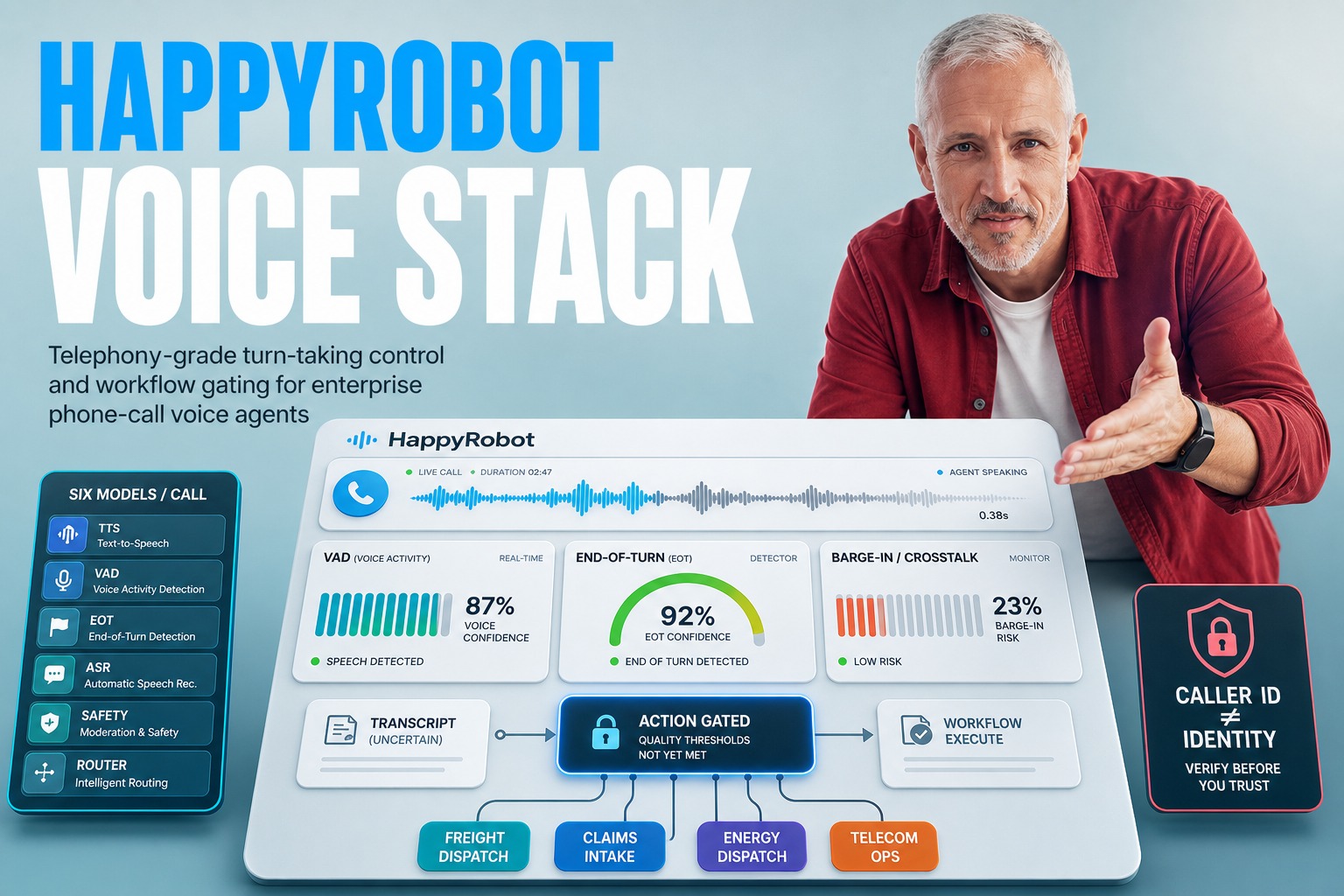
Is voice AI for phone call automation finally a ‘real’ enterprise category? → Yes: HappyRobot’s $150 million Series C at a $1.22 billion valuation signals that growth-equity investors now underwrite voice-first AI agents like infrastructure, not experiments.
What’s the primary engineering question teams should be searching for right now? → How do we deploy voice AI agents to automate operational phone calls without breaking call quality, compliance, or downstream workflows.
What’s the non-obvious technical point behind the funding signal? → The moat is increasingly the telephony-grade voice stack (TTS, voice activity detection, end-of-turn detection) rather than the agent orchestration layer everyone can copy.
What does this change for a CTO deciding this quarter? → Model selection matters less than whether your architecture can survive noisy, accented, crosstalk-heavy calls while integrating safely into freight, insurance, energy, or telecom ops.
What will we argue that some engineers may disagree with? → Production failures in voice agents happen at the audio-turn boundary, not the ‘agent logic’ boundary, so the right response is to architect around specialized voice models and strict operational guardrails before scaling.
Quick Answer: how to deploy voice AI agents for enterprise phone calls without reliability debt
If you want voice AI agents to handle operational phone calls, design your system around telephony-grade turn-taking and audio ambiguity, not around prompt flows. HappyRobot’s bet—using proprietary fine-tuned models for TTS, voice activity detection, and end-of-turn detection, reportedly running six specialized models per call—reflects where production risk concentrates. We should treat voice as an infrastructure problem: instrument the call pipeline, constrain actions, and integrate with workflows only after the agent can reliably detect who spoke, when they stopped, and what to do next.
The hard part of ‘AI agents on the phone’ is not deciding what to say; it’s knowing when to speak, when to wait, and when the other side didn’t actually finish—so architect your first milestone around audio-turn correctness, not task completion demos.
HappyRobot’s $150M round changes the buy-vs-build calculus for voice agents
The dominant signal this week is that a voice-first AI agent company just raised $150 million at a $1.22 billion post-money valuation, with growth-equity firms Prysm Capital and Eurazeo leading. That is not a typical ‘let’s try agents’ story; it implies buyers are already paying for agents that make and take calls across freight and into insurance claims intake, energy dispatch coordination, and telecom operations. For engineering leaders, this reframes the decision: the question is no longer whether voice agents can work, but what architecture is required to make them dependable enough for multi-year contracts.
- The funding source matters as much as the funding size. Growth-equity leadership suggests underwriting based on stickiness and operational fit, which pressures vendors and in-house teams to prove reliability under real call conditions rather than polished transcripts.
- Voice is returning as the operational interface teams ignored. Freight dispatch, claims intake, and dispatch coordination still happen over phones, which means automation wins are measurable in a way chat widgets often aren’t.
- The defensibility is shifting downward in the stack. The input points to proprietary fine-tuning in TTS, voice activity detection, and end-of-turn detection, which is exactly where generic voice APIs tend to degrade.
- Vertical workflow ownership becomes the differentiator. HappyRobot is positioned as owning the end-to-end call workflow rather than selling horizontal voice APIs, which typically increases integration effort but raises switching costs once deployed.
- Expansion across regulated operations raises the bar. Moving from freight into insurance, energy, and telecom implies heavier scrutiny on call handling, auditability, and failure modes, even when the ‘agent’ feels conversational.
Central claim we should design around
Our central claim is that voice-agent failures in production happen at the orchestration boundary between audio and action—voice activity detection, end-of-turn detection, and the handoff into operational systems—more than inside the language model. Engineers can reasonably disagree and insist better prompts or a better model fixes it; we see the opposite in operations-heavy domains like freight or claims: if the system interrupts, misses crosstalk, or mis-detects a pause, downstream workflow damage is inevitable, no matter how fluent the wording sounds.
Why generic voice APIs collapse in freight-grade calls
HappyRobot’s narrative is explicit: operational phone calls are loud, accented, full of jargon, and frequently involve crosstalk, which breaks off-the-shelf text-to-speech and voice-activity-detection stacks. That is the engineering reality most teams meet after the first pilot. In freight dispatch, you are not transcribing a clean meeting; you are handling fragmented audio, interruptions, and partial confirmations. If you build on generic components without designing for these conditions, the agent will fail in the only moments that matter: rate negotiation, pickup and delivery window confirmation, and status escalation.
Define the call contract before the call flow. Decide what counts as a valid commitment in your domain (rate accepted, window confirmed, claim initiated) and what must be deferred to a human when audio uncertainty is high.
Instrument turn-taking as a first-class signal. Treat voice activity detection and end-of-turn detection as observable system components with explicit confidence and failure states, not hidden ‘media plumbing.’
Separate ‘heard it’ from ‘acted on it.’ Design a hard boundary between recognition and workflow execution so ambiguous audio cannot directly trigger irreversible operational actions.
Integrate only after you can survive noise and crosstalk. In freight and similar domains, the agent must handle messy calls consistently before you connect it to dispatch, claims, or dispatch coordination systems.
The architectural implication of ‘six specialized models per call’
The input reports that HappyRobot may run six specialized models per call rather than a single general-purpose stack, with proprietary fine-tuning for TTS, voice activity detection, and end-of-turn detection. We should read that as an architectural bet: production voice agents are pipelines, not monoliths. Even if you choose a single LLM provider, your system can still require multiple domain-tuned components around it, and the complexity shows up as latency, monitoring needs, and more operational failure modes that must be engineered—not wished away.
The voice stack is becoming the moat, not the agent framework
Most ‘agent’ discourse focuses on orchestration: tools, planning, memory, and routing. HappyRobot’s positioning pushes us in a different direction: the differentiator is the voice substrate that survives contact with real phone lines. If we’re advising a CTO on whether to buy or build, we should assume orchestration layers will commoditize faster than voice reliability components. That’s why voice-first capabilities belong in your evaluation rubric alongside any AI agents development work you plan internally: the pipeline’s weakest link is rarely the planner.
| What you optimize first | What tends to break first | What ‘good’ looks like in operations |
|---|---|---|
| Orchestration and tool calling | Interruptions, barge-in confusion, false end-of-turn | The agent consistently waits, confirms, and recovers when audio is messy |
| One general-purpose voice model | Jargon, accents, crosstalk, loud environments | Specialized components are tuned and monitored as independent services |
| Fast integration to core systems | Irreversible actions triggered by mishearing | Clear gating between ‘understood’ and ‘executed’ with safe escalation |
| Chat-style UX assumptions | Phone-call dynamics and compliance constraints | The phone is treated like a different interface with different failure modes |
Vertical workflow ownership is the trade: harder to ship, harder to rip out
HappyRobot is described as a vertical agent company that owns the workflow end to end, not a horizontal API provider. That usually means more up-front integration effort because the vendor must map to your dispatch, claims, or customer operations reality. But once live, it becomes stickier because the system is evaluated on completed operational outcomes, not ‘nice conversations.’ For engineering teams, this trade changes how we scope pilots: success criteria must be workflow metrics and exception handling, not transcript quality.
Growth-equity leadership signals that reliability, not novelty, is being priced
Prysm Capital and Eurazeo leading a Series C is not just finance gossip; it changes the market expectations engineers will be held to. Growth-equity investors tend to underwrite what looks like infrastructure: multi-year contracts, retention, and expansion into adjacent verticals. The input ties that to 150+ enterprise logos and multi-year contracts with logistics majors including DHL and Kuehne+Nagel. For a buyer, this implies voice agents are being sold as dependable operational capacity, and our architecture must be designed for long-lived maintenance, monitoring, and controlled evolution.
- Procurement will ask for operational proofs, not demos. Once buyers see later-stage funding and recognizable enterprise logos, they expect predictable behavior under stress, documented exceptions, and clear escalation paths.
- Expansion across freight, insurance, energy, telecom changes requirements. Each adjacent domain raises different integration and compliance constraints, which in practice forces better governance of call logs, outcomes, and reversibility.
- Two-tranche rounds mirror two-phase deployments. The C-1 and C-2 tranches priced at the same valuation is a reminder that confidence is staged; deployments also need staged exposure where reliability gates capacity.
- Strategic investors hint at where integrations will be demanded. Participation from Orange and Deutsche Telekom’s venture arm implies telecom-adjacent expectations: call routing realities, carrier-grade reliability, and operational SLAs.
- Vertical ROI is the reason voice wins funding. When automation replaces tedious human call labor in thin-margin industries, the business wants repeatability, and engineering must treat that repeatability as a system property.
When a voice-agent vendor is financed like infrastructure, your implementation must be managed like infrastructure: change control, incident response, observability, and capacity planning become part of ‘AI,’ whether the team likes it or not.
The hidden production system is the telephony perimeter and its security model
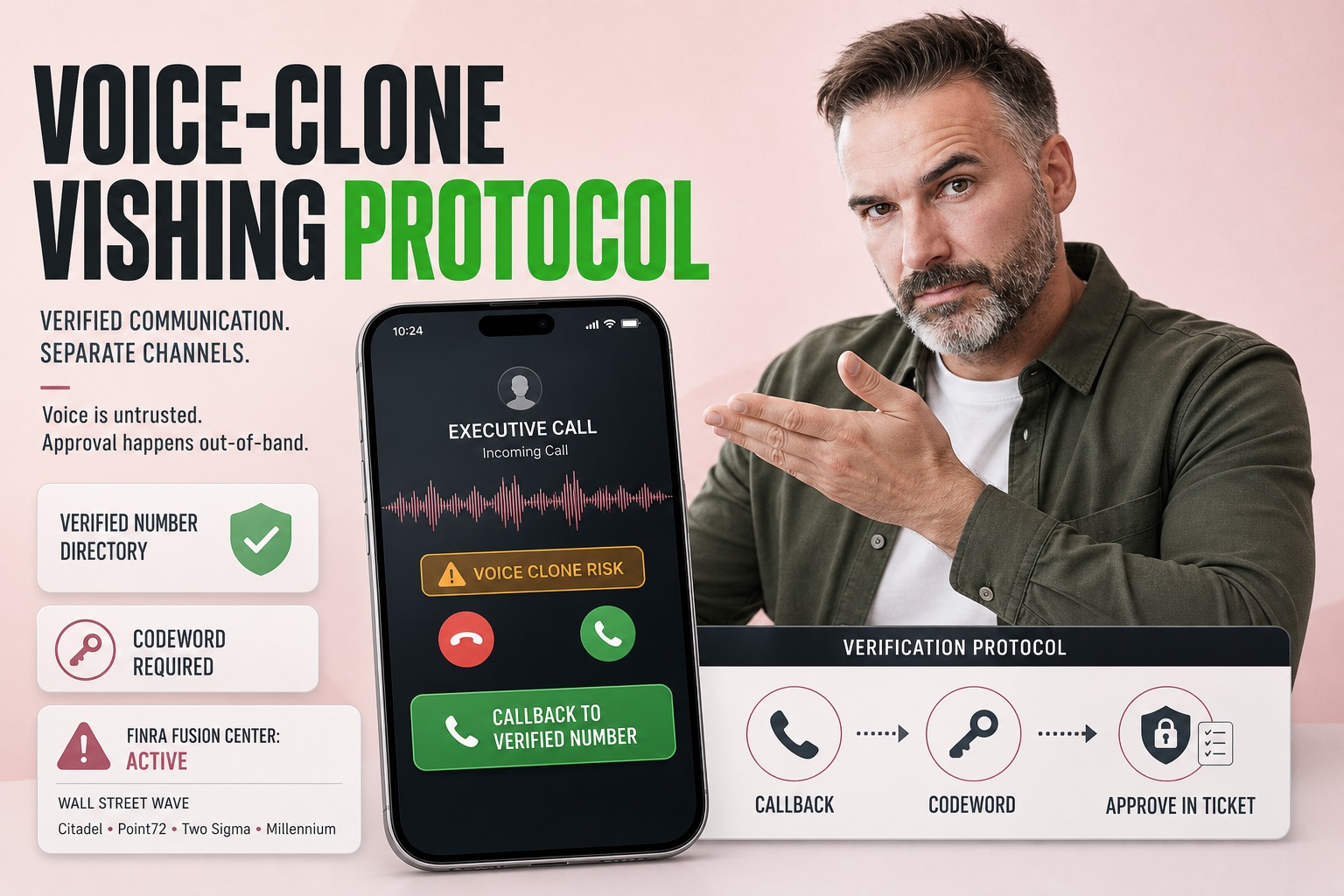
A voice agent is not only an LLM plus speech; it is a system sitting on the boundary between public networks and private operations. The moment it ‘makes and takes phone calls,’ it inherits threat surfaces that chat pilots often avoid: spoofing, social engineering, and accidental disclosure through speech. Even without adding new factual claims about any vendor, we can say the engineering response is to treat the phone channel as a security domain and to align the deployment with practices you’d expect from cybersecurity and penetration testing for externally reachable services.
- Call identity is not user identity. Phone numbers and caller ID are weak signals, so sensitive actions must rely on stronger verification patterns and conservative action gating.
- Voice agents create new data exhaust. Audio, transcripts, and call outcomes become operational artifacts, so teams need explicit policies for retention, access control, and audit trails.
- ‘Heard wrong’ is a security incident when it triggers action. Misrecognition is not just a UX bug if it changes a claim intake outcome or dispatch coordination decision.
- Outbound calls can become abuse vectors. Systems that place calls can be manipulated into contacting the wrong parties or revealing information unless strict routing and content constraints exist.
- Third-party integrations widen the blast radius. Once the agent connects to freight booking, claims intake, or dispatch systems, failures propagate into real-world commitments.
Where we see teams fail first: letting transcripts drive actions directly
In practice, teams often treat a transcript as ground truth and wire it straight into workflow triggers because it is the fastest demo path. That is precisely where noisy operational calls punish you: the errors are plausible, the counterparty moves on, and your system has already mutated state. The more ‘vertical’ the use case—rate negotiation, claims intake, dispatch coordination—the more important it is to design a safe interpretation layer that can say ‘uncertain’ and escalate rather than guessing.
How we would evaluate a voice-agent rollout this quarter at Plavno
At Plavno, we’d frame the decision around the main search question: how to deploy voice AI agents for enterprise phone calls without reliability debt. The funding signal tells us buyers will increasingly expect phone automation to work in the mess, not just in clean pilot conditions. So we would start by modeling your call types—freight dispatch, claims intake, energy dispatch coordination, telecom operations—and define what ‘safe failure’ means in each. Then we would map that to an architecture that treats VAD and end-of-turn detection as monitored services, with explicit confidence thresholds that gate workflow execution.
We would also pressure-test whether you’re buying a workflow owner or assembling a stack. A vertical provider can be stickier but demands deeper integration alignment. A do-it-yourself stack gives you control but forces you to own the ongoing tuning and monitoring that the input implies is non-trivial. When teams need help making that decision under real constraints, we typically start with AI consulting that ties technical gates to operational KPIs rather than model hype.
- Start from the worst-call scenario, not the average call. Freight-style noise, accents, jargon, and crosstalk are where systems fail, so the evaluation should begin where the business risk is highest.
- Demand explicit handling of turn-taking. If the vendor or internal design cannot clearly explain voice activity detection and end-of-turn detection behavior under interruption, you do not yet have a production plan.
- Require a reversible workflow boundary. The system must separate conversational interpretation from any commit to operational systems, with conservative escalation when confidence is low.
- Treat expansion as a feature of the architecture, not a roadmap slide. If the same agent approach claims to span freight, insurance, energy, and telecom, the integration and governance story must be credible.
- Validate the organizational operating model. The system will need monitoring and incident response; you should know who owns that and how changes are rolled out.
Real workloads where voice agents earn their keep: freight first, then adjacent ops
HappyRobot’s described use cases are a strong map of where voice agents can be economically compelling: negotiating rates with carriers, confirming pickup and delivery windows, and chasing status updates that previously required dispatchers spending hours a day on the phone. The reported expansion into insurance claims intake, energy dispatch coordination, and telecom customer operations also matters because it highlights a repeatable pattern: the phone is still the operational bus for many ‘last mile’ decisions. When we build similar systems, we treat this as a productized voice AI assistant development problem, not a chat-to-speech conversion.
- Freight rate negotiation and confirmations. A voice agent must handle jargon-heavy negotiation while producing auditable outcomes like accepted rates and confirmed windows.
- Status-chasing and exception escalation. The value is often in persistence: outbound follow-ups, inbound interruptions, and clean handoff to a human when something deviates.
- Insurance claims intake. The agent’s job is to capture structured facts from messy narratives, while ensuring uncertain audio doesn’t become a wrong claim record.
- Energy dispatch coordination. Calls often involve timing pressure and partial information, so the architecture must prioritize safe confirmation over speed.
- Telecom customer operations. High call volumes amplify small failure rates into operational pain, which forces discipline in monitoring and change management.
Buy a vertical voice agent or assemble a stack: the real engineering constraint is ownership
A CTO deciding this quarter usually isn’t choosing between ‘agent’ and ‘no agent’; they’re choosing who owns the reliability work implied by messy phone calls. If you buy a vertical workflow owner, you’re betting they already solved the telephony-grade voice stack problems the input describes. If you assemble a stack, you’re betting your team can continuously tune voice activity detection, end-of-turn behavior, and speech generation for your calls, while also integrating into operations. When you need to accelerate that ownership without losing control, an outstaffing model can help you keep architectural decisions internal while scaling implementation capacity.
- Vertical vendor path: you trade flexibility for predictability. You may accept their workflow model and integration shape, but you hope their specialization absorbs the messiness of real calls.
- Assembled stack path: you trade speed for control. You can tailor to your domain, but you also inherit ongoing tuning and incident response as permanent responsibilities.
- Hybrid path: buy core, own the guardrails. Many teams keep the agent vendor but build their own gating, audit, and escalation layer so operational commitments remain under internal control.
- The biggest hidden cost is operational staffing. Voice agents require monitoring, triage, and controlled rollouts, so plan for an operating model, not just an integration project.
- Procurement expectations rise with late-stage signals. As the category matures, stakeholders will demand commitments around reliability and governance, regardless of build or buy.
The deployment architecture that avoids ‘phone-call chaos’ propagating into your systems
The architecture pattern we recommend is to treat the phone channel as an event stream with uncertainty, and to keep that uncertainty from directly mutating business state. Telephony ingress, speech perception, and turn-taking should produce a structured, confidence-tagged representation; only then should your workflow layer decide whether to act, confirm, or escalate. This is where disciplined infrastructure choices—observability, controlled rollouts, and isolation—matter as much as model quality, and it’s why teams often anchor the build in cloud software development practices rather than in ‘AI tooling’ alone.
- Separate media handling from decision-making. Keep telephony and audio processing isolated from business logic so a media edge case cannot trigger a business-side cascade.
- Make confidence explicit in the workflow layer. Every downstream action should depend on confidence signals and require confirmation where the business risk is high.
- Design for escalation as a first-class outcome. The system should know how to hand off, not just how to complete; otherwise humans become the unplanned exception engine.
- Instrument the pipeline end to end. Monitor where failures occur—turn-taking, recognition, or downstream integration—so you can fix the right layer rather than blame the model.
- Control change like you would for a customer-facing API. Voice behavior changes can have operational consequences, so treat updates as governed releases, not ad hoc prompt tweaks.
The risks that remain even when the voice agent sounds perfect
Voice agents can sound fluent while still being operationally unsafe. The input highlights exactly why: the messy phone conditions that break generic APIs are not edge cases in freight-style operations; they are the default. Even with specialized models, the system can still mis-handle crosstalk, interpret jargon incorrectly, or over-confidently confirm something that was not agreed. The risk management stance we recommend is conservative: constrain what the agent can commit to, demand auditable outcomes, and treat every ambiguity as a workflow event that must be resolved safely.
- Overconfidence in ambiguous audio. The system may produce a plausible interpretation that is wrong, and plausibility is more dangerous than obvious failure in operational contexts.
- Workflow drift over time. Even if the agent performs well today, operational processes change, so integrations and guardrails must be maintained continuously.
- Misaligned incentives between UX and operations. A ‘smooth conversation’ goal can conflict with the need to pause, confirm, and escalate, especially in high-stakes calls.
- Hidden compliance exposure. Call artifacts and outcomes can become subject to internal policies and external expectations, requiring governance beyond the AI team.
- Vendor lock-in versus reliability. A vertical solution can become deeply embedded; that can be good for stability, but it increases the cost of switching if requirements change.
A practical decision matrix for voice AI agents: what to test before you scale
If we distill the signal from HappyRobot’s round into an engineering decision, it’s that voice automation is investable only when it behaves like a dependable system. The most important tests are not ‘can it talk,’ but ‘can it handle the call conditions our operations actually generate’ and ‘can it fail safely without corrupting downstream workflows.’ Use the table below to structure stakeholder discussions: it forces the conversation away from model brands and toward operational readiness.
| Evaluation focus | What you should look for in practice | What it prevents |
|---|---|---|
| Turn-taking resilience | Clear behavior under interruption, crosstalk, pauses, and background noise | Agents that talk over people, miss commitments, or fabricate closure |
| Workflow gating | Explicit separation between interpreted intent and executed action | Irreversible state changes triggered by mishearing |
| Observability and ops model | End-to-end monitoring of call stages and defined escalation/triage | ‘Black box’ failures where teams blame the model and can’t fix the system |
| Vendor or team ownership clarity | Who tunes the voice stack, who ships changes, who handles incidents | Reliability debt that accumulates until operations rejects the tool |
Closing insight: voice agents are becoming operational infrastructure, so build them like it
HappyRobot becoming a unicorn on phone calls—not chat windows—underscores a shift many engineering teams have postponed: the phone is still where operational work gets done, and automating it requires infrastructure-grade design. The input’s emphasis on proprietary fine-tuning for TTS, voice activity detection, and end-of-turn detection is a blueprint for where the real engineering effort sits, and why ‘agent orchestration’ alone will not carry a production deployment.
Author: Plavno team. Last updated: August 2026. If you’re evaluating voice automation for freight, insurance, energy, or telecom operations this quarter, we can help you define the reliability gates, integration boundaries, and operating model before you scale. Bring us one real call flow and one downstream workflow you cannot afford to corrupt, and we’ll map an architecture that prioritizes safe outcomes over impressive transcripts.
 Chat GPT
 Perplexity
 Claude
 Gemini