Will AI voice assistants really cut call‑center wait times? → Yes, when they understand intent and route correctly.
Is natural‑sounding speech enough to win customers? → No, misrouting erodes trust faster than robotic tones.
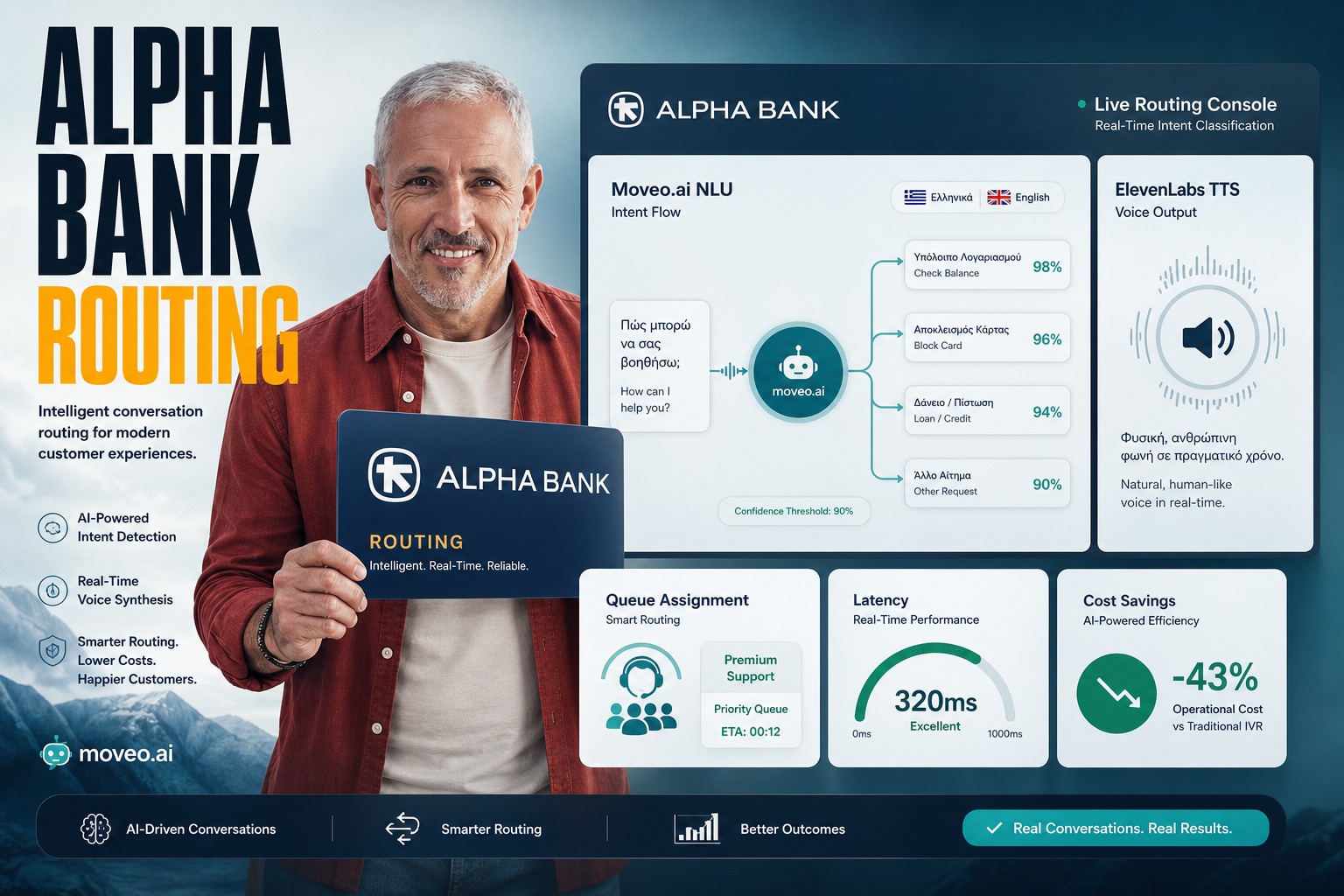
Can a Greek bank launch a multilingual voice bot this quarter? → Alpha Bank proves it’s possible with ElevenLabs and Moveo.ai.
Do we need to rebuild our entire telephony stack? → Only the routing and NLU layers need integration; the voice synthesis can be swapped.
The real bottleneck is not the synthetic voice, it’s the routing engine
Banks that focus solely on making the assistant sound human miss the point: the moment a caller’s request is misunderstood, the conversation stalls. Alpha Bank’s rollout shows that a natural‑language understanding (NLU) layer that can instantly map intent to a specialist queue is the decisive factor for CX gains. When the routing logic fails, even the most lifelike voice becomes a dead end, leading to repeat calls and churn.
How Alpha Bank’s partnership rewrites the call‑center playbook
By coupling ElevenLabs’ text‑to‑speech with Moveo.ai’s NLU, Alpha Bank created a voice gateway that accepts free‑form Greek or English. The system parses the utterance, determines the banking intent, and forwards the call directly to the appropriate team—bypassing static IVR trees. This architecture flips the classic hierarchy: voice synthesis is a peripheral service, while real‑time intent routing sits at the core of the platform.
- Instant intent extraction – Moveo.ai analyzes each utterance as it arrives, eliminating the need for pre‑recorded menu options.
- Dynamic queue assignment – Calls are routed to specialist teams based on intent, not on generic “account” or “loans” menus.
- Multilingual support – Both Greek and English are processed by the same NLU model, reducing language‑specific silos.
- Scalable voice synthesis – ElevenLabs provides a plug‑in voice that can be swapped without touching routing logic.
- Analytics feedback loop – Real‑time metrics feed back into the NLU model to improve routing accuracy over time.
Why the routing layer dominates performance budgets (M)
The moment a caller says, “I need to dispute a transaction,” the NLU must resolve intent within milliseconds. If the routing decision lags, the caller hears silence, perceives latency, and abandons the call. In practice, the latency budget for intent classification is under 200 ms; anything higher spikes abandonment rates. Consequently, engineering teams must allocate compute resources to the NLU pipeline—GPU‑accelerated inference, low‑latency APIs, and edge caching—while treating the TTS engine as a best‑effort service.
Beyond raw speed, routing correctness drives downstream metrics. A misrouted call forces a transfer, adding on average 30 seconds of handling time. Over Alpha Bank’s 4 million annual calls, even a 1 % misrouting rate translates to 40 000 extra minutes of agent time, inflating operational costs dramatically. Hence, the architecture’s success hinges on a robust intent‑to‑queue mapping, not on the voice’s naturalness.
- Latency‑first inference – Deploy NLU models on inference‑optimized hardware close to the telephony gateway.
- Graceful fallback – If confidence falls below a threshold, hand off to a human agent before the caller perceives a dead end.
- Versioned intent schemas – Keep routing rules versioned to avoid breaking changes during model updates.
- Observability stack – Instrument every routing decision for latency and confidence to spot degradation early.
- Scalable TTS pool – Run ElevenLabs voices in a stateless pool that can be autoscaled independently.
The hidden cost of over‑engineering voice fidelity (S)
Investing heavily in ultra‑realistic voice models can drain budget without improving CX if routing remains flaky. Alpha Bank’s experience demonstrates that a modest, well‑tuned voice paired with a rock‑solid NLU yields higher Net Promoter Scores than a premium voice that misroutes calls. Engineers should therefore allocate resources proportionally: 70 % to intent routing, 30 % to voice synthesis.
Assess routing latency – Measure end‑to‑end intent classification time under peak load.
Benchmark confidence thresholds – Determine the minimum confidence that still yields acceptable routing accuracy.
Scale NLU before TTS – Add inference nodes until latency meets SLA, then evaluate voice quality upgrades.
Implement fallback logic – Define clear escalation paths for low‑confidence intents.
Iterate on voice branding – Once routing is stable, refine the voice to match brand tone.
Building a production‑grade NLU pipeline for banking (M)
A production NLU stack must survive the bursty nature of call‑center traffic. Alpha Bank’s architecture uses Moveo.ai as a micro‑service behind a lightweight API gateway that receives audio streams from the telephony switch. The audio is transcribed by a speech‑to‑text engine, then passed to the intent classifier. To guarantee uptime, the service is containerized, replicated across three availability zones, and behind a load balancer that performs health checks on latency and confidence scores. This design ensures that a single node failure does not interrupt the routing flow, and that scaling decisions are driven by real‑time traffic patterns.
Operationally, the team monitors three KPIs: average intent latency, routing confidence, and transfer rate. When any KPI deviates from its SLA, an automated alert triggers a scaling event or a rollback to the previous stable model. This feedback loop keeps the system responsive and prevents the “voice‑only” failure mode where a perfect‑sounding assistant cannot understand the caller.
- Container orchestration – Use Kubernetes to manage NLU pods and enable rapid scaling.
- Geo‑distributed inference – Deploy inference nodes close to the telephony edge to cut round‑trip time.
- Model version control – Tag each intent model with a release version and keep rollback scripts ready.
- Telemetry aggregation – Funnel latency and confidence metrics into a centralized dashboard.
- Automated canary releases – Gradually expose new NLU versions to a fraction of calls before full rollout.
Why voice synthesis can be a plug‑and‑play component (S)
ElevenLabs supplies a brand‑specific voice that Alpha Bank can swap without touching the routing logic. Because the TTS service is stateless and accessed via a simple REST endpoint, the bank can replace the voice model, adjust prosody, or even switch vendors with a single configuration change. This modularity means engineering effort stays focused on the NLU and routing layers, which are the true differentiators for CX.
Prioritize intent routing latency over voice naturalness; the former directly impacts call‑center efficiency.
Quantifying the business impact of correct routing (S)
If a bank reduces misrouted calls by just 0.5 % across 4 million annual interactions, it saves roughly 20 000 minutes of agent time—a tangible cost reduction. Moreover, faster resolutions boost Net Promoter Scores, leading to higher customer retention and cross‑sell opportunities. The ROI therefore stems from operational efficiency, not from the aesthetic appeal of the synthetic voice.
Decision framework for CTOs evaluating AI voice assistants (M)
When a CTO assesses whether to invest in an AI voice assistant, the first gate should be the routing architecture. Ask: can the existing telephony stack expose real‑time audio streams to an NLU service? Does the organization have the capacity to monitor latency and confidence at scale? If the answer is yes, the next step is to pilot a lightweight voice synthesis layer. If not, the project should be deferred until the routing foundation is hardened.
In practice, we recommend a three‑phase rollout: (1) integrate NLU with a simple text‑to‑speech fallback; (2) validate intent accuracy and routing latency under load; (3) upgrade the voice model and expand multilingual support. This staged approach mirrors Alpha Bank’s incremental deployment—from call‑center pilot to full‑channel rollout—mitigating risk while delivering early value.
Our AI agents development service builds the routing layer first, then layers the voice synthesis on top.
A phased rollout lets you prove routing gains before spending on premium voice licensing.
Real‑world scenarios where routing wins (S)
Consider a fraud‑alert call where the customer says, “I see a charge I don’t recognize.” The NLU must instantly map this to the fraud‑prevention queue. If the system mistakenly routes to general inquiries, the customer repeats the issue, increasing frustration. By contrast, a correctly routed call connects the caller to a specialist within seconds, defusing tension and preventing potential loss.
Scaling the solution beyond the call center (M)
Alpha Bank plans to extend the assistant to e‑banking and mobile channels. The same routing principles apply: every textual or spoken request must be funneled through the NLU service, which then determines the appropriate backend workflow—whether it’s a chatbot, a secure API call, or a human hand‑off. By centralizing intent handling, the bank ensures consistent experience across all touchpoints while reusing the same routing logic, dramatically reducing development overhead.
Furthermore, the modular voice layer can be swapped for a text‑only interface on mobile, preserving brand voice consistency without duplicating effort. This unified intent engine becomes a strategic asset, enabling rapid feature rollout across channels with minimal integration work.
Explore our AI voice assistant development offering for end‑to‑end implementation.
A single NLU routing core powers every digital channel, delivering consistency and speed.
Comparative view: routing‑first vs. voice‑first architectures (S)
| Approach | Primary focus | Typical SLA | Risk profile |
|---|---|---|---|
| Routing‑first | Intent accuracy & latency | ≤200 ms intent latency, ≤1 % misrouting | Low – failures are caught early, fallback to human is fast |
| Voice‑first | Speech naturalness & brand tone | High‑fidelity TTS, but no strict latency target | High – misrouting leads to silent failures and churn |
How to audit your current call‑center stack for routing readiness (M)
Start by mapping the audio flow: identify where the call‑center switch (e.g., Genesys or SmartRep) can expose raw audio streams. Next, evaluate existing NLU capabilities—does the platform support Greek language models? If not, consider integrating a third‑party service like Moveo.ai. Then, instrument the path with latency probes to establish a baseline. Finally, run a misrouting analysis on a sample of recent calls to quantify the current transfer rate. This audit reveals gaps and guides investment decisions.
Step‑by‑step audit checklist
Begin with a simple spreadsheet that lists each telephony component, its API exposure, and current latency. Add columns for confidence thresholds, fallback mechanisms, and multilingual support. Populate the sheet with data from a week of call logs. Highlight any component where latency exceeds 200 ms or confidence falls below 85 %. Those rows become immediate candidates for optimization.
Preparing the organization for a routing‑centric rollout (S)
Engineering teams must adopt a mindset that treats intent routing as a critical service, on par with core banking APIs. This requires cross‑functional ownership: product managers define intent taxonomies, data scientists maintain NLU models, and DevOps engineers ensure low‑latency deployment. Training agents on the new flow also matters; they need to understand why certain calls now arrive pre‑qualified, reducing handling time.
Our cloud software development expertise helps set up the necessary CI/CD pipelines and observability tooling.
Our software development consult service aligns business processes with the routing architecture.
Cultural shift for success
Encourage a data‑driven culture where every routing decision is logged and reviewed. Celebrate reductions in transfer rates as engineering wins, not just customer service achievements. Align performance bonuses with routing accuracy metrics to reinforce the priority.
Monitoring and continuous improvement (S)
A live dashboard should display real‑time intent latency, confidence distribution, and transfer percentages. Alerts trigger when latency spikes above 250 ms or confidence dips below a safe threshold. Periodic retraining of the NLU model using freshly labeled call data ensures the system adapts to evolving customer language and new banking products.
Feedback loop mechanics
After each call, capture the final outcome (resolved, transferred, escalated). Feed this label back into the training pipeline, weighting misrouted cases more heavily. Over time, the model learns to disambiguate edge cases that previously caused routing errors.
Bottom line: architecture beats aesthetics for AI voice assistants (S)
When banks invest in AI voice assistants, the decisive factor is not how human the voice sounds but how reliably the system routes the caller to the right specialist. Alpha Bank’s partnership with ElevenLabs and Moveo.ai validates that a routing‑first architecture delivers measurable efficiency gains, while voice quality can be iterated later.
The same principles apply in AI‑driven healthcare platforms (AI healthcare solutions).
Takeaway for CTOs
Treat the NLU‑to‑queue pipeline as a mission‑critical microservice, allocate latency budgets, and implement robust fallback paths. Once routing is rock‑solid, polish the voice to match brand identity.
Next steps for enterprises ready to act (S)
Begin a small pilot in a single call‑center queue, measure intent latency and misrouting rates, and iterate on the NLU model before expanding to other channels. Leverage Plavno’s AI‑agents development service to fast‑track the routing layer and avoid common integration pitfalls.
Quick‑start checklist
- Define top‑five intents that drive the highest call volume.
- Deploy a lightweight NLU micro‑service with a 200 ms SLA.
- Integrate ElevenLabs TTS via a REST endpoint.
- Set up real‑time monitoring for latency and confidence.
- Run a two‑week pilot and evaluate transfer reduction.
Final thought: let routing be the voice of your bank
A well‑engineered routing core turns an AI voice assistant from a novelty into a profit‑center. By aligning engineering effort with the true performance driver—intent accuracy and latency—banks can deliver faster, more satisfying experiences while keeping costs in check.
Closing insight
Invest in the invisible plumbing first; the voice will follow.
Call to action
If you’re evaluating an AI voice assistant for your financial institution, let us help you design a routing‑first architecture that scales from the call center to every digital touchpoint. Our expertise in AI‑agents development and cloud software engineering ensures you get the right balance of speed, accuracy, and brand‑aligned voice.
 Chat GPT
 Perplexity
 Claude
 Gemini