Will multi‑agent AI reduce manual travel‑booking tasks? → Yes, specialized agents can automate refunds, schedule changes and unticketed airline validation.
Can we build our own agents on Spotnana’s platform? → The open design lets partners create custom agents that hook into Spotnana APIs.
Is a modular agent layer safer than a single chatbot? → By mapping each agent to deterministic workflows, you avoid hallucinations and enforce policy compliance.
What data quality is needed for reliable AI in travel? → Accurate, structured travel data is the foundation; without it the AI operates on sand.
The Core Question: How Should Travel SaaS Platforms Architect Multi‑Agent AI for Enterprise‑Grade Automation?
The travel industry is finally moving beyond flashy demos toward production‑ready agents that can handle refunds, schedule disruptions and data‑driven insights without human oversight. Engineers must decide whether to invest in a monolithic conversational assistant or to adopt Spotnana’s multi‑agent, API‑bound architecture that isolates each workflow into a deterministic micro‑service. This decision determines latency, compliance, and long‑term maintainability.
A multi‑agent design isolates risk at the orchestration boundary, turning AI failures into manageable fallback paths.
Why a Single General‑Purpose Assistant Breaks at Scale in Travel Operations
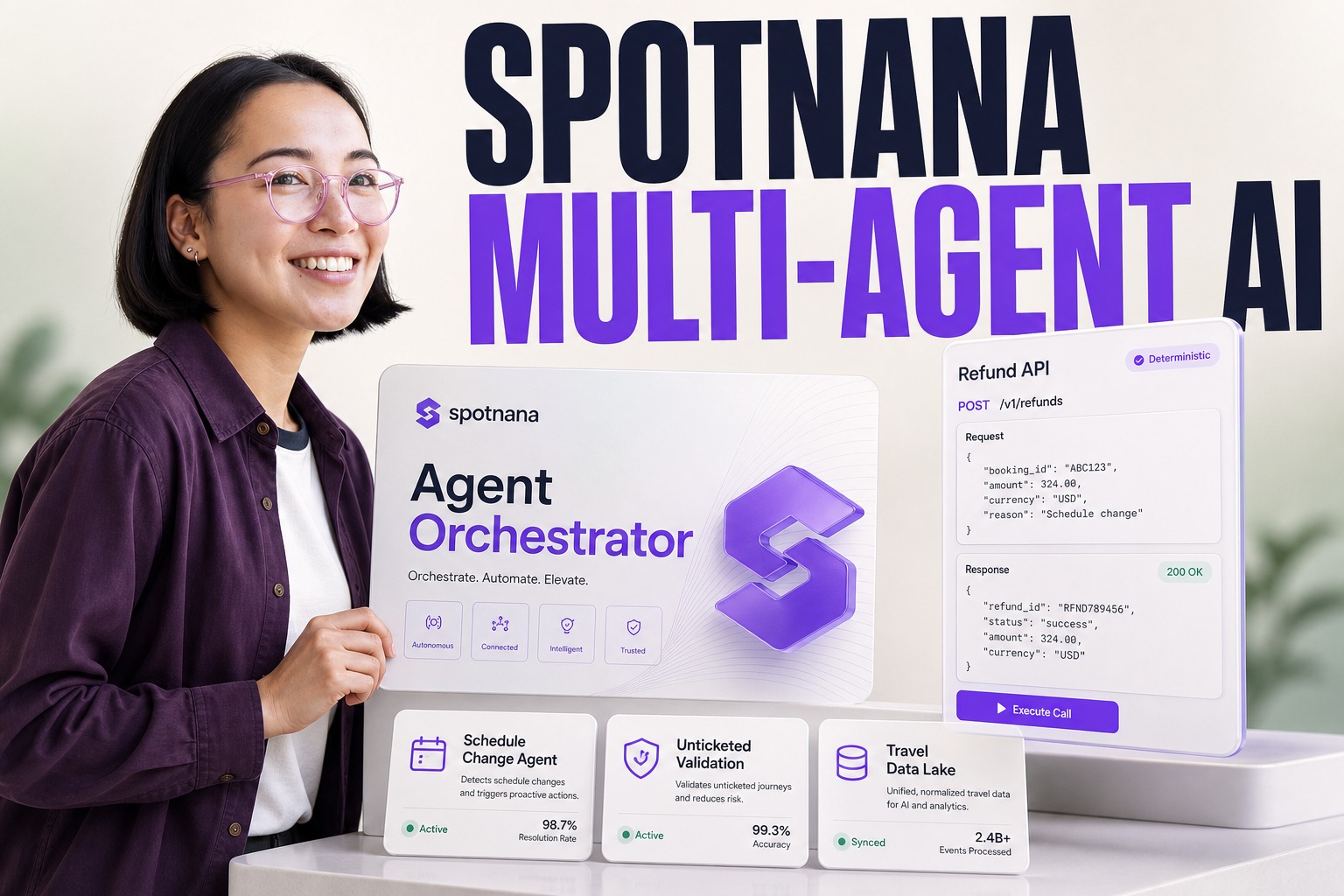
A single assistant must understand every nuance of airline fare rules, hotel policies and corporate travel guidelines. In practice, that breadth forces the model to hallucinate or improvise, leading to compliance breaches. Spotnana’s approach assigns each discrete task—refund calculation, schedule change handling, unticketed validation—to a dedicated agent that calls a specific API. The result is deterministic behavior, auditability, and the ability to enforce corporate travel policies programmatically.
- Deterministic API contracts – Each agent invokes a well‑defined Spotnana endpoint, guaranteeing the same output for identical inputs.
- Policy enforcement at the action layer – Agents cannot invent refund amounts; they only apply rules encoded in the travel policy service.
- Reduced hallucination surface – By limiting the model’s scope, you eliminate the need for post‑processing checks on every response.
- Easier compliance audits – Logs capture which API was called, what data was used, and the resulting action, satisfying regulatory requirements.
The Four‑Layer Blueprint Spotnana Publishes
Spotnana’s architecture splits responsibilities across Engagement, Agent Management, Action, and Data layers. The Engagement layer delivers conversational interfaces via OBTs, Slack or Teams. The Agent Management layer breaks a user request into sub‑tasks, routing each to a specialized AI agent. The Action layer executes deterministic workflows—refunds, itinerary updates, or data imports—through Spotnana APIs. Finally, the Data layer supplies the structured, high‑quality information that fuels accurate recommendations.
| Layer | Primary Responsibility | Key Technology |
|---|---|---|
| Engagement | Conversational UI across channels | OBT, Slack, Teams |
| Agent Management | Task decomposition and routing | Spotnana Agent Orchestrator |
| Action | Deterministic execution of travel actions | Spotnana APIs (Refund, Schedule, Unticketed) |
| Data | Structured travel content and policy data | Unified travel data lake |
How the Action Layer Turns AI Insight into Concrete Operations
When an agent decides that a refund is due, it does not generate a free‑form amount. Instead, it calls the Refund API with the booking ID, policy ID and fare rules. The API validates the request against corporate travel policies, calculates the exact amount, and returns a transaction record. This deterministic hand‑off eliminates the “creative” step that large language models tend to insert, ensuring compliance and financial accuracy.
Quick Answer: Deploy a Modular, API‑Bound Multi‑Agent Stack to Achieve Reliable Travel Automation
To guarantee enterprise‑grade reliability, travel platforms should replace monolithic chatbots with a suite of specialized agents, each tightly coupled to Spotnana’s deterministic APIs. This architecture confines AI uncertainty to the decision‑making layer while the Action layer enforces policy, data integrity and auditability. The result is a system that scales across airlines, hotels and corporate travel policies without sacrificing compliance.
The Role of Data Quality in the Multi‑Agent Model
Even the most sophisticated agents falter if the underlying data is noisy. Spotnana emphasizes a “breadth, structure, and accuracy” triad: breadth ensures coverage of all travel modalities, structure guarantees that each API receives predictable schemas, and accuracy prevents downstream errors in refund calculations or itinerary updates. Investing in a clean data lake and rigorous ETL pipelines is therefore a prerequisite for any multi‑agent deployment.
Plavno’s Perspective: Why We Advocate for Spotnana’s Architecture
At Plavno we have seen countless travel SaaS projects crumble under the weight of a single, over‑generalized AI assistant. By adopting Spotnana’s multi‑agent, API‑bound approach, we can deliver faster time‑to‑value, tighter compliance, and clearer ownership of each workflow. Our teams leverage the same modular principles across other domains—finance, healthcare, and logistics—proving that the pattern scales beyond travel. Explore our AI agents development services here.
- Faster iteration cycles – New agents can be added without touching existing ones, reducing regression risk.
- Clear ownership – Each agent maps to a specific product team, aligning development and operational responsibilities.
- Scalable monitoring – Metrics are collected per‑agent, enabling precise performance tuning and anomaly detection.
- Reusable components – Agents built for refunds can be repurposed for other financial actions across industries.
Business Impact: Quantifiable Gains from Multi‑Agent Automation
Spotnana reports that its first wave of AI agents will automate repetitive tasks such as refunds, schedule changes and unticketed validation. For a mid‑size travel agency handling 10,000 bookings per month, automating just 20 % of these tasks can free thousands of agent‑hours, cut operational costs by double‑digit percentages, and improve response times from hours to seconds. Moreover, AI‑generated analytics on completed tasks provide managers with actionable insights on volume trends and bottlenecks. Our demand forecasting solutions help predict travel demand.
Automation that surfaces its own performance metrics creates a feedback loop for continuous improvement.
How to Evaluate Multi‑Agent Readiness in Your Organization
Begin by auditing your existing APIs: are they deterministic, versioned and capable of handling idempotent calls? Next, map each high‑frequency manual task to a potential agent and assess data readiness for that workflow. Finally, run a pilot with Spotnana’s Engagement layer—perhaps a Slack bot that triggers a refund agent—to measure latency, error rates and compliance adherence before scaling.
Real‑World Applications Beyond Refunds
The multi‑agent model extends naturally to itinerary enrichment, loyalty‑program integration, and post‑travel analytics. For example, an “itinerary‑builder” agent can pull data from multiple GDSs via Spotnana’s Data layer, while a “loyalty‑reconciliation” agent validates points against a corporate rewards system. Each use case follows the same pattern: a narrow AI decision, a deterministic API call, and a data‑backed outcome. For voice‑assistant integration see our AI voice assistant development service.
- Itinerary enrichment – Agent fetches ancillary services and presents them in a conversational UI.
- Loyalty reconciliation – Agent cross‑references travel spend with rewards databases via a secure API.
- Post‑travel sentiment analysis – Agent aggregates survey data, runs it through a sentiment model, and stores results for executive dashboards.
- Regulatory reporting – Agent compiles travel activity logs into compliance‑ready reports for auditors.
Risks and Limitations of the Multi‑Agent Approach
While modularity reduces systemic risk, it introduces orchestration complexity. Poorly designed routing logic can cause latency spikes, especially when multiple agents must be invoked sequentially. Additionally, if the Data layer contains gaps—missing fare rules or outdated policy versions—agents will produce incorrect outputs despite deterministic APIs. Finally, over‑fragmentation can lead to duplicated effort if governance does not enforce a shared service catalog. Our cloud software development team ensures scalable deployment.
- Orchestration complexity – Poor routing can cause latency spikes.
- Data gaps – Missing or stale data leads to incorrect outputs.
- Over‑fragmentation – Duplicated effort without shared governance.
Mitigating Orchestration Overhead
Employ a lightweight orchestrator that batches independent agent calls and retries failed invocations with exponential backoff. Monitor end‑to‑end latency per request and set service‑level objectives that reflect user expectations for travel‑critical interactions.
Closing Insight: The Future of Travel Automation Is Modular, Not Monolithic
The shift toward multi‑agent AI is not a buzzword; it is a pragmatic response to the regulatory, compliance, and scalability challenges that travel platforms face today. By anchoring each agent to Spotnana’s deterministic APIs and reinforcing the Data layer’s quality, engineers can deliver reliable, enterprise‑grade automation that scales with market demand.
- Adopt Spotnana’s four‑layer model – Align your architecture with proven engagement, management, action, and data separations.
- Invest in data hygiene – Ensure your travel content lake meets the breadth‑structure‑accuracy criteria.
- Start small, iterate fast – Pilot a single agent (e.g., refunds) before expanding to complex workflows.
- Measure, monitor, and refine – Use AI‑generated analytics to close the loop on performance.
- Partner with experts – Leverage Plavno’s experience in building modular AI agents for rapid, compliant deployment.
Take the Next Step with Plavno’s AI‑Agent Expertise
If your travel platform is ready to move beyond ad‑hoc chatbots and into a production‑grade, multi‑agent ecosystem, we can help you design, integrate and scale Spotnana’s architecture. Our team has delivered enterprise AI solutions across travel, finance and healthcare, ensuring that every agent is governed by deterministic APIs and backed by high‑quality data. Learn more about AI automation here.
- Consultation – Review your current workflows and map them to Spotnana’s agent framework.
- Implementation – Build and deploy specialized agents that call Spotnana APIs.
- Optimization – Tune orchestration, monitor performance, and iterate based on AI‑driven analytics.
Ready to Future‑Proof Your Travel Automation?
Contact Plavno today to start a proof‑of‑concept that demonstrates measurable cost savings, compliance assurance, and faster response times for your customers. Let’s turn AI potential into reliable, revenue‑generating automation.
 Chat GPT
 Perplexity
 Claude
 Gemini