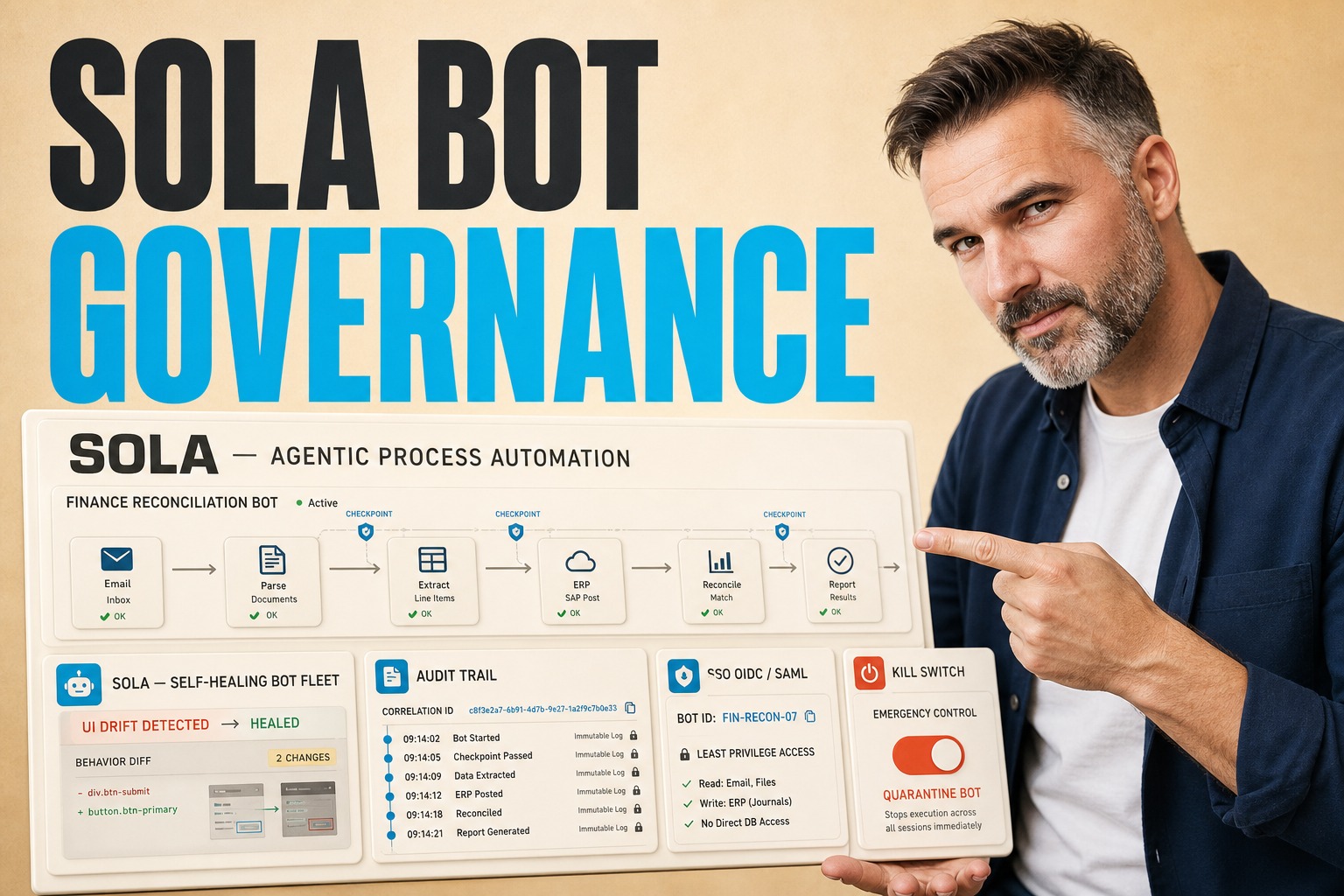
What changed in enterprise automation this week that engineers should care about? → Sola’s $17.5M Series A (bringing total funding to $21M) signals that agentic process automation is being treated as a new platform layer, not a feature inside legacy RPA.
What’s the real search question behind the hype? → Should we adopt an agentic process automation platform that records work and runs self-healing, AI-native bots across apps, or stick with traditional automation patterns?
What breaks first in production with recorded, human-like bots? → Not ‘the AI model,’ but the operational surface area: permissions, UI drift, exception handling, and auditability across many applications.
What decision do CTOs need to make this quarter? → Whether to pilot agentic automation as a governed internal platform (with controls, observability, and ownership) or to treat it like a no-code tool and accept unpredictable outages.
What’s Plavno’s angle? → Self-healing is only real if you design for change: you must architect identity, logging, and rollback as first-class requirements, or the bots will heal into non-compliance.
Central claim: Agentic process automation changes the engineering practice from building deterministic integrations to operating a bot fleet at the UI and workflow boundary, so the right response is to engineer governance and observability like you would for production services, not to debate which model is ‘smarter.’
Quick Answer: When should we adopt agentic process automation instead of RPA?
Adopt agentic process automation when your highest-cost workflows span multiple applications and change frequently, making brittle scripts and point integrations expensive to maintain. But treat it as an internal platform: require identity controls, audit logs, and rollback paths before you scale. Sola’s positioning (record processes, generate self-healing AI-native bots, and avoid code, consultants, or system replacements) is attractive, yet it increases the need for disciplined operations similar to AI automation programs.
The dominant signal: funding is flowing to bots that operate like humans, not like APIs
Sola’s $17.5M Series A, led by Kimberly Tan and Jennifer Li at Andreessen Horowitz, is a market vote that enterprise automation is shifting toward agentic process automation that interacts with software the way humans do. The notable engineering implication is where reliability work moves: instead of maintaining API contracts or ETL jobs, teams end up managing UI-level behavior across applications, sessions, and permission scopes. That changes your runbooks, your security posture, and what ‘testing’ means.
- Agentic process automation is being funded as a platform, not a patch. When investors back a full agentic platform, they are implicitly betting that enterprises will standardize on a runtime for bots, which means CTOs should evaluate it like middleware with SLAs, not like a departmental macro recorder.
- No-code is a promise to the business, not a free pass for engineering. A tool that claims ‘without code’ typically still demands engineering-grade controls around SSO, least privilege, environment isolation, and deployment cadence, or it becomes a shadow automation layer nobody can reliably own.
- Recording work creates speed, and speed creates drift. Capturing a process by demonstration compresses delivery time, but also codifies whatever exceptions, workarounds, and undocumented access patterns were present in the recording session.
- Self-healing shifts failures from build time to run time. If a bot can adapt when an application changes, failures become operational events you must observe, triage, and audit, rather than compile-time errors you catch during development.
- ‘Across applications’ is where risk multiplies. Each additional app introduces another authentication method, permission model, UI lifecycle, and data boundary; the bot fleet’s correctness becomes a systems problem, not a single workflow problem.
Why this is not just ‘next-gen RPA’ for engineering teams
Traditional automation tends to fail loudly when an element changes or an API contract breaks; agentic automation tends to fail ambiguously by doing something else that still ‘works.’ In practice, that forces a different engineering discipline: you need traceability from intent to action, and you need controls that can stop or quarantine a bot when behavior deviates. The more the bot behaves like a human across apps, the more your platform needs the same production safeguards you use for services.
The primary engineering question: can we trust self-healing bots with operational work?
The core decision is not whether Sola (founded by Jessica) can turn recorded processes into AI-native bots; it is whether your organization can operate those bots safely. Sola’s promise of no code, no consultants, and no system replacements is exactly what makes the evaluation tricky: the faster you can deploy automation, the easier it is to deploy it without clear ownership, change control, or audit evidence. Trust is earned through architecture: identity boundaries, observability, and deterministic rollback.
- Trust depends on identity, not intelligence. Even a highly capable bot becomes dangerous if it runs under shared credentials or without strong role-based access control; production trust starts with SSO integration patterns such as SAML or OIDC and strict separation of duties.
- Trust depends on audit trails, not demos. A recorded workflow that ‘worked on a call’ is not evidence; you need event logs that can be exported to your logging stack, correlated with business events, and reviewed during incident response and compliance checks.
- Trust depends on boundaries, not coverage. Automating more steps across apps can increase exposure; the safe approach is to segment workflows into minimal-permission phases and treat cross-application handoffs as policy checkpoints.
- Trust depends on failure semantics, not happy paths. Self-healing implies the bot can decide; you must define how decisions are constrained, when the bot stops, and who is paged when it cannot proceed without risking data integrity.
- Trust depends on ownership, not tooling. If operations owns it, engineering still needs to provide the guardrails; if engineering owns it, operations still needs the runbooks. Without explicit ownership, the bot fleet becomes an ungoverned production system.
The hidden reliability tax: ‘self-healing’ creates a new class of incidents
A self-healing bot can recover from UI changes, but that recovery is itself a change to behavior that must be explained. In mature environments, this implies a need for behavior diffs: what did the bot attempt, what did it do instead, and what data did it touch. Without that, outages become ‘it did something weird’ incidents that cannot be resolved with typical debugging. The more business-critical the workflow, the more you need service-grade incident patterns.
Where agentic automation really breaks: at orchestration boundaries, not at the model
Teams often debate whether a bot is ‘smart enough,’ but the recurring failures in multi-application automation are orchestration failures: sessions expire, permissions differ between environments, pop-ups block flows, and edge cases appear after a process is scaled. When a platform claims it can interact with software as humans do, it implicitly relies on browser and UI surfaces that are inherently less stable than APIs. The engineering response is to design explicit checkpoints, approvals, and fallbacks at each boundary.
Define the unit of work as an auditable transaction. Before you automate, decide what constitutes a single completed business action and what evidence proves it; without this, a bot can partially succeed and leave the system in a state no one can easily reconcile.
Separate ‘read’ phases from ‘write’ phases across applications. In practice, most damage happens when a bot writes based on incomplete context; constrain it to gather data first, then require explicit policy gates before it updates records.
Treat cross-application handoffs as failure domains. Every handoff should have a timeout, an error taxonomy, and a human escalation path, because that is where authentication shifts, UI changes, and data mismatches are most common.
Operationalize exception routing as a first-class workflow. If the bot cannot proceed, it must emit structured events to your ticketing or messaging systems and include artifacts (screenshots, step traces, correlation IDs) that humans can act on.
Build rollback or compensating actions into the process design. When a bot acts like a human, it can make the same irreversible clicks; engineering has to predefine how to undo the outcome or how to reconcile it safely.
Why ‘record a process’ is powerful and dangerous at the same time
Recording captures tacit knowledge: which screens to open, what to search for, what exceptions to ignore. That can eliminate weeks of requirements gathering, and it matches Sola’s narrative of bypassing consultants and system replacements. But recording also captures accidental behaviors: skipped validation, reliance on cached permissions, or manual judgment that only made sense in a specific context. At scale, those become systematic defects unless you add explicit constraints and review before promotion.
If you cannot explain a bot’s action to an auditor or an incident commander, you do not have automation; you have an unbounded production actor.
The architecture you need before you scale: identity, logging, and environment isolation
Agentic process automation sits in the middle of your application landscape, so it inherits the strictest requirements from security and operations. Even if the platform is no-code, the deployment must align with enterprise identity, with distinct environments for development, staging, and production, and with telemetry that integrates into your monitoring stack. When Sola says ‘across applications,’ engineers should read that as ‘across security domains,’ which makes access control design the first milestone, not the last.
| Control plane requirement | What changes with recorded, self-healing bots | What we recommend engineering demands |
|---|---|---|
| Identity and access | Bots act with real privileges across many apps, and privilege drift becomes a silent failure mode | Per-bot credentials, least privilege, strong SSO patterns, and clear ownership for credential rotation |
| Observability | ‘It adapted’ is not a usable incident artifact | Structured event logs, trace IDs per run, and export to your SIEM/logging tools |
| Environment separation | Recorded flows can be environment-specific in subtle ways | Dedicated non-prod tenants, deterministic test data, and promotion gates tied to approvals |
| Change management | Self-healing implies behavior can shift at runtime | Versioning of workflows, reviewable diffs, and an emergency kill switch with clear escalation |
The compliance reality: bots are users, and user actions must be attributable
In regulated environments, the challenge is rarely automating the task; it is proving who did what and why. A bot that interacts like a human should be treated like a privileged user account with stricter controls than a person, because it can execute at scale and at speed. The operational baseline is attribution: a bot identity, a run identity, and an immutable record of actions. Without those, self-healing becomes self-obscuring.
- Bot identities should be non-human and non-shared. Shared accounts make incident response and audits impossible; per-bot identities support least privilege and allow you to suspend a single workflow without collateral damage.
- Session management must be engineered, not assumed. Many enterprise systems have timeouts, MFA prompts, or location-based policies; your automation architecture must account for re-authentication and conditional access rather than hoping recordings will replay cleanly.
- Telemetry must be consumable by operations teams. Logs that only make sense inside a vendor UI will not help at 2 a.m.; you want event streams that can be correlated with system changes and business outcomes.
- Human approvals must be designed into the flow. For high-risk writes, architecture should route a decision to a designated approver, then resume the bot with a clear audit artifact attached.
- Data boundaries need explicit policies. When bots cross applications, they also move data; define what can be copied, where it can be stored, and how sensitive fields are handled during execution and logging.
Sola’s promise changes build-vs-buy math: ‘no consultants’ shifts work onto your platform team
Sola positions its platform as enabling automation without code, consultants, or system replacements, and that is precisely why CTOs should evaluate the internal cost center differently. The consulting work does not vanish; it changes shape into platform operations: identity integration, governance, and lifecycle management for a growing bot catalog. If you treat agentic automation as an app, you will accumulate unreviewed workflows; if you treat it as a platform, you can standardize review, testing, and promotion.
- Your org will still need process engineering, just not in the old form. Instead of writing detailed specs for developers, teams will define intent, constraints, and exception policies so that recorded workflows do not encode unsafe shortcuts.
- No system replacements means legacy complexity stays in play. Automation must navigate existing permission models, inconsistent data, and UI variations; the platform team’s job is to provide guardrails that keep this complexity from leaking into production incidents.
- Consultant-free delivery increases the risk of fragmented ownership. When business units can create bots quickly, engineering must set clear rules for who can publish to production and how changes are reviewed.
- Platform success depends on lifecycle discipline. Bots need versioning, deprecation, and retirement; otherwise you end up with dozens of near-duplicate workflows nobody dares to touch.
- The vendor relationship becomes operational, not just procurement. You are effectively adopting a runtime that sits between core systems, so you must assess support responsiveness, incident processes, and roadmap alignment as operational requirements.
The engineering staffing implication: you need operators, not just builders
Agentic automation introduces a fleet to run: many bots, many schedules, many exception queues. That pushes organizations to invest in a small platform group that can own policies, integrations, and observability, and to train business ops teams to handle exceptions without bypassing controls. When clients ask us how to staff this, we often recommend augmenting the platform group with an outstaffing model so ownership stays internal while execution capacity scales.
- Platform engineer as gatekeeper of production promotion. Someone must own environment configuration, identity integration, and the kill switch; without this role, production becomes a shared sandbox.
- Operations lead as owner of exception queues. Self-healing reduces some breakage, but exceptions still happen; the organization needs a defined owner for triage and escalation.
- Security partner as designer of bot privilege boundaries. Least privilege for bots is often more complex than for people, because bots touch many apps; security needs a seat at design time.
- Process owner as accountable business sponsor. Each bot should have a named business owner who signs off on intent and risk, especially when data moves across applications.
- Vendor manager as incident interface. When a platform sits at critical boundaries, someone must manage vendor escalations, support SLAs, and roadmap alignment as part of operational readiness.
How we evaluate agentic automation platforms at Plavno: treat them like production middleware
At Plavno, we do not evaluate agentic automation as a UI trick; we evaluate it as middleware that mediates operational work across applications. That means we look for the same things we look for in service meshes and workflow engines: governance, observability, rollback, and clear separation between environments. When teams ask us whether to pilot a platform like Sola, we start by clarifying what ‘self-healing’ is allowed to change and what must remain locked by policy.
The business impact: faster workflows are meaningless if controls slow everything else down
Sola’s funding round is a reminder that executives want operational work transformed, not just optimized. Agentic process automation can reduce the time it takes to automate cross-application workflows because recording compresses discovery and implementation. But if engineering does not design controls upfront, the organization pays later through approvals, audits, and post-incident reviews that slow down all automation, not just the risky parts. The best business outcomes come when governance is lightweight but mandatory.
| Business outcome leaders want | What agentic automation can improve | What can negate the benefit if not engineered |
|---|---|---|
| Faster operational throughput | Bots can execute repeatable, cross-app tasks with less manual effort | Weak identity and unclear ownership create security reviews and freezes that stall deployment |
| Lower change-management friction | Recorded flows reduce requirements cycles and can adapt to UI drift | Lack of audit trails turns every change into a compliance event that demands manual reconstruction |
| Reduced dependency on large replacements | ‘No system replacements’ avoids multi-quarter migrations | Legacy permissions and inconsistent data cause unpredictable exceptions that consume ops time |
| More consistent execution | Bots can follow the intended sequence every time | Self-healing without constraints can create inconsistent outcomes that are hard to detect |
How to evaluate this in practice: run a pilot that forces the hard questions early
A meaningful pilot is not a demo workflow; it is a controlled experiment that exercises identity boundaries, exception handling, and auditability. We advise picking a workflow that is cross-application and operationally real, but with bounded blast radius, then designing the pilot so it must survive environment changes and permission changes. This is where AI consulting is often valuable: the goal is to codify decision criteria and operating practices, not just to ‘get a bot working.’
- Choose a workflow with real handoffs, not a single-screen task. If the process never crosses an application boundary, you are not testing the core promise; you are testing screen automation, which understates risk.
- Force non-happy-path scenarios during the pilot window. Rotate credentials, change permissions, and introduce a UI change in non-production to see whether recovery is explainable and whether operators can confidently approve it.
- Require an audit artifact for every run from day one. If you cannot answer who ran it, what it touched, and why it made a decision, you are not ready to scale, regardless of how well it performs in a demo.
- Measure operational overhead as a first-class output. The question is not only ‘does it work,’ but ‘how many new operational touchpoints did it create,’ such as exception queues, manual approvals, and incident alerts.
- Define a production promotion gate before you build the second bot. A pilot without a promotion model becomes a prototype swamp; you want a clear path from recorded workflow to governed production asset.
Real-world applications where recorded, self-healing bots can be the right tool
Agentic process automation is most compelling where operational work spans multiple applications and where change is continuous, making deterministic scripts expensive. It can also be a pragmatic bridge when leadership explicitly does not want system replacements, because it allows teams to improve operational throughput while legacy systems remain. The architectural reality is that these are always integration problems disguised as UI tasks, so the success factor is whether you can standardize how bots authenticate, log, and escalate.
- Cross-application back-office reconciliation. When teams manually compare records across systems and then update statuses, a bot can execute the repeatable parts, but it must be constrained around data integrity and must route ambiguous mismatches to human review.
- Operational triage and routing. A bot can gather context from multiple tools and prepare a case for a human, which reduces swivel-chair time without granting broad write privileges; this design is often safer than full end-to-end automation.
- Employee or customer operations workflows. Many operations flows involve checking multiple systems, verifying identity, and updating records; automation can accelerate the checks, but approvals and audit evidence must be designed into the run.
- Procurement and finance assistive automation. Bots can collect required documents and verify completeness across portals, but write actions should be gated to prevent accidental commitments or policy violations.
- Migration bridges without replacements. When an organization refuses system replacement, bots can keep legacy and new tools aligned temporarily, but engineering must treat this as a time-bound strategy with retirement plans.
A pattern we see work: assistive bots first, autonomous writes second
When teams start with bots that read across applications, compile context, and propose next actions, they build trust and operational maturity without exposing the organization to silent destructive writes. As confidence grows, they can expand into controlled write phases with explicit approvals and compensating actions. This pattern fits the reality that the hardest parts are cross-application constraints and exception semantics, not the initial recording of steps. It is also easier to secure, because read privileges can often be narrower.
- Start with ‘collect and summarize’ behaviors. Reading across systems and producing a structured summary tests authentication, session stability, and observability while keeping blast radius low.
- Add constrained writes with mandatory approval gates. For updates, require policy checks and a human sign-off until you have enough operational evidence that the bot behaves predictably under change.
- Instrument exception categories as product metrics. Exceptions are not failures to hide; they are the signal of where your workflow design and constraints are incomplete.
- Build a kill switch culture, not a hero culture. Operators should be trained to stop automation quickly when anomalies occur, and leadership must reward safe shutdowns instead of demanding uninterrupted autonomy.
- Document intent and constraints alongside the workflow. Recording captures steps, but not business intent; intent documentation is what lets a reviewer detect when ‘self-healing’ would violate policy.
Risks and limitations CTOs underestimate: self-healing can become self-escalating
The biggest risk is not that the bot stops working; it is that it keeps working while doing the wrong thing. In systems engineering terms, this is a shift from hard failures to soft failures. The more a bot adapts to UI drift, the more it can drift away from the original business intent unless constraints are explicit and monitored. Another risk is organizational: when a platform advertises no code and no consultants, teams may bypass engineering review and create a parallel production layer.
The right response: build a bot operating model before you build a bot catalog
If you take one action from Sola’s funding signal, it should be this: decide how your organization will run agentic automation as a production system. Define who owns bot identities, how workflows are promoted, how incidents are handled, and how audit evidence is stored. Then pilot with a workflow that forces those mechanisms to be used. If you skip the operating model, the platform’s speed will simply accelerate unmanaged risk, and you will freeze adoption after the first serious incident.
- Define a production promotion process that includes security sign-off. Even if recording is easy, promotion must be gated; otherwise you will accumulate privileged automation without review.
- Treat bot behavior changes as change events. Self-healing should emit signals when it deviates; those signals need review workflows, not just logs that nobody reads.
- Establish incident runbooks for automation outages. Decide what constitutes an automation incident, who is paged, and how to halt or quarantine a bot without halting the business.
- Create a bot registry with owners and intent statements. A catalog without ownership becomes abandoned; a registry with clear intent allows governance that scales.
- Plan for lifecycle: deprecation and retirement. When the underlying applications evolve, some bots should die; retirement is a success condition, not a failure.
Infrastructure reality check: bot fleets still need cloud-grade engineering
Even when automation is ‘no code,’ the runtime still interacts with many enterprise systems and must be operated with the same discipline as other production workloads. You will need capacity planning for concurrent runs, secure secret storage and rotation, network controls, and integrations with logging and alerting. Whether you host in your environment or use a managed offering, the engineering questions resemble those of cloud software development: reliability, security, and operability matter more than how quickly the first workflow is recorded.
- Secrets and credential rotation are non-negotiable. Bots authenticate to systems, and those credentials must be stored securely and rotated on schedule; any shortcut here becomes a systemic breach risk.
- Network and data egress controls must be explicit. Cross-application automation often touches sensitive data; architecture should define where execution happens and how data is prevented from leaking into uncontrolled storage or logs.
- Concurrency and scheduling create operational hotspots. When many bots run at the same time, they can overwhelm downstream applications; you need throttling, backoff behavior, and coordination that respects system limits.
- Logging volume and retention become real costs. Auditability requires storing evidence; engineering must plan where logs go, how long they are retained, and how they are secured.
- Dependency changes should trigger automated checks. When applications change, bots can drift; monitoring should detect upstream changes and prompt targeted validation rather than waiting for business users to complain.
Plavno’s closing insight: the winners will treat agentic automation as a platform product
Sola’s $17.5M Series A and $21M total funding highlight a shift: enterprises are being offered automation that can be recorded, deployed quickly, and adapted over time without system replacements. Our position is that this breaks the old engineering comfort zone of deterministic integrations; it requires a bot operating model with identity, observability, and governance that is as rigorous as any production service. If you respond by piloting with controls first, you can capture speed without sacrificing trust.
At Plavno, we help CTOs design the operating model and architecture for agentic automation and AI-driven workflows through our AI agents development practice. Author: Plavno team. Last updated: August 2026.
 Chat GPT
 Perplexity
 Claude
 Gemini