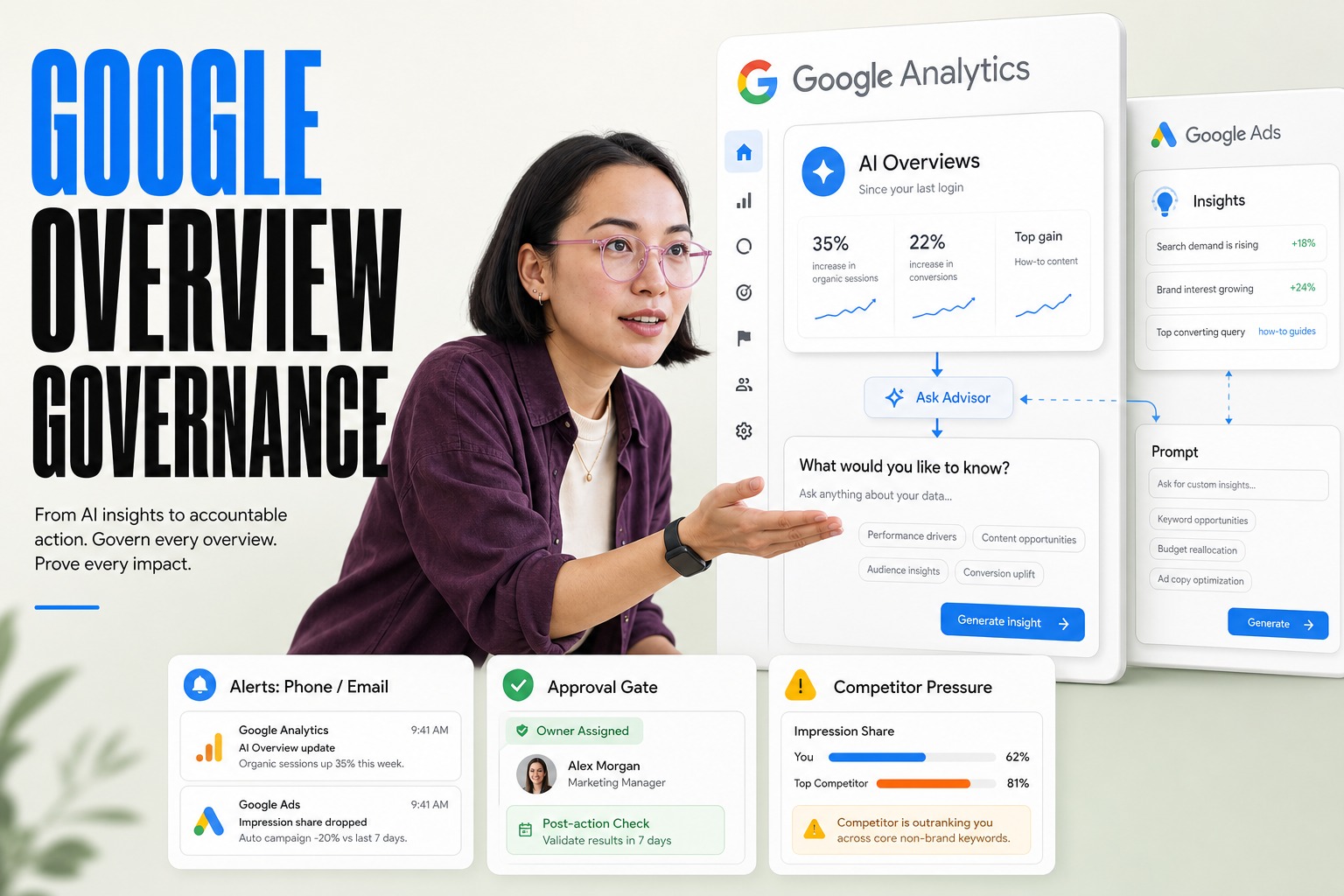
What changed this week inside Google Analytics and Google Ads? → Google Analytics now shows AI Overviews at the top of the homepage summarizing important updates since your last login, and Google Ads revamped its homepage with AI-powered personalized insights cards plus a prompt box for custom insights.
What is the real engineering question behind this? → How do we turn AI-generated homepage summaries and notifications into controlled, auditable decisions instead of reactive dashboard checking.
Should analyst teams trust these summaries to drive actions? → Use them as triage signals, not truth; the value comes from how you route them into investigation and change management.
What is the biggest risk if we adopt this fast? → We create a high-velocity insight stream with no governance, so strategy shifts happen without consistent context, ownership, or post-change validation.
What will this article help us decide this quarter? → Whether to operationalize Google’s new AI Overviews, Ask Advisor handoff, and Ads insights cards as the front door to performance response.
Quick Answer: Use AI Overviews as triage, not as your analytics brain
If your team is asking, how do we use Google Analytics AI Overviews and Google Ads AI insights cards in a production decision workflow, our answer at Plavno is: treat them as a high-signal inbox that accelerates detection, then force every recommended next step through your existing analysis and approval path. The win is speed with discipline, not automation without guardrails.
Central claim: Google’s shift to AI Overviews, Ask Advisor handoffs, and Ads insight cards moves the bottleneck from finding anomalies to governing actions, so teams should invest less in “better dashboards” and more in routing, ownership, and verification around every AI-surfaced signal.
The dominant signal is not smarter analytics, it is a new front door for decisions
Google Analytics now places AI Overviews at the top of its homepage to summarize important updates since the last login, and it adds optional notifications via phone or email at a frequency the user chooses. Google Ads, in parallel, is surfacing timely AI-powered insights cards on its homepage, personalized to the business, and letting you ask for a custom insight through a prompt box.
This matters because it changes the operational cadence. Instead of analysts pulling context from reports on a schedule, the tools push context when the tool decides it is important. In practice, push-style insight streams are only as good as the organization’s ability to triage, assign, and validate actions. If we do not design that loop intentionally, “more insight” becomes “more untracked change.”
- Treat the homepage as an inbox, not a dashboard: the Overviews and insight cards are a queue of potential incidents and opportunities that must be routed.
- Force explicit ownership per signal: every card must map to a person who can analyze further and decide, otherwise the alert becomes noise.
- Preserve the context that arrived with the card: the summary and the reason it surfaced must be kept intact when someone investigates.
- Require a post-action check: if strategy is adjusted, the team needs a defined moment to verify the change against the same performance area that triggered it.
The Ask Advisor click is a workflow primitive, not just a convenience
When a Google Analytics data card catches your eye, a single click carries that context into Ask Advisor to analyze further. That sounds like a UI detail, but for an engineering-minded analytics leader it is a new workflow primitive: context is being packaged, handed off, and expanded without requiring the analyst to rebuild the question manually.
The practical implication is that your team’s “question formation” step is being partially outsourced to the product. If we accept that, then our quality control must move to the handoff boundary. We should be asking whether the context that travels into Ask Advisor is sufficient for the decisions we make, and whether our internal documentation and approval flow can reference that same context consistently.
If context is preserved across the Overviews-to-Advisor handoff, the workflow speeds up; if context is lost, your team will make faster but less repeatable decisions.
Where teams accidentally lose context during “one click” analysis
Even with a seamless click into Ask Advisor, teams often lose the original trigger condition in their own communication layer. An analyst sees a summary, clicks into deeper analysis, then posts a paraphrase to stakeholders, and the paraphrase becomes the only durable record. In a mature operation, the original card and its phrasing are part of the incident record, because that is what lets you later explain why the team reacted, and whether the reaction matched the trigger.
Google Ads insight cards will speed up strategy changes, whether you are ready or not
Google Ads has revamped its homepage to surface timely AI-powered insights cards personalized to your business, and it explicitly frames them as context you can use to confidently adjust strategy and capture new demand the moment it appears. It also points users to questions like how competitors are impacting impression share or what trends could improve campaigns, and it offers a prompt box above the insight cards to generate a custom insight.
At Plavno, we read this as a shift toward “homepage-first operations” in advertising. The homepage becomes an operational console, not a report. If your team already has a disciplined campaign-change process, these cards can reduce time-to-awareness. If your process is informal, the prompt box will tempt people to generate an insight that feels actionable and skip the hard parts: checking assumptions, confirming causality, and documenting the rationale. This is where AI automation becomes less about bots and more about controlling the flow of decisions.
| Surface in Google products | Best used for in a real team | Common failure mode to design around |
|---|---|---|
| Google Analytics AI Overviews on the homepage | Triage of performance changes since last login | Treating a summary as a finalized diagnosis |
| Click-through into Ask Advisor | Structured deeper analysis starting from the surfaced context | Losing the original trigger when sharing internally |
| Google Ads AI-powered insights cards on the homepage | Spotting shifts that justify campaign strategy review | Changing bids/budgets based on a single card without verification |
| Ads prompt box for custom insight | Investigating a specific question that is top of mind | Prompt-driven fishing that creates conflicting narratives |
Competitor and impression share prompts change how attribution debates start
Google Ads explicitly invites you to ask how competitors are impacting impression share, which changes the social dynamics of campaign performance reviews. Instead of starting with a blank slate and pulling reports until a story emerges, the tool can seed a story and make it feel urgent. The engineering response is not to ban the question, but to require that any competitor-driven narrative results in a traceable investigation path and a clearly bounded decision, so you do not reshape strategy around an implied causal link.
- Clarify what a custom insight is allowed to do: in many teams it should inform investigation, not authorize a campaign change.
- Separate “question asked” from “decision made”: the prompt box can generate angles, but the decision must be justified independently.
- Standardize stakeholder language: if the homepage says impression share, your internal write-up should use the same term to avoid semantic drift.
- Preserve reversibility: any change influenced by a card should have a clear rollback path if the next cycle contradicts it.
The real break point is governance: who gets to act on AI-surfaced signals
The hardest part of adopting AI Overviews and Ads insight cards is not whether the AI is “right.” The hard part is that the tools lower the friction to noticing something and to feeling justified in acting. That means your organization needs an explicit answer to a simple question: when the homepage says something matters, who is authorized to change strategy, and under what conditions.
In most companies, analytics and advertising changes touch multiple constraints at once: budget, brand, compliance, and operational capacity. If you do not predefine a governance path, the cards become political ammunition rather than engineering input. The teams that win this quarter will not be the ones with the cleverest prompts, but the ones who convert AI-surfaced signals into consistent decisions.
| AI-surfaced signal | Operational owner (example) | What “done” looks like |
|---|---|---|
| Seasonal peaks in sales called out in a summary | Growth lead + analytics lead | Documented hypothesis and a bounded plan to respond |
| Change in traffic that appears since last login | Analytics on-call or equivalent | Root-cause investigation started with preserved context |
| Ads insight suggesting opportunity or risk | Campaign owner | Decision recorded with rationale and next validation point |
| Competitor/impression share concern | Paid media lead | Agreement on whether it requires action or monitoring |
Operationalizing phone and email notifications requires an incident mindset
Google Analytics now allows opting into notifications via phone or email at a frequency that suits you, which is a meaningful operational feature: it turns analytics into a push channel. Push channels are powerful, but they also require rate control, escalation paths, and expectations about response time, even if you do not call it “incident response.”
At Plavno, when we help teams operationalize this, we treat it like a lightweight incident pipeline: notifications arrive, someone triages them, deeper analysis happens in Ask Advisor or in the relevant Ads workflow, and only then do changes happen. If your organization does not have a reliable way to record what notifications were received and what decisions followed, you will not be able to learn from misses. This is where a software development consult often pays for itself: not by building more charts, but by building the operating mechanics around the charts.
Define what counts as an actionable update versus a watch-only update, using the same language your teams already use for priority.
Choose a single human role responsible for first-pass triage of notifications, even if that role rotates.
Require that any click into Ask Advisor produces a short internal note that preserves the original context of the card.
Gate any strategy adjustment behind a second look by the accountable owner for that domain, so the change is intentional.
Schedule a follow-up check that references the same performance area that triggered the original summary or insight card.
Seasonal peaks and traffic shifts are operational events, not just analytics trivia
Google Analytics calls out examples like seasonal peaks in sales and changes in traffic that you can quickly understand, along with guidance on what you should do about it. In many businesses, those are not abstract signals; they imply staffing changes, inventory decisions, support load, and campaign pacing. Treating them as operational events is the difference between “we saw it” and “we responded.”
The right response is to pre-author the kinds of actions you are willing to take when those categories appear. A seasonal peak might trigger a marketing push, but it might also trigger a temporary freeze on risky landing page changes. A traffic change might trigger a campaign review, but it might also trigger a tracking audit before anyone touches budgets.
Notification frequency is a product setting, but alert fatigue is an architecture problem
Google Analytics lets you opt into phone or email notifications at a frequency that suits you, which sounds personal, but it becomes an architecture problem the moment multiple stakeholders subscribe. If leadership, marketing, and analytics all receive the same push signals, you can end up with parallel reactions, duplicated investigations, and conflicting instructions to the team.
We recommend treating notification frequency as part of your operating design. The “best” frequency depends on how quickly your team can investigate and act without causing churn. If the organization cannot absorb the volume, you should centralize triage and keep most stakeholders on a slower informational cadence so the team maintains one coherent response path.
| Notification pattern | What it optimizes for | What it risks |
|---|---|---|
| Broad distribution to many recipients | Shared awareness | Multiple uncoordinated strategy changes |
| Centralized triage with limited recipients | Consistent decisions | Bottlenecks if ownership is unclear |
| High frequency for operators, low frequency for stakeholders | Fast response with stable messaging | Mismatch between what leaders see and what teams are doing |
| Phone-first urgency | Rapid attention | Reaction bias when the summary is ambiguous |
AI summaries amplify whatever your instrumentation is currently getting wrong
AI Overviews summarize important updates since the last login, but they can only summarize what the underlying measurement captured. If tracking is inconsistent, naming conventions are messy, or campaign tagging is brittle, the summary will still look confident while representing a distorted picture. That is not an AI problem; it is a data quality problem that the AI makes more visible.
The practical move is to treat every “surprising” Overview as a trigger to check instrumentation first, not last. When your team is tempted to adjust strategy immediately, pause and ask whether the system is measuring the thing you think it is measuring. If you do not do this, you will repeatedly chase phantoms that look like trends.
- Broken attribution hygiene: a traffic shift appears meaningful but is actually a tagging inconsistency across campaigns.
- Inconsistent event naming: a seasonal sales peak is real, but the supporting metrics fragment across multiple labels.
- Untracked site changes: the summary highlights a change, but the team cannot correlate it to releases or content updates.
- Segment drift: stakeholders interpret the same card differently because “traffic” is not scoped the same way across teams.
Visual reporting will raise the stakes for narrative consistency
The input signal also points to becoming a data expert with new visual reporting, which implies that more stakeholders will consume insights in a more polished form. Visual reporting reduces friction to sharing, but it also increases the risk that a screenshot becomes the truth. When Overviews and Ads insight cards seed the narrative, visual reporting can harden that narrative quickly.
Key rule: AI Overviews and insight cards should trigger a standardized investigation and decision record, otherwise your org will optimize for speed over correctness without realizing it.
Plavno’s perspective: build a decision loop around the cards, not around the model
At Plavno, we do not see Google’s AI Overviews, Ask Advisor, and Ads insight cards as “features to enable.” We see them as a new interface layer for decision-making that your systems and teams must integrate with. The tools are telling you what matters right now and nudging you toward what to do about it; your job is to decide how that nudging becomes accountable change.
In practice, this is where AI agents become useful, but not in a magical sense. A well-designed agent can preserve context, route work, and enforce governance while humans remain the decision-makers. If you are exploring that path, our work in AI agents development focuses on operational reliability: consistent handoffs, explicit approvals, and traceable outcomes, not just “smart responses.”
- Triage agent for analytics notifications: captures the Overview context, assigns an owner, and requires a short investigation note before closing.
- Campaign change gatekeeper: ensures that Ads insight-driven adjustments are reviewed by the accountable campaign owner.
- Context historian: stores the original phrasing of cards and the internal rationale so later audits are possible.
- Stakeholder messenger: produces a consistent summary for leadership that matches the investigated findings, not the first impression.
The business impact is time-to-action, not “better reporting”
Google positions these changes around understanding what matters right now, capturing new demand, and confidently adjusting strategy. That maps directly to a business outcome that leadership actually cares about: how quickly the organization can notice a shift and respond without causing thrash. The AI layer is reducing the time spent hunting for interesting changes, but the organization must still invest in making responses safe.
If you implement a disciplined decision loop, these surfaces can shrink the gap between signal and action while keeping strategy coherent. If you do not, they will simply increase the number of times the organization changes direction based on incomplete interpretation.
- Marketing operations: fewer missed demand moments because the homepage highlights what changed since the last login.
- Paid media efficiency: faster escalation when competitor pressure impacts impression share, without turning every dip into panic.
- Executive alignment: a single narrative about what changed, why it matters, and what action is being taken.
- Team capacity protection: fewer parallel investigations because routing and ownership are explicit.
The hidden KPI is reversibility of changes, not confidence of insights
The Ads homepage promises context to confidently adjust strategy, and that is attractive. But in real engineering operations, confidence is not the safety mechanism; reversibility is. If you cannot undo a change cleanly, you should treat insight-driven adjustments as high risk, even if the card feels persuasive. The maturity move is to design campaign and analytics processes so changes are bounded, documented, and easy to revert when follow-up signals contradict the first interpretation.
How to evaluate adoption this quarter without betting the business on a homepage
If you are deciding whether to lean into Google Analytics AI Overviews, Ask Advisor, and Ads insight cards right now, do not frame it as a tooling decision. Frame it as an operating model decision. Start by asking which categories of updates you are willing to treat as actionable, and which must remain informational until validated.
Then run a controlled pilot: a limited group subscribes to notifications, a small set of campaign owners agrees on how insight cards trigger review, and you record every action taken because of these surfaces. The test is not whether the cards are interesting. The test is whether your organization can stay coherent while moving faster.
What “good” looks like in operations after you turn this on
In a healthy rollout, the team can point to a consistent chain: an AI Overview or Ads insight card appeared, a responsible owner investigated via the offered deeper path such as Ask Advisor, and a decision was recorded with rationale. Later, when leadership asks what changed, you can answer without reconstructing the story from memory. That is when the new AI surfaces become leverage rather than noise.
- Ask for explicit ownership mapping: when a card appears, your org should already know who is responsible for that domain.
- Demand a durable record of the trigger: preserve the original context carried into deeper analysis so the narrative does not mutate.
- Require bounded actions: strategy adjustments should be scoped so they can be evaluated and reversed if needed.
- Align stakeholders on notification roles: not everyone needs the same frequency; most need outcomes, not raw signals.
Closing insight: the advantage goes to teams who can operationalize context
Google is making it easier to see what matters right now in Google Analytics and Google Ads, and to move from a surfaced card into deeper analysis through Ask Advisor or a custom prompt. The engineering advantage will go to teams who treat that as a context pipeline that must be governed, not as a shortcut to skip process. If you want help designing that operating loop, our AI consulting work focuses on shipping decision-ready analytics workflows that hold up under real organizational pressure.
Author: Plavno team. Last updated: August 2026.
 Chat GPT
 Perplexity
 Claude
 Gemini