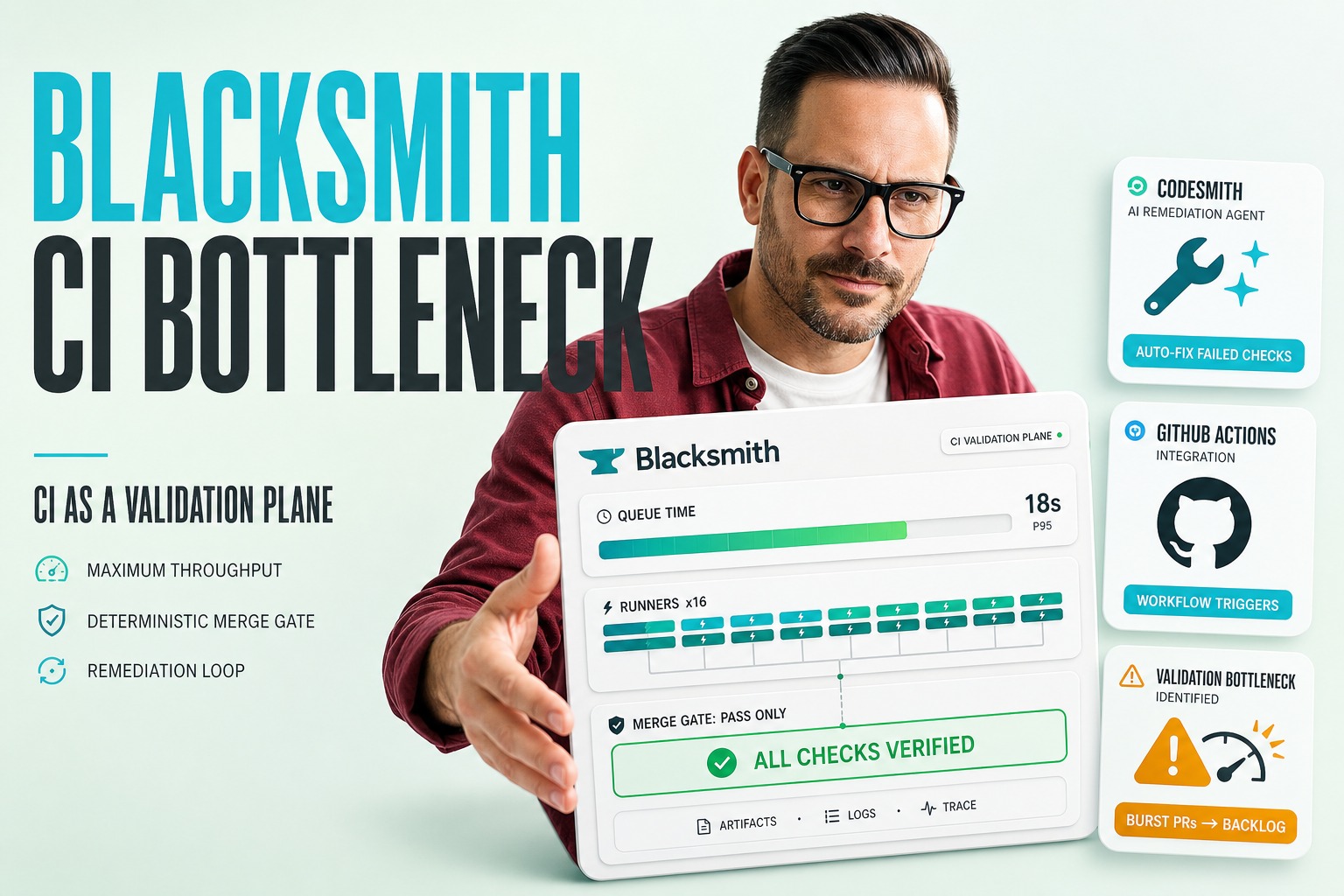
What changed in the market this week? → A CI-focused platform, Blacksmith, raised $45 million as AI coding tools increase code volume and push validation into the critical bottleneck.
What is the primary engineering question we should be searching for? → How do we scale testing and validation for AI-generated code without slowing delivery or letting low-quality changes reach production.
Why is this urgent for CTOs right now? → AI tools like Cursor, OpenAI Codex, and Anthropic Claude Code make it easier to generate code, but they do not make quality automatic; validation throughput becomes the gating factor.
Where will teams misdiagnose the problem? → By debating model quality or prompt patterns, while the real failure is overloaded CI capacity, slow feedback loops, and unclear ownership for fixing failed checks.
What’s the angle we take at Plavno? → Treat validation as a first-class production system with its own scaling strategy and remediation loop, not as a background pipeline you can keep ‘good enough.’
The new bottleneck is not writing code, it is proving code
AI coding tools have made it dramatically easier to generate code, and the market just signaled where the pressure moves next: validation. Blacksmith’s $45 million Series B at a $550 million valuation (up from a $60 million valuation when it raised a $10 million Series A less than a year ago) is not about another developer convenience layer; it is about CI becoming the throughput governor for modern teams. Our central claim is simple: AI accelerates output, but it breaks traditional CI assumptions, so the right response is to architect validation as an elastic, measurable system with explicit remediation ownership.
Quick Answer: how do we scale testing and validation for AI-generated code?
You scale testing and validation for AI-generated code by treating CI capacity, test selection, and failure remediation as a single system. In practice, that means you optimize for faster test feedback and controlled merge throughput, not for producing more code, because AI makes it easy to create more changes than your current validation path can reliably verify.
The most practical near-term strategy is to separate concerns: keep your deterministic checks (build, tests, linters, policy gates) authoritative, and then add automation that reduces the time-to-fix when checks fail. That is the business logic behind platforms like Blacksmith, which started as a cloud provider for CI workloads and later added an AI agent (Codesmith) that can automatically fix failed checks.
- Define what ‘validated’ means for your org: If your merge policy is ambiguous, AI will amplify inconsistency by producing more borderline changes.
- Increase validation throughput before you increase change throughput: If developers can generate more code than CI can test, you will ship slower and riskier.
- Shorten the failure loop, not just the pipeline: Faster tests matter, but so does how quickly a failed check gets corrected and re-verified.
- Design for a crowded tooling landscape: You will be choosing among GitHub Actions, hyperscaler services, AI tool ‘built-ins,’ and specialist CI platforms like Blacksmith.
The dominant signal: CI is becoming a product category again
Blacksmith’s growth narrative is a clean market tell: a platform that began as a cloud provider for CI workloads now serves more than 5,000 customers (up from more than 700 less than a year ago) and is expanding into a broader suite of coding tools. When a CI vendor can reach a $10 million annualized revenue run rate with 10 employees and later grow to about 30 while reporting revenue in the tens of millions of dollars, it suggests teams are buying validation capacity as a strategic lever, not as plumbing.
Map your current delivery constraint to one of three points: test runtime, CI scheduling/queueing, or fix-and-retest cycle time.
Decide whether your constraint is infrastructure (you need faster or more CI execution) or workflow (you need faster remediation and clearer ownership).
Align tool choice to the constraint: a CI execution platform, an AI remediation agent, or a combined approach.
Establish a merge gate that cannot be bypassed by AI-generated changes, even when an AI agent proposes a fix.
Why AI coding breaks ‘good enough’ CI economics
In the pre-AI workflow, most teams could tolerate a CI pipeline that was merely acceptable: a build step, a test suite, maybe some linting, and an occasional flaky failure. The reason was simple: human coding speed implicitly limited how many changes hit the pipeline. Tools like Cursor, OpenAI Codex, and Anthropic Claude Code remove that natural limiter, so validation becomes the bottleneck because people are writing even more, as Blacksmith’s CEO Aditya Jayaprakash put it.
This is the engineering change that matters this quarter: we can no longer treat CI as a cost center to minimize and ignore. CI becomes a throughput system, and throughput systems need explicit architecture. Blacksmith is competing on speed of testing and affordability, and its competitive set explicitly includes GitHub Actions, Cursor Automations, validation baked into Codex and Claude Code, other startups, and AI code-testing services offered by Amazon Web Services, Microsoft Azure, and Google Cloud. That list tells us procurement is not deciding between ‘CI or not CI’; it is deciding where validation lives in the stack and who owns the feedback loop. For teams modernizing that loop, our work often starts under AI automation services because the pipeline is as much operations as it is code quality.
The failure mode shifts from slow tests to slow decisions
When more code is produced, slow test execution is only half the problem; the other half is the decision latency around failures. A failed check can trigger a multi-hour cycle of triage, local reproduction, patching, and re-running. That cycle was tolerable when failures were infrequent; it becomes a constant drag when AI-assisted changes arrive continuously. The system you need is one that makes the path from failure to verified fix predictable and fast, without weakening the gate.
Speed of testing becomes a moat because it controls developer behavior
A faster CI system does not just save minutes; it changes what engineers attempt. When validation feedback is slow, developers batch changes and merge fewer times, which increases risk. When feedback is fast, developers merge smaller units of change and can rely on CI as a real-time safety net. Blacksmith’s stated competition on speed and affordability is essentially competition on developer behavior shaping: whoever controls feedback cadence controls how safely teams can ship AI-accelerated output.
| Validation approach in the market | What it optimizes for (as positioned) | Architectural implication for your stack |
|---|---|---|
| Specialist CI execution platform (for example, Blacksmith as a cloud provider for CI workloads) | Speed of running builds and tests, plus affordability | Treat CI as an external execution layer you scale like infrastructure, with explicit cost and queue management |
| General CI inside a developer platform (for example, GitHub Actions) | Broad integration and workflow convenience | You often optimize for ecosystem fit, then engineer around performance limits with caching, parallelism, or split pipelines |
| AI coding tools with validation capabilities (for example, Codex and Claude Code with baked-in validation, or Cursor Automations) | Tight loop between generation and checking | Validation becomes part of the coding surface, but merge governance still needs independent, deterministic gates |
| Hyperscaler testing services (AWS, Azure, Google Cloud) | Portfolio breadth and enterprise procurement alignment | You may gain platform consistency, but must design portability and control cost visibility across teams |
Codesmith-style remediation changes who owns a failing pipeline
Blacksmith broadened its platform with Codesmith, an AI coding agent that can automatically fix failed code checks. That is the second important shift after ‘CI must scale’: remediation can be automated, which changes how teams staff and govern quality. In a conventional setup, a failing check is a developer interruption and an engineering manager headache. In an agent-assisted setup, a failing check becomes a queued task that can be proposed, patched, and re-validated with less human time.
The trade-off is not whether automation can patch a failure; it is whether your organization can accept automated change proposals without weakening standards. The correct posture is to let AI reduce the time-to-fix while keeping the same definition of ‘pass.’ In production terms, that means deterministic validation remains the source of truth, and AI-generated fixes remain hypotheses that must be re-verified through the same CI gate. If you do not enforce that separation, your remediation tool becomes a silent bypass.
The strongest pattern is ‘agent proposes, CI disposes’
An AI agent that fixes failed checks is most valuable when it lives downstream of the same checks you already trust. The moment you allow the agent to redefine the check or waive a failure, you are no longer accelerating validation; you are eroding it. In practice, the healthiest architecture keeps the agent outside the policy boundary: it can draft changes, but only the deterministic pipeline decides what merges.
The architecture you actually need: a validation plane, not a pipeline
Most teams describe CI as a pipeline, but AI pushes us toward thinking in planes: a validation plane that continuously evaluates changes, regardless of how they were authored. Blacksmith started as a cloud provider for CI workloads, which fits this mental model: CI execution is a scalable substrate. When you adopt that view, you start designing interfaces: how code enters validation, how results are surfaced, and how fixes are proposed and re-verified.
To make this real, we typically define a stable contract around the CI system: the codebase triggers builds and tests, the system reports outcomes, and merges are blocked unless criteria are met. Everything else becomes optional optimization. This is also where cloud architecture matters. Whether CI compute is in-house, in a specialist platform, or via a hyperscaler, you need predictable isolation, clear access control to secrets, and traceable artifacts. When teams approach this as a cloud system rather than a scripting repository, our work often overlaps with cloud software development because CI reliability becomes an operational property, not just a repo setting.
- Build throughput collapses under bursty change: AI-assisted coding can create spikes in pull requests that a fixed-size runner pool cannot absorb.
- Signal quality gets diluted by repeated failures: If checks fail frequently and resolution is slow, developers start ignoring CI output.
- Ownership becomes fuzzy: When failures are constant, teams waste time deciding whether it is test flakiness, infra issues, or bad changes.
- Merge policy becomes negotiable: Under pressure, teams are tempted to bypass gates, which is how low-quality AI-generated changes reach production.
Affordability is not procurement, it is a scheduling decision
Blacksmith explicitly positions itself against a crowded market on speed and affordability. Engineering leaders often treat affordability as a pricing discussion, but in CI it is mostly a scheduling and utilization problem. If your CI system queues work poorly, you pay twice: you pay for wasted developer time while waiting, and you pay for compute that is either over-provisioned for peaks or under-provisioned and constantly backlogged.
This is why the ‘CI as a product’ shift matters: teams will increasingly choose platforms based on how they manage execution at scale, not just on whether they can run tests. Blacksmith’s trajectory, from CI cloud provider to adding an AI remediation agent, is consistent with a market that wants both better utilization and faster recovery from failures. When we evaluate CI systems for clients, we treat the queue, artifact handling, and failure feedback loop as first-class architecture, because that is where the hidden cost accumulates.
The crowded market is a feature, not a bug, if you design clean boundaries
Because the competitive set spans GitHub Actions, hyperscalers, AI tool validation, and specialists, you should assume parts will change. The long-lived asset is not the vendor; it is the boundary you define around validation. When your merge policy, artifact expectations, and reporting formats are stable, you can swap execution backends or add remediation tools without reworking engineering governance.
Where built-in validation in AI coding tools will disappoint you
Validation capabilities baked into Codex and Claude Code, and automations in tools like Cursor, can tighten the loop between generation and checking, but they do not replace a shared, authoritative merge gate. The reason is organizational: individual developers can run checks locally or in-tool, but the business needs a consistent definition of done across the team. A CTO cannot audit quality based on what each engineer happened to run.
The practical stance is to treat in-tool validation as a convenience layer for early feedback, and CI as the contractual layer for merge. That stance aligns with Blacksmith’s observation that validation is still a bottleneck and becomes even bigger as more code is produced. We can welcome more local checking, but we should not confuse it with production-grade validation governance.
Allow AI tools to generate code and run lightweight checks early, but treat results as advisory.
Require every change to pass the same centralized CI checks before merging, regardless of author.
If an AI agent proposes a fix to a failed check, route it through the same review and CI cycle as any other change.
Keep the merge decision in a single place so quality is auditable across teams and time.
The right response is to build a closed-loop validation system
Blacksmith’s platform evolution hints at the winning pattern: closed-loop validation. First you run builds and tests at scale; then you shrink the time between failure and a verified fix. Codesmith exists because many organizations do not just need more compute; they need fewer human minutes per failure. That is what changes engineering practice: CI is no longer just execution, it is execution plus remediation flow.
In closed-loop systems, the hard part is control. You need deterministic checks to remain the source of truth, and you need change provenance to remain clear when an agent participates. That governance requirement is why many teams will not rely solely on validation baked into AI coding tools; they need a platform boundary they can reason about. At Plavno, when we implement agentic workflows, we do it under a separate engineering discipline than chatbots or UI assistants because the blast radius is different. The work aligns closely with AI agents development when the agent is directly influencing what reaches production.
If AI makes it easy to produce changes, then validation becomes your production safety system, and safety systems must be engineered for throughput, not treated as background automation.
Plavno’s position: most teams should optimize the fix loop before switching models
We see teams spending cycles debating which AI coding tool produces cleaner output, but the market signal is that quality will be defended in validation, not generation. Blacksmith’s customer growth and its move into an agent that fixes failed checks make the point: as long as validation is slow, even good code will ship slowly, and bad code will slip through under pressure.
The fastest way to improve AI-assisted delivery is to make failures cheap: cheap to detect, cheap to understand, and cheap to correct, without relaxing the gate.
How to evaluate a CI and validation platform this quarter without getting trapped
Blacksmith is operating in a crowded market by its own description, which is exactly why evaluation has to be architecture-led. When platforms compete on speed of testing and affordability, your evaluation should focus on what you can observe and control: how fast you get a trustworthy signal, how predictable the system is under load, and how easy it is to integrate with your merge governance.
We recommend a decision process that starts from your delivery graph, not from vendor demos. If you have many repos, many teams, and frequent changes, you will care about standardization and consistent gates. If you have a smaller team but high urgency, you will care about shortening the failure-to-fix cycle and reducing cognitive load. Blacksmith’s own roadmap intent to expand into a broader suite of coding tools suggests vendors will try to own more of the developer lifecycle; you should decide how much lifecycle ownership you want to outsource versus keep in-house. When clients want a neutral assessment across this tool landscape, we typically anchor it in AI consulting because it is a cross-cutting decision touching engineering, security, and finance.
Real-world adoption looks like Mercury and Supabase buying throughput, not hype
Blacksmith reports customers including Mercury, Supabase, Clerk, Ashby, and Expensify. We should not assume anything about how each customer uses the platform, but the meta-pattern is clear: fast-growing product companies tend to buy leverage where it unblocks shipping. In 2026 realities, the unblocker is increasingly validation capacity, not code generation capacity.
A validation platform is most valuable when it reduces uncertainty: it should make the ‘can we merge’ answer fast and boring, even when code is produced quickly.
Risks that grow with agent-assisted fixes and outsourced validation execution
The upside of agentic remediation is obvious: fewer human minutes spent on broken checks. The risk is equally obvious: if the agent is treated as authoritative, mistakes can flow downstream faster. Codesmith is described as an AI coding agent that can automatically fix failed code checks; that capability should be treated like a high-privilege automation component, not like an autocomplete feature.
There is also an ecosystem risk. Blacksmith is competing with GitHub Actions, Cursor Automations, built-in validation in Codex and Claude Code, numerous startups, and AI code-testing services offered by AWS, Azure, and Google Cloud. This means vendor churn is likely, and feature overlap will increase. Teams must design validation boundaries to avoid lock-in and to preserve auditability of what ran, where, and with which inputs. If your compliance posture depends on traceable build artifacts and secure secret handling, you should evaluate CI execution like any other externalized workload, which often intersects with cybersecurity and penetration testing in regulated organizations.
The decision logic we use: buy speed, keep policy, measure flow
When we advise CTOs, we do not start by asking which vendor is best; we start by asking which constraint is most expensive: slow feedback, slow remediation, or unreliable results. Blacksmith’s narrative makes a strong case that many teams are now paying for speed and affordability in test execution, and then adding an agent layer to reduce time-to-fix.
If you cannot explain who owns a failing check and how it gets resolved, you do not have a validation system, you have a queue.
Why staffing and operating model matters as much as the tool choice
Blacksmith reached a $10 million annualized revenue run rate with 10 employees and later grew its workforce to about 30 while reporting revenue in the tens of millions. For CTOs, this is a reminder that validation leverage can be operationalized: a small team can deliver disproportionate CI value if the platform scales and the workflows are right. The mirror image is also true: a large engineering org can waste enormous time if validation ownership is diffuse.
This is where your operating model becomes part of the technical architecture. If you rely on internal platform engineering to own CI, you need enough specialization to treat it as production infrastructure. If you buy a platform and integrate it, you still need someone to own policy, governance, and incident response when validation blocks releases. In many US teams, the fastest way to bridge that gap is a flexible staffing model: a dedicated platform squad for a quarter to re-architect validation, then a smaller steady-state owner team. Depending on the situation, we implement that via outstaffing so the client retains day-to-day control while scaling the exact roles needed.
When to stay with GitHub Actions versus adding a specialist platform
If your biggest pain is integration friction, staying with a general platform like GitHub Actions can be rational, because it is already embedded in developer workflows. If your biggest pain is throughput and the queue is the bottleneck, a specialist CI execution platform is often worth evaluating, because the vendor’s product focus is explicitly on running builds and tests faster and more affordably. Blacksmith’s origin as a cloud provider for CI workloads is a direct response to that pain.
The business impact shows up as avoided delay and reduced rework, not ‘AI ROI’
Blacksmith’s customers include companies where engineering speed is existential, and the company notes that some of its largest customers now spend more than $1 million a year on the platform. We should read that as an indicator that validation spend can reach material levels when it buys back release capacity. The internal business case is rarely about saving pennies on CI minutes; it is about preventing expensive release delays and preventing production incidents caused by unverified changes.
For leadership, the most important reframing is that validation is a revenue enabler when it shortens cycle time safely. AI coding makes more output possible, but output without verification increases rework and raises operational risk. A robust validation plane reduces that rework by catching issues earlier and by tightening the fix loop, especially when automation can propose repairs for failed checks. Your finance team will still want cost visibility and predictability, but the strategic metric is flow: how reliably the organization can move from change to verified merge.
A pragmatic next step: treat validation like a product you ship internally
If we had to reduce this to one action for this quarter, it is this: assign a single owner for validation throughput and give them the mandate to redesign the system end-to-end, including execution capacity, failure handling, and merge governance. The market is telling us that validation is now the bottleneck, and platforms like Blacksmith are being funded and adopted because they attack that bottleneck directly.
At Plavno, we help teams design validation planes that integrate with existing repos and AI coding workflows without weakening gates, and we do it with the same rigor we apply to any production system. Author: Plavno team. Last updated: August 2026.
 Chat GPT
 Perplexity
 Claude
 Gemini