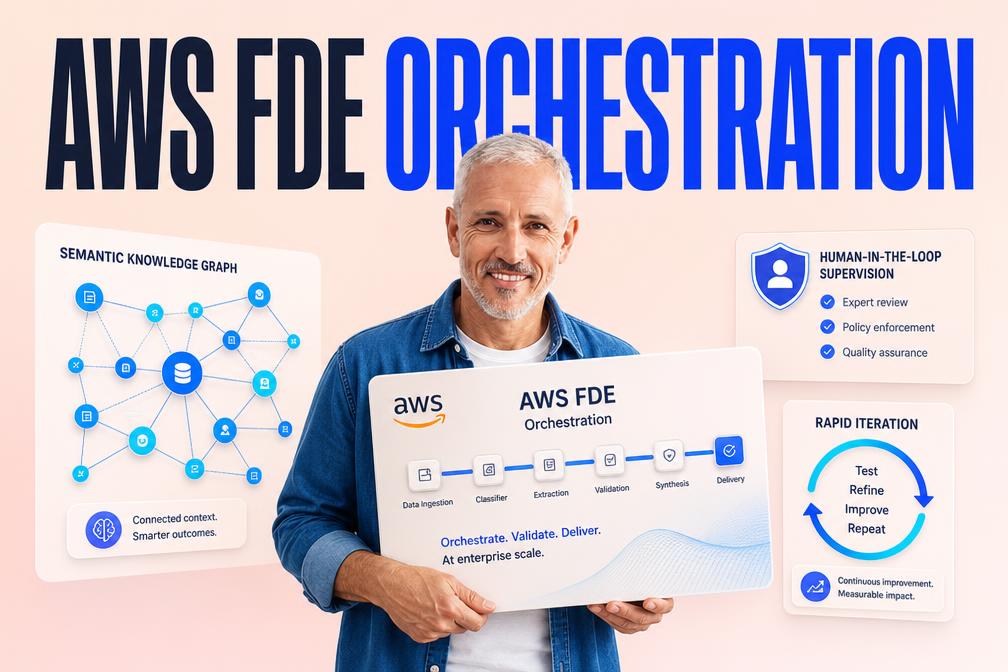
What is AWS Forward Deployed Engineering (FDE)? → A new AWS division that embeds top‑tier AI engineers directly into client teams to build production‑ready AI systems in days instead of months.
How does FDE differ from traditional consulting? → Instead of delivering recommendations, FDE engineers co‑develop code, deploy AI agents, and hand over a self‑sufficient stack.
Which customers are already using FDE? → The Allen Institute, Cox Automotive, the NBA, the NFL, Ricoh, and Southwest Airlines.
What is the headline claim of this article? → Embedding AI specialists via AWS FDE shifts the bottleneck from model selection to integration orchestration, so enterprises must prioritize orchestration frameworks and governance over raw model performance.
Quick Answer: AWS FDE Cuts AI Deployment Time to Days by Making Orchestration the Critical Success Factor
AWS Forward Deployed Engineering replaces the multi‑month, hand‑off consulting cycle with a hands‑on team that installs purpose‑built AI agents, a semantic knowledge layer, and a governed deployment pipeline directly inside the customer’s cloud. The result is a dramatic reduction in schedule—months become days—because the real delay moves from training a model to wiring the model into secure, compliant orchestration. Enterprises that ignore orchestration governance will still face long‑running delays, even with the fastest models.
The real speed gain comes from moving the integration bottleneck, not from faster GPUs.
How the FDE Model Rewrites the AI Project Timeline
In the traditional consulting model, a vendor delivers a design, the client builds a prototype, and then a lengthy hand‑off follows security reviews, compliance checks, and scaling work. AWS FDE collapses this loop by stationing engineers who simultaneously write code, configure AI agents, and embed a semantic knowledge graph inside the client’s environment. By the time the first day ends, the core AI logic is already running against live data, and the hand‑off is reduced to a brief knowledge transfer.
- Human‑in‑the‑loop supervision – senior AWS engineers monitor AI agents to catch mis‑behaviors early.
- Semantic layer deployment – a versioned knowledge graph lives inside the customer’s VPC, keeping data governance intact.
- Rapid iteration cycles – code, test, and deploy happen in a single day rather than weeks of back‑and‑forth.
- Partner ecosystem scaling – AWS injects trained partners to extend capacity without diluting expertise.
The Architecture That Makes Days Possible (M)
The FDE architecture pivots on three pillars: an AI‑driven development lifecycle, a localized semantic layer, and a secure orchestration framework. First, AI agents generate boilerplate code, configuration files, and even unit tests, while engineers review each artifact. Second, the semantic layer abstracts enterprise data into a governed graph, ensuring that AI reasoning never leaves the client’s controlled environment. Third, a container‑based orchestration platform enforces policy, audit, and compliance at every deployment step, turning what used to be a months‑long security review into an automated checkpoint.
Second, because the AI agents operate under strict supervision, the risk of uncontrolled model drift is mitigated. The orchestration platform logs every decision, ties it to versioned data schemas, and can roll back changes instantly. This tight loop replaces the traditional “design‑hand‑off‑implement” cadence with a continuous, observable pipeline that scales across teams.
Why Orchestration, Not Model Choice, Becomes the New Bottleneck
When the model itself is no longer the limiting factor—thanks to pretrained, high‑performing foundations—the time spent wiring that model into existing services, data stores, and security policies dominates the schedule. Orchestration must therefore handle data lineage, access controls, and latency guarantees in a way that models alone cannot. Engineers who focus on selecting the biggest model without building a robust orchestration layer will still see projects stall at integration.
The Role of Human‑Supervised AI Agents in Production Code Generation
AWS FDE’s AI agents are not autonomous coders; they are tools that draft scaffolding, suggest API contracts, and generate test suites. Human engineers validate each output, ensuring that the generated code respects the client’s security posture and compliance mandates. This collaborative loop dramatically reduces the manual effort of writing boilerplate while preserving the governance needed for regulated industries.
| Phase | Traditional Consulting | AWS FDE Approach |
|---|---|---|
| Planning | Weeks of stakeholder meetings | One‑day joint sprint |
| Coding | Separate vendor team, hand‑off delays | Co‑development with AI agents |
| Security Review | Multi‑stage audits over weeks | Automated policy checkpoints |
Why the Semantic Knowledge Layer Is a Game‑Changer (M)
The semantic layer acts as a versioned, governed knowledge graph that lives inside the customer’s own cloud account. By pulling enterprise data into a graph structure, the AI agents can reason over up‑to‑date information without ever exposing raw datasets to external contractors. This design satisfies stringent data residency requirements for sectors like finance, healthcare, and government, while still enabling rapid AI‑driven insights.
Moreover, because the graph is versioned, any change to data schemas triggers an automatic regeneration of dependent code. This eliminates the classic “schema drift” problem that often forces teams back into lengthy redesign cycles. The result is a self‑healing pipeline where the AI agents adapt to data evolution without human intervention beyond policy approval.
How Enterprises Should Re‑Architect Their AI Delivery Stack
The first step is to audit existing orchestration tooling—Kubernetes, Airflow, or proprietary pipelines—and map it against the security and compliance requirements of the target industry. Next, embed a semantic knowledge graph that mirrors the current data landscape, and expose it through controlled APIs. Finally, adopt AI‑assisted code generation as a complement to, not a replacement for, human engineers, ensuring every artifact is reviewed before promotion.
The Decision Logic for Choosing FDE Over Traditional Consulting
When evaluating whether to engage AWS FDE, senior engineers should weigh three factors: the criticality of time‑to‑market, the regulatory strictness of the domain, and the maturity of internal orchestration capabilities. If a project demands rapid deployment under heavy compliance constraints, the FDE model offers a clear advantage. Conversely, if an organization already has a mature CI/CD pipeline and low compliance overhead, the incremental benefit may be smaller.
Plavno’s Perspective on the FDE Shift
At Plavno, we see the AWS FDE move as a signal that integration expertise will dominate AI talent markets. Our own AI‑agents development practice already emphasizes orchestration, governance, and secure deployment. By aligning with the FDE philosophy, we can augment client teams with the same hands‑on expertise, delivering end‑to‑end solutions that respect data sovereignty while accelerating delivery.
- Talent focus – hire engineers skilled in orchestration, not just model tuning.
- Toolchain alignment – adopt container‑native pipelines that mirror AWS best practices.
- Governance first – embed policy checks early in the AI‑driven lifecycle.
- Partner leverage – work with AWS‑trained partners to scale capacity quickly.
Business Impact of Cutting Deployment Time to Days
When a multi‑month AI project collapses to a few days, the financial upside is immediate: reduced labor costs, faster revenue generation, and lower opportunity cost for missed market windows. Companies like Southwest Airlines and the NBA have already reported accelerated feature roll‑outs, allowing them to respond to customer demand in near real‑time. The strategic advantage is not just speed, but the ability to iterate continuously without the overhead of lengthy governance cycles.
Cost reduction – fewer consulting hours translate directly into lower project budgets.
Revenue acceleration – new AI‑enabled products reach customers weeks earlier.
Risk mitigation – automated compliance checks lower audit failure risk.
Competitive differentiation – rapid AI adoption signals market leadership.
Talent retention – engineers work on cutting‑edge integration rather than repetitive hand‑offs.
How to Evaluate FDE for Your Organization (S)
Start by mapping your current AI delivery timeline against the three‑month benchmark typical of traditional consulting. If your cycle exceeds that, run a pilot where an AWS FDE team co‑locates with your engineers for a single high‑impact use case. Measure the reduction in hand‑off time, the number of compliance checkpoints automated, and the overall cost per delivered feature. Use those metrics to decide whether a broader engagement makes sense.
Real‑World Applications That Already Benefit
The NBA’s AI‑driven analytics platform now updates player performance dashboards in near real‑time, thanks to an FDE‑installed semantic layer that ingests game data instantly. Southwest Airlines uses the same approach to predict flight delays, integrating AI agents with their existing scheduling system and cutting the model deployment window from weeks to hours. In each case, the decisive factor was the ability to orchestrate data flows securely, not the raw power of the underlying model.
The secret sauce is a secure, versioned knowledge graph that lets AI agents work without ever leaving the client’s cloud.
Risks and Limitations of the FDE Model (S)
While the FDE approach accelerates delivery, it also concentrates expertise in a small team of AWS engineers, creating a dependency risk if the engagement ends. Additionally, organizations that lack mature internal security practices may struggle to adopt the semantic layer without substantial re‑architecting. Finally, the model assumes that AI agents can generate correct code; any systematic bias in the agents could propagate quickly if not caught by human reviewers.
Closing Insight: Prioritize Orchestration Over Model Size
The AWS Forward Deployed Engineering initiative proves that the biggest gains in AI projects come from shrinking integration friction, not from training ever larger models. Enterprises that invest in robust orchestration frameworks, secure semantic layers, and human‑in‑the‑loop governance will capture the full value of rapid AI deployment, while those that chase model performance alone will continue to be held back by integration bottlenecks.
Take the Next Step with Plavno
If you’re ready to re‑architect your AI delivery stack for day‑scale deployments, our AI agents development service can embed the same expertise that powers AWS FDE into your organization. We help you build secure semantic layers, automate compliance checkpoints, and train your engineers to manage AI‑driven orchestration at scale. Let’s turn integration from a bottleneck into a competitive advantage.
 Chat GPT
 Perplexity
 Claude
 Gemini