What’s the dominant signal in this week’s AI adoption news? → A state government is deploying a sovereign AI workspace across departments as a day-to-day tool, not a small pilot.
What’s the primary search question engineers are really asking? → How do we deploy a sovereign AI workspace for regulated users while keeping sensitive data in-country and auditable?
Why does this matter right now for US CTOs and platform teams? → The winning pattern is shifting from ‘buy a chatbot’ to ‘operate an inspected, policy-driven AI workbench’ that touches documents, identity, and records.
What’s the non-obvious engineering risk? → Failures show up at data boundaries (permissions, ingestion, auditability), not inside the language model.
What should we do differently because of this? → Treat sovereignty as an architectural requirement: design for inspection, constrain retrieval, and integrate identity and workflows before scaling to thousands of daily users.
A sovereign AI workspace rollout across government departments changes the default architecture
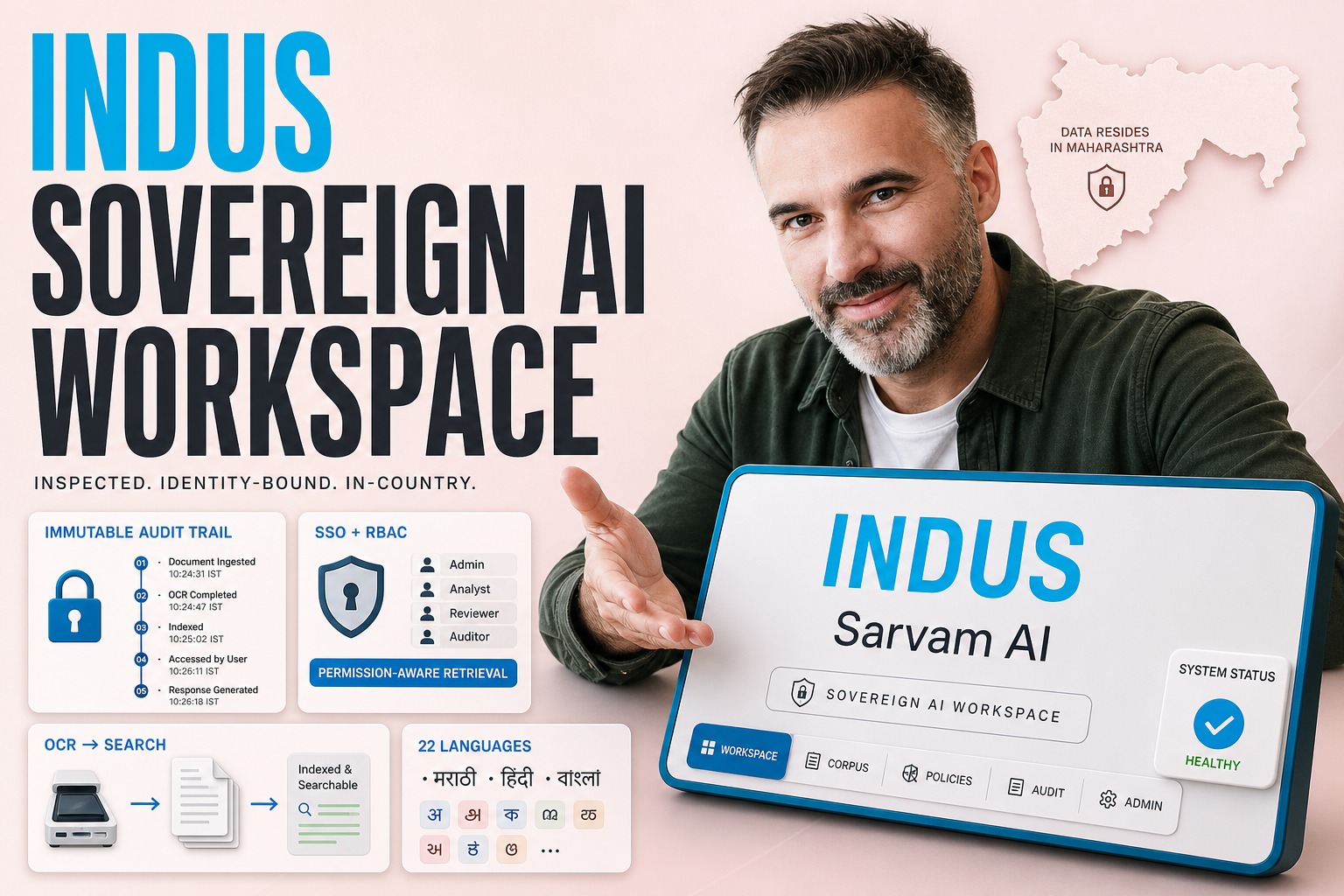
The core signal is not that another assistant can draft and summarize. The signal is that the Government of Maharashtra approved deploying Indus, Sarvam AI’s sovereign AI workspace, across state departments with around 2,500 officials using it in daily work. That combination of scale, daily usage, and cross-department scope forces a different design center than a single-team proof-of-concept.
When a platform is positioned as sovereign, runs on secure, audited infrastructure located entirely within a country, and can be inspected by the state, the engineering conversation moves from prompt quality to systems design. You’re no longer ‘trying AI.’ You’re operating a controlled workspace that touches policy research, drafting, translation, summarization, data analysis, and scanning records into searchable text, and you have to prove where the data went.
Quick Answer: how do you deploy a sovereign AI workspace without leaking regulated data?
A sovereign AI workspace is deployable when sovereignty is treated as an end-to-end handling contract, not a vendor label. In practice, that means the workspace must run on infrastructure within the required borders, produce auditable evidence of access and processing, and integrate with your identity and document permissions so the model never sees what the user cannot see. If you cannot inspect the system’s behavior, you cannot safely scale it.
The Maharashtra rollout also implies a crucial sequencing lesson: start with high-frequency administrative tasks (research, drafting, translation, summarization, OCR into searchable text) and only then expand the program into higher-stakes modalities like voice agents for citizen outreach and speech technologies. Voice will amplify both value and failure modes, so your governance, audit logs, and data lifecycle controls need to be real before you add a microphone.
Central claim: ‘sovereign AI’ breaks at governance and data boundaries, so the right response is an inspected workspace architecture
Our central claim is straightforward and arguable: deploying sovereign AI at organizational scale fails far more often at orchestration boundaries than inside the model, which means the right response is to architect an auditable, identity-bound, policy-enforced AI workspace rather than optimize prompts or chase model swaps. The Maharashtra decision to deploy a sovereign workspace across departments makes that boundary-work unavoidable.
For a CTO, this changes the immediate decision this quarter. You’re not selecting a single model feature set; you’re selecting an operational posture: audited infrastructure, inspectable controls, multilingual handling, OCR ingestion, and a workflow surface where officials draft and decide. If you try to bolt sovereignty onto a generic assistant later, you’ll end up with shadow usage, incomplete logs, and permissions drift.
Why ‘secure, audited, in-country’ becomes an engineering specification, not compliance wallpaper
The phrase secure, audited infrastructure located entirely within a country implies design choices in networking, identity, and observability that you can test. In practice, teams typically need a dedicated cloud region or on-prem footprint, strict network egress controls, centralized identity (SSO with RBAC), and tamper-resistant audit logs that can be reviewed by auditors and security teams. The trade-off is operational overhead, but the payoff is predictable data residency and inspectability.
What a sovereign AI workspace really is: a controlled workbench for documents, not a chat window
A sovereign AI workspace earns its name when it behaves like a workbench where regulated users can research policies and precedents, prepare first drafts, translate and summarize long documents, analyze datasets for patterns, and convert scanned records into searchable text. Those are not ‘chat features’; they are workflows that touch document stores, scanning pipelines, and data tables, with security consequences.
In production, this usually means you are building (or buying) a front-end interface plus a workflow layer that mediates access to enterprise data sources. Even if the underlying model is excellent, the system’s credibility comes from how it retrieves documents, how it records actions, and how it respects permissions. The trade-off is that you must invest in integration work: connectors to document repositories, structured logging, and policy enforcement across calls.
The Maharashtra rollout highlights another operational reality: multilingual support across 22 languages, including Marathi, makes the workspace a language-handling platform, not a monolingual assistant. That shifts engineering effort toward encoding normalization, language identification, translation quality gating, and consistent searchability across scripts. The model matters, but the pipeline determines whether officials trust and adopt it.
Multilingual support is a data pipeline problem, not a UI feature
When a workspace supports 22 languages, the hard parts tend to show up in ingestion and retrieval: normalizing text, handling mixed-language documents, indexing in a way that preserves meaning across scripts, and ensuring that summaries and translations can be traced back to source documents. Teams typically lean on mature OCR and translation stacks, but sovereignty constraints mean you have to run them within your own boundary and log their outputs for later inspection. The trade-off is slower iteration, but higher institutional trust.
- Research on policies and precedents: This forces a retrieval layer that can cite source documents from controlled repositories rather than open web content.
- First drafts of notes and replies: This pushes you into workflow integration where drafts must be stored, reviewed, and attributed like any other official correspondence.
- Translation and summarization of lengthy scheme documents: This requires consistent document chunking, version control, and a way to show what text was summarized.
- Data analysis for patterns and exceptions: This demands safe access paths to datasets and guardrails so analysis doesn’t become data exfiltration.
- Converting scanned records into searchable text: This requires OCR pipelines, retention rules, and search indexing that respects permissions.
The first production failures happen in ingestion, permissions, and logging, not in ‘hallucinations’
In real deployments, teams often blame the model when users complain about wrong or missing answers. But at sovereign scale, the most common root cause is broken data plumbing: incomplete ingestion of policy documents, stale indexes, OCR errors that distort meaning, and permissions mismatches between the source repository and the AI workspace. Those issues look like model failures to end users, but they are orchestration failures.
A sovereign workspace also amplifies the cost of ambiguity in auditability. If an official uses the platform to draft a reply to a citizen request, you need to know what sources were used and whether the user was authorized to access them. That requires an event trail across the workflow layer, retrieval layer, and document access layer, with consistent identifiers. The trade-off is that you must treat audit logging as first-class infrastructure, not a later add-on.
OCR and scanned-record conversion is a perfect example of where ‘helpful automation’ becomes a governance project. As soon as scanned records become searchable text, they become more accessible, more linkable, and easier to copy. The architecture must decide where the text is stored, how it’s indexed, and who can search it, and it must do so within the sovereign boundary promised.
OCR-to-searchable-text changes your threat model
When scanned records are converted into searchable text, you increase discoverability, which is the point, but you also increase blast radius if permissions or retention are wrong. In practice, teams need a controlled OCR pipeline, clear storage boundaries, and an indexing strategy that enforces access control at query time, not just at ingestion time. The trade-off is complexity: secure search is harder than secure storage, and sovereignty makes outsourcing that complexity less acceptable.
‘Systems can be inspected’ implies reproducibility, change control, and a paper trail for every answer
Sarvam AI’s statement that Indus runs on secure, audited infrastructure within India and that systems can be inspected by the state is more than a hosting decision. Inspectability implies that an external reviewer can understand how the system is configured and how data is processed, including what changed between last week and this week. In engineering terms, you need configuration management, model and prompt versioning, and controlled releases.
This is where many enterprise AI efforts quietly fail: the team ships an assistant quickly, but cannot later reconstruct why a specific output was produced for a specific user. For regulated work, ‘we don’t know’ is not acceptable. The trade-off is that teams must invest in observability that spans the entire workflow and retrieval path, not just latency dashboards.
| Deployment choice | What it optimizes for | What breaks under scrutiny |
|---|---|---|
| Black-box AI assistant SaaS | Fast rollout and broad features | Data residency ambiguity and limited inspectability |
| Sovereign AI workspace on audited in-country infrastructure | Data control and auditability | Higher integration and operations burden |
| Department-only pilot without cross-department rollout | Low initial risk | Hidden scaling issues in identity, permissions, and document governance |
If you can’t answer ‘who accessed what data, through which workflow, on which infrastructure boundary’ you do not have sovereign AI in production—you have a chat interface with an unresolved risk ledger.
Scaling past a pilot is mostly identity and workflow integration, not model tuning
The Maharashtra deployment is explicitly described as happening at the level of the wider state administration rather than as a limited pilot in a single department. That is the step where architecture choices stop being theoretical. Cross-department rollout forces you to reconcile identity domains, role definitions, and document entitlements across organizational boundaries.
In practice, this is where SSO integration, RBAC, and consistent group management become the ‘AI project.’ If an official can draft a note, translate a policy, or search scanned records, the system must reliably map their identity to what they are allowed to see and do. The trade-off is that identity integration takes time and can feel unrelated to AI, but skipping it is how you end up with either over-restricted systems nobody uses or over-broad access you can’t defend.
Why 2,500 daily users shifts reliability requirements
Around 2,500 officials using a workspace daily changes your operational assumptions. You have to plan for sustained concurrency, predictable capacity, and graceful degradation when upstream systems are slow, because the assistant is embedded in routine administration. Teams typically add rate limiting, request queuing, caching for repeated policy retrieval, and structured incident response. The trade-off is that you must operate the AI workspace like a tier-one internal product, not a demo.
A practical reference architecture we recommend for sovereign AI workspaces
At Plavno, when we design a sovereign AI workspace, we start from boundaries: the sovereign infrastructure boundary, the identity boundary, and the data boundary. The UI is the least risky piece; the risky pieces are the connectors to document repositories, the OCR ingestion pipeline, the retrieval and summarization layer, and the audit logging plane that ties every action to a user and a source.
A workable architecture typically separates the workspace into distinct services: an authentication and authorization layer integrated with enterprise SSO, a document ingestion and indexing layer that can process both native documents and scanned records, a workflow layer for drafting and review, and an inference layer that can be swapped or updated without losing auditability. The trade-off is more moving parts, but you gain controllability and the ability to demonstrate compliance.
This is also where sovereignty stops being ‘hosting’ and becomes ‘operating.’ If the infrastructure must remain in-country and be auditable, you need disciplined infrastructure-as-configuration practices, controlled deployments, and security reviews that treat AI services like any other regulated system. This is a core part of AI consulting work because the solution is as much governance engineering as it is ML.
Start with a data handling contract: Define what data may enter the workspace, where it is stored, and what must never cross the sovereign boundary.
Bind every action to identity: Integrate SSO and RBAC so retrieval and drafting respect the same permissions as source systems.
Design the ingestion pipeline first: Include OCR for scanned records and ensure indexing supports audit and access control.
Make inspectability measurable: Ensure auditors can review configurations, logs, and change history without vendor dependence.
Only then expand to voice and outreach: Treat voice agents and speech workflows as a second phase after text workflows are stable.
Plavno’s perspective: treat the AI workspace like a regulated product, not a chat widget
We see teams underestimate sovereign AI because they treat it like a conversational UI project. A workspace that drafts notes, summarizes schemes, translates across languages, and analyzes data is closer to a regulated productivity suite than a chatbot. That means you need product discipline: change control, release management, incident response, and operational ownership.
When we build these systems, we aim for predictable behavior under audit. That often means limiting the degrees of freedom in the assistant, focusing on controlled retrieval from approved documents, and making drafts and summaries traceable to sources. If you need help productizing this, the right framing is not ‘chatbot development’ but AI assistant development with governance and workflow integration as first-order requirements.
The business impact is speed without shadow AI, because routine work is where adoption compounds
The Maharashtra deployment targets routine administrative tasks: handling files, preparing correspondence, responding to citizen requests, and working with large volumes of policy and scheme documents. That is exactly where AI adoption compounds, because users repeat the workflow daily and quickly internalize what the system is good at. The business win is not novelty; it is cycle-time reduction on repetitive, text-heavy work.
But the bigger business implication for regulated organizations is avoiding the shadow-IT pattern where staff use unapproved external tools to translate, summarize, and draft because internal systems are too slow. A sovereign AI workspace is a way to channel that demand into an auditable platform that keeps data within the required boundaries. This is why many organizations treat it as part of digital transformation: you’re modernizing work itself, not just adding an AI layer.
Evaluating ‘sovereign AI workspace’ vendors: the difference between a promise and an operational capability
The Maharashtra announcement uses strong sovereignty language: data remains in-country, infrastructure is secure and audited, and systems can be inspected by the state. When you evaluate vendors against a similar requirement, the key question is whether those are operational capabilities you can verify, not marketing claims you can’t test.
In practice, vendor evaluation becomes an engineering due diligence exercise. You should be able to determine where the system runs, what logging and audit evidence exists, what parts are managed by the vendor versus your team, and how the system supports your workflows for research, drafting, translation, summarization, data analysis, and OCR. The trade-off is time: deeper due diligence slows procurement, but it prevents late-stage surprises where ‘sovereign’ collapses into a thin wrapper over non-inspectable services.
Don’t let language coverage hide governance gaps
Supporting 22 languages is meaningful, but language breadth can distract from governance fundamentals. A multilingual assistant that lacks consistent permissions, audit logs, and inspectability is still risky; it just makes risk harder to detect because fewer reviewers can comfortably validate outputs across all languages. In practice, teams should validate multilingual retrieval and summarization against the same governance controls as English: source traceability, access enforcement, and logged workflows. The trade-off is more QA work, but fewer unpleasant audit findings.
Real operational use cases: policy research, drafting, and scanned records are different workloads
Policy research on precedents is a retrieval-heavy workload: the system succeeds when it can find the right sources and present them in a way that supports an official’s decision-making. That pushes you toward strong document indexing, metadata, and permission-aware retrieval rather than ‘creative’ generation. In regulated settings, correctness often means citing the exact document and section.
Drafting notes and replies is a workflow-heavy workload: the value is in starting from a structured template and producing a first draft that an official can edit, approve, and file. That requires integration with document management, correspondence systems, or at least a controlled storage system that preserves versions and attribution. The trade-off is that you must build around human approval rather than aiming for full autonomy.
Converting scanned records into searchable text is an ingestion-heavy workload: performance depends on OCR quality, file format handling, and indexing strategy. It also changes the organization’s information surface area, making access control and retention far more important. Done well, it unlocks decades of legacy records; done poorly, it creates a searchable liability.
Voice agents for citizen outreach are the next phase, and they raise the stakes on sovereignty
The announcement frames the Indus rollout as the first step in a broader program, including voice agents for citizen outreach and speech technologies for public services. That’s a predictable roadmap: once officials trust AI for internal drafting and research, organizations want to extend it outward to citizen-facing interactions where volume and accessibility are higher.
From an engineering standpoint, voice adds new pipelines: speech-to-text, intent handling, dialog management, and text-to-speech, all operating under the same sovereignty constraints around data location and auditability. The trade-off is that voice is less forgiving: misrecognition, latency, and unclear handoffs to human agents can damage public trust quickly.
If you are planning that phase, treat it as a distinct product with stricter reliability and escalation paths, not a simple channel on top of the text assistant. We often advise teams to start with contained voice workflows and expand, using patterns from AI voice assistant development where auditability and handoff design are first-class concerns.
The risks you can’t outsource: prompt injection, data exposure, and workflow drift
Sovereign infrastructure reduces some classes of risk, but it doesn’t eliminate application-layer threats. Any workspace that can research, summarize, translate, analyze data, and ingest scanned records is exposed to prompt injection through malicious documents, accidental data exposure through overly broad retrieval, and workflow drift where users treat drafts as final without appropriate review.
The engineering response is to treat the AI workspace as a policy enforcement point. In practice, that means constraining what sources the assistant can use for each workflow, logging what was accessed, and requiring human approval for externally visible outputs such as responses to citizen requests. The trade-off is friction: guardrails can slow users down, but they prevent failures that are expensive to reverse.
Finally, sovereignty creates a subtle risk: teams assume ‘in-country’ equals ‘safe,’ and invest less in monitoring and red-teaming. Inspectability helps only if you actually inspect, and audited infrastructure helps only if audit evidence is collected and reviewed. Treat sovereignty as a baseline requirement, not the finish line.
Why retrieval ranking mistakes look like hallucinations
In many enterprise assistants, incorrect outputs are blamed on hallucination, but the real culprit is often the retrieval and ranking layer serving the wrong source text. When that happens, the model faithfully summarizes or drafts based on irrelevant or outdated documents, and the result feels like a model error. In a sovereign AI workspace, this is especially dangerous because it undermines trust in official workflows. The trade-off is that you must invest in retrieval evaluation and document governance, not just model selection.
Guardrails that still respect sovereignty: constrain the workspace, not the people
A practical way to keep sovereignty intact while improving safety is to constrain the workspace’s capabilities by workflow. For example, policy research can be limited to approved repositories; drafting can require explicit user confirmation before saving; translation and summarization can preserve source links; and OCR outputs can be labeled and stored with controlled access. These are application-layer controls that you can implement entirely within your sovereign boundary.
- Immutable audit events: Record who initiated research, drafting, translation, summarization, data analysis, or OCR, and which sources were accessed.
- Permission-aware retrieval: Enforce access controls at query time so the assistant cannot retrieve text the user cannot access in the underlying repository.
- Source traceability for outputs: Ensure summaries and drafts can be traced back to the exact documents and versions used.
- Retention and lifecycle policies: Treat generated drafts and OCR text as regulated records with defined storage and deletion rules.
- Human escalation paths: For citizen requests and public-service workflows, design explicit handoffs to staff when confidence or policy conditions aren’t met.
What to do this quarter if you’re a CTO planning a sovereign AI workspace
If sovereignty is on your roadmap, we would not start by debating model providers. We would start by mapping the workflows that will be used daily, because that determines your integration and governance burden: research, drafting, translation, summarization, data analysis, and OCR ingestion. Then we would define the sovereign boundary, decide what must be auditable, and build the identity and permissions integration early so adoption doesn’t create a parallel, ungoverned toolchain.
Execution-wise, most organizations need a cross-functional team that includes platform engineering, security, and the operational owners of the workflows. If you don’t have the bandwidth in-house, a common approach is to staff the integration and platform work through outstaffing so you can move quickly without losing architectural control. The trade-off is that you must actively manage design decisions; sovereignty cannot be delegated blindly.
Closing insight: sovereign AI succeeds when every answer has a defensible lineage
The Maharashtra rollout is a reminder that sovereign AI is not a research project; it is an operational decision to make routine administration faster while keeping government data within borders and open to inspection. The engineering win is not a clever prompt. It is the ability to explain, after the fact, how a draft, translation, summary, or search result was produced, from which documents, under which permissions, on which audited infrastructure.
Author: Plavno team
Last updated: August 2026
 Chat GPT
 Perplexity
 Claude
 Gemini