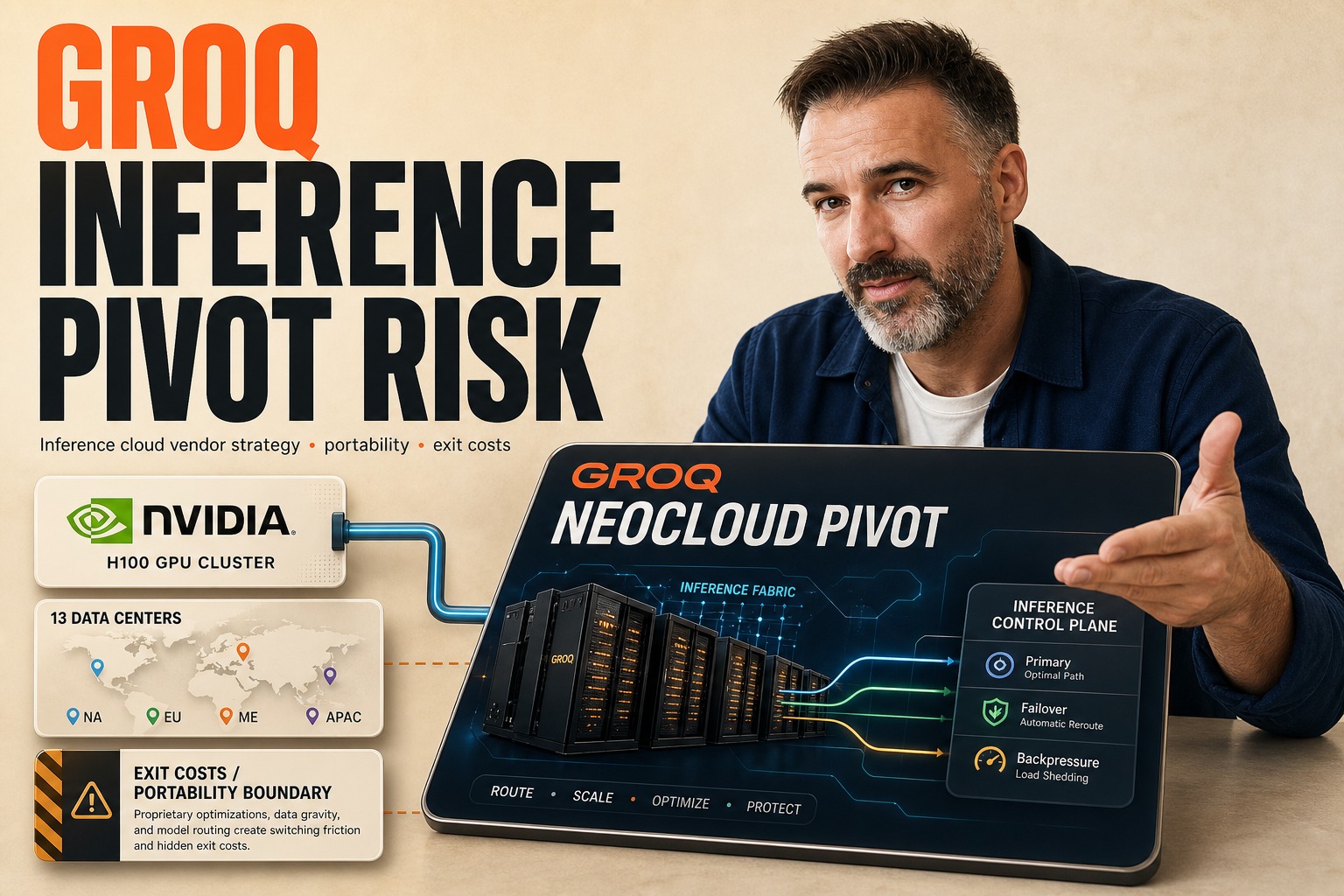
Is Groq still an AI chip company, or a cloud provider now? → Groq is pivoting from building its own inference chips to operating Nvidia-based systems as a neocloud focused on AI infrastructure services.
What is the dominant signal engineers should care about? → Inference is being positioned as the most critical layer of AI infrastructure, and specialized GPU clouds are racing to own that layer.
What is the search question this answers? → How should we evaluate a neocloud GPU provider for training and inference versus hyperscalers this quarter?
What changed in the market this week that makes the question urgent? → Groq raised $350 million at a new $3.5 billion valuation while expanding data center footprint and targeting medium and larger Nvidia clusters.
What’s the non-obvious angle? → The biggest engineering failures won’t come from the model; they’ll come from committing your production inference plane to a vendor whose economics and capacity strategy you don’t control.
Neoclouds just made inference a vendor-strategy decision, not an engineering afterthought
Groq’s move toward operating Nvidia systems as a neocloud is a loud signal that the industry is reorganizing around inference capacity as a product. That matters because when inference becomes a distinct infrastructure layer, your architecture choices start to encode vendor commitments: networking patterns, cluster assumptions, observability boundaries, and procurement constraints. This quarter’s decision is less about which model you prefer and more about which compute supplier you can safely depend on.
Central claim: Groq’s pivot shows that inference is becoming a standalone cloud layer, which breaks the old practice of treating GPU capacity as interchangeable; the right response is to design inference as a portable control plane with explicit exit costs and financial-risk boundaries.
Quick Answer: how to evaluate a neocloud GPU provider for AI inference and training
If you’re considering a neocloud for Nvidia-accelerated training and inference, evaluate it as critical infrastructure, not as a commodity GPU rental. Groq’s trajectory—$350 million raised, 13 data centers across multiple regions, and a stated focus on medium and larger Nvidia clusters—implies serious capacity ambition, but also ties you to the Nvidia ecosystem and to the provider’s capital intensity. In practice, we recommend treating neocloud adoption as a reversible architectural decision with clear portability, governance, and observability requirements.
The signal behind Groq’s funding: inference capacity is being productized
Groq is explicitly positioning itself as an AI inference cloud while serving millions of developers and enterprises and operating 13 data centers across North America, Europe, the Middle East, and Asia Pacific. The practical implication is that inference is no longer just something you do wherever GPUs happen to exist; it’s being sold as a specialized service layer. For engineering leaders, that shifts the question from peak throughput to operational dependency and contractable reliability.
- Product scope is widening: Neoclouds are not just offering instances; they are building clusters, regions, and an operations envelope you must integrate with.
- Nvidia ecosystem gravity is increasing: Providers operating Nvidia systems pull you into Nvidia-accelerated workflows and procurement realities.
- Cluster-centric buyers are the target: Groq explicitly highlights demand for medium and larger sized clusters for training and inference, which changes network and data assumptions.
- Economics become architecture: High capital expenditure and rapidly depreciating hardware (a concern raised around CoreWeave) turns vendor health into an engineering risk.
Why this question is search-driven right now: neoclouds are competing with hyperscalers on urgency, not features
The urgency comes from how quickly enterprises are scaling AI workloads and how capacity constraints force near-term decisions. Groq says the new funds support those seeking usage of medium and larger sized clusters of Nvidia accelerated computing for training and inference, which is exactly the buyer profile that cannot wait for a perfect long-term platform. When procurement timelines compress, teams tend to hardcode vendor assumptions—then spend quarters undoing them.
The real keyword isn’t Groq—it’s inference cloud vendor strategy
Most teams searching for Groq are actually searching for a way out of a bottleneck: how to secure enough GPU capacity without building a data center program. That’s why we frame the decision as inference cloud vendor strategy. Your ability to move workloads between providers, or even split them, will determine whether you can keep shipping when pricing, capacity, or contract terms change.
The engineering mistake: treating neocloud GPUs as interchangeable compute
In production, GPUs are never just GPUs. Your inference service ends up coupled to network topology, storage placement, queueing, and the provider’s operational tooling. When a neocloud advertises powerful Nvidia clusters, the temptation is to migrate quickly and normalize later. That’s the failure mode. If you don’t design for portability on day one, you inherit a brittle dependency you’ll only notice during a traffic spike or a vendor incident.
Portability is not a migration project; it is an architecture property you either bake into the first deployment or you effectively lose.
Where neocloud economics leak into your system design
The market is openly questioning whether neoclouds can be profitable enough long term given heavy investment requirements. That uncertainty is not abstract: it shows up in your incident response plan, your data retention posture, and your ability to forecast cost. When investors worry about high capital expenditures, debt reliance, and rapidly depreciating hardware, engineers should translate that into practical questions about capacity guarantees, contract flexibility, and the provider’s willingness to support steady-state operations.
What Groq’s pivot implies: your model layer is stable, your infrastructure layer is not
Groq originally aimed to compete on inference with its own LPUs, then shifted into operating Nvidia systems after its founder and top talent moved to Nvidia in connection with a $20 billion licensing deal that paid out to investors. We shouldn’t moralize that story; we should operationalize it. It implies that vendor direction can change quickly, and the workloads you care about—training and inference—will be carried by whatever infrastructure strategy wins internally.
Your response is to isolate the parts of your AI stack that must remain stable (APIs, request/response contracts, governance) from the parts that can change (underlying GPU provider, cluster composition, regional placement). In most enterprises, the stable part is not the model checkpoint; it is the business process that calls inference.
Start from the workload shape, not the vendor pitch: Decide whether you need training, inference, or both, and whether you need single-region or multi-region behavior before you look at providers.
Define your portability boundary: Identify what must remain invariant across providers (API contract, auth, audit logs, observability) and what can be provider-specific.
Treat cluster access as a production dependency: If you need medium or larger clusters, model the failure modes of losing that cluster, not just losing a single node.
Contract for reversibility: Ensure your data, logs, and deployment artifacts can exit cleanly if pricing or capacity changes.
Operationalize governance early: Decide who can deploy new models, rotate keys, and change routing, and enforce it as policy, not convention.
Data center footprint is not reliability: why 13 sites still requires your own controls
Groq operates 13 data centers across North America, Europe, the Middle East, and Asia Pacific, which signals reach. But footprint alone does not equal reliability for your specific workload. Reliability is achieved when your service has explicit routing, backpressure, and degradation behavior that matches how the provider fails. Even with many sites, you still need to design for regional saturation, quota surprises, and dependency failure when a model gateway or logging pipeline becomes the real choke point.
Multi-region inference fails at the seams you don’t test
Teams typically test for a region outage as if it were binary. In reality, you more often see partial capacity loss, elevated latency, or queue growth that triggers retries and amplifies cost. If you adopt a neocloud with global data centers, build your own traffic management logic so you can shift load without depending on undocumented provider behaviors. This is as much about protecting your budget as protecting uptime.
Why “medium and larger clusters” changes your architecture more than your billing
Groq’s stated goal to support customers seeking medium and larger sized clusters of Nvidia accelerated computing is a key architectural clue. Cluster-sized inference and training tend to force you into data locality decisions, synchronized deployment processes, and stronger orchestration discipline. The failure modes also escalate: one misconfigured job can monopolize capacity, and one networking issue can degrade the entire inference plane. That’s why we advise treating cluster access like a scarce resource with governance.
When you buy clusters, you inherit the provider’s operational rhythm; your release process must match it or you will break production.
The uncomfortable part: neocloud viability becomes part of your threat model
The market has an open question about whether neoclouds will generate long-term returns on massive infrastructure investment. That uncertainty is not a reason to avoid neoclouds; it is a reason to model vendor risk the same way you model external API risk. If the provider changes pricing, contract terms, or capacity allocation, your system should have a path to continue operating—perhaps at reduced capability—without an emergency rewrite.
Nvidia’s ecosystem dominance means your differentiation must move up the stack
Groq’s pivot places it directly inside Nvidia’s AI infrastructure ecosystem, and it’s not alone: Nvidia supplies GPUs powering clouds from CoreWeave, Lambda, and Nebius, while also investing billions into some of those companies. For engineering strategy, that means the underlying accelerators are converging. So differentiation shifts to orchestration quality, governance, operational maturity, and commercial terms. Your competitive advantage will come from how you run inference, not from whose Nvidia GPUs you rent.
- Routing and failover discipline: You need deterministic traffic policies that survive provider-side capacity shifts.
- Governance and auditability: Enterprises need strong change control around model updates and data access.
- Observability that spans vendors: Metrics and tracing must remain consistent even if your compute vendor changes.
- Commercial clarity: Capacity reservation, quota behavior, and data egress terms influence architecture choices.
The “post-licensing-deal” lesson: talent and IP moves can redirect platforms overnight
Groq’s valuation reset and the context around the Nvidia licensing deal highlight a pattern engineering leaders have seen repeatedly: platform direction can change fast when key people, IP, or strategy shifts. Even if you are satisfied with today’s service, your long-lived systems must outlast leadership changes and product pivots. Architecturally, the only durable hedge is to keep your inference interface stable while allowing the underlying provider to be swapped.
Don’t confuse a provider’s roadmap with your own reliability roadmap
A provider can be perfectly sincere about becoming the world’s leading inference cloud and still face constraints that affect you first: supply chain timing, data center buildouts, or capacity reallocation to larger customers. Your reliability roadmap should be based on what you can control: routing, caching, queuing, and policy enforcement. Roadmaps are not runbooks.
How we’d structure an inference plane so Groq is an option, not a lock-in
At Plavno, we treat external GPU clouds—hyperscalers or neoclouds—as execution substrates behind an internal control plane. The control plane owns authentication, request validation, observability context propagation, and model registry governance, while the provider layer owns capacity. This pattern lets you use Groq or another Nvidia-based neocloud when it is available and cost-effective, without embedding provider assumptions into every microservice.
- Stable inference API contract: Downstream apps call one interface regardless of where inference runs.
- Provider-agnostic deployment artifacts: The build and release pipeline targets a standardized runtime envelope.
- Unified observability context: Traces and logs carry consistent identifiers across vendors and regions.
- Policy-first access controls: Keys, roles, and audit events are enforced in your control plane, not ad hoc.
Plavno’s perspective: the cloud layer is where AI projects quietly succeed or fail
Most AI initiatives fail in production because teams over-invest in model selection and under-invest in operational integration. When inference is framed as the most critical AI infrastructure layer, as Groq’s leadership asserts, we agree with the direction but not with the implicit assumption that buying capacity is enough. The right move is to invest in the cloud foundation—networking, identity, observability, and release engineering—so your AI workloads can move as the market moves. This is the core of our cloud software development work.
| Decision dimension | Hyperscaler default | Neocloud reality |
|---|---|---|
| Capacity access | Often broad but shared with many services | Often optimized around GPU clusters and AI demand |
| Vendor coupling | Deep platform integrations over time | Deep coupling via cluster assumptions and contracts |
| Risk profile | Large diversified businesses | Capital-intensive operators with faster strategic pivots |
| Differentiation | Managed services breadth | Focused AI infrastructure and cluster delivery |
Business impact: inference becomes a line item you can’t hide inside AI R&D
As AI workloads scale, inference shifts from experimentation to an operational cost center with uptime expectations. Groq’s emphasis on inference being the largest and most critical layer of AI infrastructure matches what CFOs and CTOs will soon align on: inference is not a lab expense. That forces a clearer allocation model inside enterprises, where product teams must justify capacity needs and platform teams must provide controls that prevent runaway usage.
- Budget predictability becomes an engineering goal: Cost control requires backpressure, quotas, and routing, not just finance oversight.
- Procurement timelines collide with release timelines: Infrastructure contracts and model releases must be planned together.
- Customer-facing SLAs emerge: Once inference is user-visible, downtime becomes a product issue, not a research issue.
- Platform teams regain relevance: Centralized governance and shared tooling reduce duplicated vendor integrations.
How to evaluate Groq-style neoclouds in practice without a months-long bake-off
We recommend evaluation that mirrors production reality: start with the minimum architecture that could survive vendor change, then test a single workload end-to-end. The objective is not to find the fastest provider in a benchmark; it is to determine whether you can operate the service reliably when capacity shifts, when regions degrade, and when large clusters are shared among teams. You’re validating operability under uncertainty, not theoretical performance.
| Evaluation question | What to look for | Why it matters |
|---|---|---|
| Can we run both training and inference? | Clear support for clusters sized for each workload | Prevents split-brain architectures and duplicated data flows |
| How do we observe failures? | Consistent logs, metrics, traces across regions | Incident response speed depends on visibility |
| Can we exit cleanly? | Data and artifact portability, contract reversibility | Vendor strategy changes faster than enterprise roadmaps |
The operational controls that matter more than the GPU brand
Because Groq and other neoclouds are operating Nvidia systems, the GPU brand is not the differentiator. What matters is whether you can operate the full lifecycle: deploy, rollback, monitor, audit, and throttle. In practice, enterprises need a consistent identity layer (SSO, service accounts), predictable quotas, and a clear incident channel. If those are weak, you will build compensating mechanisms that increase complexity and reduce throughput.
- Release engineering discipline: Deployments must be reversible and safe under partial capacity loss.
- Traffic governance: Route by tenant, product, or risk level so one workload cannot starve others.
- Data handling clarity: Know where prompts, outputs, and logs land so compliance doesn’t become a blocker.
- Escalation mechanics: When capacity is scarce, operational communication becomes part of reliability.
Real-world application: enterprise support copilots that can’t wait for perfect capacity
A support copilot is a typical workload that pushes teams toward inference clouds quickly: you need consistent response times and the ability to handle bursts. If a neocloud offers access to larger Nvidia clusters, that can help you scale, but your architecture must assume variability. We usually design a tiered inference approach where high-risk tickets degrade to simpler workflows when capacity is constrained, while high-value interactions keep priority routing.
| Scenario | What breaks first | What we design around |
|---|---|---|
| Burst in user demand | Queue growth and retry storms | Backpressure and controlled retries |
| Regional degradation | Latency variance, partial timeouts | Traffic shifting and graceful degradation |
| Provider quota changes | Silent throttling | Explicit quota awareness and fallbacks |
Real-world application: training pipelines that need medium and larger clusters
Training workloads are where cluster promises become seductive. If your team is chasing a delivery date, a neocloud that prioritizes access to larger Nvidia clusters can be the difference between shipping and slipping. But training is also where mistakes get expensive: a mis-specified job can consume capacity and force other workloads to stall. We encourage enterprises to isolate training environments, enforce strict admission control, and keep inference protected as a separate production lane.
- Separate lanes for training and inference: Shared clusters invite priority conflicts when training jobs run long.
- Artifact lineage: Track model versions, datasets, and deployment approvals to avoid accidental regressions.
- Quota and scheduling policies: Treat GPU time as a governed resource, not a first-come first-served pool.
- Rollback readiness: Training outputs should never force a production rollout without gates.
Risks you must surface: capex pressure, depreciating hardware, and dependency exposure
The market discussion around CoreWeave—strong revenue growth alongside concerns about high capital expenditures, heavy reliance on debt, and exposure to rapidly depreciating hardware—should be read as a general warning for this category. Neoclouds operate in a world where infrastructure is expensive and hardware ages quickly. As customers, we can’t fix that, but we can ensure our systems don’t assume perpetual pricing stability or unlimited capacity.
If a provider’s business model depends on always-growing demand, your architecture must assume demand shocks and contract shocks.
The decision we’d advise a CTO to make this quarter
If you need capacity now and your workloads match the profile of medium and larger Nvidia clusters, a neocloud can be a rational move—provided you treat it like a reversible infrastructure dependency with explicit controls. We would not advise betting your entire inference plane on a single provider without a portability plan and without observing real operational behavior under load. When this is executed well, you gain speed without surrendering strategic freedom. This is where targeted AI consulting earns its keep: not by picking a vendor, but by de-risking the architecture.
What to do next: build the control plane before you scale the clusters
The practical next step is to implement the minimal control plane that lets you route requests, enforce policy, and observe behavior across providers. Then you can trial Groq or another neocloud for a bounded workload and decide whether it earns a larger share of traffic. When teams skip this and jump straight to cluster adoption, they end up rebuilding governance mid-flight. We often pair this with workflow hardening and AI automation so the organization can safely scale usage without scaling chaos.
Author: Plavno team. Last updated: August 2026. If you’re evaluating neoclouds for Nvidia-accelerated training or inference, we can help you design a portable inference plane and run a production-grade evaluation that surfaces vendor risk early. When you need to move fast, we typically staff a small platform squad via outstaffing to build the control plane while your product teams keep shipping.
 Chat GPT
 Perplexity
 Claude
 Gemini