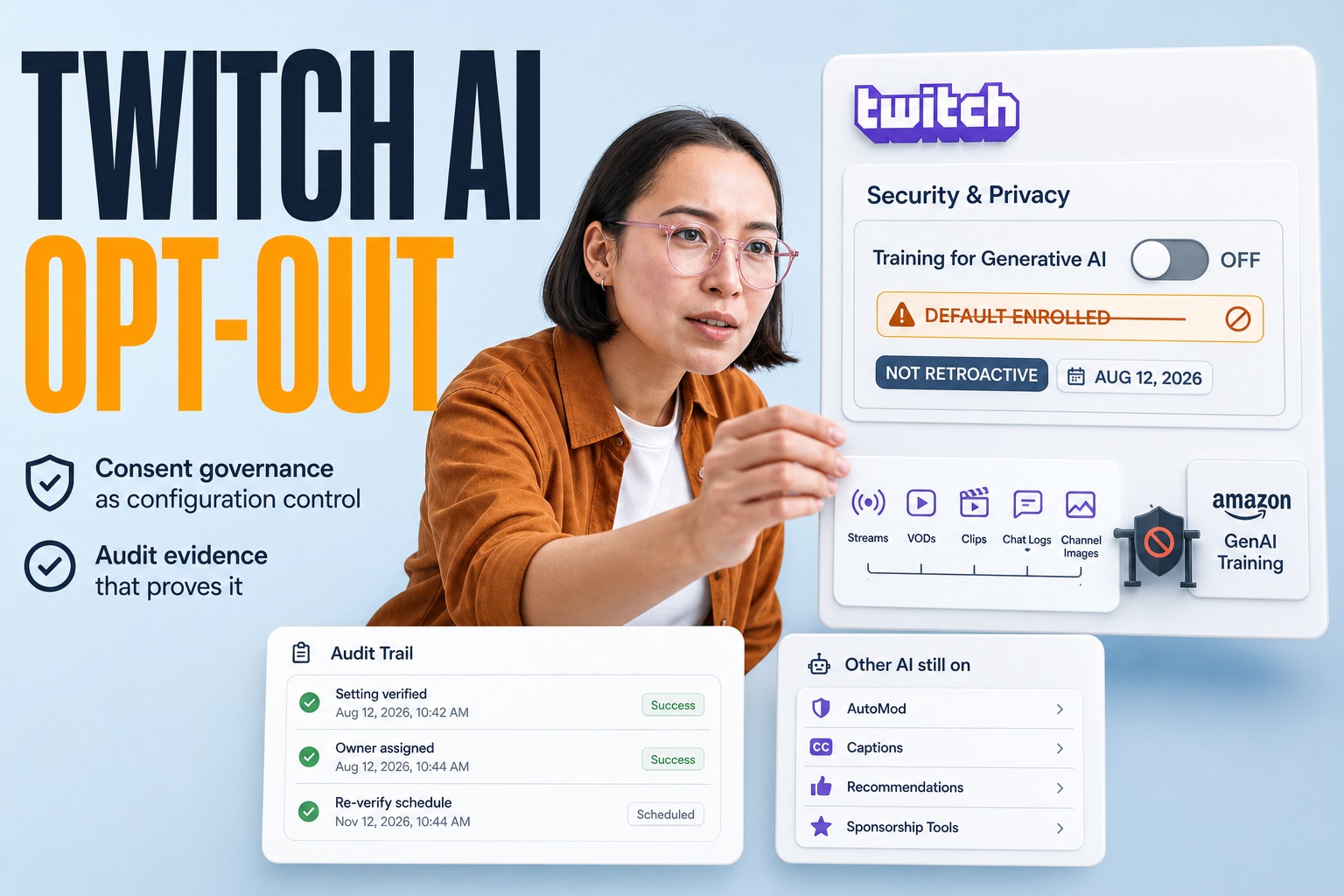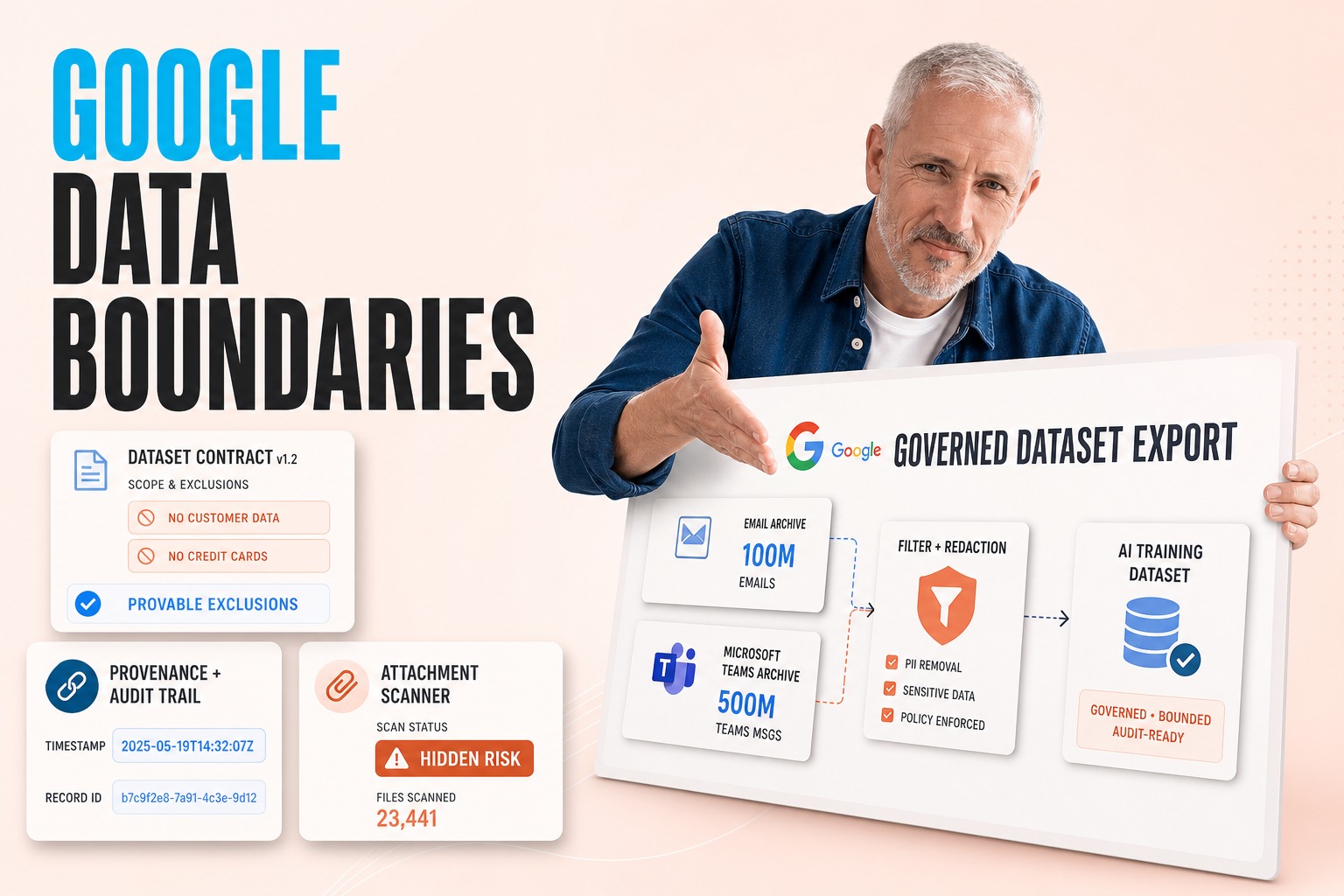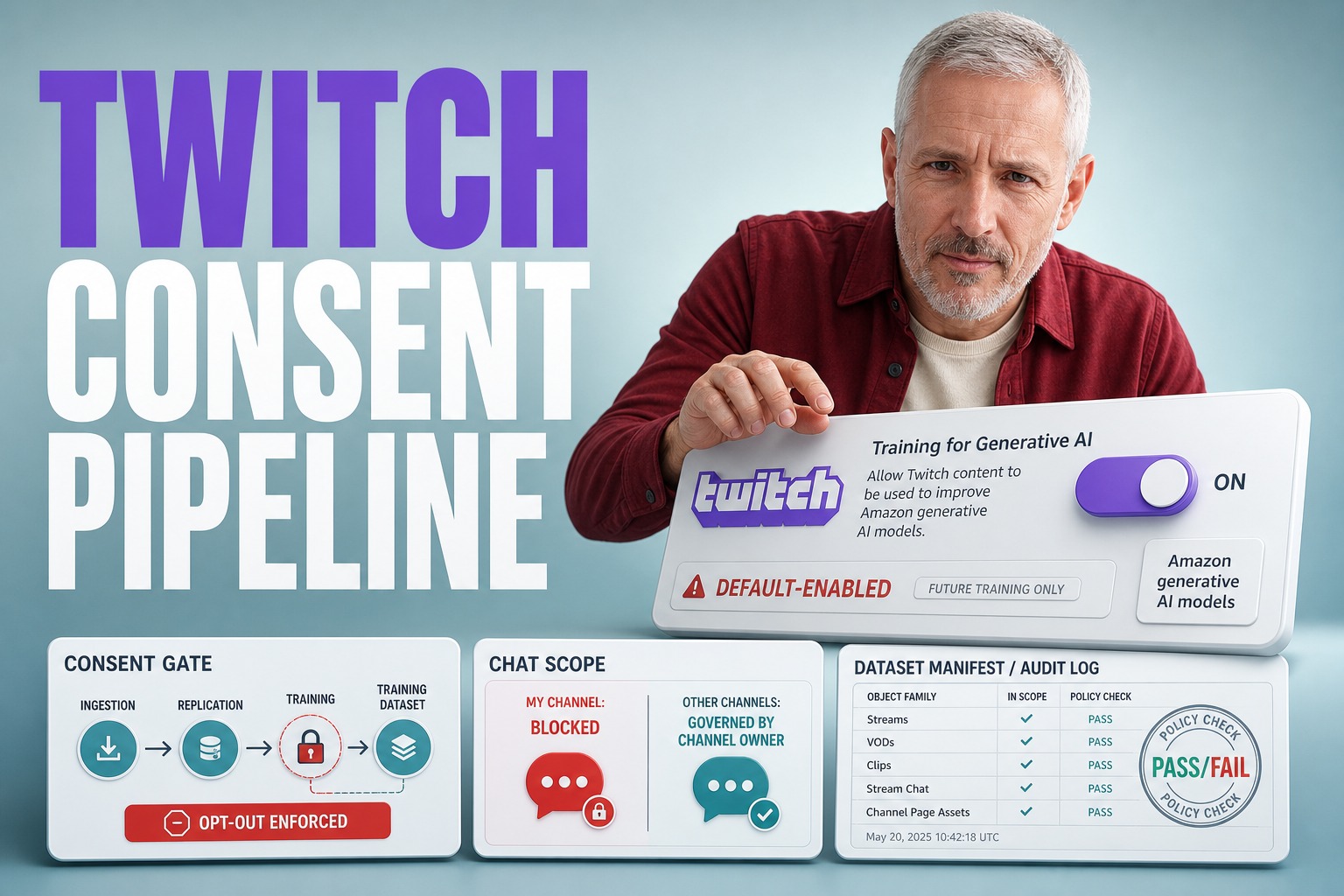
Did Twitch just change the rules for training generative AI on creator content? → Yes: on August 12, 2026, Twitch added a “Training for Generative AI” setting that governs whether a channel’s content can be used to train Amazon’s generative AI models.
Why are engineering leaders paying attention if we don’t run a streaming platform? → Because a default-enabled training control exposes the real hard problem: enforcing consent at scale across streams, chat, media derivatives, and downstream model-training pipelines.
What’s the business/technical question we should actually be searching? → How do we design a consent-gated data architecture for generative AI training on user-generated content, without breaking safety, moderation, and platform ML features?
What does the Twitch change imply about where the risk lives? → The risk lives less in the model and more in the data plumbing: toggles, scope rules (your channel vs. other channels), and “future training only” semantics.
What should we do this quarter if we’re building AI features on UGC? → Treat “AI training permission” as a first-class data attribute with auditable lineage, hard gates at ingestion and dataset assembly, and explicit handling for cross-scope content like chat.
The dominant signal: “default-enabled” AI training flips consent from legal text into a systems problem
Twitch introduced a new “Training for Generative AI” setting on August 12, 2026 that allows streamers to block their channel content from training Amazon’s generative AI models, but it was enabled by default and launched without an email, pop-up, or advance announcement.
At Plavno, we see this as a design pattern that forces a decision: either your data platform can enforce consent as a machine-checkable policy across artifacts like streams, VODs, clips, chat, and channel-page assets, or you’re effectively relying on ambiguity at scale.
Author: Plavno team. Last updated: August 2026.
- Central claim we’re defending: Default-enabled training toggles don’t primarily change model strategy; they break teams that treat consent as a UI preference instead of an enforceable data contract that travels through storage, ETL, and dataset assembly.
- Primary query this article answers: How should we architect “AI training opt-out” so it’s technically enforceable across UGC pipelines, including cross-channel chat and derived media?
- Why Twitch matters to B2B engineering: Twitch’s scope includes streams, VODs, clips, stream chat, and channel page images/text—exactly the multi-artifact sprawl that most UGC products underestimate.
- What “future training” means operationally: If your system can’t distinguish “eligible for future training” from “already replicated into training stores,” you can’t make truthful guarantees.
- The governance trap: Safety and security AI features often must remain on; if you don’t separate “platform ML” from “generative training,” you’ll end up with a single messy switch that satisfies nobody.
Quick Answer: How do we implement an AI-training opt-out that actually works in production?
If you’re building AI on user-generated content, implement AI-training consent as a durable, queryable policy attached to every content object and every derivative you generate, then enforce it at multiple choke points: ingestion into long-term storage, replication into analytics lakes, and assembly of training corpora.
Twitch’s new setting is a concrete reminder that “a toggle in settings” is not the control; the control is the ability to prevent a channel’s streams, VODs, clips, stream chats, and channel-page images/text from ever reaching the generative training pipeline when the owner disables training.
In practice, the hard edge cases are scope and time. Twitch’s documentation says the change applies to future training and does not mention what happens to content already used, and it also clarifies that chat messages posted in other streams remain subject to those channel owners’ settings.
Those two statements imply your architecture must encode “who owns this content” and “what training window is permitted” in a way your data platform can enforce automatically, not by manual cleanups.
A settings toggle is only real if it is backed by an auditable, consent-aware data lineage that can prove which exact artifacts were eligible for generative training at the moment they entered a training dataset.
What Twitch’s toggle actually covers—and why the scope definition is the engineering spec
Twitch’s setting, called “Training for Generative AI,” is located under Security and Privacy in account settings, and Twitch says it covers a channel’s streams, VODs, clips, stream chats, and the images and text on a channel page.
Twitch also states this content can be used to train Amazon models that generate or synthesize text, audio, images, or video. For engineers, that scope statement is effectively a data catalog: it names the object families you must track, store, and propagate through processing systems without losing ownership and permission context.
Treat “streams, VODs, clips” as separate objects, not formats of the same thing, because their storage paths, retention, and derivative generation typically diverge even when they share a creator.
Treat “stream chat” as its own content domain with different authorship rules, because a single timeline contains messages from many users who may have different expectations.
Treat “channel page images and text” as first-class training inputs, because these assets often live in separate CMS or profile services that data teams forget to gate.
Treat “generate or synthesize text, audio, images, or video” as a hint that multimodal training sets are assembled from heterogeneous stores, which increases the chance permission gets dropped.
Treat “future training only” as a temporal constraint that should be modeled explicitly, because you need a clean boundary between already-materialized datasets and new dataset builds.
The default-enabled choice changes your incident model, not just your UI
Twitch enabled the toggle by default for all accounts, which meant every creator was included before they had a chance to opt out, and Twitch did not send an email, show a pop-up, or make an advance announcement.
Whether one agrees with that product call is almost beside the point for system architects: it shifts the “AI training permission” conversation into an operational risk surface where teams need fast answers about data flows, not just policy statements.
If an executive asks whether an opt-out actually blocks training, “we have a toggle” is not an acceptable systems answer.
Where consent fails in real pipelines: replication beats preferences every time
Twitch’s documentation emphasizes that other AI-powered features on the platform—automated captions, content recommendations, sponsorship tools, ad selection, and chat moderation tools like AutoMod—will keep working no matter how the setting is configured, and it says these features do not keep content for training new generative models.
That’s an explicit separation between “AI features operating on content” and “content retained for new generative training.” Most product teams collapse these into one mental bucket called “AI,” and then they build a single switch that can’t map to real data flows.
In production, consent fails when content escapes into secondary systems that weren’t built to understand it. Streams and chats get replicated into analytics stores, search indexes, feature stores, and offline training lakes; clips get re-encoded; audio gets extracted for captioning.
The moment you have multiple sinks, a UI toggle can only be honored if every sink consumes a consistent, machine-readable policy. Otherwise, your pipeline will keep building training data from whichever store still has the bytes.
- Ingestion as the first choke point: When a stream, VOD, clip, or chat event lands, the service that writes it must attach an enforceable “training eligible” policy so downstream consumers cannot pretend the policy never existed.
- Replication as the common failure mode: Data copied into an analytics lake or warehouse often loses rich metadata; if consent is not replicated with the data, you will eventually train from the copy.
- Derivatives as consent amplifiers: Captions, transcripts, embeddings, thumbnails, and extracted audio are all “new objects” operationally; if you don’t bind them back to the source’s consent, they become an ungoverned side door.
- Feature ML vs. generative training: Twitch explicitly says safety/security-related systems can’t be disabled because it would weaken protections; that only works if the platform can technically separate those pipelines.
- Cross-channel participation: Twitch notes your opt-out only covers your own channel and your chat messages in other streams can still be used based on those channel owners’ settings; your architecture must model that split.
The “my channel vs. other channels” rule forces a real ownership graph
Twitch’s limitation that the opt-out only covers a user’s own channel, while chat messages posted in other streams are still subject to the settings of those channel owners, is a direct signal that “authorship” and “control” are not identical.
In many products, a user creates content inside another entity’s space (a community, a workspace, a marketplace listing), and training permission must be computed from a graph: who authored it, where it was posted, and which entity’s policy governs training eligibility.
“Future training only” is a dataset versioning problem masquerading as policy
Twitch’s documentation says the change applies to future training and does not mention content already used before the opt-out was available.
That implies a practical boundary: you can stop new dataset builds from pulling new content, but you may not be able to unwind what has already been incorporated into past training runs.
For architects, this is a reminder that dataset assembly needs immutable build manifests and provenance; without them, you can’t even answer which training sets included which content.
- Consent must be queryable, not just stored: If a training job can’t efficiently filter by policy at build time, engineers will bypass the filter to ship.
- Every training dataset needs a manifest: Without a durable record of what objects were included, “future only” becomes vague language instead of a boundary you can enforce.
- Policy must survive transformations: When you extract audio to improve speech-to-text, or generate captions, you must propagate the source policy to every derivative artifact.
- Moderation and safety pipelines need their own lane: Twitch states disabling AI systems related to safety/security would weaken protections; that separation should be reflected in data stores and access controls.
- UI controls require backend proof: A toggle must correspond to backend enforcement points that can be audited, or it’s merely a preference screen.
The real shift: consent becomes a first-class field in your data model
The Twitch launch shows how quickly a platform can be forced to explain what its AI training practices include: streams, VODs, clips, chat, and channel-page assets; training for models that synthesize text, audio, images, or video; and an opt-out that affects future training.
We argue the core engineering response is to elevate “training eligibility” into the canonical data model and make it non-optional for any storage or processing layer that might feed generative training.
At Plavno, when we design agentic or generative systems for products with UGC, we treat AI training permission like payment authorization: it is not a UI state, it’s a backend contract with traceability.
That approach aligns with the separation Twitch describes: product features like captions and recommendations can operate regardless of the toggle, but generative training retention must be explicitly controlled. This is the kind of architecture we build in AI agents development engagements when teams need enforceable governance, not just policy text.
Why “no announcement” is a technical lesson: communication is part of the control plane
Twitch did not send an email, show a pop-up, or make any advance announcement before the setting appeared, and it spread because a creator-reporter spotted it and posted a screenshot.
Engineering leaders often treat comms as a marketing concern, but in data governance, communication is a component of the control plane: it is how users discover controls, how you define the semantics of the control, and how you avoid mismatched expectations that become operational escalations.
If a setting is buried under Security and Privacy, enabled by default, and only discoverable by power users, then support and engineering will be forced to answer questions the system might not even be instrumented to answer, such as what data was used prior to the control.
Twitch’s chief product officer said on a Patch Notes livestream that he could not confirm what Amazon had already used for model training before the toggle existed, adding that he did not know what the company had or had not used.
That uncertainty is precisely why we recommend building dataset provenance as an engineering requirement, not an afterthought.
| What the user thinks the toggle does | What the backend must actually enforce | What breaks if you don’t |
|---|---|---|
| “My channel content won’t train generative AI.” | Training dataset builders must exclude that channel’s streams, VODs, clips, stream chats, and channel page images/text after opt-out. | Silent leakage via replicated stores or derivatives becomes a trust incident. |
| “My chat is protected if I opt out.” | Chat messages posted in other channels must follow the channel owner’s setting, not the author’s, per Twitch’s stated limit. | Users assume global coverage; you face mismatched expectations and escalations. |
| “This applies immediately.” | The system must define “future training” in terms of dataset build timestamps and manifests. | You can’t answer whether past datasets included the content. |
| “Safety tools should be optional too.” | Safety/security AI pipelines must be separated if they cannot be disabled, as Twitch states. | A single switch forces unsafe trade-offs or misleading UX. |
What the Patch Notes livestream revealed: the opt-in debate is really about adoption math
Twitch executives addressed the reaction during a Patch Notes livestream on August 12, answering questions from nearly 3,000 viewers.
When asked why the setting defaulted to opt-out instead of opt-in, Twitch’s chief product officer said, “If this was opt-in, nobody would opt in. That’s honestly the answer.”
For product engineering teams, that blunt statement matters because it frames the toggle not as a neutral preference but as a lever for collecting training data at scale, which raises the bar on technical governance.
If your generative training program relies on default inclusion, you must over-invest in enforcement, auditability, and scope clarity—because you are choosing scale over explicit participation.
Designing the “training eligibility” contract so it survives real storage and processing
Twitch’s support documentation explicitly lists the content types and clarifies that existing AI features like automated captions and AutoMod will continue regardless of the setting, and it gives an example that audio from a stream could help improve speech-to-text systems that make captions better on Twitch and other Amazon products.
That example is important because it highlights a common systems pattern: one pipeline produces a product feature now (captions), while another pipeline retains data to improve models later (training). If you don’t separate those lifecycles, your system will unintentionally treat product operations as training consent.
The engineering response is to define a contract that any service can evaluate: content object ID, owning channel, content domain (stream, VOD, clip, chat, profile asset), and a training policy that is checked whenever data is copied into a store intended for generative training.
We are not asserting Twitch’s internal architecture; we’re extracting the requirement their public semantics impose. In most organizations, this requires aligning product services, data engineering, and ML teams so that “training stores” are explicitly labeled and access-controlled.
Keep “feature inference” separate from “training retention” or you’ll create false opt-outs
Twitch says automated captions and other AI-powered features keep working regardless of the setting and that those features do not keep content for training new generative models.
The only way that statement can hold consistently is if the systems that run live inference are isolated from the systems that retain data for training, with distinct storage rules and access permissions.
In enterprise products, we implement that separation as different data paths and different retention contracts so “use for safety” never becomes “use for training.”
Start with a single authoritative policy source tied to the account or channel setting (like Twitch’s Security and Privacy toggle) and make every downstream system consume it from one place.
Propagate the policy onto each content object at write time so the permission becomes part of the object’s metadata, not a runtime guess.
Ensure every derivative artifact created from that content inherits the source policy so extracted audio, transcripts, and thumbnails can’t drift into training stores.
Enforce the policy again at dataset assembly time so even if a replica exists, the training builder filters it out based on the latest eligibility.
Instrument audit logs around policy checks so you can answer “why was this included” without relying on tribal knowledge.
Handle chat like a shared ledger, because the governing setting may not be the author’s
Twitch’s statement that opt-out only covers a user’s own channel, and that chat messages in other streams are subject to those channel owners’ settings, is a powerful warning to any team building community or collaborative products.
A message has an author, but the space it’s posted into may control training eligibility.
We treat this as a multi-tenant policy decision that must be computed deterministically and stored with the event, because recomputing later from mutable settings can make historical enforcement inconsistent.
- Use explicit policy precedence: Decide whether the author’s preference, the space owner’s preference, or a combined rule governs training eligibility for shared content, and encode it consistently.
- Persist the governing scope: Store which channel/workspace/community policy was applied at creation time so future audits don’t depend on today’s settings.
- Avoid “global toggles” that lie: A single user-level switch can’t accurately represent cross-space rules like Twitch’s chat limitation.
- Separate moderation retention from training retention: Twitch notes safety/security AI cannot be disabled; treat safety logs and generative training corpora as different classes of data.
- Document the semantics in-product: If users can discover the toggle only in settings, they still need a plain-language explanation of scope boundaries like “your messages elsewhere follow that channel.”
Plavno’s perspective: the winning architecture is consent-aware data lineage, not “better prompts”
The Twitch situation is being discussed as an AI controversy, but for builders it’s a data architecture story. The setting covers multiple content types, has a cross-channel exception for chat, and is described as applying to future training without clarity on past use.
Those are exactly the cases where teams without lineage and manifest discipline get trapped: they can’t answer what went where, and they can’t prove their enforcement.
When we advise CTOs through AI consulting, we push a position that some engineers will disagree with: model choice is rarely the make-or-break factor in trust incidents; orchestration and data governance are.
If your ingestion, replication, and training build systems don’t share a common consent contract, a new toggle will create the illusion of control while the data continues to flow into places you can’t fully enumerate.
Business impact: defaults create training scale, but they also create enterprise-grade obligations
Amazon has owned Twitch since 2014, and at an industry event in 2024 a Twitch executive confirmed Amazon was training AI on Twitch content, saying the company followed user trust and privacy rules in different countries.
On August 12, 2026, Twitch made the training control explicit, but launched it default-enabled and then acknowledged on stream, “We don’t expect you to be happy or excited about this.”
For business leaders, the message is that training scale and user sentiment are now linked to technical transparency.
The operational obligation is not just “have an opt-out.” It’s to be able to defend the boundary Twitch describes: AI-powered platform features (captions, recommendations, AutoMod) remain available regardless of the setting, while generative model training retention is governed by the toggle.
If your architecture can’t keep that separation, you will either cripple core features or weaken your training governance. We frequently see this in companies that want generative capabilities but haven’t invested in a data platform designed for policy enforcement.
| Decision you must make this quarter | What Twitch’s change suggests is non-negotiable | What to measure internally |
|---|---|---|
| Build generative training on UGC or buy external datasets | Users will demand scope clarity across content types (streams/VODs/clips/chat/profile assets) | Whether every content domain has consistent IDs and ownership metadata |
| Use default-inclusion or explicit opt-in | Default inclusion forces you to prove enforcement and boundaries | Whether policy checks are logged and auditable end-to-end |
| Keep safety AI always-on | Safety/security may not be optional, as Twitch states | Whether safety pipelines are physically/logically separate from training corpora |
| Promise “future only” semantics | You need dataset manifests to define what “future” means | Whether you can enumerate which datasets were built when and from what sources |
How to evaluate your own opt-out in practice: ask where the bytes go after settings change
If we strip away the emotions, Twitch gave us a clean set of acceptance criteria to test in any UGC product: a user can toggle training off; it covers specific object families; it does not affect operational AI features like captions and AutoMod; it has a scope caveat for chat in other channels; and it applies to future training without addressing past use.
As engineers, we should evaluate our own systems against those kinds of explicit semantics, because users will discover the mismatch eventually.
In practice, we run a “settings flip” thought experiment. The question is not whether your UI updates; the question is whether a piece of content created after the flip, and a derivative created from that content, can still reach any pipeline that builds a generative training corpus.
The second question is whether content created before the flip is treated differently in “future training” jobs, and whether you can show the logic behind that boundary.
This is also where a security mindset matters, because any ungoverned replica is effectively an exfiltration path into training.
Real-world applications: captions and moderation prove you can decouple “use” from “train”
Twitch says automated captions, recommendations, sponsorship tools, ad selection, and AutoMod will continue to function regardless of the generative training toggle, and that these features do not keep content for training new generative models.
That statement maps to a pragmatic product architecture: you can run inference and deliver value without retaining content for generative training, as long as you have separate pipelines and retention rules.
For teams building similar features, this is a blueprint for reducing governance risk while still shipping AI.
Validate that turning training off blocks new writes into any store designated for generative training, not just into one “training bucket” that other teams can bypass.
Validate that streams, VODs, clips, chat, and profile assets share a consistent way to inherit policy, since Twitch’s scope spans all of them.
Validate that chat posted in other “spaces” follows the space owner’s policy if your product has shared contexts, mirroring Twitch’s channel-based governance.
Validate that safety and moderation AI can remain operational even when training is off, because Twitch explicitly says safety/security opt-outs would weaken protections.
Validate that “future training” has a defined operational meaning by referencing dataset build logs and manifests, not assumptions.
Risks and limitations: “we don’t know what was already used” is the predictable failure mode
On the August 12 Patch Notes stream, Twitch’s chief product officer said he could not confirm what Amazon had already used for model training before the toggle existed, adding that he did not know what the company had or had not used.
From an engineering perspective, that is the predictable outcome when dataset provenance is not designed as a product requirement.
Even if your current policy is correct, you will be unable to answer historical questions without manifests, audit logs, and clear boundaries between training corpora and other stores.
- Historical ambiguity becomes permanent: If you can’t reconstruct what training sets contained, you can’t confidently speak about pre-toggle usage when stakeholders ask.
- Cross-scope content creates surprises: Twitch’s chat limitation shows how easily “my content” becomes “content in someone else’s space,” and users will interpret that differently than engineers.
- Safety exceptions are politically sensitive: Twitch says safety/security AI can’t be disabled; if you don’t separate those pipelines, users may assume you ignored the toggle.
- Derivatives outlive the source: Even if you stop training on streams, extracted artifacts like transcripts can persist unless your policy propagates consistently.
- Discovery gaps trigger backlash: Twitch did not announce the setting via email or pop-up; when controls aren’t discoverable, users assume the worst and your support burden spikes.
The security angle most teams miss: consent enforcement is also a data exfiltration problem
A generative training corpus is effectively a high-value aggregation of user content. Twitch’s situation highlights why: the setting covers multiple content types, and it is explicitly about training models that can synthesize text, audio, images, or video.
Even if your organization is acting in good faith, any uncontrolled replication into training stores looks like unauthorized reuse, and any inability to answer “what was included” looks like a security failure.
This is why we often pair governance work with cybersecurity and penetration testing thinking: you’re trying to identify where content can flow without policy checks, which is the same mindset as finding where sensitive data can move without access control.
The goal isn’t to villainize ML teams; it’s to ensure that when a toggle flips, every path that could feed training is either blocked or provably filtered.
Closing insight: default-enabled training is survivable only with provable boundaries
Twitch’s August 12, 2026 change made a previously implicit practice explicit: there is now a setting that lets streamers block their channel content from training Amazon’s generative AI models, but it launched enabled by default, with scope limits for chat in other channels, and with “future training” language that does not address past use.
Our central claim holds: this is less about the model and more about whether your architecture can enforce, audit, and explain consent across content domains and scopes.
If you’re shipping generative AI on UGC, the right response this quarter is to design for provability: consent-aware metadata on every object, clear separation between safety/operational AI and generative training retention, and dataset manifests that make “future training” a technical boundary rather than a promise.
If you need to stand up that governance quickly without stalling product delivery, we can extend your team via an outstaffing model focused on data platform, backend, and ML infrastructure engineers who have built enforceable pipelines before.
| Common stakeholder question | Answer you can give only if the system is built right | What Twitch’s semantics force you to clarify |
|---|---|---|
| “If I turn it off, will you still use my content?” | “We can prove training dataset builders exclude your eligible content domains after the change.” | Streams, VODs, clips, stream chats, channel page images/text are in scope for the setting. |
| “What about my messages in other spaces?” | “Those messages follow the governing policy of the space they’re posted into, and we store that scope with the event.” | Twitch explicitly says chat in other channels follows those channel owners’ settings. |
| “Did you already train on my old content?” | “We can reference dataset manifests and build logs for the periods in question.” | Twitch documentation covers future training and does not mention what happened before. |
| “Will moderation and safety still work?” | “Yes, because safety pipelines are isolated from generative training retention.” | Twitch says disabling AI systems related to safety/security would weaken protections, so they remain. |
 Chat GPT
 Perplexity
 Claude
 Gemini