Is Stripe’s OpenRouter acquisition just an AI bet, or an infrastructure shift? → It’s a signal that the interface between developers and many model providers is becoming a strategic layer worth billions.
What’s the real search question engineers are asking right now? → Should we adopt an AI model router (an OpenRouter-style single interface to many models) instead of integrating each model provider directly?
What changes for production teams this quarter? → Model access stops being only an ML choice; it becomes a payments, governance, and procurement architecture decision.
Where do teams get burned when they add a routing layer? → At billing attribution, auditability, and vendor lock-in boundaries, not at model quality.
What’s Plavno’s angle? → We think the winning design is to decouple model routing from cost governance and treat the router as a replaceable adapter, even if Stripe makes the router feel like ‘the platform.’
Quick answer: should we use an AI model router or integrate LLM providers directly?
If you expect to use multiple model providers and you want faster experimentation, a model router can be the right move—but only if you design your own cost allocation, audit trail, and failure handling around it. Stripe’s move to acquire OpenRouter for more than $7 billion (with separate reporting above $8 billion) makes routing feel inevitable, yet the safest engineering posture is to treat any router as a swappable edge layer and keep your billing and governance logic under your control.
Central claim: Stripe’s acquisition of OpenRouter turns model access into a finance-and-governance layer, and that breaks the common practice of ‘just call the best model’; the right response is to architect routing as a replaceable adapter while keeping attribution, policy, and audit ownership inside your platform.
The dominant signal isn’t ‘more AI’—it’s that the model access layer is now priced like infrastructure
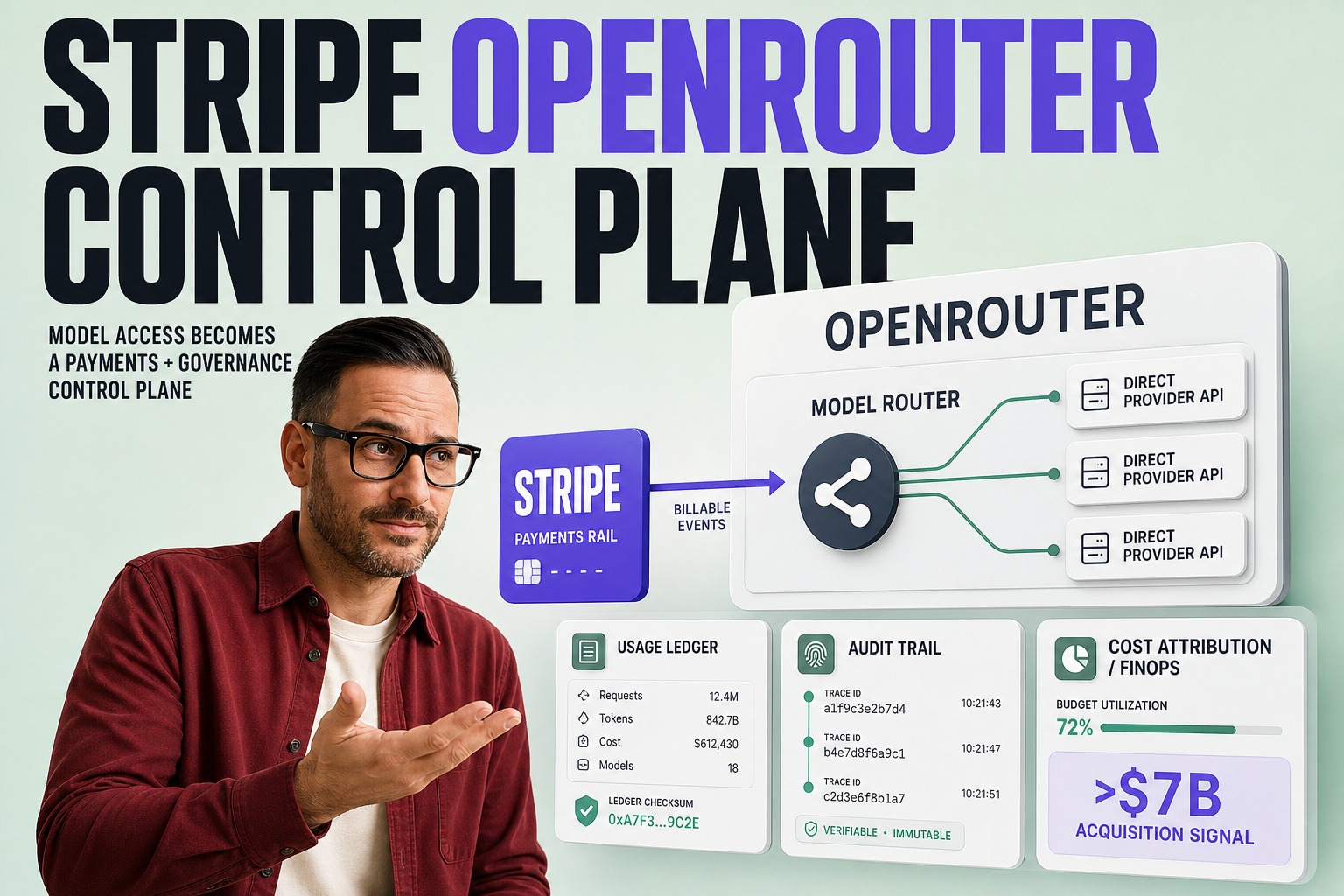
Stripe is a privately held financial-infrastructure company, valued at $159 billion in a February 2026 employee tender offer and described as robustly profitable—so when it agrees to acquire OpenRouter in a multibillion-dollar transaction, we should read it as an infrastructure land grab, not a feature add. OpenRouter’s headline value is that it gives developers a single interface for accessing hundreds of AI models, which effectively sits between your application and every model provider you might use.
If a routing interface can swing from a roughly $1.3 billion valuation to a multibillion-dollar acquisition in months, your architecture is already downstream of someone else’s pricing power.What this forces CTOs to decide: who owns model choice, cost, and audit in your stack?
The hard decision is no longer whether LLMs help, but where to anchor control when the access layer becomes a strategic asset. OpenRouter was already using Stripe to power payments infrastructure for millions of AI developers earlier this year, and now Stripe is buying the layer that mediates access to ‘hundreds of AI models.’ That implies a future where model usage and financial transactions converge, and we either design for that coupling deliberately—or we inherit it accidentally.
- Engineering ownership shifts from ML to platform teams. When a single interface can front hundreds of models, the day-to-day work becomes contract surfaces, reliability boundaries, and observability semantics. A typical failure mode is that the ML team ‘chooses a model,’ but the platform team has to explain costs, retries, and outages without stable provider-level visibility.
- Procurement and FinOps become part of inference architecture. A routing layer can simplify experimentation, but it also creates a new billing abstraction. If your internal chargeback is built around provider invoices, a router can break attribution unless you design a mapping from app-level events to router-level spend.
- Compliance and audit stop being a vendor checkbox. When requests can traverse multiple providers through one interface, you need to decide what your authoritative audit log is. If the router is the only consolidated record, you are operationally dependent on its event model and retention assumptions.
- Negotiation power changes shape. Direct integrations often map cleanly to per-provider commitments; a router changes the conversation to aggregate volume and routing policy. That can be good for flexibility, but it can also make it harder to prove which application drove which spend.
- Your incident response runbooks get more abstract. Teams used to ‘provider X is down’ now face ‘the interface is returning errors,’ and debugging requires correlating router telemetry, network paths, and your own request lifecycle tracking to avoid blind spots.
A model router is not just a convenience API; it becomes your de facto control plane
OpenRouter’s stated value proposition in the market framing is a single interface for accessing hundreds of AI models, and that is exactly what turns it into a control plane. Control planes decide what is reachable, how identity is represented, and how usage is measured—even when you think you’re only buying a developer convenience. If Stripe captures economics from AI usage and the financial transactions surrounding it, the router becomes more than ‘integration glue’; it becomes the place where cost, policy, and access are easiest to centralize.
- The unified interface becomes your canonical dependency. Once multiple teams build against one contract, swapping away later is expensive even if the router is ‘just HTTP.’ The integration cost isn’t syntax; it’s the semantics of errors, rate limits, and usage reporting that your internal systems start to assume.
- Routing decisions leak into product behavior. When your product experiences differ based on which model is selected, the router’s policy becomes product logic. In practice, teams end up encoding ‘acceptable answers’ and ‘acceptable cost’ constraints into the routing layer, whether they intended to or not.
- Observability becomes a first-class architectural problem. A single interface can simplify metrics collection if it exposes consistent usage events, but it can also hide provider-level signals that matter for debugging. Without your own end-to-end trace IDs and request journaling, you cannot confidently answer why a user saw a degraded response.
- Security boundaries get harder to reason about. Consolidating access can reduce the sprawl of API keys and secrets across services, but it also centralizes blast radius. If your router credential is compromised, the attacker may inherit access to many downstream providers through one choke point.
- Governance becomes easier to start and harder to validate. It’s tempting to treat the router dashboard as governance. The real test is whether your internal controls can reproduce the same billing and access story independently for audits and customer escalations.
Stripe’s acquisition reframes routing as payments infrastructure, not AI tooling
In the input story, Stripe is already powering OpenRouter’s payments infrastructure for millions of AI developers, and the acquisition pushes that coupling to its logical end: the company that processes billing wants to own the interface that generates the billable events. For engineering leaders, the implication is practical: if your LLM stack has no strong internal cost and usage model, the ‘best’ integration path will increasingly be the one that makes billing easiest for the vendor—not the one that makes reliability and governance easiest for you. This is where AI consulting becomes less about model choice and more about systems design under economic constraints.
| Decision you must make | Direct provider integrations | Model router in front of providers |
|---|---|---|
| Who defines the contract your app depends on? | Each provider’s API contract becomes a separate dependency surface, which can increase integration effort but also preserves provider-specific clarity. | The router’s contract becomes the primary dependency, lowering day-one integration cost while concentrating long-term coupling into a single external surface. |
| Where does spend attribution come from? | Typically aligned with provider invoices and per-provider usage reports; easy to map to committed spend but harder to unify across providers. | Typically aligned with router usage events; easier to unify but can require extra internal work to map router events to application chargeback and budgets. |
| How do you debug failures? | Provider-specific signals can be clearer, but multi-provider strategies require you to build your own normalization and correlation. | A single interface can standardize some signals, but can also obscure the underlying provider context unless you build explicit correlation and journaling. |
| What’s your negotiating leverage? | Negotiation happens provider by provider, often with more precise commitments tied to known workloads. | Negotiation can shift to aggregated usage through the router, increasing flexibility but potentially reducing transparency for internal cost owners. |
The valuation jump is your warning: build for portability even if you adopt a router
The report describes OpenRouter moving from a roughly $1.3 billion valuation only months earlier to an acquisition valued at more than $7 billion (with separate reporting above $8 billion). Even if we ignore the investor narrative—like a16z investing roughly $20 million, owning more than 17%, and seeing that stake become about $1.19 billion on paper—the engineering signal is clear: when an interface layer is scarce and strategic, its pricing and terms can change quickly. Portability is no longer ‘nice-to-have’; it’s risk management.
The hidden lock-in is semantic, not syntactic
Most teams over-index on whether the router’s endpoint is easy to call, but lock-in happens when you reshape internal behavior around external semantics. If the router is your single interface, its interpretation of usage, its error taxonomy, and its reporting granularity become the truth your internal stakeholders rely on. The cost of switching later is not rewriting calls; it’s re-validating budgets, audit artifacts, and incident procedures that have been built on top of that semantic layer.
Multi-model access amplifies your governance workload unless you centralize policy
A router makes it trivial to ‘access hundreds of AI models,’ but that variety is exactly what complicates policy. In practice, production teams need a policy decision about which workloads may use which providers, what categories of data are allowed to leave which boundary, and what logging is required. Without a single internal policy engine—separate from the router—you risk turning governance into ad hoc per-team behavior that can’t be audited consistently.
Billing is a data model problem that product teams rarely plan for
When the access layer and the payment layer converge, the billing artifact becomes a data product. You need to decide what your ‘unit of AI work’ is—per request, per conversation, per workflow—and how that maps to the router’s usage events and your own customer billing. If you don’t define this early, you end up with billing disputes you can’t explain, which is the fastest way to lose internal confidence in the entire AI initiative.
In production, the system you can measure and reconcile is the system you can scale.The architecture we recommend: treat routing as an adapter, keep governance as a first-party service
At Plavno, we like routers as a productivity tool, but we don’t like them as the place where governance lives by default. The architecture stance that survives vendor moves is to treat the router as an adapter layer at the edge of your platform, while building a first-party ‘AI gateway’ concept inside your stack that owns identity mapping, policy decisions, and usage journaling. That’s the difference between adopting routing for speed and outsourcing your cost narrative to a third party. This is also why teams investing in AI agents development need to think about orchestration economics, not just agent capabilities.
Define your authoritative usage record before you pick a router. We start by deciding what events matter to the business: per-end-user, per-tenant, per-feature, and per-workflow. Then we ensure every inference request and response is correlated to that internal event model, so router reports are a convenience, not the source of truth.
Put an internal policy decision point in front of the router. The router can remain the single interface to many models, but your platform should decide whether a request is eligible to be routed at all, what data can be included, and what tenant-level controls apply. This keeps security and compliance consistent even as the set of accessible models changes.
Create a deterministic mapping from product actions to spend attribution. If your customer asks why a feature costs what it costs, your answer cannot be ‘that’s what the router billed us.’ You need to connect product actions to internal usage events, then reconcile those events against router invoices and, if needed, provider-level statements.
Instrument failures as business incidents, not just HTTP errors. When the system is multi-provider, failures are often partial: timeouts, degraded answers, or policy blocks. We log these as domain incidents tied to user impact and cost impact, because otherwise teams only see ‘some errors,’ not which feature is burning budget or eroding trust.
Keep a tested exit path even if you never use it. An exit path means at least one workload can run on a direct provider integration without the router, and that the data you need for audits and billing still exists. The goal isn’t to switch; it’s to keep negotiating power and operational certainty when pricing or terms shift.
Where the dollars show up: your margins depend on who can explain AI transaction volumes
The investor framing in the input is explicit: investors should watch developer growth, AI transaction volumes, model usage, and how OpenRouter integrates with Stripe’s payment stack, because the strongest case is that Stripe captures economics from both AI usage and the financial transactions around it. For product and engineering leaders, that translates into margin pressure and pricing strategy. If you can’t attribute AI spend to a feature and a customer, you will either underprice (and bleed) or overprice (and stall adoption), regardless of model quality.
- SaaS teams trying to add AI features hit an attribution wall. Imagine a B2B platform rolling out AI summarization across multiple modules. With a router, experimentation is fast, but without internal event accounting, the CFO sees a single growing line item. Engineering then gets asked to ‘reduce AI cost,’ but no one can tell which module, tenant, or workflow is responsible.
- Marketplaces and platforms face dispute-driven requirements. When customers resell or embed AI-powered workflows, the billing chain becomes multi-party. If you rely only on router-level reporting, you might not have the tenant-level granularity to defend bills, issue credits, or detect abuse patterns without building your own ledger.
- Regulated industries need audit narratives that survive vendor changes. Whether it’s healthcare, legal, or finance, the question is often ‘show us what happened’ rather than ‘did it work.’ If your authoritative record is external, your ability to answer auditors is coupled to retention and reporting choices you don’t control.
- Enterprise procurement wants predictable commitments. Direct integrations can align neatly to contracts; routing can add flexibility but complicate forecasts. If you can’t translate ‘AI transaction volumes’ into stable budget envelopes per business unit, you’ll face internal friction even if the feature is popular.
- Support teams become the first casualty of abstraction. When a user reports a bad AI experience, support asks engineering for an explanation. If the only answer is ‘the router selected a different model,’ you create a trust gap; if you can explain the policy and the trade-off, you can fix the product and defend the decision.
How to evaluate a router in practice: start from your failure modes, not your feature wishlist
The evaluation should begin with operational questions: when something goes wrong, who gets paged, what data do they need, and how quickly can they reconcile a cost spike with a product change? A router’s promise is speed—one interface instead of many—but in production, speed without clarity becomes chaos. We recommend running a pilot where you intentionally force common incidents (policy blocks, cost ceilings, provider errors) and verify that your team can tell a coherent story from user action to routing decision to billable event.
If you can’t reconcile a customer’s bill with a specific set of AI requests without relying on the router’s dashboard, you are not ‘done integrating’—you are one pricing change away from losing control of your unit economics.
Real deployments that benefit from routing—if you build the missing platform pieces
Routing layers are most defensible when the business genuinely needs multi-model optionality. The obvious cases are products that serve multiple enterprise customers with different preferences, regions, or risk tolerances, or platforms that iterate quickly on AI-driven features. But the router alone doesn’t solve the hard part: you still need a stable internal interface for your product teams, a consistent identity model, and a usage ledger that can survive a vendor switch. That’s why we often pair routing with AI automation services to ensure the operational workflow around AI is engineered, not improvised.
| Scenario | Why a router is attractive | What you still must build yourself |
|---|---|---|
| Multi-tenant SaaS adding AI across many modules | One interface can reduce integration overhead when different modules want different models and teams want to iterate quickly. | A tenant-aware usage ledger and policy layer so cost, limits, and audit are attributable per customer and per feature, not just as aggregate router spend. |
| Enterprise platform with changing model preferences | Customers may request specific providers or rapidly evolving model choices; a single interface helps you adapt without rewriting every service. | A stable internal contract and testing strategy so model changes don’t create silent product regressions, plus reconciliation so finance can map customer invoices to AI usage. |
| Developer-facing product serving ‘millions of AI developers’ style workloads | A unified interface can simplify onboarding and experimentation for a broad developer base that expects variety. | Abuse controls, rate policies, and incident runbooks that map developer behavior to billable events and to customer support actions, independent of external reporting. |
| AI agent products that call models repeatedly in workflows | Multi-step workflows can benefit from flexible model selection across steps, especially when costs and quality trade-offs differ by step. | Workflow-level attribution, so you can explain which step drove spend; otherwise ‘AI transaction volumes’ become an opaque aggregate that can’t be optimized rationally. |
The risks that don’t show up in a demo: valuation pressure, abstraction debt, and audit gaps
The input story is candid about the risk: paying several times OpenRouter’s recent funding value assumes continued explosive AI demand and durable developer adoption. Engineering teams inherit that risk indirectly through pricing changes, contract constraints, and roadmap pressure. The other risk is abstraction debt: once your organization builds around a single interface, every edge case becomes ‘someone else’s problem’ until it becomes yours during an outage or a billing dispute. The final risk is audit gaps, where you have usage but not proof-grade traceability.
Plavno’s perspective: build your own AI gateway even when you buy the router
We think the most durable approach is to keep the router outside your core domain model. Internally, we design an AI gateway as a first-party service that owns request identity, tenant policies, and usage journaling, and then treats any external model interface—direct or routed—as a downstream adapter. That way, if a router becomes a Stripe-native surface with deeper payments coupling, you can still switch based on engineering criteria, not corporate gravity. When teams need to move fast, we implement this as part of a broader platform engagement under custom software development.
Closing insight: Stripe didn’t just buy a company—it bought the tollbooth your app may end up driving through
The investor story—Stripe’s capacity to buy, OpenRouter’s jump from roughly $1.3 billion to more than $7 billion, and the idea that Stripe can capture economics from AI usage and surrounding transactions—adds up to a single engineering lesson: the access layer is now economically strategic. If we build as if model calls are a commodity utility, we will lose control of cost narratives and audit posture when the tollbooth changes terms. Author: Plavno team. Last updated: August 2026.
 Chat GPT
 Perplexity
 Claude
 Gemini