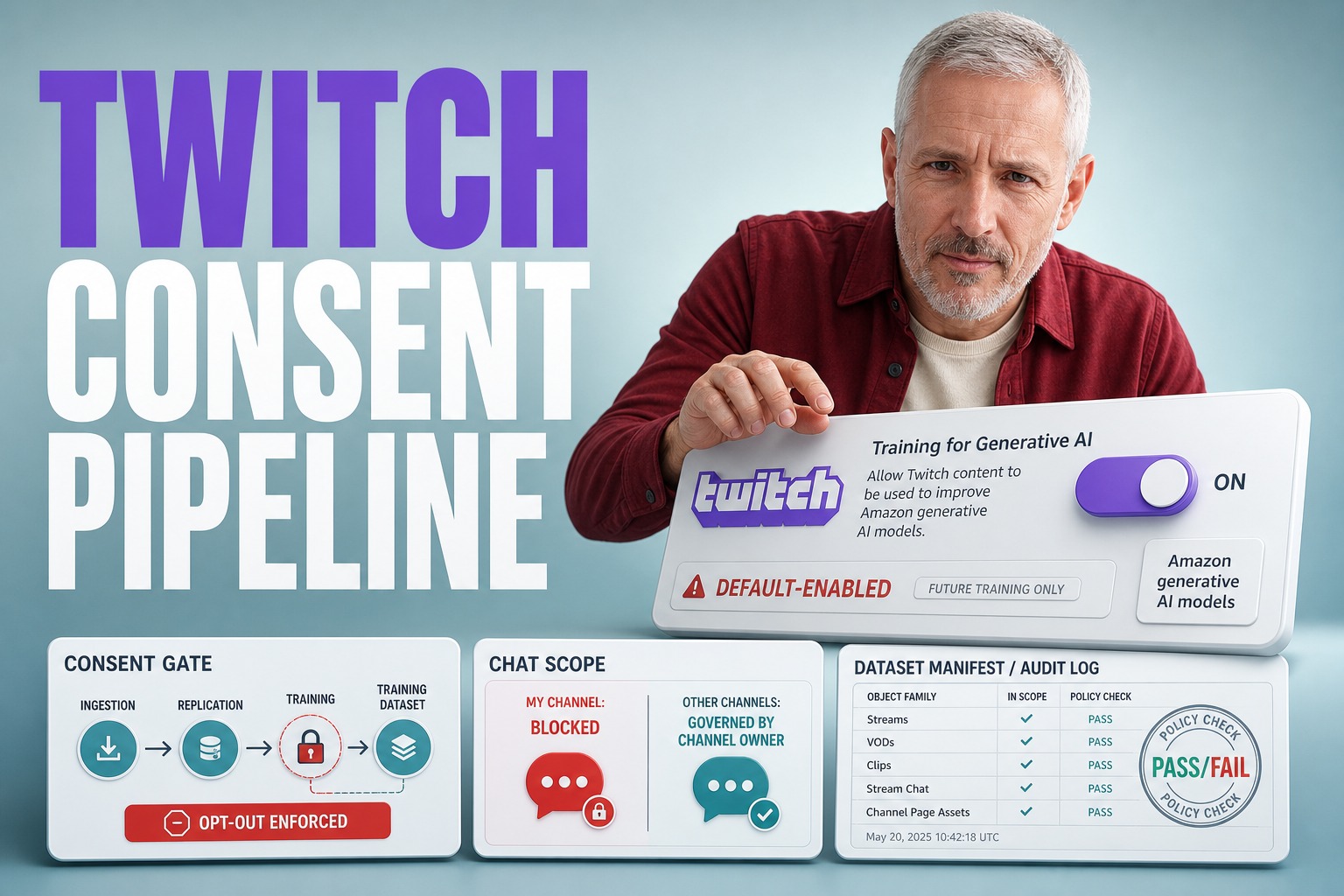
Did Twitch just change how “publishing” works on major platforms? → Yes. As of August 12, 2026, Twitch accounts were automatically enrolled in Amazon’s generative AI training program unless the account owner manually turns off a privacy toggle.
What is the primary engineering question we should be asking? → How do we prevent third-party platforms from turning our streams, VODs, clips, chat logs, and channel assets into generative AI training data without our teams noticing too late?
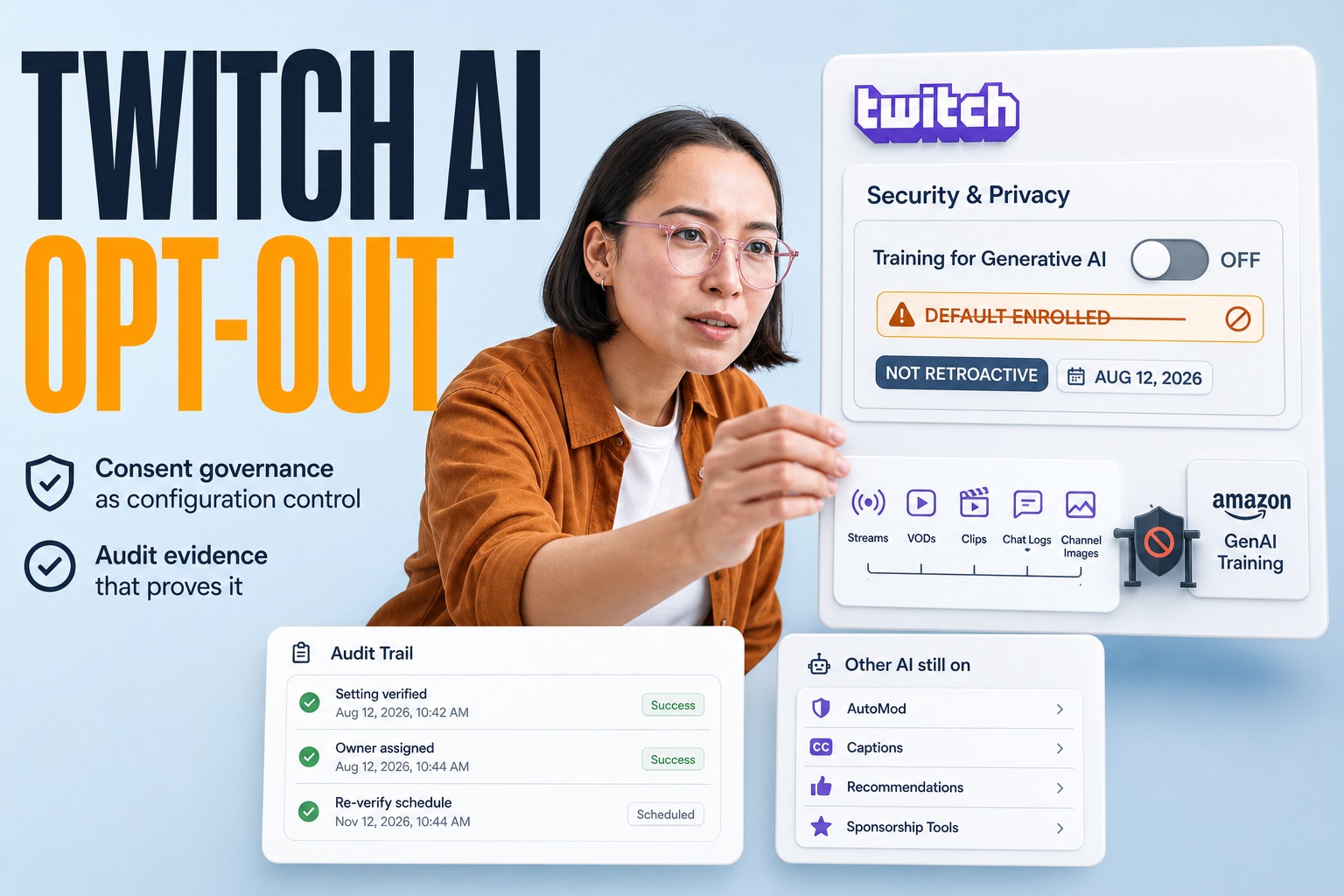
Is there a single switch that makes this risk go away? → No. Twitch’s toggle stops future use for Amazon-wide generative AI training, but it is not retroactive and does not stop Twitch’s other AI uses like AutoMod, captions, recommendations, and sponsorship tools.
Why does this matter this quarter for a CTO or Head of Engineering? → Because default enrollment means your content pipeline is also a data-sharing pipeline, and governance has to move from “policy awareness” to “operational controls” across accounts, assets, and teams.
What’s the non-obvious angle here? → Failures happen at the consent boundary, not the model boundary, which means the right response is architecture and evidence: source-of-truth custody, account configuration management, and audit-grade decision trails.
Twitch default-enrolled creators into GenAI training, and it breaks the old platform publishing playbook
Twitch’s move to automatically enroll every account in Amazon’s generative AI training program (with a manual opt-out toggle) is the clearest signal yet that “posting content” on a platform is no longer a distribution-only act. Our central claim at Plavno is this: default-enrollment AI training breaks the engineering practice of treating third-party platforms as marketing surfaces, so the right response is to engineer platform publishing like data sharing with controls, custody, and auditability.
Author: Plavno team. Last updated: August 2026.
If a platform can flip you into training by default, then “consent” is now an operational dependency; you either manage it like configuration, or you lose it like configuration.
Quick Answer: How do we stop Twitch from using our content to train generative AI?
For Twitch specifically, you stop future use for Amazon-wide generative AI training by turning off the “Training for Generative AI” toggle in Settings, under Security and Privacy, in the Privacy section. This is not retroactive, so anything already ingested stays ingested, and it does not opt you out of Twitch’s other AI processing such as AutoMod, captions, recommendations, and sponsorship tools. Operationally, teams should treat this as a control you must inventory, enforce, and periodically re-verify.
Why this changes engineering practice more than it changes policy language
Twitch’s public distinction that “Twitch is not training GenAI models on streamer content” while Amazon is doing so is the exact kind of boundary that confuses teams in production environments: it sounds like a legal nuance, but for engineers it is a data-flow truth. If your organization streams on Twitch, you must assume your streams, VODs, clips, chat logs, and channel images can become inputs to an Amazon generative AI pipeline unless you opt out. That reclassifies publishing as a data transfer decision.
The real search problem: “Twitch AI training opt-out” is a governance problem, not a UI problem
Most teams will discover Twitch’s generative AI training enrollment the same way they discover any brittle dependency: after a public moment forces attention. The immediate search query is tactical, but the engineering requirement is structural: a buried toggle in Security and Privacy is not a governance system. Governance means knowing which accounts exist, who owns them, what content is published through them, and how the organization proves the settings were configured when it mattered.
- Your “content” includes more than video. Twitch explicitly frames enrollment around a broad set of account outputs: streams, VODs, clips, chat logs, and channel images. For a brand channel, that means your marketing output, your community interaction, and even moderation context can be repurposed into training data unless the toggle is changed. Engineers should read this as multiple data classes leaving your perimeter, not a single media file.
- The control is buried where engineers won’t operationalize it. The toggle sits in Settings, under Security and Privacy, in the Privacy section, rather than in the Creator Dashboard where a streaming team expects to manage publishing and compliance. That placement is a signal: the platform’s default user journey isn’t designed around consent management. If your org has many accounts, a manual UI workflow is not an enforceable control.
- The opt-out only governs future ingestion. Twitch’s opt-out stops future content from training Amazon’s generative AI models, but it is not retroactive, and content already ingested stays ingested. From an engineering perspective, this means you cannot treat “we changed the setting” as remediation for past exposure. If you need remediation, you need different levers than a toggle.
- Other AI processing continues even after opt-out. Twitch’s non-generative AI uses remain: AutoMod, captions, recommendations, and sponsorship tools are still operating on your data. Even if your organization opts out of generative training, you still must evaluate whether these operational AI features create compliance or reputational concerns for your specific content types, audiences, and regulated obligations.
The opt-out toggle is a governance control, not a deletion control
The most common mistake we see is teams treating opt-out as a cleanup mechanism. Twitch’s policy behavior, as stated, makes that impossible: opting out is forward-looking, and it does not remove content that was already ingested prior to the toggle change. If you need a posture that stands up under internal review, you must handle this like any other irreversible data egress: you document when you learned about the setting, when you changed it, which accounts were affected, and how you will prevent drift.
Establish account ownership as an engineering artifact. Identify every Twitch account your organization controls, including legacy, regional, and campaign-specific accounts, and assign an accountable owner who can authorize privacy posture changes and keep evidence of decisions.
Record the current setting state with time context. Since the opt-out is not retroactive, “when we flipped the toggle” is part of the risk story. Treat timestamped evidence as a compliance input, not an optional note.
Decide whether streaming continues under opt-out-only guarantees. If your content has contractual, regulatory, or partner constraints, you may choose to pause publishing until governance controls and approvals are in place, rather than trusting a buried UI switch.
Separate internal source assets from platform derivatives. Maintain your original media, overlays, and brand assets outside Twitch so you can assert what was created internally versus what was published and transformed on the platform.
Create a repeatable re-verification ritual. Because the toggle is a settings-level control, it can drift via role changes, account handoffs, or platform UX changes. Make “verify training setting state” a recurring operational step, not a one-time reaction.
Why opting out of GenAI still leaves other AI processing in place
Twitch’s own description makes a crucial distinction: opting out targets Amazon’s generative AI training, but it does not remove you from Twitch’s other AI uses such as AutoMod, captions, recommendations, and sponsorship tools. For engineers, the practical consequence is that you do not get a single “AI off” switch; you get a single lane closure. That means you must evaluate data exposure by function, not by the marketing label of “AI.”
- AutoMod changes the meaning of chat logs. Even if you opt out of generative AI training, AutoMod still processes community messages to moderate content. In practice, that means chat remains a live operational signal being analyzed, which can matter if your channel includes support workflows, incident discussions, or sensitive partner conversations that you would never place into a third-party moderation pipeline.
- Captions create a parallel text exhaust. Automatic captioning turns audio into structured text, which typically becomes easier to index, search, and route across internal platform systems. Even without generative training, that text exhaust can influence downstream features and analytics. The engineering implication is that “we only streamed video” is no longer a safe simplification.
- Recommendations are an always-on inference surface. Recommendation systems treat your content and audience behavior as inputs. That is operationally different from model training, but it still means your content is part of an optimization loop you do not control. If your brand’s risk posture depends on strict context and placement, algorithmic distribution is part of the compliance discussion.
- Sponsorship tools pull your channel into commercial inference. Twitch explicitly lists sponsorship tools among AI uses that remain. For organizations with strict brand governance, the key question becomes whether commercial matching, categorization, or performance inference creates obligations around disclosures, approvals, and partner constraints.
If you operate on Twitch, you now need a data-processing stance, not a content stance
The engineering decision is no longer “should we stream”; it is “under what data processing assumptions can we stream.” That is a different kind of decision because it requires engineering, security, marketing, and legal to agree on what content is safe to publish when streams, VODs, clips, chat logs, and channel images may flow into Amazon’s generative AI pipeline by default. When teams want to formalize this quickly, we typically start with AI consulting to translate policy language into operational controls.
When opt-out is manual and buried, the risk isn’t that one person forgets; the risk is that nobody can prove they remembered.
Build an off-platform source of truth so policy changes don’t rewrite history
A brand channel should never treat Twitch as the canonical repository of record for media, community logs, or brand assets. Twitch’s setting behavior makes the reason explicit: the platform can default your content into generative AI training, and opting out is not retroactive. If you don’t own a source of truth outside the platform, you cannot even answer basic questions later about what was published, when it was published, and under which privacy posture it was published.
| Architecture stance | What it optimizes for | What it sacrifices |
|---|---|---|
| Twitch as the only repository | Convenience for creators and marketers | Auditability when settings change, and clarity on what existed before opt-out |
| Off-platform master storage + Twitch as distribution | Custody of originals and internal evidence trails | More operational work to manage assets and publishing workflows |
| Segmented publishing (separate accounts/content classes) | Reduced blast radius if one account is misconfigured | Higher governance overhead and increased coordination across teams |
| “No chat as a system of record” posture | Minimizes sensitive data living in platform chat logs | Less context for community operations and support workflows |
Operational controls: account configuration, evidence, and incident response
The Twitch toggle is in Settings under Security and Privacy, which means it is a configuration item, not a contract. Engineers should therefore manage it the way they manage any security-relevant configuration: ownership, change control, and evidence. If your organization has to defend its posture internally, you will want an incident-ready narrative around what happened on August 12, 2026, how you assessed exposure, and how you prevented recurrence. This is also where cybersecurity and penetration testing thinking helps, because consent drift is a security failure mode.
How to evaluate any platform that defaults you into AI training
Twitch is simply a clean case study because the logic was said out loud and the mechanism is visible: default enrollment, a manual opt-out, and a non-retroactive effect. For CTOs, the durable lesson is how to evaluate any platform you publish to, whether it’s a streaming service, a community tool, or a content hosting product. You are looking for the shape of control: where it lives, what it covers, and whether you can prove its state over time.
| Evaluation question | What Twitch’s described behavior implies | What engineers should assume going forward |
|---|---|---|
| Is AI training opt-in or opt-out? | It is opt-out by default enrollment | Defaults matter more than policy prose because most accounts will keep defaults |
| Is opt-out retroactive? | No; content already ingested stays ingested | Settings changes are not remediation for past exposure |
| Does opt-out cover all AI use? | No; AutoMod, captions, recommendations, sponsorship tools remain | You must model “AI use” as multiple independent lanes |
| Is the control discoverable in the creator workflow? | It is not in the Creator Dashboard | If the control is buried, you must operationalize it yourself or accept drift |
Decision logic when the platform offers only buried opt-out
When a platform’s AI training control is hidden in general privacy settings, teams often respond with a one-time scramble and then move on. That is the wrong operating model because the platform has signaled the expected behavior: most users will stay opted in unless they actively hunt down the toggle. The decision logic we use is whether your organization can sustain ongoing verification and whether your content risk profile can tolerate non-retroactive exposure.
- If your content is high-sensitivity, treat default enrollment as a go/no-go gate. For regulated industries, legal matters, or high-stakes brand environments, the non-retroactive rule is the key constraint. If you cannot accept that anything streamed before a change remains ingested, you should not publish until the setting is verified across every account and there is a documented approval.
- If your organization has multiple channel operators, assume settings drift. A buried UI setting will be toggled inconsistently across teams, especially with contractor support, rotating marketers, or partner-managed channels. The engineering answer is to centralize account control and make “settings state” something you can evidence, not something you assume.
- If chat is operational, reclassify it as data exhaust with long-term consequences. Twitch includes chat logs in the content types relevant to training. Even if your team thinks of chat as ephemeral, it is a durable artifact in platform systems. Operationally, that means you should decide what categories of support, escalation, and customer detail are never allowed in chat.
- If you are streaming for community trust, default enrollment becomes a reputational risk. Even when the setting is toggled off later, your audience may ask whether prior streams or logs contributed to training. The ability to answer credibly depends on evidence, not on good intentions.
- If you can’t staff governance, reduce the surface area. Rather than trying to perfect compliance across many accounts and formats, organizations often do better by narrowing what is streamed, limiting who can publish, and constraining which assets ever touch the platform.
What to monitor after you flip the switch
Opting out is the start of operations, not the end. Twitch’s setting is located in a part of the UI that is easy to forget, and the platform can evolve its privacy and AI policies over time. If your organization continues to stream, you need a lightweight monitoring posture that is realistic for the team you have. The goal is not paranoia; it is preventing silent re-enrollment, role-based misconfiguration, or policy drift from undermining your stated posture.
- Monitor for account handoffs and role changes. The biggest operational risk is that the people who know about the toggle leave the project, and the next operators inherit defaults. If your channel runs across marketing, partnerships, or agencies, role churn is normal; build a handoff process that includes verifying the “Training for Generative AI” setting.
- Monitor for workflow changes that bypass the usual owner. If publishing becomes decentralized, someone will spin up a new account for a campaign, and it will be auto-enrolled. Because Twitch default-enrolled every account as of August 12, 2026, the safe assumption is that new accounts will follow the same pattern unless explicitly set otherwise.
- Monitor the difference between “Twitch” and “Amazon” in internal comms. Twitch’s framing that Amazon trains models while Twitch does not can cause stakeholders to misunderstand risk ownership. Engineers should keep the narrative simple: if data flows to Amazon’s generative AI pipeline, the organization’s exposure is real regardless of internal corporate boundaries.
- Monitor which AI features remain in scope even after opt-out. AutoMod, captions, recommendations, and sponsorship tools remain operational. Teams should periodically revisit whether those features create new obligations for disclosure, moderation policy, or customer messaging, especially if the channel’s purpose evolves.
Real deployments: what this changes for media teams, esports, and customer communities
We see the same pattern across organizations that treat Twitch as a serious channel: the more the stream becomes part of business operations, the more chat logs and VODs become business records. When that material can be fed into Amazon’s generative AI training by default, engineering leaders need to decide whether to re-architect workflows so sensitive operations never happen in-platform. Teams that automate moderation, routing, and publishing often connect this to AI automation work so the process doesn’t depend on one person remembering a hidden setting.
Risks and limitations that survive the opt-out
Even after you turn off Twitch’s “Training for Generative AI” toggle, the situation is not “fixed” in the sense most executives mean. Twitch’s described behavior makes two limitations explicit: the opt-out is not retroactive, and it does not disable Twitch’s other AI systems. On top of that, the setting is a UI control, which means your real risk is operational: inconsistent application across accounts, loss of evidence, and a mismatch between what stakeholders believe and what the platform actually does.
Irreversibility of past ingestion. Twitch’s opt-out is not retroactive, and content already ingested stays ingested. The practical limitation is that you cannot unwind exposure for streams, VODs, clips, chat logs, or channel images published before the change.
Partial scope of control. Opting out affects Amazon’s generative AI training, but it does not remove your data from Twitch’s other AI uses like AutoMod, captions, recommendations, and sponsorship tools. If your risk posture depends on “no AI processing,” the toggle does not meet that requirement.
Discoverability and compliance drift. The toggle is in Settings under Security and Privacy, not where creator workflows typically live. Over time, that makes consistent enforcement fragile, especially across teams, agencies, or multiple channel owners.
Narrative ambiguity across stakeholders. Twitch’s statement that it is not training models while Amazon is can confuse decision-makers into thinking the risk is smaller than it is. For engineering leadership, ambiguity is itself a risk because it undermines consistent policy and operational response.
Reputational exposure independent of technical compliance. Even if you opt out promptly, audiences and partners may view default enrollment as unacceptable. Your ability to respond depends on what you can prove about timing, settings state, and what content categories were published when.
Plavno’s position: architecture and governance beat policy hope
At Plavno, we don’t treat default enrollment into generative AI training as a “creator settings issue”; we treat it as a platform dependency that must be engineered. The right response is to design for custody of originals, controlled publishing, and evidence that survives team turnover and policy shifts, especially when opt-out is non-retroactive. When organizations want to productize that posture, we typically build the workflow layer around it through AI agents development so governance is embedded in how work gets done.
- Build a publishing pipeline that separates creation from distribution. We design systems where the organization’s master assets and approval trail live outside the platform, and Twitch is treated as a downstream distribution endpoint. That way, if a platform changes defaults again, the organization still has custody, provenance, and internal clarity on what was published under which assumptions.
- Make account settings enforceable, not tribal knowledge. The Twitch toggle is easy to miss and easy to forget. We operationalize it by consolidating ownership, restricting who can create or manage accounts, and creating an evidence trail that can be reviewed by security, legal, and leadership without relying on memory.
- Classify chat and clips as business data when the business uses them that way. Because Twitch explicitly includes chat logs and clips in the content types relevant to training, we treat them as data assets with a risk profile. That leads to practical policy: what can be discussed in chat, what must move to controlled channels, and what gets archived outside the platform.
- Design stakeholder messaging around what the toggle does and does not do. The dangerous failure mode is executives believing the opt-out “fixed everything.” We craft internal communication and external posture that is precise: opt-out stops future generative AI training use, is not retroactive, and does not disable other AI features like AutoMod, captions, recommendations, and sponsorship tools.
- Prepare for the next policy shift, not just this one. Twitch is a template for a broader pattern: default enrollment because opt-in would reduce participation. Our architecture stance assumes these defaults will recur across platforms, and we build governance that can be ported across channels rather than rebuilt each time.
 Chat GPT
 Perplexity
 Claude
 Gemini