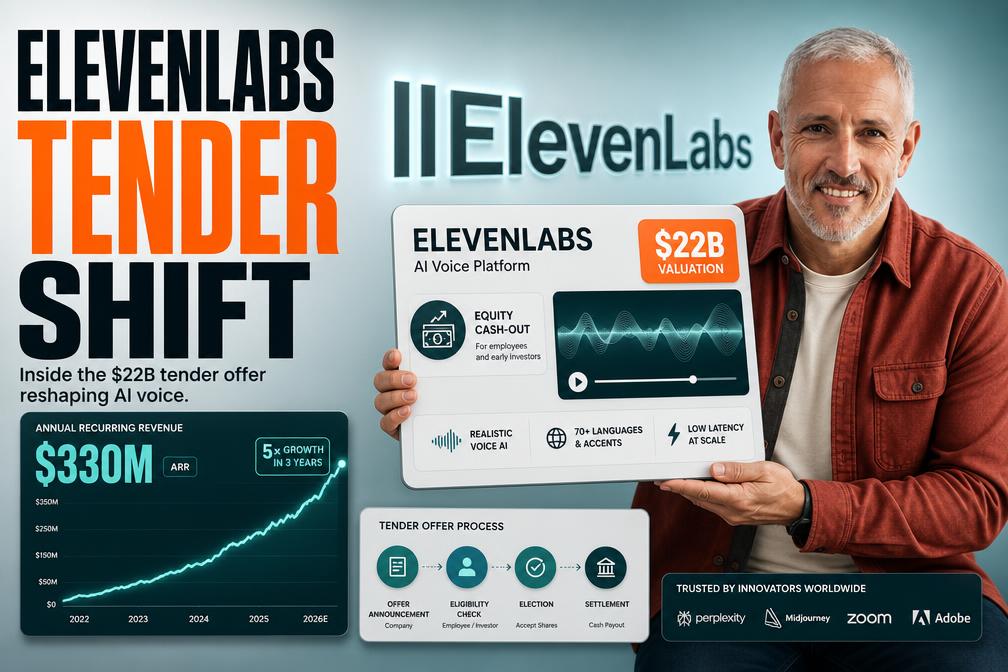
What is a secondary tender offer and how does it differ from a primary funding round? → A tender offer lets existing shareholders sell shares to new investors without issuing fresh equity, providing liquidity without dilution.
Why does ElevenLabs’ $22 B valuation matter to other AI startups? → The size and speed of the jump set a new benchmark that can distort hiring expectations across the sector.
Can a tender offer improve talent retention without an IPO? → Yes, because it puts a concrete cash value on employee equity, making private‑company jobs financially competitive.
What should a CTO ask before supporting a tender offer? → The CTO must assess whether the valuation reflects product fundamentals or merely market hype, and whether the resulting hiring incentives align with long‑term engineering goals.
What a $22 B Tender Offer Really Means for Your AI Startup
The headline‑grabbing $22 billion secondary sale for ElevenLabs is not a fresh cash infusion; it is a liquidity event that re‑prices existing shares. For engineering leaders, the signal is that valuation can now be decoupled from the balance sheet, meaning the market can assign a premium based on hype, talent demand, or strategic positioning rather than on revenue or product maturity. This shift forces CTOs to treat the valuation as a hiring lever, not as a guarantee of sustainable growth.
- Liquidity without dilution – Employees cash out without shrinking the ownership pool of the founders.
- Market‑driven price tag – The $22 B figure is set by investor appetite, not by disclosed financials.
- Retention shortcut – A tender puts a tangible cash value on private‑company equity, reducing turnover risk.
- Disclosure gap – Secondary sales carry fewer reporting requirements, leaving less visibility into the company’s actual performance.
- Strategic signaling – The high valuation can be used to attract top talent and partners, even if the underlying metrics are modest.
Why the Valuation Spike Is Not a Funding Event
ElevenLabs’ latest tender does not add capital to its balance sheet; instead, it reshuffles ownership among existing and new investors. The company’s reported $330 million ARR remains unchanged, and the $22 billion headline is a market‑derived multiple rather than a reflection of cash flow. For CTOs, this means the headline cannot be used as a proxy for product health, and engineering roadmaps must still be justified on revenue growth, not on a headline‑driven valuation.
| Aspect | Primary Funding Round | Secondary Tender Offer |
|---|---|---|
| Capital Inflow | Fresh cash for R&D, hiring, and expansion | No new cash; liquidity only for existing shareholders |
| Dilution | Shares issued, reducing existing ownership percentages | Ownership percentages stay the same; only share holders change |
| Disclosure | Full regulatory filing, detailed financials required | Limited reporting; valuation set by private negotiation |
| Market Signal | Investor confidence in growth trajectory | Investor confidence in market hype and talent retention |
How Tender Offers Shift the Retention Equation
When a company like ElevenLabs offers a secondary sale, it effectively monetizes employee equity ahead of an IPO. This creates an immediate financial incentive for engineers to stay, because the upside is no longer a distant promise. However, the trade‑off is that the company may feel pressure to meet a valuation‑driven narrative, potentially accelerating product releases at the expense of engineering rigor. The retention boost must therefore be balanced against the risk of compromising long‑term technical debt management.
- Immediate cash reward – Engineers can cash out a portion of their shares, reducing personal financial risk.
- Reduced turnover pressure – With a tangible payout on the table, the lure of competitor offers weakens.
- Potential speed‑up expectations – Stakeholders may demand faster product milestones to justify the high valuation.
- Alignment challenges – Compensation packages may become misaligned with actual performance incentives.
- Future dilution risk – If the company later raises a primary round, early cash‑out participants may see their remaining stake diluted.
The Engineering Implications of a Rapid Valuation Leap
A valuation that jumps from $3.3 billion to $22 billion in eighteen months can create a false sense of security for engineering teams. The pressure to deliver headline‑worthy features intensifies, and the temptation to cut corners on testing, observability, or scalability grows. Moreover, the lack of fresh capital means that any additional engineering spend must be financed from existing cash reserves, which can constrain hiring and tooling budgets. CTOs must therefore guard against over‑promising on performance while the market narrative inflates expectations.
Liquidity Without Dilution – The Hidden Trade‑off
Providing liquidity through a tender offer satisfies employee cash‑flow needs, but it also removes a lever that could be used to fund strategic engineering initiatives. Without new equity, the company cannot tap the capital markets to expand its compute infrastructure, hire senior architects, or invest in long‑term research. Consequently, the engineering organization may face resource constraints precisely when the market expects rapid product expansion.
Key rule: A secondary tender offers liquidity, not capital; treat it as a talent‑retention instrument, not a growth engine.
Why CTOs Must Treat the Tender as a Strategic Hiring Tool
The tender’s primary value lies in its ability to convert private‑company equity into cash for employees. This conversion changes the compensation calculus for engineers who might otherwise wait for an IPO or a large primary round. By positioning the tender as a recruitment differentiator, CTOs can attract senior talent that values immediate financial upside. At the same time, they must ensure that the engineering roadmap remains grounded in realistic delivery timelines, because the market’s valuation expectations will not soften.
Leveraging our AI agents development and AI consulting services can help align the tender with product strategy. CTOs should also consider how this aligns with broader digital transformation initiatives.
The Risk of Over‑valued Talent Packages
When compensation is anchored to a $22 billion valuation, engineers may develop expectations that outpace the company’s actual revenue trajectory. If future product releases lag, the disconnect can trigger attrition spikes, especially if competitors offer more modest but realistic equity stakes. Moreover, inflated packages can distort internal salary bands, making it harder to onboard mid‑level talent without creating pay inequities.
Principle: Align equity incentives with verifiable product milestones, not with speculative market caps.
Balancing Product Moat Development with IPO Timelines
ElevenLabs aims for an IPO within two to three years, a timeline that is now compressed by the $22 billion valuation stamp. Engineering leaders must decide whether to prioritize rapid feature delivery to meet investor expectations or to invest in building a defensible moat—such as unique voice‑cloning algorithms, robust data pipelines, and compliance frameworks. The right balance preserves long‑term value and reduces the risk of a post‑IPO performance dip.
Practical Steps to Evaluate a Secondary Sale for Your Team
Before endorsing a tender, CTOs should run a disciplined assessment that weighs liquidity benefits against strategic costs. First, quantify the cash‑out impact on the existing equity pool and model how remaining options will be allocated to future hires. Second, audit the product roadmap to ensure that any acceleration required by a high valuation does not compromise quality or security. Third, engage with finance and legal teams to understand the limited disclosure obligations of a secondary sale, and how they affect investor transparency.
Our expertise in AI voice assistant development and outstaffing can further support the execution of these steps.
Map equity dilution scenarios – Model how different cash‑out percentages affect future option pools.
Validate revenue assumptions – Cross‑check the $22 billion multiple against disclosed ARR and growth rates.
Assess talent market impact – Survey competing offers to gauge whether the tender truly improves retention.
Plan engineering resource allocation – Determine if existing budgets can sustain accelerated delivery without new capital.
Define post‑tender milestones – Set concrete product and compliance goals that align with the heightened valuation.
Real‑World Scenarios Where Tender Offers Changed the Game
In the fintech sector, a mid‑stage startup used a secondary tender to lock in its senior engineers ahead of a regulatory rollout, preventing a talent exodus that could have delayed critical compliance work. Similarly, a health‑tech firm leveraged a tender to fund a rapid expansion of its AI‑driven diagnostic platform, but later faced backlash when the product failed to meet promised accuracy thresholds, exposing the danger of over‑promising on a valuation‑driven narrative.
Takeaway: Use tender offers to secure talent, but never let a headline valuation dictate engineering priorities.
Bottom Line for Engineering Leaders
The ElevenLabs $22 billion tender illustrates that valuation can become a strategic HR lever separate from capital raising. CTOs must therefore treat the event as a recruitment and retention mechanism, while rigorously anchoring engineering plans to real product metrics. By decoupling headline value from cash flow, organizations can avoid the trap of chasing market hype at the expense of technical excellence. The disciplined approach—valuing talent, protecting the product moat, and aligning incentives with measurable outcomes—will ensure that a lofty valuation translates into sustainable growth rather than fleeting hype.
 Chat GPT
 Perplexity
 Claude
 Gemini