12 Voice AI Agent Use Cases With Real Call-Center Metrics
12 Voice AI Agent Use Cases With Real Call-Center Metrics
October 19, 2026· min read·#AI#Tech·Reviewed by Plavno AI Engineering Team
The voice AI use cases with clearest lift are support triage, banking inquiries, appointment booking, logistics tracking, and delivery support when workflows are structured. The comparison reviews 12 scenarios by call-center impact, integration complexity, compliance needs, and repeatability.
Share this post
voice AI use cases are now measured less by novelty and more by call-center metrics: containment, first-call resolution, workload reduction, booking speed, and escalation quality. This ranked roundup uses Plavno delivery data to show where conversational automation creates the clearest operational lift.
The list is built for operations leaders, CX teams, product owners, and founders comparing practical AI phone agent use cases before investing in a custom assistant.
QUICK ANSWER
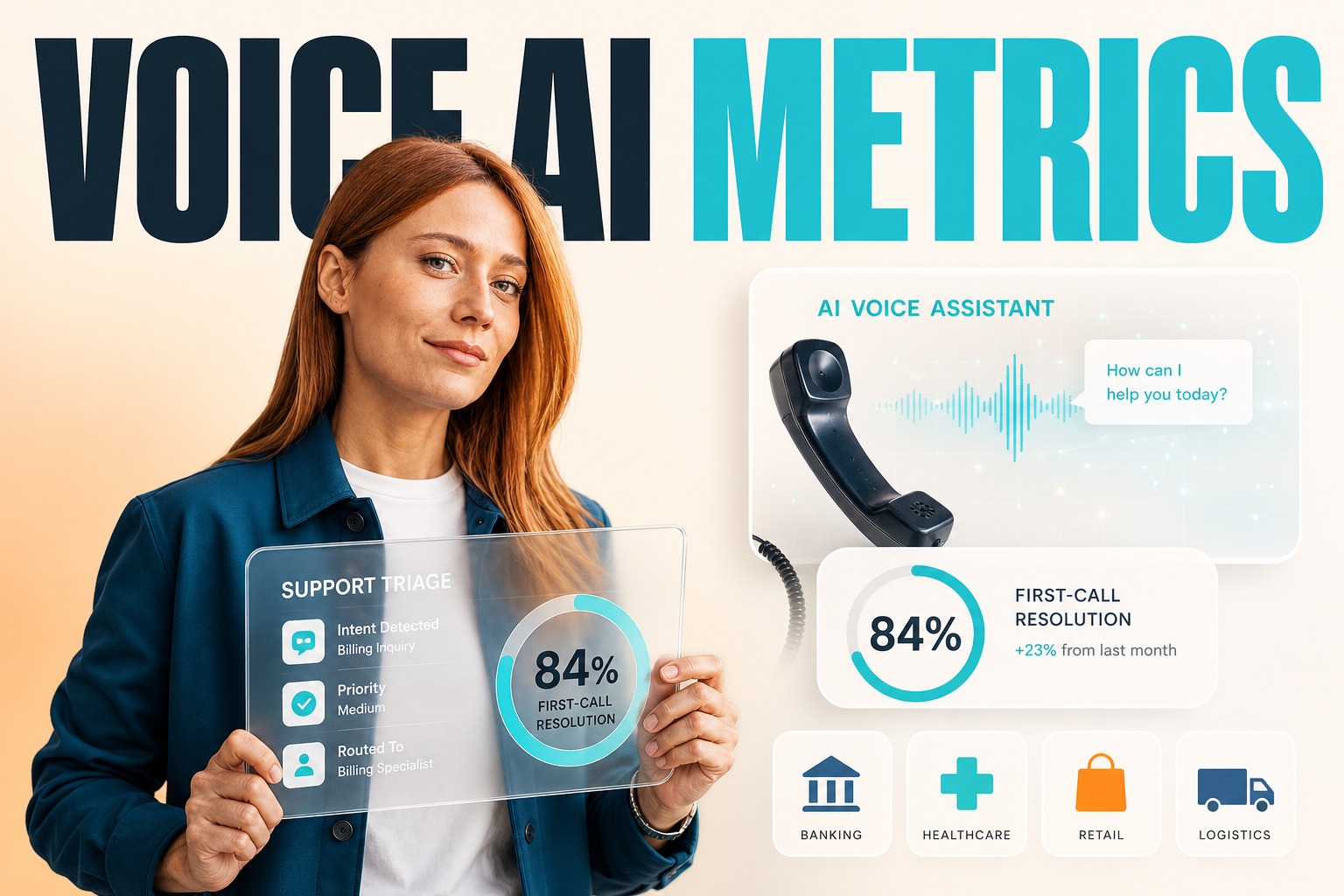
voice AI use cases with the strongest Plavno results are support triage with 84% first-call resolution, banking inquiries with 82% resolved without humans, appointment booking that runs 42% faster, logistics tracking with 60% self-service, and food-delivery automation that cuts call-center workload by 67%.
voice AI use cases were ranked by production value, measurable call-center impact, integration complexity, and repeatability across industries. We weighted outcomes from Plavno delivery work higher than demo potential, especially where STT, TTS, RAG, SIP, CRM APIs, and sub-700 ms response design affected live calls.
Production cases with measurable containment, resolution, or speed gains.
Stack depth across telephony, CRM, ERP, scheduling, payments, and knowledge bases.
Compliance readiness for SOC 2, HIPAA, PCI DSS, GDPR, and audit logs.
Pricing transparency around build cost, usage, $/min telephony, and maintenance.
Team support for conversation design, QA, analytics, and post-launch tuning.
1. Support Triage
Best for: Service desks with repetitive inbound queues
84% first-call resolution made this the top-ranked use case because the assistant solved common requests before routing to humans. Plavno’s implementation used intent classification, CRM lookup, RAG over support policies, and escalation rules for edge cases. The honest limitation is scope control: if teams automate too many intents at launch, fallback quality drops. Learn more about Plavno’s voice assistant work at AI voice assistant development.
2. Food-Delivery Order Support
Best for: Food delivery platforms and marketplaces
67% lower call-center workload came from automating order status, courier delays, refunds, and restaurant availability. In the Plavno food-delivery case, the assistant connected to order APIs and used conversational voice AI to handle peak-hour surges without adding agents. It is one of the clearest voice AI agent examples because the questions are urgent but structured. The main limitation is dependency on clean real-time order data. See the case at AI voice assistant for food delivery.
3. Banking Inquiry Automation
Best for: Banks handling balance, card, branch, and product calls
82% of banking inquiries resolved without humans showed how far automation can go when authentication and knowledge boundaries are clear. The assistant handled account FAQs, card blocking guidance, branch hours, loan eligibility pre-checks, and handoff to verified agents. Plavno designed the flow with secure identity checks, PII masking, audit logs, and role-based access. The limitation is that regulated advice still needs human review.
4. Healthcare Appointment Booking
Best for: Clinics, diagnostic centers, and provider networks
42% faster appointment booking came from replacing receptionist back-and-forth with real-time slot matching. The assistant captured symptoms, insurance details, preferred locations, and provider availability through scheduling APIs. For healthcare teams, voice AI for call centers works best when it respects consent, HIPAA safeguards, and clear escalation. The limitation is that ambiguous clinical intent must route to trained staff.
5. Logistics Tracking
Best for: Carriers, 3PLs, and shipment-heavy retailers
60% self-service in logistics tracking reduced “where is my order” calls by connecting voice flows to TMS, WMS, and carrier APIs. The assistant provided ETA, delivery exceptions, pickup status, proof-of-delivery notes, and escalation for lost parcels. This is one of the most practical AI phone agent use cases because the caller usually needs one verified answer. The limitation is API freshness across subcontracted carriers.
6. Voice Routing
Best for: Multi-skill call centers with frequent transfers
31% fewer misrouted calls was achieved by replacing static IVR menus with natural-language intent capture. The assistant detected language, urgency, sentiment, and customer tier before sending calls to the right queue. Plavno typically uses SIP integration, ASR confidence thresholds, and routing analytics; the implementation pattern is covered in AI voice routing for call centers. The limitation is that routing rules need active governance as products change.
AI AUTOMATION
Ready To Reduce Call Volume?
Design a secure voice assistant around your queues, systems, compliance needs, and measurable support KPIs.
Best for: Fintech, utilities, subscriptions, and lending teams
28% higher successful promise-to-pay capture came from timely outbound calls that confirmed identity and offered approved payment options. The agent used policy-safe scripts, payment-link delivery, retry scheduling, and CRM notes after every interaction. This automation improves conversational voice AI ROI when agents spend too much time on low-complexity reminders. The limitation is strict compliance review for collection language.
8. Insurance FNOL Intake
Best for: Claims teams receiving first notice of loss calls
45% more structured claim records resulted from guiding callers through incident details, location, photos, injuries, and policy context. The assistant summarized calls into claim-management fields instead of leaving agents to interpret long recordings. It can ask calm follow-up questions while preserving escalation for emotional or severe events. The limitation is that coverage decisions should remain outside the bot.
9. Retail Returns
Best for: E-commerce brands with seasonal call spikes
36% fewer repetitive return-status calls came from connecting the assistant to order, warehouse, and refund systems. It verified order IDs, checked eligibility windows, generated return labels, and explained refund timing. These call automation use cases work well because policies are rule-based and easy to test. The limitation is exception handling for damaged items, fraud signals, and marketplace orders.
10. HR Candidate Screening
Best for: Recruiting teams with high applicant volume
52% faster first-round screening was achieved by asking consistent qualification questions and syncing transcripts to ATS records. The voice agent confirmed availability, salary expectations, location preferences, language skills, and role-specific requirements. Recruiters still reviewed summaries and edge cases, which kept hiring decisions human-led. The limitation is candidate experience: tone, pacing, and opt-out options must be carefully tested.
11. Travel Disruption Calls
Best for: Airlines, hotels, OTAs, and travel support teams
39% faster disruption triage came from identifying reservation records, trip urgency, loyalty tier, and preferred alternatives before agent handoff. The assistant could explain cancellation rules, collect rebooking constraints, and prioritize stranded travelers. This is useful when weather, strikes, or system outages overwhelm live teams. The limitation is inventory volatility, so integrations must refresh availability in seconds.
12. Voice Security Checks
Best for: Regulated teams worried about fraud and impersonation
24% fewer risky authentication handoffs came from adding fraud-aware checks before sensitive requests reached agents. Plavno combined caller verification, anomaly flags, knowledge-based questions, and escalation for suspicious behavior. Security matters more as AI voice agents become easier to imitate; see Plavno’s guidance on preventing AI voice cloning scams. The limitation is that voice biometrics should complement, not replace, layered authentication.
When a Voice Automation Platform Is Enough vs When to Build Custom
A standard platform is enough when voice AI use cases involve simple FAQs, one CRM, and low-risk routing. Build custom when calls touch regulated data, multiple back-office systems, real-time inventory, payments, or domain-specific workflows. Custom development also fits when your target metric is not just containment, but first-call resolution, agent productivity, and audit-ready quality. If you expect complex integrations, start with a discovery sprint and a narrow production pilot.
FAQ
What are the most common voice AI use cases? → The most common examples are support triage, order status, appointment scheduling, banking FAQs, logistics tracking, payment reminders, claims intake, returns, recruiting screening, and intelligent routing.
How do you measure the ROI of voice AI? → Measure containment rate, first-call resolution, average handle time, transfer rate, cost per call, missed-call recovery, CSAT, and agent hours saved. Strong conversational voice AI ROI usually appears when automation removes repetitive calls without hurting escalation quality.
What data is needed before launching a voice agent? → You need call recordings, intent categories, FAQs, CRM fields, API access, escalation rules, compliance requirements, and baseline metrics such as call volume and average handle time.
Can a voice assistant integrate with existing call-center tools? → Yes. A custom assistant can connect through SIP, contact-center APIs, CRM systems, scheduling platforms, payment gateways, and analytics dashboards.
The best voice AI use cases are not the flashiest; they are the ones tied to measurable operational friction. Start with a call category where volume is high, data is structured, and escalation rules are clear, then expand after proving containment and resolution. To move from shortlist to pilot, Automate your inbound calls with a focused assistant built around your systems.