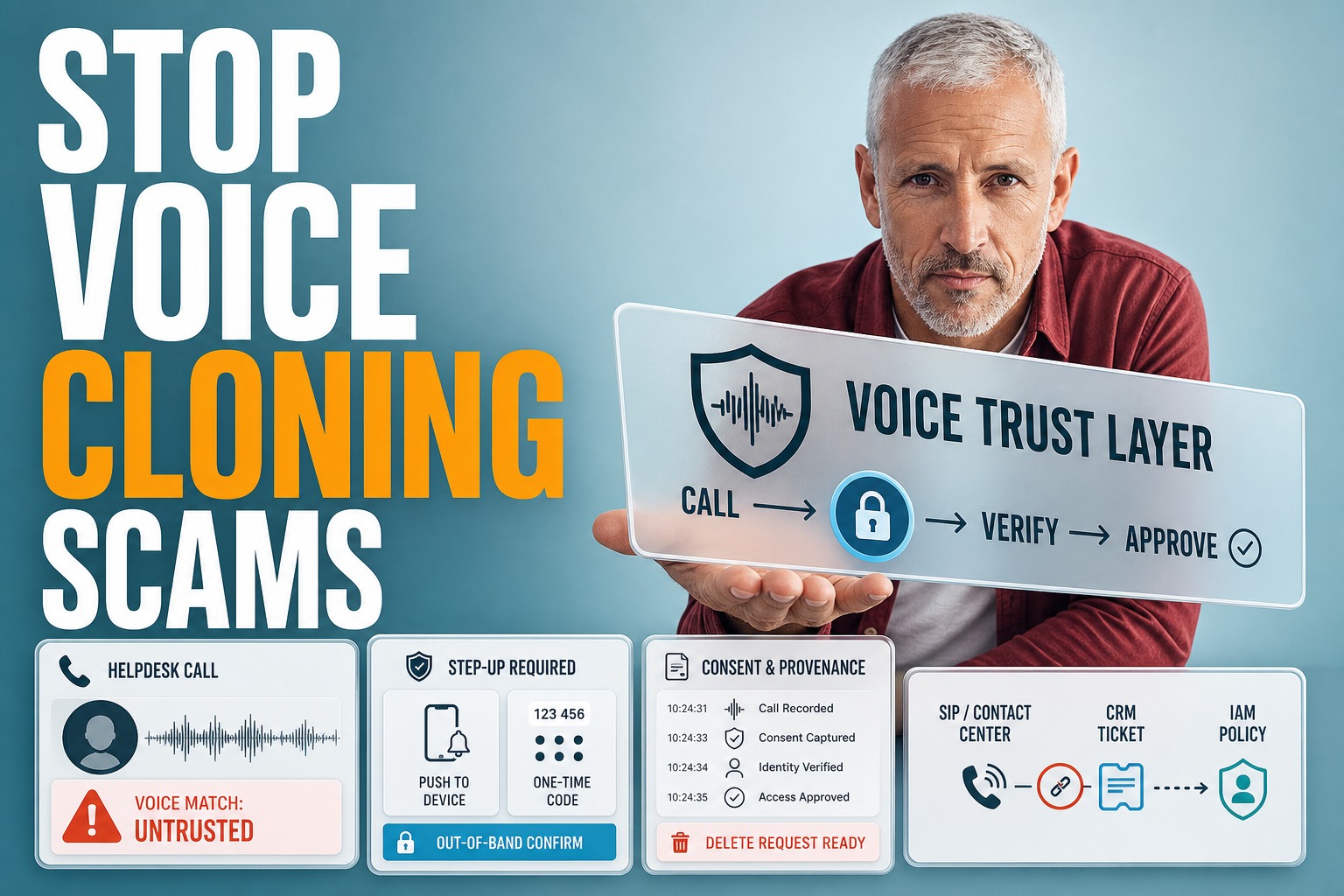
What’s the dominant shift this week? → Voice cloning is moving from a niche media concern to a mainstream identity and fraud vector, triggering public campaigns and pushing lawmakers toward “voice ownership” rights.
What’s the business/technical question teams are searching for? → How do we prevent AI voice cloning scams against our call center, helpdesk, and approvals flows without killing customer experience?
Why does it matter now, not “someday”? → A campaign backing letter and petition activity is explicitly framing voice as identity, while Denmark is already reforming laws to grant ownership over face, body, and voice.
What’s the engineering decision this quarter? → Whether to keep using voice as an authentication factor and whether to ship voice AI features without a consent and provenance layer.
What’s our angle at Plavno? → Most failures happen at the boundary between telephony, identity, and operations, so the right fix is architectural: treat voice as a high-risk biometric signal and redesign the workflow around verification, consent, and traceability.
Quick Answer: how to prevent AI voice cloning scams in production systems
If your business relies on phone calls to reset passwords, approve payments, or escalate support, assume voice can be copied and plan controls accordingly. A campaign cited this week claims that with the right AI system a voice can be cloned in three seconds, and also claims that 28% of UK adults report being targeted by a voice-cloning scam; whether your organization operates in the UK or not, the practical takeaway is that voice is no longer a reliable “something you are” factor on its own.
At Plavno, we recommend designing call and voice-assistant flows so that the caller’s voice is never the sole gate to account-level actions. Put a verification step that does not depend on voice timbre in front of sensitive actions, add provenance and consent for any voice synthesis you deploy, and instrument the workflow like a fraud system: logging, step-up verification, and incident response. This is less about picking an “anti-deepfake model” and more about re-architecting identity boundaries.
Central claim: voice cloning breaks authentication at the workflow boundary, so architecture matters more than “better models”
Voice cloning is being publicly reframed as theft of identity, not just theft of content, and that reframing breaks a common engineering shortcut: treating the phone channel as “trusted” because a human voice is present. When actors and campaigners push for ownership of voice as a statutory right, and when Denmark moves toward legal ownership over face, body, and voice, it implies that the technical center of gravity is shifting from media tooling to identity governance and compliance.
Our central claim is simple and arguable: voice-cloning risk is primarily a workflow and identity-boundary problem, not a model-quality problem, and the right response is to redesign phone and voice-AI flows so they never hinge on voice alone, while adding explicit consent and provenance for any synthetic voice output. Engineers can disagree and try to “detect deepfakes” as the primary strategy; we see that approach fail most often where systems hand off responsibility between telephony, CRM, and IAM.
The news signal engineers should take seriously: “ownership of voice” is becoming a systems requirement
The immediate signal isn’t celebrity involvement; it’s that campaigns are demanding enforceable ownership and removals of unauthorized AI content, and Denmark is already reforming law to give citizens legal ownership over face, body, and voice. That direction changes what CTOs need to build because voice stops being “an asset you can record” and becomes a protected attribute that needs consent, retention limits, and a deletion path across vendors.
Even if your company is not in Denmark or the UK, US teams should treat this as an early warning for procurement and architecture. Once “voice ownership” enters policy, engineering teams inherit obligations: where voice is stored, how it is shared with transcription or TTS vendors, how consent is captured, and how “remove my voice” is executed across call recordings, training sets, and generated content caches. The operational work is upstream of any one AI model.
“Three seconds to clone” changes the threat model from rare forgery to routine automation
When a public campaign says a voice can be cloned in three seconds with the right AI system, it effectively tells criminals and red teams the same thing: this can be industrialized. In practice, that pushes voice attacks into the category of credential stuffing and phishing—repeatable, scalable, and aimed at the weakest workflow. The right engineering response is to assume the attacker can obtain a sample, then focus on reducing what voice alone can unlock.
Where voice-based systems actually fail: helpdesk identity, not speech synthesis
Most enterprises don’t get “deepfaked” in a Hollywood way; they get socially engineered through the seams of their systems. A typical failure path starts with a call into a helpdesk line, runs through a CRM lookup, and ends with an agent or automated IVR initiating a password reset, MFA reset, bank detail change, or escalation to privileged support. The attacker’s advantage is not perfect audio; it’s that the workflow was designed for speed and empathy, not adversarial verification.
Architecturally, these flows often span vendors and protocols: telephony (SIP trunks or a cloud contact center), call recording and transcription, CRM (like a ticketing system), and IAM (SSO, MFA, device trust). Each layer has its own logs and its own notion of identity. If you rely on “the voice sounds right” to bridge those layers, you create an authentication boundary with no cryptographic anchor.
The most important shift we recommend is to treat voice as a potentially compromised identifier and to move “proof” into verifiable signals: possession factors, out-of-band confirmation, and policy-driven step-up controls that your IAM and ticketing systems can enforce consistently.
The contact-center handoff is the highest-risk integration point
A real scenario we see: a caller convinces an agent (or a bot) to change an email address on file, then uses that change to trigger downstream password resets. The telephony platform logs the call; the CRM logs the ticket; the IAM logs an eventual login. Without a joined-up identity event, the organization cannot tell whether the “caller identity” was ever verified, so remediation becomes guesswork.
The trade-off is customer experience. If you add friction everywhere, you lose conversion and CSAT; if you add friction nowhere, you accept fraud. The engineering goal is to place friction only where the blast radius is large: account recovery, payment approvals, and privileged changes.
- Voice-as-trust shortcut: teams treat the phone channel as inherently “human,” so agents override policy under pressure.
- Unverifiable identity handoffs: telephony, CRM, and IAM store different identifiers, and no system owns the end-to-end proof.
- Overbroad permissions: frontline roles can trigger high-impact actions because the workflow was built for speed.
- Vendor opacity: transcription, analytics, and TTS providers process audio, but consent and retention are not mapped to technical controls.
The architecture response: treat voice as a biometric signal that cannot be your only factor
Once you accept that voice can be replicated, the architecture pattern changes. Voice becomes a biometric-like signal that can help route, personalize, or reduce friction, but it cannot be the single gate for sensitive operations. This is the same mental model security teams already apply to caller ID: useful context, not proof.
In practice, this means revisiting where “authorization” really happens. If your contact center can reset MFA, then MFA reset is the protected action, not the phone call. Put policy there: require a second factor not derived from voice, require an existing authenticated session, require approval via a known device, or require a time-delayed change with notification. The specific mechanism will vary, but the governing principle is consistent: high-impact actions need an independent proof.
The trade-off is implementation complexity across systems. You will touch telephony routing, agent desktop UX, CRM workflows, and IAM policies. But that complexity is exactly where voice attacks live, and tackling it reduces risk far more than chasing perfect deepfake detection.
| Workflow element | What breaks with voice cloning | Architectural mitigation |
|---|---|---|
| Account recovery over the phone | “Sounding like the user” becomes sufficient | Step-up verification through IAM policy and out-of-band confirmation |
| Voice assistants for support | Synthetic voice can pressure users into unsafe actions | Constrain what the assistant can execute; require explicit confirmation for protected actions |
| Call recordings and training data | Voice becomes a protected attribute with consent expectations | Consent capture, retention controls, and deletion pathways across vendors |
| Executive approvals by phone | Urgency + familiar voice bypasses process | Move approvals into audited systems with traceable identity proof |
If a workflow allows a single phone call to change identity credentials, you’ve effectively made voice the root of trust—and voice is no longer a root you can defend.
Consent and provenance are now part of the engineering spec for voice AI
Public pressure is targeting the idea that AI companies can “steal and profit” from voices without consent, and Denmark’s direction on ownership signals where regulation can land. For engineering teams, that translates into a practical requirement: if you deploy any voice synthesis, voice conversion, or even broad audio processing, you need a consent model that can be audited and revoked.
Provenance sounds abstract until you ship a voice assistant that speaks in a branded voice, or you use a contractor’s voice for IVR prompts, or you generate localized versions of customer support content. Without a provenance record linking the output to an authorized voice source and a valid contract, you create legal exposure and operational confusion. The trade-off is speed: it’s faster to prototype voice features by uploading audio and iterating, but that speed becomes expensive when you later have to unwind where the voice went.
“Ownership of voice” implies deletion, not just permission
Once voice is treated as an owned attribute, consent cannot be a one-time checkbox. Enterprises should expect requests to remove unauthorized AI content and, more importantly, to remove voice data from systems and vendors. Technically, that means you need to know where call recordings, transcripts, embeddings, and generated outputs live, and whether a vendor can actually delete them when asked.
Detection is useful, but it cannot carry the security plan by itself
It’s tempting to buy a “deepfake detector” and declare victory. Detection can be helpful as a signal—especially for triage and escalation—but it is rarely robust enough to be your only defense because attackers adapt, the channel is noisy, and the cost of false positives is high in customer support. The practical outcome is that teams either disable detection after it annoys users, or they over-trust it and get surprised.
A more resilient pattern is layered verification. Use detection as a risk score that influences workflow decisions: route to senior agents, block certain actions, require out-of-band confirmations, or impose cooling-off periods. Architecturally, that means your telephony and contact center stack must be able to call into a risk service and your CRM must be able to enforce policy outcomes, rather than leaving the decision to individual agents in the moment.
Identify which phone-driven actions change identity state, payment state, or privileged access.
For each action, decide what independent proof is acceptable when voice is assumed forgeable.
Wire policy enforcement into the system that owns the action (IAM for credential changes, finance tooling for payments, CRM for customer record updates).
Add a risk signal path from telephony and conversation analytics into workflow routing.
Instrument and rehearse incident response so fraud patterns become operational knowledge, not tribal memory.
Shipping voice assistants safely means constraining power, not just improving prompts
Many teams are accelerating voice assistants for support, scheduling, and internal helpdesks. That’s fine—but you must treat any action-capable assistant as a privileged integration, because a cloned voice can manipulate both the assistant and the human on the other end. The core design move is to separate “conversation” from “execution”: let the assistant answer questions freely, but fence off sensitive operations behind explicit confirmations and independent verification.
This is where product requirements and engineering architecture meet. A voice agent integrated with a ticketing system or CRM should not be able to complete high-impact changes without a verified identity context, and it should log the reason and signals used for any step-up. When we build AI voice assistant development programs, we push teams to treat the assistant as a front end to policy-driven backends, not as a shortcut around them.
Monitoring turns voice fraud from “one-off weird call” into an observable security domain
Voice-based attacks often look like customer service noise until you give them the same telemetry discipline as account takeovers. Your systems need to correlate call events, agent actions, CRM updates, and IAM changes into a single investigatory timeline. If those logs live in separate vendor dashboards with no shared identifiers, your security team will not be able to respond quickly or learn.
A practical architecture is to emit structured events from telephony/contact center platforms, from agent tooling, and from identity systems into a central security analytics pipeline. The trade-off is integration work and data governance, especially when call audio and transcripts contain sensitive information. At Plavno, we typically pair this with cybersecurity and penetration testing to validate where social engineering plus voice spoofing can cross system boundaries.
The business impact is bigger than scams: it changes cost, CX, and your ability to deploy voice AI
The campaign’s claim that 28% of UK adults report being targeted by a voice-cloning scam is a market signal: customers are learning to distrust voice interactions. That directly impacts contact centers and any product that uses voice as a convenience layer. If users start asking “how do I know it’s really you?” your brand experience becomes a security experience.
For CTOs, the immediate cost driver is operational. If you keep voice as a primary identity factor, you’ll increase fraud handling, chargebacks, and manual reviews. If you remove voice entirely, you may increase average handle time and abandonment because every call becomes a verification ceremony. The right balance is targeted: keep voice for routing and personalization, but move sensitive outcomes behind verifiable, auditable steps that can be explained to customers and regulators.
Real-world use cases where voice cloning risk shows up first
A common early failure is executive impersonation over the phone: a familiar voice urges a rushed change to a payment workflow or a vendor record. Even if your finance systems are modern, humans are still in the loop, and the attacker’s goal is to trigger an exception path. The technical fix is not “train staff better” in isolation; it’s to design finance and procurement systems so exceptions are still authenticated and logged.
Another hotspot is healthcare-style workflows where callers request record updates, refills, or appointment changes. Voice and empathy are central to the interaction, so teams resist adding friction. The compromise architecture is to allow low-risk changes via voice while pushing anything that changes identity attributes into authenticated portals or verified callbacks, with clear audit trails.
A third case is customer support for fintech and marketplaces, where password resets and payment method changes are common. Here, voice cloning doesn’t need to be perfect; it just needs to be plausible enough to get the agent to click the wrong button. System design has to assume that plausibility is achievable and that the safest path is to make risky buttons require system-enforced step-up, not agent judgment.
Risks and limitations: overcorrecting can damage CX, undercorrecting can damage trust
The biggest limitation in most enterprise environments is that identity workflows are already brittle. If you bolt on too many verification steps, you’ll create support backlogs, frustrate legitimate users, and drive them to insecure side channels. If you undercorrect, you will eventually face an incident where you cannot prove whether consent existed for voice use or whether the caller was verified.
There is also a governance risk: if you deploy voice AI across multiple vendors—telephony, transcription, analytics, and TTS—you may not be able to answer simple questions like where voice data is stored, how long it is retained, and whether it can be deleted. With “ownership of voice” becoming a public and legislative theme, this lack of clarity becomes a liability even before a breach happens.
Plavno’s perspective: build a “voice trust layer” that spans security, product, and legal
At Plavno, we see companies treating voice as either pure UX or pure security. That split is why implementations fail: security teams don’t control contact-center UX, and product teams don’t control IAM policy. The workable approach is to define a voice trust layer that includes policy enforcement, consent/provenance tracking, and operational monitoring—and to assign ownership for it.
This is also where “AI agents” must be approached carefully. An agent that can take actions based on a conversation is effectively an integration hub, and the moment voice can be cloned, the agent becomes an attractive target. For organizations building or buying these systems, our bias is toward security-first designs like AI security solutions that harden the boundary between speech interaction and sensitive execution paths.
How to evaluate your exposure this quarter without turning it into a year-long program
Start with a workflow inventory, not a model inventory. Map which phone flows can change identity credentials, payment details, or privileged access, and identify the system of record for each change. The evaluation question is not “can a voice be detected as fake?”; it is “what can a single call cause to happen, and where is the proof stored?” Once you can answer that, you can place step-up verification where it matters.
Then assess your vendor and data posture. If you are using external services for transcription, analytics, or TTS, you need a clear understanding of retention and deletion capabilities and what consent covers. This is where cross-functional alignment matters: legal can define rights and contracts, but engineering has to implement the delete path and the audit trail. When clients need to move quickly, we often structure this work as an architecture sprint under AI consulting so the outcome is a concrete boundary diagram, enforcement points, and an execution backlog.
Finally, test the seam. Run a tabletop exercise or a controlled red-team scenario focused on phone-based account recovery and high-impact changes. The goal is to find where humans override policy, where systems don’t log the right evidence, and where the handoffs between telephony, CRM, and IAM allow an attacker to “become” a customer with nothing but a voice.
Closing insight: voice will remain valuable, but it can’t remain authoritative
Voice will keep winning as an interface because it’s fast and human. The mistake is to treat it as authoritative identity proof in workflows that can change credentials, money, or access. With public pressure escalating and legal reforms like Denmark’s pointing toward ownership rights, the organizations that move first will be the ones that can explain, prove, and enforce how voice is used.
Author: Plavno team
Last updated: August 2026
 Chat GPT
  Perplexity
  Claude
  Gemini
