AI for Real Estate Property Management: Maintenance Requests, Tenant Support, and Leasing
AI for Real Estate Property Management: Maintenance Requests, Tenant Support, and Leasing
October 16, 2026· min read·#AI#Tech·Reviewed by Plavno AI Engineering Team
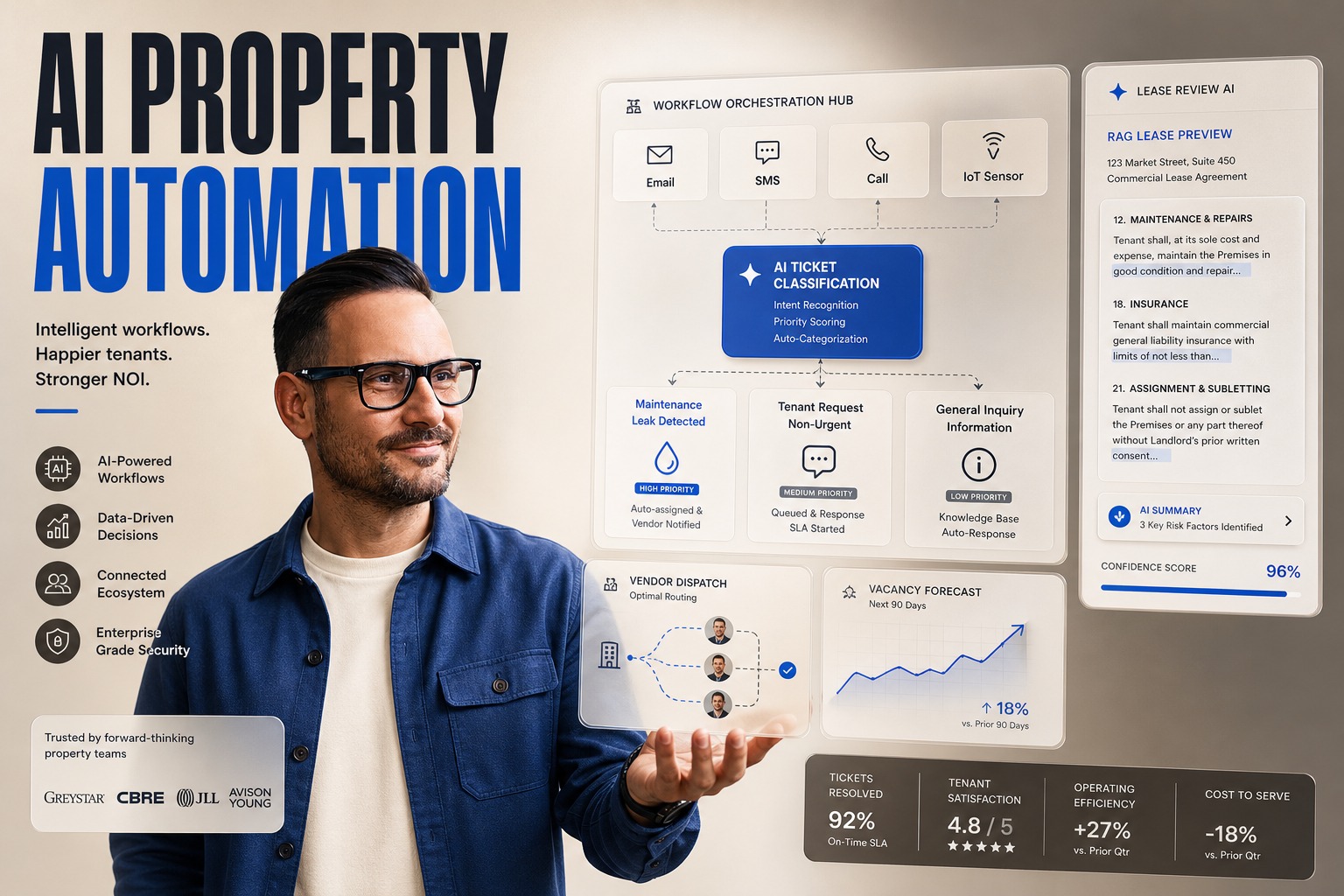
AI for property management connects tenant messages, maintenance tickets, lease documents, and forecasting data into governed workflows. It helps teams classify requests, draft grounded replies, route vendors, review lease clauses, and predict vacancy risk while keeping legal, safety, and high-cost actions under human control.
Share this post
Property managers are squeezed between rising tenant expectations, thin operating margins, aging buildings, and fragmented systems. AI for property management matters now because the work is still heavily message-driven: a burst pipe becomes five emails, a voicemail, a vendor call, a lease lookup, and a spreadsheet update. At portfolio scale, that creates slow response times, inconsistent service, and poor visibility into future vacancies. Modern real estate teams need software that can read requests, classify intent, retrieve policy, draft tenant replies, route vendors, review lease clauses, and forecast occupancy from operational signals. The goal is not a generic chatbot. The goal is a governed workflow layer that connects PMS, CRM, accounting, IoT, document storage, and communication channels into one auditable operating system.
QUICK ANSWER
AI for property management automates maintenance intake, tenant support, lease review, and vacancy forecasting by combining LLMs, RAG, workflow routing, and predictive models. Well-scoped pilots usually start with 2–3 workflows, integrate with PMS data, and measure response time, ticket resolution, occupancy risk, and staff hours saved.
How AI Is Used in Property Management Today: Market Context
Property operations are a high-volume decision environment. The same team handles emergencies, amenity questions, delinquency notices, renewals, vendor scheduling, inspections, and lease interpretation.
Maintenance intake is noisy: tenants describe symptoms, not asset failures, so staff must infer category, urgency, location, access rules, and vendor type.
Tenant communication is fragmented: requests arrive through portals, email, SMS, phone transcripts, and onsite staff notes, often without shared context.
Leases are difficult to operationalize: parking, pets, subletting, deposits, escalation clauses, and renewal windows are buried in PDFs and scanned addenda.
Vacancy forecasting is reactive: teams often rely on historical occupancy and gut feel instead of renewal probability, maintenance friction, pricing, and local demand signals.
Legacy PMS workflows stop at records: they store work orders and contacts, but rarely reason across documents, messages, and time-series events.
This is where real estate management AI becomes practical. A portfolio platform can classify a leaking ceiling as urgent, check warranty history, draft a tenant update, and trigger vendor dispatch without forcing staff through five systems.
For teams planning new products or modernization, Plavno’s real estate app development company experience helps connect product design, integrations, compliance, and model engineering from day one.
Technical Architecture: How AI for property management Works in Practice
A production-grade platform is not one large prompt. It is a set of bounded components that convert messy operational input into verified actions.
Core components
Intake layer: email parsers, Twilio SMS, call transcripts, tenant portal forms, mobile app events, OCR for photos, and webhook ingestion from PMS tools.
Normalization pipeline: entity extraction for unit, tenant, asset, lease ID, vendor, SLA, urgency, and access window using JSON Schema outputs.
Knowledge layer: RAG over leases, policies, appliance manuals, vendor contracts, building rules, and historical tickets stored in a vector DB such as Pinecone, Weaviate, or pgvector.
Decision layer: rules plus LLM reasoning determine category, priority, next best action, escalation, and confidence score.
The best architecture uses different models for different jobs. A small classifier can route 80% of requests at low cost, while GPT-4.1, Claude, or a private Llama model handles complex lease reasoning.
RAG reduces hallucination by forcing answers to cite lease clauses, policy snippets, or maintenance history. Human-in-the-loop approval remains mandatory for evictions, deposit disputes, legal interpretations, and high-cost repairs.
The highest ROI rarely comes from replacing property managers; it comes from removing the coordination tax between tenants, vendors, leases, and accounting systems.
Infrastructure and APIs
Runtime: Kubernetes or serverless workers process messages, while queues such as Kafka, SQS, or RabbitMQ protect against traffic spikes.
Data stores: PostgreSQL handles transactional records, Redis caches active conversations, and object storage keeps lease files, invoices, photos, and transcripts.
Security: SOC 2 controls, RBAC, field-level encryption, audit logs, tenant data isolation, and PII redaction should be designed before model integration.
Performance: tenant chat should target sub-2-second perceived latency, while background lease review can tolerate minutes if every decision is traceable.
AI AUTOMATION
Ready to reduce ticket load?
Build secure real estate workflows that connect tenant messages, maintenance data, lease documents, and forecasting models.
AI for property management: Business Impact and Measurable ROI
The business case improves when each metric maps to a technical lever. Maintenance ticket AI reduces manual triage, tenant support automation lowers repetitive calls, and leasing automation shortens document review cycles.
$180B
potential annual value generative AI could create in real estate.
Higher occupancy: vacancy models combine lease expiry, rent delta, ticket history, sentiment, payment behavior, and local market velocity.
For owners, the KPI stack should include cost per ticket, average handle time, SLA breach rate, renewal probability, days vacant, lead-to-lease conversion, and model deflection rate.
Implementing Leasing Automation, Tenant Support Automation, and Maintenance Ticket AI
A successful rollout starts with constrained workflows, not a portfolio-wide transformation. The right sequence validates data quality, model accuracy, staff adoption, and governance before scaling.
Step 1: select the pilot workflow. Start with maintenance intake, tenant FAQ, lease abstraction, or renewal risk scoring where volume is high and outcomes are measurable.
Step 2: map data sources. Connect PMS, CRM, document storage, ticketing, accounting, access control, and communication channels through stable APIs.
Step 3: define decision boundaries. Separate auto-resolved tasks, staff-approved actions, legal escalations, and emergency workflows.
Step 4: build evaluation sets. Use historical tickets, lease clauses, tenant messages, and known resolutions to test precision, recall, groundedness, and escalation accuracy.
Step 5: deploy with observability. Track latency, prompt cost, token usage, fallback rate, hallucination flags, and manual override reasons.
Step 6: scale by asset class. Multifamily, commercial, student housing, and short-term rentals have different lease logic, SLAs, and tenant journeys.
Common pitfalls:
Automating before cleaning taxonomy: inconsistent issue categories destroy reporting and routing accuracy.
Ignoring edge cases: mold, lockouts, domestic safety, ADA requests, and fair housing concerns need explicit escalation paths.
Skipping vendor integration: a ticket classifier without dispatch capability only moves work between queues.
Measuring chatbot deflection only: real value also appears in shorter vacancies, fewer SLA breaches, and higher renewal confidence.
EXAMPLE USE CASE
In an enterprise knowledge assistant project, Plavno built secure retrieval, role-aware answers, and workflow access across internal documents. The same RAG pattern supports lease search, policy lookup, and maintenance knowledge bases for property teams.
Risks and Mistakes to Avoid With Real Estate Management AI
AI in real estate touches regulated decisions, private tenant data, financial records, and physical safety. That makes governance a product requirement, not a post-launch checklist.
Hallucinated policy answers: every tenant-facing response about fees, deposits, access, or lease obligations should be grounded in retrieved sources.
Fair housing risk: leasing agents must avoid protected-class inference, discriminatory scoring, and opaque denial explanations.
PII leakage: prompts and logs may contain IDs, payment history, phone numbers, medical accommodations, or domestic safety notes.
Over-automation of emergencies: gas leaks, active flooding, fire, security issues, and lockouts require deterministic routing and human escalation.
Weak auditability: property teams need to know which data, rule, model, and user approval produced each action.
The safest architecture treats the model as a reasoning component inside a controlled workflow, not as the system of record or final authority.
Generative AI in real estate is strongest when it summarizes, classifies, drafts, and retrieves. It becomes risky when it silently decides eligibility, fees, legal remedies, or resident obligations without review.
Why Plavno’s AI for property management Approach Works
Plavno builds real estate products as software platforms first and AI layers second. That means data contracts, observability, permission models, workflow states, and integration reliability are designed before prompts reach production.
Our teams combine backend engineering, ML, product design, DevOps, QA automation, and domain analysis. For complex operational knowledge, our enterprise assistant work shows how governed retrieval can reduce time spent searching internal documentation while preserving access control.
The same engineering patterns apply beyond real estate. We use forecasting and workflow automation ideas from supply chain risk detection and predictive maintenance patterns from AI in manufacturing operations to design reliable PropTech systems.
Architecture before automation: we define sources of truth, event flows, and failure modes before selecting models.
Measurable pilots: every use case has baseline metrics, acceptance criteria, and a path to scale.
Human control: legal, financial, emergency, and high-cost actions remain reviewable and auditable.
Enterprise readiness: deployments can support SOC 2-aligned controls, cloud isolation, and role-based tenant data access.
FAQ: AI in Real Estate for Property Operations
How is AI for property management used? Property teams use 4 core patterns: ticket classification, tenant support automation, lease document review, and vacancy forecasting. The system reads messages, retrieves relevant policy or lease text, proposes actions, and updates connected systems while escalating legal, safety, or financial exceptions to staff.
How much does it cost to implement AI for property management? A pilot often costs 30–80 thousand dollars when it includes one or two workflows, PMS integration, RAG setup, QA, and monitoring. Enterprise platforms cost more because they add multi-property permissions, data migration, vendor integrations, analytics, and security controls.
What are AI agents for real estate? AI agents for real estate are workflow components that plan and execute bounded tasks, such as triaging a leak, drafting a renewal email, or comparing lease clauses. A safe agent uses tools, permissions, confidence thresholds, and approval gates instead of acting freely.
What affects real estate software development cost? Real estate software development cost depends on 5 factors: integrations, data quality, document complexity, security requirements, and workflow depth. A simple tenant chatbot is cheaper than a platform that connects accounting, IoT sensors, lease repositories, vendor dispatch, and portfolio forecasting.
Property management will not be transformed by isolated chat widgets. The durable advantage comes from AI-native workflows that connect communication, documents, maintenance, leasing, and forecasting into one governed platform. AI for property management gives operators faster response times, cleaner ticket routing, stronger lease visibility, and better vacancy decisions without losing human control. If your portfolio still depends on inbox triage and spreadsheet forecasting, start with one measurable workflow and scale from validated operational data.
PROPTECH AI
Modernize property operations?
Turn maintenance, tenant support, leasing, and forecasting into connected workflows with secure AI engineering.