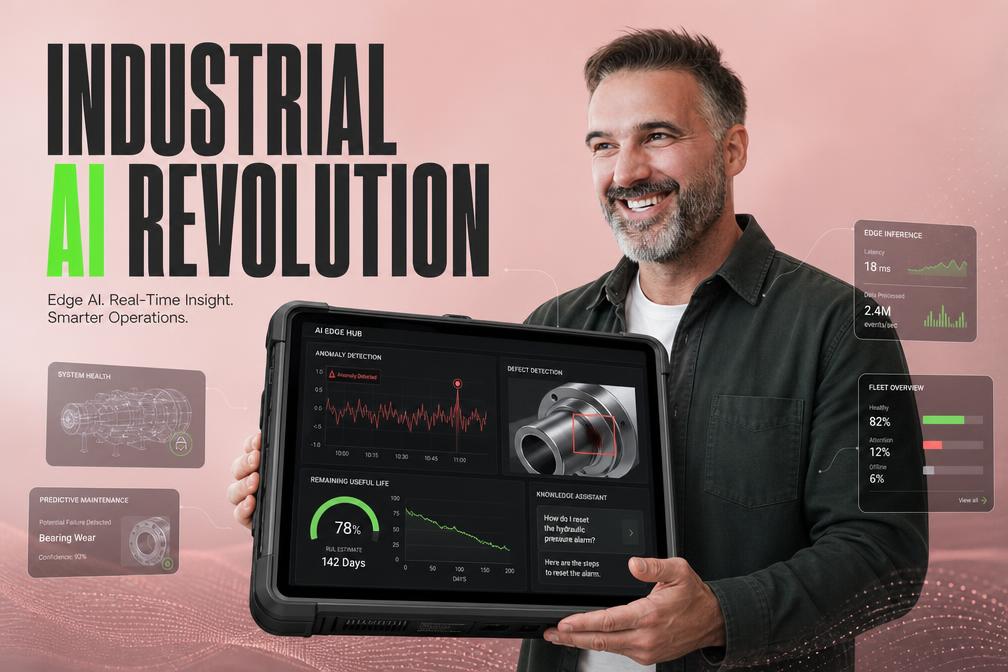
Manufacturing is no longer just about physical throughput; it is a battle of data latency and decision velocity. In an environment where a single hour of unplanned downtime can cost a mid-sized automotive plant upwards of $50,000, the tolerance for reactive maintenance and manual inspection is effectively zero. The modern factory floor generates terabytes of telemetry, visual data, and unstructured logs daily, yet most of this value remains locked in silos. The competitive edge now belongs to organizations that can bridge the gap between raw operational technology (OT) data and actionable intelligence. This is where AI in manufacturing shifts from a buzzword to a critical infrastructure layer, enabling systems that see defects before they ship, predict failures before they happen, and codify tribal knowledge into queryable digital assets.
Industry challenge & market context
The transition to Industry 4.0 has exposed the fragility of legacy manufacturing architectures. While hardware has advanced, the software stack often relies on brittle, monolithic SCADA systems that struggle to communicate with modern cloud infrastructure. The primary bottlenecks are not mechanical but informational.
- Data fragmentation between Operational Technology (OT) and Information Technology (IT) creates blind spots, where vibration data from a CNC mill sits isolated from the ERP system.
- Reliance on human visual inspection leads to fatigue-based error rates; manual quality checks typically catch only 80% of defects, and the rate drops significantly after the first two hours of a shift.
- Reactive maintenance models (run-to-failure) result in excessive spare parts inventory and catastrophic unplanned outages.
- Loss of tribal knowledge due to an aging workforce creates a skills gap; when senior maintenance engineers retire, their diagnostic intuition leaves with them.
- Security vulnerabilities in legacy protocols make industrial IoT (IIoT) devices attractive targets for intrusion, requiring robust, zero-trust architectures.
Technical architecture and how AI in manufacturing works in practice
Implementing industrial AI is not a simple "lift and shift" operation. It requires a distributed architecture that respects the physical constraints of the factory floor—latency, bandwidth, and reliability—while leveraging the scalability of the cloud. A robust solution typically follows a hybrid edge-cloud pattern.
System Components and Data Ingestion
The architecture begins at the edge. Manufacturing environments cannot afford the latency of sending high-frequency sensor data to the cloud for real-time decision-making. Instead, we deploy edge gateways—industrial PCs or ruggedized devices running Kubernetes—that sit close to the machinery. These gateways ingest data via OPC-UA, MQTT, or Modbus TCP.
- Edge Gateway: Runs Dockerized inference engines (e.g., TensorFlow Lite or ONNX Runtime) for immediate anomaly detection.
- Message Broker: Apache Kafka or MQTT brokers buffer high-velocity telemetry to handle backpressure and ensure data durability during network outages.
- API Gateway: Exposes a unified REST/GraphQL interface to the factory floor, handling authentication via OAuth2 or mutual TLS for device-to-device communication.
- Orchestration Layer: Uses tools like Kubernetes or serverless functions (AWS Lambda/Azure Functions) to manage scaling and lifecycle of inference services.
Computer Vision AI for Quality Control
For quality control AI, the pipeline is distinct. High-resolution cameras stream data via RTSP to an inference cluster. We avoid sending raw video to the cloud; instead, we process frames at the edge. A typical stack involves OpenCV for preprocessing and a detection model like YOLOv8 or EfficientDet for object detection.
When a defect is detected, the system does not just flash a red light. It triggers an event-driven workflow. The inference service publishes a message (e.g., "Defect Type: Scratch, Confidence: 98%, Location: Conveyor Belt 4") to a message queue. This event is consumed by a downstream service that updates the Manufacturing Execution System (MES), logs the defect in a database for traceability, and can even trigger a robotic arm to reject the part. This loop must be idempotent; if the network flickers, the system must not double-count the defect or duplicate the reject command.
Predictive Maintenance AI and Time-Series Analysis
Predictive maintenance AI relies on time-series forecasting. Vibration, temperature, and acoustic data are aggregated into a time-series database like InfluxDB or TimescaleDB. The data pipeline involves feature extraction—converting raw signals into frequency domains using Fast Fourier Transform (FFT)—before feeding the data into an LSTM (Long Short-Term Memory) network or a Transformer-based model.
The real value of predictive maintenance is not predicting when a machine will fail, but calculating the optimal time to perform maintenance that minimizes total cost, balancing spare parts inventory against production downtime.
In practice, the model outputs a "Remaining Useful Life" (RUL) score. If the RUL drops below a threshold, the system triggers a work order in the CMMS. To ensure accuracy, we implement a "human-in-the-loop" feedback mechanism. When a technician inspects the machine, they confirm or deny the alert, and this label is fed back into the training pipeline to continuously fine-tune the model.
Knowledge Automation and RAG
Addressing the skills gap requires knowledge automation. We build internal knowledge assistants using Retrieval-Augmented Generation (RAG). The architecture involves indexing PDF manuals, SOPs, and maintenance logs into a vector database like Pinecone, Milvus, or pgvector.
- Embedding Model: Converts text into high-dimensional vectors using models like OpenAI text-embedding-3 or open-source alternatives like HuggingFace's BERT.
- Orchestration Framework: LangChain or LlamaIndex manages the retrieval logic, constructing the prompt with relevant context chunks.
- LLM Layer: A hosted model (e.g., GPT-4o) or a private LLM (e.g., Llama 3 running on vLLM) generates the answer based strictly on the retrieved context to prevent hallucinations.
When a junior engineer asks, "How do I reset the hydraulic pressure on Unit B?", the system queries the vector store, retrieves the specific manual page, and generates a step-by-step guide. This interaction is logged for observability, allowing engineering leads to audit what information is being accessed and identify gaps in the documentation.
Infrastructure and Governance
Deployment must handle the "air-gapped" reality of many factories. We use a GitOps approach (ArgoCD or Flux) to synchronize configurations. For security, we enforce strict network segmentation: the OT network is isolated from the IT network via a DMZ, with only specific API endpoints allowed through. Data residency is handled by ensuring sensitive telemetry never leaves the on-premise cluster; only anonymized aggregates are sent to the cloud for global analytics.
Business impact & measurable ROI
Adopting AI in manufacturing drives measurable financial outcomes, but the ROI depends on moving beyond pilot projects into full-scale integration. The benefits are categorized into availability, performance, and quality.
- Reduced Downtime: Predictive maintenance typically increases equipment availability by 10-20%. By shifting from reactive to proactive scheduling, plants can reduce unplanned downtime by up to 50%, directly protecting the bottom line.
- Scrap Reduction: Computer vision AI operates with 99.9% consistency, unlike human inspectors. By catching defects in real-time, manufacturers can reduce scrap rates by 20-30%, saving significant raw material costs.
- Labor Optimization: Knowledge automation reduces the time required for troubleshooting by 30-40%. Junior engineers can resolve complex issues faster, reducing the dependency on a small pool of senior experts.
- Inventory Optimization: Predictive insights allow for just-in-time spare parts delivery, reducing inventory carrying costs by 15-25%.
A 1% increase in Overall Equipment Effectiveness (OEE) can translate to millions of dollars in annual revenue for high-volume manufacturers; AI is the lever that moves that needle by optimizing the three pillars of OEE: availability, performance, and quality.
The cost levers are equally important. By running inference at the edge, companies avoid massive cloud egress fees associated with streaming video. Utilizing spot instances for non-critical batch processing (like model retraining) further optimizes the cloud bill.
Implementation strategy
Successful deployment requires a phased approach that balances speed-to-value with technical rigor. We recommend a roadmap that prioritizes high-impact, low-complexity use cases first.
- Assessment and Data Audit: Identify the "bleeding neck" problems—machines that fail most often or lines with the highest scrap rates. Audit the data availability: are sensors installed? Is the historical data labeled?
- Pilot Deployment (The "Lighthouse" Project): Select a single production line. Deploy a limited-scope computer vision system or a vibration analysis pilot. Focus on establishing the data pipeline and validating model accuracy against human labels.
- Infrastructure Hardening: Once the pilot proves value, scale the infrastructure. Implement the Kubernetes clusters, the message brokers, and the CI/CD pipelines for model updates. Establish the governance framework for data security.
- Integration and Scaling: Connect the AI outputs to existing business systems (SAP, Oracle, MES). Ensure that the "stop the line" signal from the AI model is trusted and acted upon by operators.
- Continuous Improvement: Move from "monitoring" to "agent-based" automation. Use frameworks like AutoGen or CrewAI to create multi-agent systems that can autonomously diagnose issues and schedule repairs without human intervention.
Common Pitfalls
Many initiatives fail due to "over-engineering" the first iteration. Do not attempt to build a fully autonomous factory in year one. Avoid "black box" models; operators need to understand *why* the AI flagged a defect. Finally, do not neglect the data hygiene; an AI model is only as good as the data it is trained on, and manufacturing data is notoriously noisy.
Why Plavno’s approach works
At Plavno, we do not treat AI as a magic wand. We approach it as an engineering discipline grounded in software architecture best practices. Our team builds bespoke solutions that integrate seamlessly with your existing stack, whether you are running legacy PLCs or modern IIoT sensors. We specialize in the full lifecycle of AI development, from initial data strategy to the deployment of production-grade inference pipelines.
Our expertise in computer vision allows us to create defect detection systems that operate at the speed of your production line, while our work in AI automation ensures that your workflows are intelligent and adaptive. We understand the nuances of the manufacturing sector, from the constraints of on-premise hardware to the strict requirements of operational safety.
We leverage modern orchestration tools like AI agents and robust custom software engineering to create systems that are maintainable, scalable, and secure. Whether you need to augment your team with skilled developers or require a comprehensive AI consulting strategy, Plavno provides the technical depth to execute.
The future of manufacturing is intelligent, connected, and autonomous. By implementing rigorous, architecture-focused AI solutions today, you are not just optimizing for the next quarter; you are building the resilience required to lead the market in the next decade. If you are ready to move beyond pilots and deploy industrial-grade AI, let's discuss your architecture.