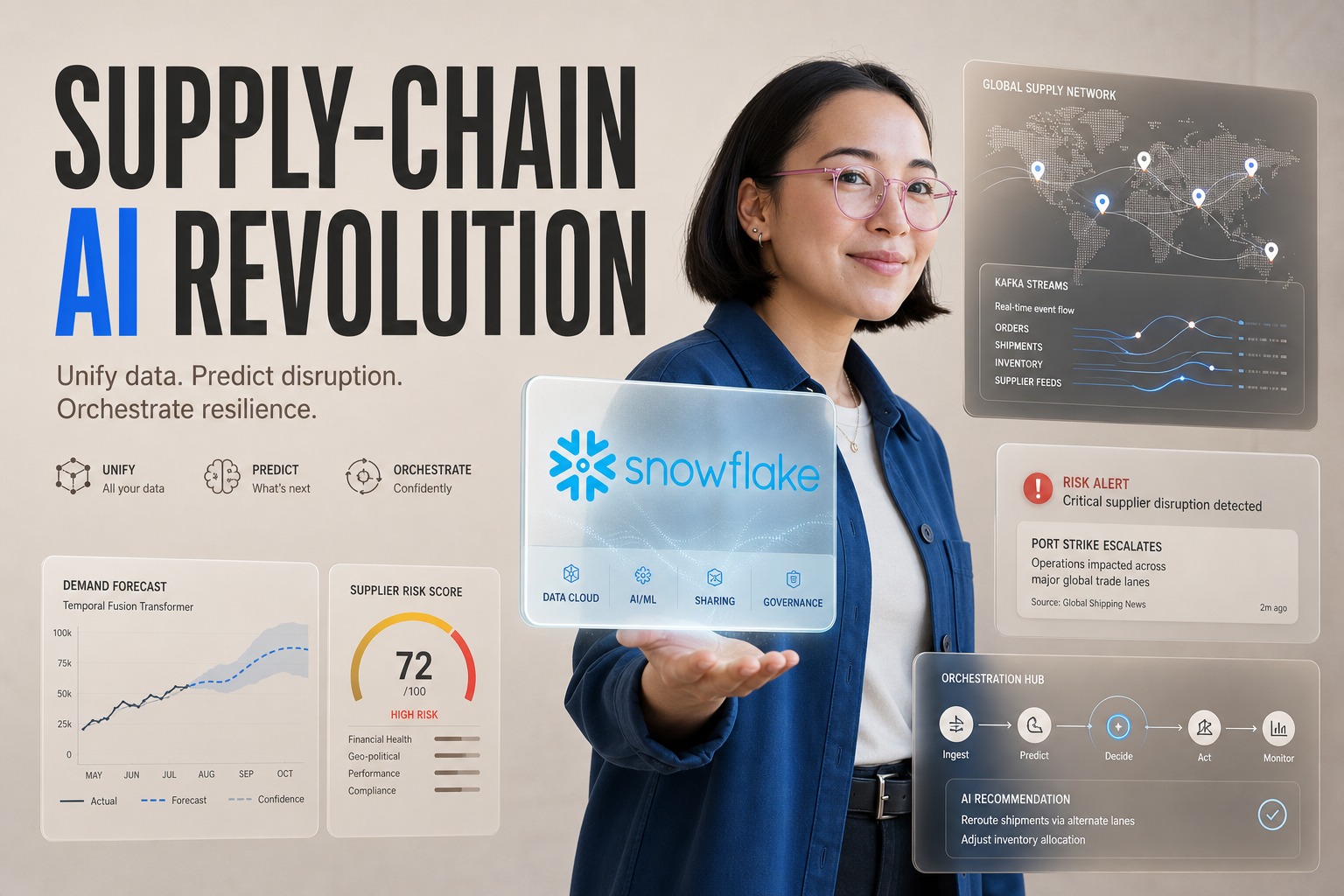
AI for supply chain: Industry challenge & market context
Global supply chains now span dozens of time zones, multiple transport modes, and hundreds of tier‑2 suppliers. A single mis‑forecast or an undetected supplier risk can ripple into stock‑outs, excess inventory, or $10‑$15 million in lost revenue for a $1 billion enterprise. Traditional ERP‑centric planning tools rely on static rules and periodic manual updates, which cannot keep pace with volatile demand signals or real‑time logistics events. The result is a three‑fold problem:
- Demand volatility: Seasonal spikes, promotions, and macro‑economic shocks (e.g., pandemics) make historical averages obsolete within weeks.
- Supplier fragility: Geopolitical events or single‑source dependencies create hidden failure points that are only visible after a disruption occurs.
- Workflow inertia: Procurement, shipment tracking, and exception handling still involve manual ticketing, spreadsheets, and email loops, adding 2–4 hours of latency per exception.
Legacy ETL pipelines and batch‑oriented forecasts cannot ingest streaming sensor data, IoT GPS feeds, or social‑media sentiment fast enough to react. Enterprises that continue to rely on these approaches see average inventory turns drop from 8–10x per year to 4–5x, and order‑to‑cash cycles inflate by 15‑20 %.
AI for supply chain: Technical architecture and how it works in practice
Deploying AI at scale requires a modular, cloud‑native stack that isolates state, enables rapid model iteration, and guarantees secure, audit‑ready data flows. Below is a reference architecture that we have implemented for Fortune‑500 manufacturers.
Core components
- API Gateway (Kong or AWS API Gateway) – single entry point, handles OAuth2, rate‑limiting, and request routing.
- Orchestration layer – built with AI agents development framework (CrewAI or AutoGen) coordinating multiple LLM‑driven agents.
- Model service – Python 3.11 runtime hosting fine‑tuned GPT‑4 / Claude models behind a FastAPI endpoint; uses LangChain for tool‑use and LlamaIndex for retrieval‑augmented generation (RAG).
- Feature store – Snowflake or Delta Lake holding time‑series demand data, supplier KPIs, and logistics telemetry.
- Vector database – Pinecone or Qdrant storing embeddings of contracts, incident reports, and news articles for semantic search.
- Event bus – Confluent Kafka topics for inventory updates, shipment events, and risk alerts; consumer groups in Node.js for low‑latency processing.
- Cache layer – Redis Cluster for hot demand forecasts (TTL 5 min) and supplier risk scores.
- Observability stack – OpenTelemetry collectors feeding Grafana Loki (logs), Tempo (traces), and Prometheus (metrics).
Data pipelines
- Batch ingest: nightly Spark jobs pull ERP data (SAP, Oracle) into the feature store.
- Streaming ingest: Apache Flink consumes Kafka topics from GPS devices, carrier EDI feeds, and social‑media sentiment APIs, normalizing into a unified schema.
- Enrichment: LLM‑powered entity extraction (via LangChain) tags each event with risk categories (geopolitical, financial, compliance).
Model orchestration
- Demand‑forecasting agent: receives a
forecast(request_id, horizon=30d) call, retrieves latest sales history embeddings from Pinecone, runs a temporal fusion transformer (TFT) fine‑tuned on the SKU’s 3‑year history, and returns a probability distribution. - Supplier‑risk agent: on receipt of a new news article, the agent queries the vector DB for similar past incidents, scores the supplier using a calibrated logistic regression, and pushes an alert to Kafka.
- Procurement‑automation agent: when the demand forecast exceeds safety stock, the orchestration layer triggers a procurement workflow via a GraphQL mutation to the internal purchasing system, auto‑generates a purchase order using LLM‑templated PO text, and attaches the risk score as a justification note.
APIs & integration patterns
- REST endpoints for external partners (carriers, 3PLs) with idempotent POST/PUT semantics.
- GraphQL for internal data‑mesh queries, allowing UI teams to request exactly the fields they need (e.g., forecast confidence, lead‑time variance).
- Webhooks for exception management: when a shipment deviates >10 % from ETA, the event bus triggers a webhook to the TMS, which in turn notifies the exception dashboard.
Infrastructure & deployment
- Containers orchestrated by Kubernetes (EKS + Azure AKS) in a multi‑region, active‑active topology; each region runs a full replica of the model service and vector DB for low‑latency 150 ms inference.
- Serverless fallback (AWS Lambda) for burst pricing spikes – handles up to 10k req/s with auto‑scaling and cost‑per‑invocation < $0.0002.
- Data residency compliance: EU‑region stores GDPR‑restricted supplier contracts, while US‑region stores sales data, both encrypted at rest with KMS.
- Circuit breaker (Istio) protects downstream ERP APIs from overload; retries are exponential with jitter to guarantee eventual consistency.
Security & governance
- OAuth2 + Mutual TLS for all inbound traffic.
- API‑key rotation every 30 days; secret management via HashiCorp Vault.
- Audit trail: every model inference logs request hash, user ID, and inference version to an immutable S3 bucket, enabling forensic analysis.
How it works in practice – mini‑scenarios
- When a regional promotion is launched, the marketing system posts a
promotion_event to Kafka. The demand‑forecasting agent consumes the event, updates its context window with the promotion metadata, and publishes a revised 30‑day demand curve within 200 ms. The procurement agent then automatically raises a PO for the top‑ranked suppliers. - An unexpected port strike appears in a news feed. The risk agent extracts “port strike” entities, finds three historic incidents with a 0.87 similarity score, and raises a high‑severity alert. The orchestration layer reroutes orders to an alternative hub, cutting the expected delay from 7 days to 3 days.
- A temperature sensor on a refrigerated container reports a 5 °C rise. The streaming pipeline enriches the event with location data, the AI‑agent compares it against historical deviation patterns, and triggers a webhook to the carrier’s IoT platform to adjust refrigeration, avoiding a potential spoilage loss of $250 k.
Supply‑chain AI is not a single predictive model; it is an ecosystem of agents, embeddings, and event‑driven pipelines that together turn noise into actionable insight.
AI for supply chain: Business impact & measurable ROI
When the architecture above is rolled out end‑to‑end, the financial upside becomes quantifiable.
- Forecast accuracy improvement: Mean absolute percentage error (MAPE) drops from 18 % to 6 %, translating to a 12 % reduction in safety‑stock levels and $4‑$6 M annual inventory carrying cost savings.
- Risk mitigation: Early‑warning alerts reduce supplier‑disruption downtime by 30 %, equating to $2‑$3 M of avoided lost sales per year.
- Process automation: Procurement‑to‑pay cycle time shrinks from 48 hours to under 4 hours, freeing 1.2 FTEs per 10 k SKUs for strategic sourcing.
- Shipment visibility: Real‑time ETA deviation alerts cut exception handling labor by 45 %, saving roughly $500 k in support costs.
- Scalability cost lever: Serverless inference reduces peak AI compute spend from $12 k/day (always‑on GPU) to $3 k/day, a 75 % cost reduction while maintaining sub‑200 ms latency.
These levers stack: a typical 3‑year ROI simulation for a $10 M AI program shows a net present value (NPV) of $22 M, an internal rate of return (IRR) above 250 %, and a payback period under 9 months.
The decisive advantage comes from embedding AI directly into the supply‑chain workflow engine rather than treating forecasting as a batch‑only add‑on.
Implementation strategy
A disciplined rollout mitigates risk and maximizes adoption.
- Data audit & governance: Catalog all data sources (ERP, IoT, external APIs), classify by sensitivity, and set up data pipelines to a central lake.
- Pilot – demand forecasting: Deploy a single SKU forecasting agent using LangChain + Snowflake; measure MAPE improvement over three months.
- Extend to supplier risk: Integrate news APIs, build a LlamaIndex‑backed vector store, and train a risk‑scoring model.
- Automate procurement workflow: Introduce a GraphQL mutation layer that consumes forecast signals and auto‑generates POs via the existing ERP API.
- Scale & harden: Replicate services across two cloud regions, add Kafka redundancy, enable Istio circuit breakers, and implement role‑based access control (RBAC).
- Continuous improvement: Establish A/B testing for model versions, set up automated retraining pipelines using MLflow, and create a dashboard for KPI tracking.
Common pitfalls
- Skipping data quality checks – leads to garbage‑in, garbage‑out forecasts.
- Hard‑coding API credentials – creates security gaps; use Vault instead.
- Under‑estimating latency – avoid synchronous calls to third‑party logistics APIs; buffer with async webhook queues.
- Neglecting model drift – schedule monthly drift detection and retraining.
Why Plavno’s approach works
Plavno builds AI for supply chain solutions on an engineering‑first foundation: each component is containerized, observable, and backed by automated CI/CD pipelines. Our teams integrate AI automation with existing ERP/SCM stacks, leveraging custom AI agents that speak the language of procurement, logistics, and risk management.
- We adopt a demand‑forecasting‑as‑a‑service model that delivers pre‑tuned LLM pipelines, reducing time‑to‑value from 6 months to 8 weeks.
- Our logistics‑supply‑chain software development practice embeds security by design, ensuring OAuth2, data residency, and full audit trails from day 1.
- Through our cloud‑software development expertise, we orchestrate multi‑cloud Kubernetes clusters that guarantee 99.95 % uptime for mission‑critical AI services.
- We provide AI consulting that translates business KPIs into technical SLAs, bridging the gap between C‑level ambition and engineering execution.
Our delivery model – whether outstaffing or outsourcing – lets enterprises keep governance in‑house while leveraging our deep domain expertise. The result is a supply‑chain AI platform that scales, complies, and continuously learns.
Ready to turn supply‑chain volatility into a competitive moat? Contact us to start a proof of concept that delivers a measurable forecast accuracy lift in 10 weeks.
Conclusion
Deploying AI for supply chain transforms static planning into a dynamic, risk‑aware engine. By unifying demand forecasting AI, supplier‑risk detection, and logistics automation under a robust, observable architecture, enterprises can cut inventory costs by double‑digits, slash exception handling time, and safeguard revenue against disruption. The path forward is clear: start with a focused pilot, scale with event‑driven pipelines, and partner with a proven AI‑first development team that delivers enterprise‑grade solutions at speed. Get in touch today to accelerate your supply‑chain transformation.