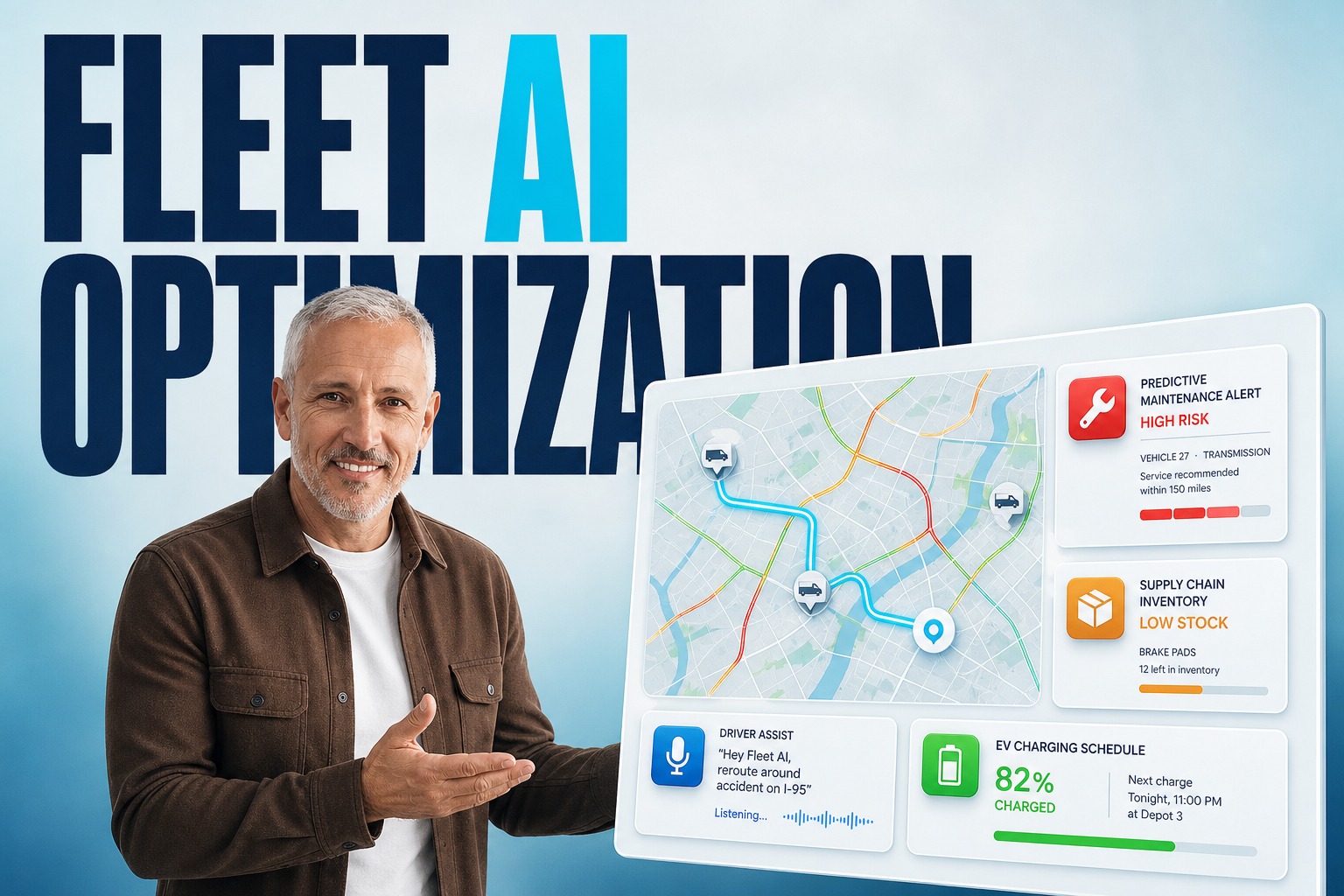
AI in Automotive and Mobility: Fleet Optimization, Predictive Maintenance, and Driver Support
AI in Automotive and Mobility: Fleet Optimization, Predictive Maintenance, and Driver Support
October 20, 2026· min read·#AI#Tech·Reviewed by Plavno AI Engineering Team
AI in automotive and mobility turns vehicle telemetry into routing, maintenance, driver support, and supply-chain decisions. The strongest ROI comes from focused pilots tied to KPIs like downtime, fuel cost, ETA accuracy, or service labor.
Share this post
AI in automotive and mobility is moving from innovation decks into dispatch centers, service bays, cockpits, and supply-chain control towers. The timing is practical: fleets are absorbing volatile fuel prices, driver shortages, stricter emissions targets, parts delays, and customer expectations for same-day visibility. At the same time, vehicles now stream GPS, CAN bus, OBD-II, ADAS, battery, temperature, and driver-behavior telemetry at industrial scale. The opportunity is not “autonomy everywhere.” It is better decisions every minute: which route to assign, which truck to service before failure, which driver needs coaching, which part to stock, and which in-vehicle interaction should be handled by a voice assistant instead of a call center. For CTOs and mobility operators, the real question is how to turn noisy vehicle data into safe, governed, ROI-positive software.
QUICK ANSWER
AI in automotive and mobility improves fleet routing, predictive maintenance, driver support, and supply-chain decisions by combining telemetry, optimization models, ML forecasting, and agentic workflows. A strong first release usually targets 1–2 measurable KPIs, such as downtime, fuel cost, ETA accuracy, or maintenance labor.
Industry Challenge and Market Context for Mobility AI
Automotive AI programs fail when teams treat vehicles as generic IoT devices. A fleet is a moving cyber-physical system with intermittent connectivity, safety constraints, union rules, SLA penalties, and expensive downtime.
Routing is dynamic: traffic, driver hours, charging stops, depot windows, weather, and customer priority change faster than static TMS rules.
Maintenance is reactive: many fleets still service by mileage intervals, missing failure signatures hidden in vibration, fault codes, temperature, and utilization patterns.
Driver support is fragmented: mobile apps, IVR, dispatch calls, and in-cab systems often duplicate workflows without context.
Legacy telematics is descriptive: dashboards show what happened, but rarely recommend actions with confidence, cost, and operational trade-offs.
Data ownership is messy: OEM APIs, aftermarket devices, ELD providers, ERP, WMS, TMS, and insurers expose inconsistent schemas and latency.
Security exposure is real: connected vehicle software must protect PII, trip data, maintenance records, and OTA workflows under SOC 2-grade controls.
The shift is toward decision intelligence: models that detect anomalies, simulate routes, predict ETA risk, and trigger workflows across maintenance, dispatch, procurement, and customer communication.
Technical Architecture: How AI in Automotive and Mobility Works in Practice
A production architecture starts with telemetry ingestion, not the model. CAN bus, OBD-II, GPS, accelerometer, battery, ADAS, tire-pressure, fuel, and driver-event data must be normalized before ML can add value.
Ingestion layer: MQTT, Kafka, REST, webhooks, and OEM APIs collect high-frequency and batch data from vehicles, depots, and third-party platforms.
Data platform: lakehouse storage, time-series databases, feature stores, and schema registries keep vehicle events queryable and auditable.
Model layer: gradient boosting, temporal CNNs, LSTMs, graph optimization, reinforcement learning, and anomaly detection support routing and maintenance tasks.
Agent layer: AI agents for automotive workflows can compare route plans, open maintenance tickets, query inventory, and escalate exceptions to humans.
Knowledge layer: RAG connects manuals, warranty policies, service bulletins, SOPs, and historical repairs through a vector DB such as Pinecone, Weaviate, or pgvector.
Runtime layer: Kubernetes, Redis caches, API gateways, observability, and feature flags keep decisions fast, reversible, and measurable.
The competitive advantage is not owning more vehicle data; it is closing the loop between prediction, workflow execution, and verified operational outcome.
For in-vehicle assistants, the stack must also handle wake words, ASR, NLU, text-to-speech, offline fallback, and latency budgets often below 300–700 ms for perceived responsiveness. Guardrails are mandatory: the assistant can explain a warning light, but should not override safety-critical driving behavior.
Fleet management AI also depends on optimization constraints. Vehicle capacity, HOS rules, cold-chain thresholds, charging curves, tolls, CO₂ targets, and promised delivery windows should be modeled explicitly, not buried in prompts.
Teams planning connected mobility platforms often combine AI engineering with automotive software development services to integrate telematics, dispatch, maintenance, and supply-chain systems without creating another isolated dashboard.
AI MOBILITY
Need a production roadmap?
Design fleet, maintenance, and driver-assistant AI around measurable operations KPIs, not disconnected prototypes.
Business Impact: AI in Automotive and Mobility ROI From Fleet Management AI
The strongest ROI comes when technical levers map to cost centers. Route optimization reduces miles, idle time, failed deliveries, and overtime. Predictive maintenance vehicles programs reduce roadside failures, emergency towing, warranty leakage, and unplanned asset downtime.
−15%
logistics cost improvement reported for AI-enabled supply-chain management adopters
In practice, measurable value appears in five areas. Dispatch teams get more accurate ETAs and fewer manual reassignments. Maintenance leaders replace blanket service intervals with risk-based scheduling. Finance sees lower fuel, tire, labor, and penalty costs. Customer teams reduce “where is my order?” contacts. Safety managers identify harsh braking, fatigue patterns, and high-risk routes earlier.
For EV fleets, mobility AI also optimizes charging windows, depot energy demand, battery degradation, and route feasibility. The result is not one model, but a control system that continuously balances cost, SLA, asset health, and driver experience.
Implementation Strategy: Pilot, Scale, Governance, and Cost Control
A credible roadmap starts with a narrow operational decision. “Optimize the fleet” is too broad. “Reduce unplanned downtime for 300 refrigerated trucks by predicting compressor failure seven days earlier” is buildable.
Step 1 — baseline: define KPIs such as downtime hours, fuel per mile, maintenance cost per vehicle, ETA error, or route adherence.
Step 2 — data audit: inspect telemetry frequency, missing values, timestamp drift, device reliability, fault-code quality, and integration access.
Step 3 — pilot model: build one use case with offline validation, shadow-mode recommendations, and human review before automation.
Step 4 — workflow integration: connect predictions to TMS, CMMS, ERP, inventory, driver apps, and customer notifications through APIs.
Step 5 — MLOps: deploy monitoring for drift, precision, recall, false positives, latency, data freshness, and business outcome metrics.
Step 6 — scale: expand by vehicle class, region, depot, or workflow after proving unit economics and operational adoption.
Cost depends on data readiness, integrations, model complexity, and safety requirements. A focused proof of concept may take 8–12 weeks. A production platform with telematics integration, dispatch workflows, role-based access, monitoring, and cloud deployment usually requires a cross-functional team: product owner, backend engineer, ML engineer, data engineer, frontend engineer, QA, DevOps, and domain SME.
Common pitfalls are predictable.
Over-automation: replacing dispatcher judgment before the system has reliable confidence scoring and exception handling.
Data leakage: training models on future repair labels, completed route data, or manually corrected records without controls.
No feedback loop: failing to capture whether a recommendation was accepted, rejected, delayed, or wrong.
Ignoring supply chain: predicting a part failure without checking whether the part, technician, bay, and vehicle slot are available.
EXAMPLE USE CASE
Plavno built fleet software for dispatch, vehicle tracking, trip management, and operational visibility. The solution centralized fleet processes and created the foundation for route analytics, driver workflows, and scalable mobility automation.
Risks and Mistakes to Avoid in Connected Vehicle Software
Risk in this domain is not limited to bad predictions. A routing model can create unsafe schedules. A maintenance classifier can overload service bays. A voice assistant can distract a driver. A supply-chain forecast can create excess inventory for the wrong part family.
Every production model should have an operational owner, a rollback path, a confidence threshold, and a measurable cost of being wrong.
Safety boundary violations: never let generative AI issue driving-critical commands without deterministic controls and certified systems.
Latency blindness: a useful ETA model may tolerate seconds, while an in-cab assistant interaction may need sub-second response.
Weak identity controls: vehicle, driver, dispatcher, mechanic, and supplier permissions should be separated through RBAC and audit logs.
Vendor lock-in: abstract OEM and telematics APIs so fleets can change devices, vehicles, or data providers.
Unclear compliance: trip history, driver behavior, and location data require retention, consent, encryption, and access policies.
Automotive supply chain optimization using AI adds another risk: recommendations depend on supplier lead times, demand uncertainty, part compatibility, warranty rules, and depot constraints. Without high-quality master data, the model optimizes noise.
Why Plavno’s Approach to AI in Automotive and Mobility Works
Plavno approaches mobility systems as operational software first and AI software second. That means we start with workflows, edge cases, integration contracts, and measurable business outcomes before selecting models.
Our teams combine cloud architecture, data engineering, ML, web and mobile delivery, and QA for fleet-grade products. We connect models to the systems that operators actually use: dispatch portals, driver apps, service desks, inventory tools, ERP, CRM, and telematics platforms.
The engineering principle is simple: make the AI recommendation explainable enough for humans, integrated enough for systems, and observable enough for executives.
FAQ
How is AI in automotive and mobility used today? It is used across 4 major areas: fleet routing, predictive maintenance, driver assistance, and supply-chain optimization. Typical systems ingest telemetry, detect anomalies, forecast demand or failure risk, recommend actions, and trigger workflows in TMS, ERP, CMMS, or in-vehicle applications.
How much does it cost to implement AI in automotive and mobility? Cost usually depends on 5 factors: data readiness, number of integrations, model complexity, user interfaces, and compliance requirements. A focused pilot is smaller and faster than a full platform with telematics ingestion, MLOps, dispatch automation, and connected vehicle software.
How do AI agents for automotive workflows help fleet teams? They can coordinate 3 types of tasks: information retrieval, decision support, and workflow execution. For example, an agent can check fault codes, read service history through RAG, verify parts availability, create a work order, and notify dispatch for approval.
How does AI in automotive supply chain optimization using ERP, TMS, and telematics data work? It combines 6 data streams: demand, routes, vehicle health, inventory, supplier lead times, and service capacity. The system forecasts part needs, prioritizes replenishment, identifies bottlenecks, and aligns procurement with predictive maintenance vehicles schedules.
What affects automotive software development cost for supply-chain optimization? The cost is driven by 4 variables: integration depth, data quality, optimization constraints, and required automation level. AI agents for automotive supply chain optimization using supplier, depot, and vehicle data need stronger governance than a dashboard-only analytics project.
The winning strategy is not to add a chatbot to a dashboard. It is to build a decision layer that connects vehicles, drivers, dispatch, maintenance, inventory, and customers. AI in automotive and mobility delivers value when every prediction becomes an accountable workflow with a clear KPI. Start with one operational bottleneck, validate the data, deploy in shadow mode, and scale after proving economics. If you want a technical partner that can design the architecture and ship the product, start with a focused roadmap.
AI MOBILITY
Ready to operationalize AI?
Turn fleet telemetry, maintenance signals, and driver workflows into production software with measurable ROI.