bg image
bg image

Serving Herndon & Virginia

Herndon teams cut manual ops work with production AI agents in 2026

Federal contractors, telecom groups, and growth-stage firms in Herndon still burn hours on repetitive research, triage, and reporting. Autonomous agents handle those loops so people focus on decisions that move revenue. You keep control of data access, audit trails, and cost caps from day one. This page is for operators who need measurable relief, not another pilot that dies in a slide deck. We scope the job against your real systems and the load your teams already carry. Get AI Agents cost estimate in 24 hours. Tell us budget, timeline, stack, and the dataset or process you want automated first.

Discuss Project

Overview

Why Dulles corridor firms automate judgment work now

Herndon sits inside one of the densest contractor and telecom corridors in the United States. Teams near Reston, Ashburn, Tysons, and Chantilly juggle classified-adjacent workflows, multi-vendor SLAs, and customer portals that still depend on humans copying data between tools. That friction shows up as delayed insights, overtime on night shifts, and inconsistent answers when staff churn. AI agents close those loops by reading context, calling approved tools, and returning structured results with a trail you can audit.

Trusted AI Agents Partner for Herndon Businesses. We work with US-based clients, including companies operating in Virginia. Our delivery focus is B2B work where mistakes cost money: operations analytics, case intake, and knowledge retrieval across legacy systems. A typical engagement starts with one high-volume process, not a full rewrite of your stack. You get a working agent path you can expand without locking the company into a black box.

We already shipped an AI agents analytics assistant for telecom operations. That build combined LLM reasoning with telecom analytics so staff stopped chasing the same weekly insight packs by hand. Insights automation cut the manual prep cycle and surfaced anomalies earlier for ops leads. Lessons from that project guide how we scope Herndon deployments: clear tool boundaries, grounded data, and human review on high-risk actions.

Local leaders also need agents that respect integration reality. ERP connectors, ticket systems, and document stores rarely share a clean schema. We map those seams early and design the agent to fail closed when data quality drops. That approach protects budget and keeps technical debt from compounding across the Dulles corridor footprint.

If you run multi-site Virginia operations, start with the process that eats the most senior time each week. We document baselines, pick success metrics, and ship an MVP path that your own engineers can extend. 10+ AI agent and automation programs delivered in the US market back that method. The goal is durable relief for Herndon operators, not demos that impress once.

Talk to an Expert
Judgment Work Automation

Judgment Work Automation

Agents read context, call approved tools, return auditable structured results

Ops Analytics Focus

Ops Analytics Focus

B2B loops for analytics, case intake, and knowledge across legacy systems

One-Process MVP Path

One-Process MVP Path

Start on the high-volume workflow; expand without a black-box lock-in

Fail-Closed Design

Fail-Closed Design

Mapped ERP/ticket seams, grounded data, human review on high-risk actions

Agent runtime core

Production agent stacks Herndon ops can trust in 2026

Herndon clients receive a controlled agent runtime, not a chatbot bolted onto a website. The core is an orchestration layer that plans steps, selects tools, and writes intermediate state to durable storage. We prefer explicit graphs over free-form chat loops so retries, timeouts, and human gates are first-class. That design survived real telecom analytics loads where the agent had to pull metrics, compare periods, and draft operator-ready notes without inventing figures.

Model choice stays practical. We route simple classification and extraction to smaller models for cost control. Heavier synthesis goes to stronger models only when the task needs it. Tool calling is typed and validated. Every external action passes through a thin adapter with rate limits and schema checks. This keeps the agent from thrashing APIs when upstream systems slow down during peak Dulles corridor traffic.

Security/compliance sits in the same path as features. Secrets live in managed vaults. Prompts never hold raw credentials. Role-based policies define which records an agent may read or write. For contractors serving federal programs in Northern Virginia, we document data residency, retention, and redaction rules up front. Logs capture prompt hashes, tool IDs, and outcomes without dumping sensitive payloads into shared stores.

DevOps mirrors how you already ship services. Agents deploy as versioned containers with config pinned per environment. CI runs eval suites on golden tasks before promotion. Feature flags let you open new tools to a pilot group in Reston or Ashburn first. We wire health checks on latency, token spend, and failure rates so on-call staff see agent health beside the rest of the stack.

We ground architecture choices in shipped work. The telecom analytics agent used LLM planning plus domain metrics feeds so insights automation stayed factual. Separately, structured content and form workflows from our public services portal work inform how agents hand off to humans when a case needs review. Ecommerce catalog patterns from store builds teach inventory-safe tool design when agents touch product or SKU data. You inherit those patterns without buying theory.

What you leave with is a maintainable codebase, runbooks, and ownership clarity. Your team can swap models, add tools, or tighten policies without a full rewrite. That is the bar for Herndon enterprises that cannot afford another fragile pilot in 2026.

plavno logo

Build your first
Smart AI project today!

Just tell the Plavno AI Agent about your project - it will ask questions, gather requirements, and propose a tailored solution

Delivery capabilities

What Herndon operators actually get from an agent build

Process discovery that protects budget

Process discovery that protects budget

Many Herndon firms automate the wrong step and burn six months. We start with time studies on the work that delays revenue or compliance close. Shadow tickets, reports, and escalations to find the true bottleneck. Then we mark steps safe for full automation versus assisted mode. You leave discovery with a ranked backlog and cost caps. Tool choice follows the backlog, not the other way around. This keeps sponsorship intact through the first release.

Tool-using agents on your systems

Tool-using agents on your systems

Agents only help if they act inside your tickets, CRM, and data warehouses. We build typed connectors with retries and idempotency so repeated runs do not double-post changes. LLM function calling drives the next step with strict JSON schemas. Failed tool calls surface to operators with context, not silent drops. Telecom analytics work taught us to treat metrics APIs as first-class tools. Herndon stacks get the same discipline around auth and blast radius.

Grounded answers from private knowledge

Grounded answers from private knowledge

Generic models invent details when your SOPs live in SharePoint and PDFs. We index approved sources with chunking tuned to how staff actually search. Retrieval returns citations your auditors can follow. Agents refuse when sources conflict or confidence falls. This pattern fits Northern Virginia contractors who cannot ship unverified advice to field teams. You control refresh cadence when policies change.

Human gates on high-impact actions

Human gates on high-impact actions

Not every step should run unsupervised on day one. We insert approval queues for refunds, contract changes, and external notices. Reviewers see the proposed action, source snippets, and risk flags in one screen. Approvals feed back into eval sets so the agent improves. Ops leads in McLean and Herndon keep authority while volume still drops. Escalation paths mirror your existing on-call charts.

Cost and quality controls in production

Cost and quality controls in production

Token spend and error rates become budget line items fast. We meter usage per team and per workflow with hard ceilings. Offline evals catch regressions before you notice user complaints. Online traces show which tools dominate latency. Finance partners get weekly spend snapshots without opening notebooks. This is how AI agent programs survive past the pilot phase across Virginia sites.

AI Agents Solutions for Herndon Industries

Agent use cases mapped to Northern Virginia work

These patterns match the industries that dominate Herndon, Reston, Ashburn, and the broader Dulles corridor economy in 2026.

Telecom Analytics

Telecom Analytics

Ops Briefs

Telecom operations analytics assistants

Network and customer ops teams drown in recurring insight packs. Manual pulls miss anomalies until customers escalate. We build analytics agents that query approved metric stores, compare windows, and draft concise briefs for shift leads. The approach mirrors our AI analytics agent for telecom: LLM reasoning plus domain feeds with automation of insight packaging. Staff spend time on action instead of spreadsheet assembly. Technical path uses tool calling, schema validation, and stored prompts versioned with the service. Expected ROI shows as fewer late-night prep hours and faster mean time to notice on known KPI drifts.

Case Intake

Case Intake

Triage

Federal contractor case intake triage

Prime and sub teams near Herndon handle high volumes of intake forms with strict logging needs. Junior staff burn cycles routing incomplete packages. An agent reads submissions, checks required fields against policy, and opens tickets with structured summaries. Humans only touch exceptions and classified edges per your rules. Result is shorter queue time and cleaner audit trails for program offices. Implementation pairs document parsers with workflow APIs and a reject path when confidence is low. Programs often reclaim one FTE equivalent of pure routing work within the first two quarters of steady use.

NOC Support

NOC Support

Alert Summary

Data center and cloud NOC support

Ashburn and surrounding campuses run 24/7 event streams that overwhelm chat channels. Agents summarize correlated alerts, pull runbook steps, and propose the next diagnostic command set. Engineers confirm before any change hits production gear. That cuts noise while keeping humans accountable for infrastructure risk. Stack choices favor streaming inputs, short context windows, and strict allowlists on actuators. Facilities report clearer handoffs between shifts and less missed context during incident peaks.

Knowledge Workers

Knowledge Workers

Drafts

Professional services knowledge workers

Consulting and managed service firms in Tysons and Herndon reuse similar proposals and research packs. Agents assemble first drafts from approved past work and current RFPs. Partners edit strategy while juniors avoid blank-page thrash. Citations keep claims tied to internal sources only. Build uses retrieval over firm knowledge bases plus style constraints enforced in the prompt graph. Cycle time on first drafts often drops by multiple days on multi-workstream bids.

SaaS Support

SaaS Support

Safe Actions

SaaS support deflection with safe actions

Product companies along the corridor face ticket piles that mix how-to questions with account changes. Agents answer grounded FAQ items and execute low-risk tools like password resets or plan lookups. Anything financial or destructive stays behind a human gate. Support leaders see deflection on repetitive themes without losing CSAT on edge cases. Architecture includes CRM connectors, subscription APIs, and eval sets built from historical tickets. Mixed teams usually free senior agents for complex churn-risk conversations.

Service Workflows

Service Workflows

Guided Intake

Public-facing service workflow assistants

Agencies and civic vendors still rely on static pages and long forms. Agents guide residents through eligibility checks and package complete submissions for staff. Structured content models similar to our Strapi public services portal keep pages and bilingual flows coherent. Custom forms remain the system of record while the agent reduces incomplete filings. Next.js front ends and static generation patterns hold up under spikes. Offices cut rework on incomplete packets and give clerks cleaner queues each morning.

Case Study

We help customers cut
down on development

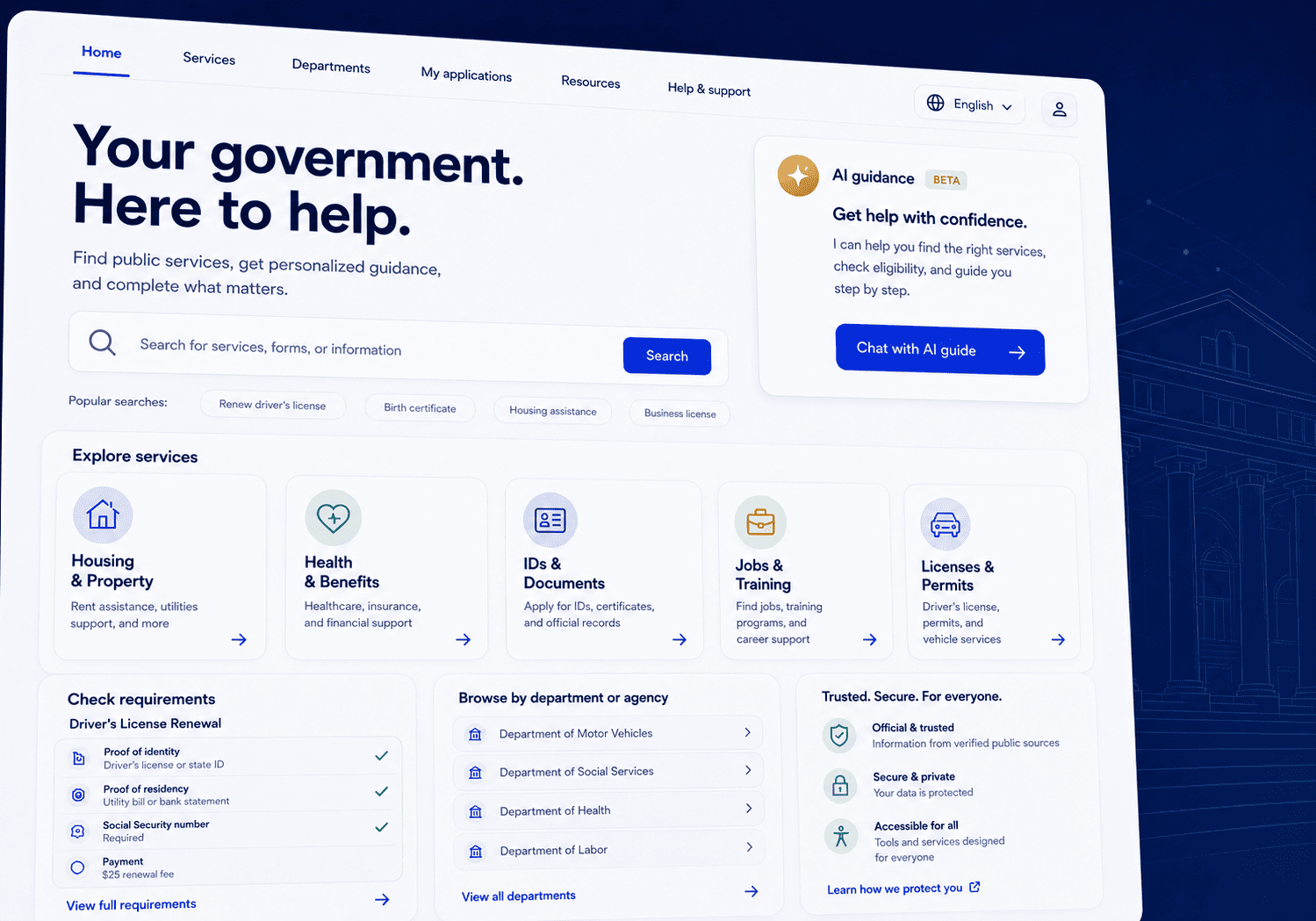
AI-Powered Citizen Services Website Platform for Virginia State Agencies

Plavno developed a modern eGovernment website platform for Virginia state agencies that centralizes citizen services, public information, department content, and an AI-powered guidance agent in one scalable system.

Read More
70%

reduction in routine citizen inquiries to agency staff

AI-Powered Citizen Services Website Platform for Virginia State Agencies

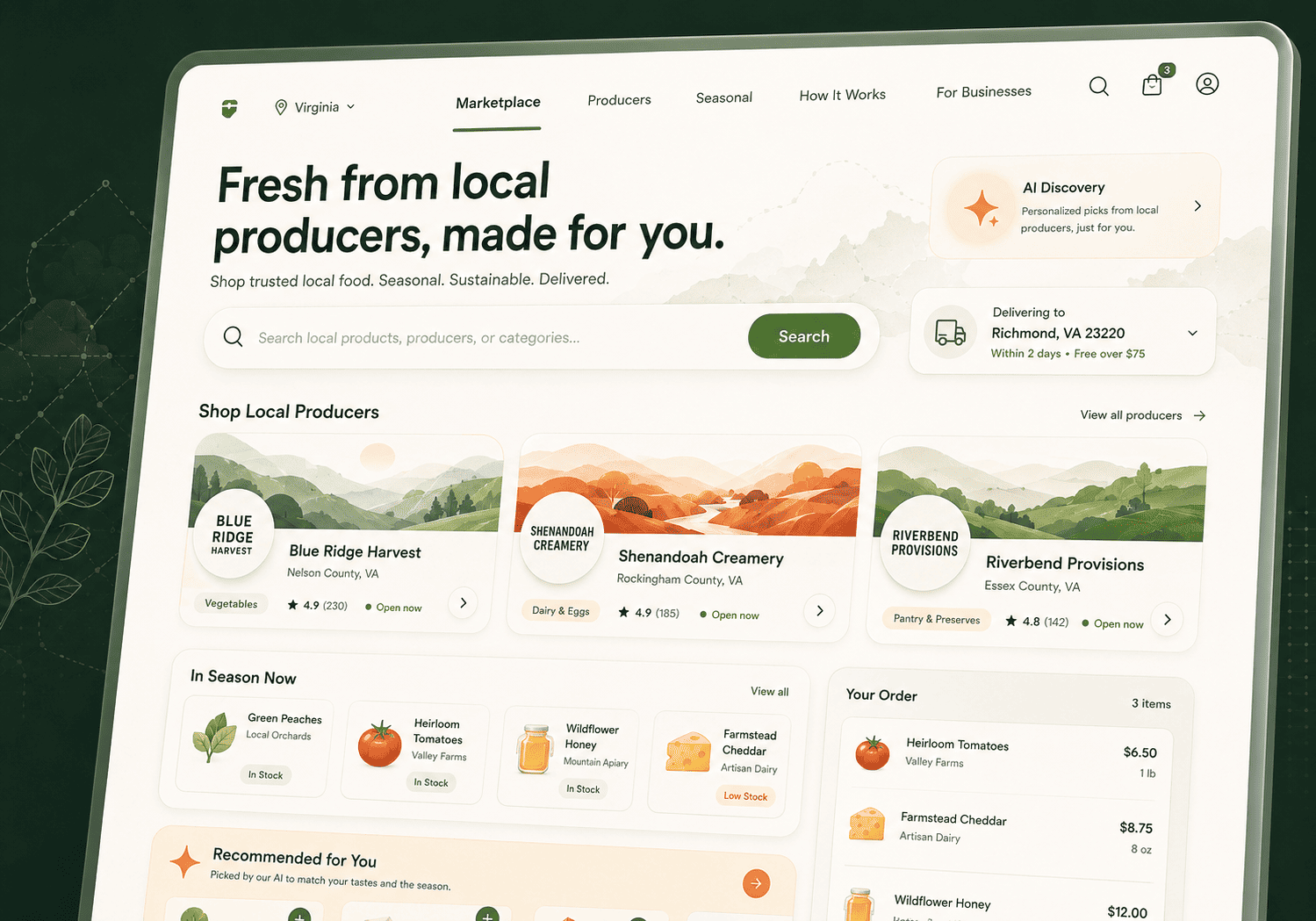
Digital Marketplace for Virginia Farmers, Local Producers & Direct-to-Consumer Food Sales

Plavno developed a custom multi-vendor marketplace for Virginia-based farmers, food producers, and regional sellers to unify product listings, vendor operations, customer ordering, and local fulfillment workflows.

Read More
3x

increase in product discovery relevance

Digital Marketplace for Virginia Farmers, Local Producers & Direct-to-Consumer Food Sales

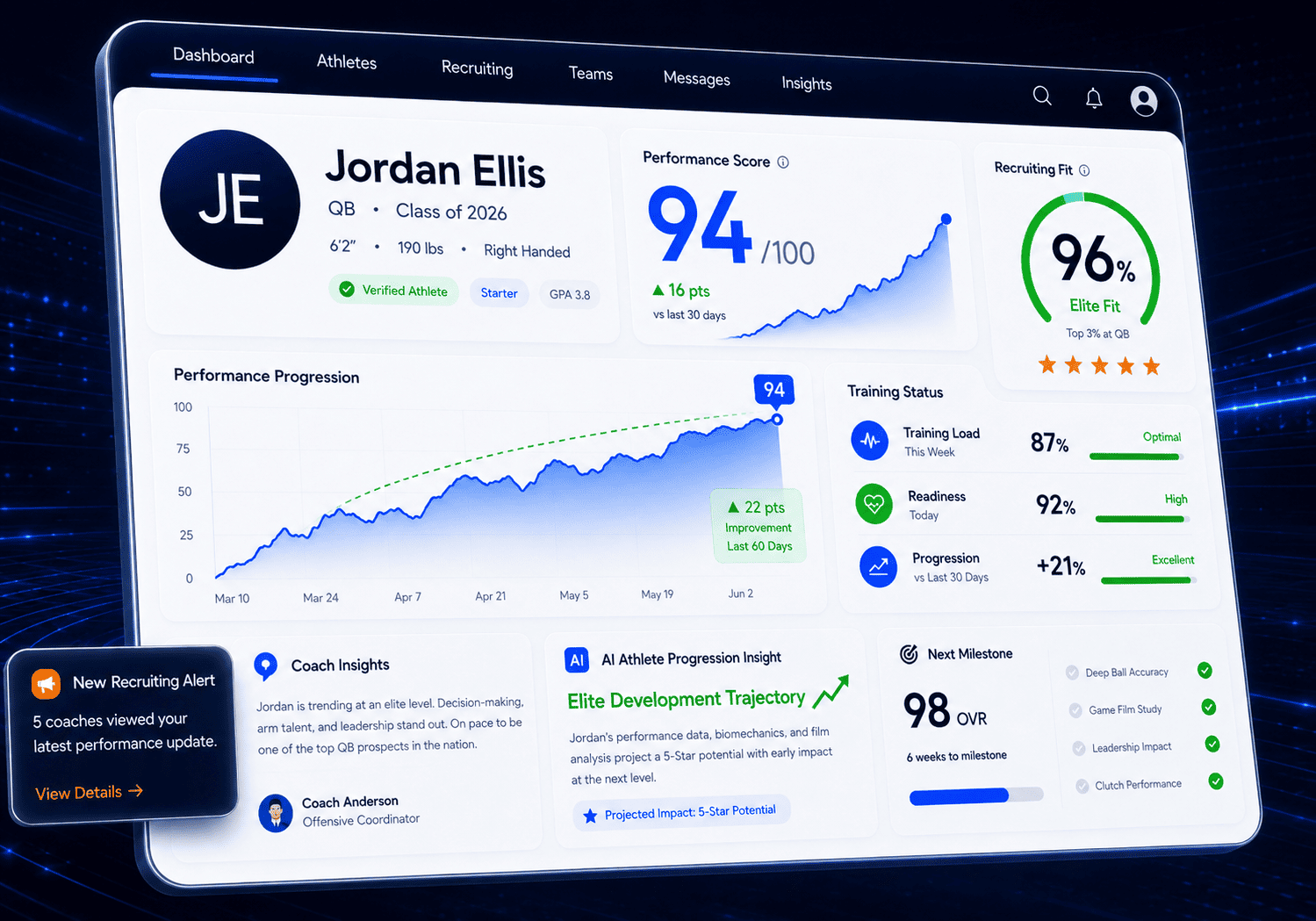
AI-Powered Sports Performance & Recruiting Platform for Virginia Clubs, Academies & Youth Programs

Plavno developed a custom sports technology platform for Virginia-based clubs and academies to combine athlete performance tracking, coach communication, recruiting workflows, and mobile engagement in one ecosystem.

Read More
3x

faster recruiting pipeline

AI-Powered Sports Performance & Recruiting Platform for Virginia Clubs, Academies & Youth Programs

Engineering contrast

Why Herndon buyers pick deep agent engineering

Generic shops ship chat demos. We ship agents your ops and security teams will actually run.

Generic Agencies
Our Platform (Deep Engineering Expertise)
Typed tool adapters with idempotent writes
checkmark
Offline eval suite before production promote
checkmark
Token and cost ceilings per workflow
checkmark
Human approval queues for high-risk actions
checkmark
checkmark
Runbooks and ownership transfer to your team
checkmark
Slide deck of model brand names as the deliverable
checkmark
Traceable logs for prompt, tool, and outcome
checkmark

Testimonials

We are trusted by our customers

“They really understand what we need. They’re very professional.”

The 3D configurator has received positive feedback from customers. Moreover, it has generated 30% more business and increased leads significantly, giving the client confidence for the future. Overall, Plavno has led the project seamlessly. Customers can expect a responsible, well-organized partner.

Sergio Artimenia

Commercial Director, RNDpoint

Sergio Artimenia

“We appreciated the impactful contributions of Plavno.”

Plavno's efforts in addressing challenges and implementing effective solutions have played a crucial role in the success of T-Rize. The outcomes achieved have exceeded expectations, revolutionizing the investment sector and ensuring universal access to financial opportunities

Thien Duy Tran

Product Manager, T-Rize Group

Thien Duy Tran

“We are very satisfied with their excellent work”

Through the partnership with Plavno, we built a system used by more than 40 million connected channels. Throughout the engagement, the team was communicative and quick in responding to our concerns. Overall, we were highly satisfied with the results of collaboration.

Michael Bychenok

CEO, MediaCube

Michael Bychenok

“They have a clear understanding of what the end user needs.”

Plavno's codes and designs are user-friendly, and they complete all deliverables within the deadline. They are easy to work with and easily adapt to existing workflows, and the client values their professionalism and expertise. Overall, the team has delivered everything that was promised.

Helen Lonskaya

Head of Growth, Codabrasoft LLC

Helen Lonskaya

“The app was delivered on time without any serious issues.”

The MVP app developed by Plavno is excellent and has all the functionality required. Plavno has delivered on time and ensured a successful execution via regular updates and fast problem-solving. The client is so satisfied with Plavno's work that they'll work with them on developing the full app.

Mitya Smusin

Founder, 24hour.dev

Mitya Smusin

Data, cost, guardrails

Keep agent data paths honest and costs predictable

Architecture alone fails when data is stale or tools are too wide. The second build focus for Herndon programs is the data contract between the agent and your systems of record. We inventory sources, owners, refresh rates, and quality signals before writing prompts. Each field the agent may touch gets a producer, a freshness SLA, and a fallback when values go missing. That discipline came from analytics work where bad metrics would have created false ops alarms.

Integration work stays boring on purpose. Message queues buffer bursts from ticket spikes. Change data capture feeds keep indexes warm without nightly full scrapes when possible. For document heavy units, we separate parsing from reasoning so OCR failures never look like model genius. Public services portal experience with structured pages and secure forms taught us to validate inputs before any automated path continues.

Cost control is a product feature. We budget tokens by workflow, cache repeated retrievals, and collapse multi-call chains when a single structured extract will do. Batch jobs run off-peak for Ashburn-heavy data pipelines. Product owners see projected monthly spend during design, not after a surprise invoice. When usage climbs, we add routing rules that downgrade easy tasks instead of expanding spend silently.

Guardrails cover both model behavior and enterprise policy. Output filters strip secrets. Topic blocks stop the agent from advising outside its charter. For regulated Virginia contractors, we align retention and access logs with existing SOC2 evidence collection. Security reviews happen on the same cadence as other customer-facing services.

Post-launch, the same contracts drive monitoring. Drift shows up when retrieval hit rates fall or tool error codes spike. We define owners for each alert so issues do not bounce between data and app teams. Herndon clients leave with a living data map, not a one-off integration spreadsheet that ages out in a quarter.

Architecture & Engineering Overview

How Herndon AI agent programs stay fundable after launch

Baseline Time Back

Baseline Time Back

Measure cycle time and rework before build; prove hours recovered after two sprints

Caps & Human Gates

Caps & Human Gates

Token/tool hard limits plus approvals on money, access, and external messaging

Platform Consolidation

Platform Consolidation

Shared evals and logging replace shadow GPT scripts across teams

Owned Orchestration

Owned Orchestration

Prompts and graphs in your code; models stay swappable components

For Business: Technical ROI & Risk Mitigation

Sponsors fund agents to recover hours and reduce error cost, not to chase model brands. The business case holds when one workflow proves time back with controls finance can audit. We baseline cycle time and rework before build, then measure the same stats after two stable sprints in production. Telecom analytics automation showed how insight prep can leave the night shift and still improve signal quality for leads.

Risk drops when the agent cannot spend freely or write freely. Hard caps on tools and tokens bound the blast radius of a bad prompt. Human gates on money, access, and external messaging protect brand and compliance. These controls matter for Northern Virginia firms selling into government and enterprise buyers who demand evidence.

Technical debt shows up as shadow IT scripts and one-off GPT experiments with no owners. Centralizing the first agent platform with shared evals and logging prevents five different teams from reinventing the same fragile bot. Consolidation itself becomes a savings line when licensing and on-call load shrink.

Budget conversations stay honest. You fund discovery, MVP on one process, then expansion only after metrics clear thresholds. That sequence protects Herndon leadership from multi-year AI roadmaps that never hit a P&L outcome. It also creates a repeatable playbook you can take to sister sites in Reston or McLean.

Finally, vendor lock-in risk is managed by keeping orchestration and prompts in code you own. Models become swappable components. If pricing or quality shifts in 2026, you re-route tasks without rewriting the business logic layer.

Kickoff & ADRs

Kickoff & ADRs

Freeze workflow, metrics, touch systems; record model routing and secrets

Assisted Launch

Assisted Launch

Human gates on writes; higher autonomy on read-only analytics first

Progressive Delivery

Progressive Delivery

PR-governed prompts, golden suites, feature flags to pilot cohorts

Quarterly Transfer

Quarterly Transfer

Spend, drift, SLOs, runbooks — then advisory handoff to your platform team

For CTOs: Architecture & Technical Lifecycle

CTO buyers need a lifecycle that fits existing platform engineering. Agents ship like any other service: design review, staging evals, progressive delivery, and explicit owners. Kickoff freezes the target workflow, success metrics, and systems the agent may touch. Architecture decision records capture model routing, storage, and secret handling before code spreads.

Trade-offs appear early. Fully autonomous loops reduce headcount pressure but raise residual risk on edge cases. Assisted modes slow pure velocity yet improve trust during the first quarters. We recommend assisted launch for write paths and higher autonomy for read-only analytics, then revisit after measured error rates stabilize.

Governance mirrors change management. Prompt and tool changes go through pull requests. Golden task suites block releases that regress accuracy or latency. Feature flags isolate new tools to a Herndon pilot cohort before enterprise rollouts along the Dulles corridor.

Lifecycle does not end at launch. Quarterly reviews cover spend, drift, and roadmap items from ops feedback. Platform teams receive runbooks, dependency maps, and SLOs aligned with other customer-critical services. When the internal team is ready, we step back to advisory rather than permanent staff-aug that never transfers skill.

Integration strategy prefers thin adapters over deep forks of SaaS APIs. That keeps upgrades cheaper when vendors change schemas. Event-driven handoffs beat long synchronous chains that lock browser sessions during multi-step agent plans.

Orchestration Graphs

Orchestration Graphs

Explicit plan nodes over free-form multi-agent chatter; each step testable

Container Runtime & Workers

Container Runtime & Workers

Versioned services, durable state across retries, scale by queue depth

Typed Tools & Schemas

Typed Tools & Schemas

JSON validation before CRM writes; idempotency keys stop double side effects

Golden Evals & Fixtures

Golden Evals & Fixtures

Empty results, rate limits, conflicts — fail closed with operator messages

For Engineers: Implementation Details & Stack

Engineers inherit code that is boring in the best way. We favor explicit orchestration graphs, typed tools, and deterministic evals over clever unbounded agents. Runtime is containerized. State stores keep plan progress across retries. Workers pull jobs so horizontal scale follows queue depth instead of sticky chat sessions.

Why these choices: free-form multi-agent chatter is hard to debug under production load. Graphs make each node testable. JSON schemas catch malformed tool arguments before they hit CRM write endpoints. Caching repeated retrieval chunks cuts both latency and token burn on common Herndon SOPs.

Edge cases get fixtures. Empty search results, partial tickets, rate-limited APIs, and conflicting source docs all have golden tests. Timeouts fail closed with operator-facing messages. Idempotency keys stop double side effects when a worker restarts mid-step. Patterns from the telecom analytics agent guide how insight tools report uncertainty instead of inventing missing KPIs.

Front-end handoffs use structured payloads. When we need content surfaces, headless CMS patterns like those in the Strapi public services portal keep service pages and forms consistent for human follow-up. Ecommerce-style catalog lessons apply if agents ever touch product inventory states with strict stock rules.

Local dev parity matters. Docker compose spins the orchestrator, fake tools, and eval runner. Engineers reproduce production failures without touching live customer data. Documentation lists every env var and the blast radius of each tool permission so new hires in Virginia offices ramp safely.

Unified Telemetry

Unified Telemetry

Traces stitch request, retrieval, model, tools; p95, cost/success, overrides

Security Baselines

Security Baselines

Least-privilege accounts, short-lived tokens, PII redaction, role-gated traces

VPC & Canaries

VPC & Canaries

Private cloud targets; staged rollouts on noncritical queues first

Incident → Eval Loop

Incident → Eval Loop

Disable tool, roll back prompt, append cases; cost beside reliability reviews

Infrastructure, Observability & Security

US clients need the same operational bar they already apply to payments and identity. We instrument agents for latency, cost, correctness proxies, and security events in one plane. Traces stitch user request, retrieval hits, model calls, and tool outcomes. Metrics track p95 step time, token cost per success, and human override rates.

What we monitor and why: rising override rates signal trust decay. Retrieval miss spikes signal stale indexes. Tool 429 waves signal need for backoff or quota talks with upstream owners. Alerts route to the workflow owner, not a generic AI mailbox that nobody watches overnight.

Security baselines include least-privilege service accounts, short-lived tokens, and encryption in transit and at rest. Prompt and response logs redact known PII patterns. Access to raw traces is role gated. For SOC2-minded firms and healthcare-adjacent work in the region, evidence packs reuse the same control narratives as other apps.

Deployment targets private cloud or your VPC when data cannot leave. We support staged rollouts with canaries on noncritical queues first. Incident response playbooks define how to disable a tool, roll back a prompt version, and communicate status to ops. Drills happen before go-live so Herndon on-call staff are not learning during an outage.

Post-incident, we append new cases to the eval set. That closes the loop between production pain and prevention. Cost reviews sit on the same calendar as reliability reviews so spend surprises never arrive alone.

Eugene Katovich

Eugene Katovich

Sales Manager

Need a custom software solution? We’re ready to help!

Plavno has a team of skilled developers ready to tackle the project. Ask me!

Get a Free Quote

Readiness check

Confirm your Herndon team is ready to start agents

  • Name the single workflow and owner — Pick one process with volume, pain, and a named business owner who can decide weekly. Write the start state, end state, and systems touched in plain language. Capture how staff currently measure success so baselines are real. Include approximate monthly volume and peak hours for Herndon or multi-site Virginia load. Without a single owner, pilots stall in shared slack channels. This step prevents multi-workflow scope that never ships.

  • Inventory data sources and freshness — List every system the agent must read or write with owner contacts. Note refresh delays, known quality gaps, and fields that are often empty. Mark which sources are authoritative when two tools disagree. Flag any data that cannot leave a given network boundary. Good inventories cut weeks of surprise integration work later. Share sample exports under NDA so we can design retrieval and validation early.

  • Define allowed actions and stop rules — Document which tools may run without a human and which always need approval. State dollar, access, or customer-impact thresholds that force a gate. Describe how the agent should behave when confidence is low or tools fail. Align with security and legal before code starts. Clear stop rules keep trust high during the first production month. They also speed review with enterprise buyers in Northern Virginia.

  • Prepare eval examples from real history — Export 30 to 100 anonymized cases that represent easy, medium, and nasty edge paths. Include the correct human outcome for each. Note any seasonal spikes unique to your corridor customers. These become golden tests that block bad releases. Teams that skip evals argue from anecdotes after launch. Strong sets turn quality debates into measurable diffs.

  • Set budget, timeline, and success thresholds — Agree target spend for discovery and MVP before optional expansions. Choose calendar dates for staging and first production cohort. Define the metric gates that unlock phase two funding. Include who signs off on go-live inside your Herndon leadership chain. Hard numbers keep vendors and internal teams honest. Bring stack details and dataset scope to the first working session.

Vitaly Kovalev

Vitaly Kovalev

Sales Manager

Request a Herndon agent readiness audit

Share budget, timeline, stack, and workflow scope to receive a scored readiness audit plus a fixed-scope MVP estimate for Herndon businesses. The audit doubles as a planning lead magnet your ops and security leads can reuse internally.

Talk to Experts

Practical answers

AI agents questions from Herndon and Virginia buyers

Straight answers on cost, timing, data, quality, security, and life after launch for teams building agents in 2026.

What drives the cost to build AI agents for a Herndon company?

Cost follows workflow complexity, system count, and risk controls more than model brand names. A read-only analytics agent with two clean APIs costs far less than an agent that writes into ERP, CRM, and billing with human gates. Northern Virginia programs often add security reviews, logging depth, and staging environments that pure demo shops skip. Those items raise investment and also raise survival odds after launch. Labor is the main line item. Discovery, connector engineering, eval design, and hardening dominate. Token spend during build is visible but usually smaller than engineering time. If your data needs heavy cleaning or OCR, plan for that before model work. Multi-site Virginia rollouts add environment parity and access management that single-office pilots avoid. Local market rates reflect competition for platform and ML-adjacent talent along the Dulles corridor. You can offset that by supplying clear owners, sample data, and decisions within days instead of weeks. Fixed-scope MVPs keep first invoices predictable. Expansion pricing should map to added tools and measured usage, not open-ended retainers that hide idle time. Ask every vendor for a breakdown: discovery, build, eval harness, security work, and month-one operations. Compare those lines, not a single rounded number. Include your internal staff time in the true total. Herndon buyers who track both cash and opportunity cost make cleaner go or no-go calls after the first release.

How long does it take to build AI Agents software?

A focused MVP on one workflow often lands in eight to twelve weeks when data access is ready on week one. That path covers discovery, thin connectors, orchestration, basic evals, and a pilot group in production. Full deployment across several teams and write-heavy tools commonly takes four to six months including hardening, training, and progressive rollout. Timeline stretches when legal reviews or federal-adjacent controls sit on the critical path. Discovery should finish with a written scope, not endless workshops. Two to three weeks is enough if stakeholders in Herndon can meet and decide. Build sprints then deliver vertical slices: retrieval first, then read tools, then guarded writes. Parallel work on eval sets saves time later when quality debates appear. MVP means limited tools and clear success metrics, not unfinished security. You should still have logging, auth, and rollback before real users rely on the agent. Full deployment adds more systems, richer monitoring, cost budgets, and runbooks owned by your staff. Skipping those turns a fast MVP into a long incident response hobby. Dependencies matter. Waiting on API credentials or data shares can add quiet weeks. Prepare inventories and sample tickets before kickoff. Teams that start with clean access regularly hit calendar commitments. Teams that discover source systems mid-build rarely do. Plan buffer around change freezes unique to your industry and to Northern Virginia contractor cycles.

What data do you need before creating AI agents for our stack?

We need representative examples of the work, not your entire warehouse on day one. Provide anonymized tickets, reports, or transcripts that show happy paths and failures. Include the fields humans actually use to decide. Document which system is source of truth when duplicates exist. Share API docs or integration guides for each tool the agent must call. Access patterns matter as much as raw files. Explain authentication methods, rate limits, and whether sandboxes exist. Note data residency rules for Virginia and broader US operations. If some tables cannot leave a VPC, say so early so architecture stays honest. Describe retention rules that affect logging and eval storage. Quality signals help. Point out fields that are often blank, delayed, or manually overwritten. Tell us seasonal spikes tied to your customer base along the Dulles corridor. If compliance flags certain content, mark it for redaction pipelines. The better the map, the less time spent reverse engineering tribal knowledge from chat screenshots. You do not need a perfect lakehouse to start. Many Herndon programs begin with one CRM view, one metrics API, and a curated document set. We expand sources after the first workflow proves value. Start small, label ownership, and keep a living inventory. That habit becomes the foundation for later agents without repeating discovery from scratch.

How should we evaluate quality for enterprise AI agent solutions?

Quality is task success under production constraints, not a vibe check on a few chat turns. Define golden tasks with expected outputs and allowed tool sequences. Score exact fields for extraction jobs and rubric-based grades for free text summaries. Track citation presence when answers must ground in private docs. Separate model quality from connector failures so root causes stay clear. Offline evals run on every meaningful change. Online evals sample live traffic with human review on a schedule. Watch override rates, time-to-resolution, and rework after agent suggestions. For telecom-style analytics agents, compare insight accuracy against analyst baselines on the same periods. Business metrics must sit beside model metrics or the project drifts into tech theater. Latency and cost are quality dimensions too. An accurate answer that arrives after the shift ends still fails operations. A cheap wrong answer creates expensive cleanup. Set budgets per workflow and alert when unit economics slip. Herndon leadership should see a simple weekly scorecard: success rate, cost per success, and open incidents. Vendors who cannot show eval harnesses are guessing. Ask for how tests are versioned, who updates labels, and what blocks a release. Insist on access to traces for your own audits. Quality measurement is a program, not a slide. Treat it like any other production reliability practice in Northern Virginia enterprises.

How do you handle security and compliance for AI agents in Virginia?

Security design starts with least privilege and clear data boundaries. Agents receive only the tools and rows required for the named workflow. Secrets never live in prompts. Logs redact sensitive patterns and restrict who can replay full traces. Network paths prefer private connectivity when customer data cannot traverse the public internet. These basics align with how serious US enterprises already run services. Compliance mapping depends on your obligations. SOC2 evidence reuse covers change management, access reviews, and incident response for many B2B firms. Healthcare-adjacent and federal contractor work may add stricter controls, training, and documentation. We align with your existing policies rather than inventing a parallel AI rulebook that security teams will reject. Virginia operators often need explicit statements on data residency and subprocessors. Threats specific to agents include prompt injection via documents and unsafe tool chaining. We mitigate with input segregation, allowlisted tools, output filters, and human gates on high-impact actions. Regular red-team style tests belong in the release cycle. Incidents have playbooks: disable tool, roll back prompt, notify owners, append cases to evals. Procurement will ask about model providers, retention, and training use of your data. We document answers up front and keep architecture flexible if a provider term changes. Security review is scheduled in the project plan, not left as a surprise before go-live. That sequencing keeps Herndon launches on calendar while meeting enterprise bars.

Contact Us

This is what will happen, after you submit form

Need a custom consultation? Ask me!

Plavno has a team of experts ready to start your project. Ask us!

Vitaly Kovalev

Vitaly Kovalev

Sales Manager

Schedule a call

Get in touch

Fill in your details below or find us using these contacts. Let us know how we can help.

Required because you selected “Other” above

No more than 3 files may be attached up to 3MB each.
Formats: doc, docx, pdf, ppt, pptx, xls, xlsx, txt.
Book your meeting