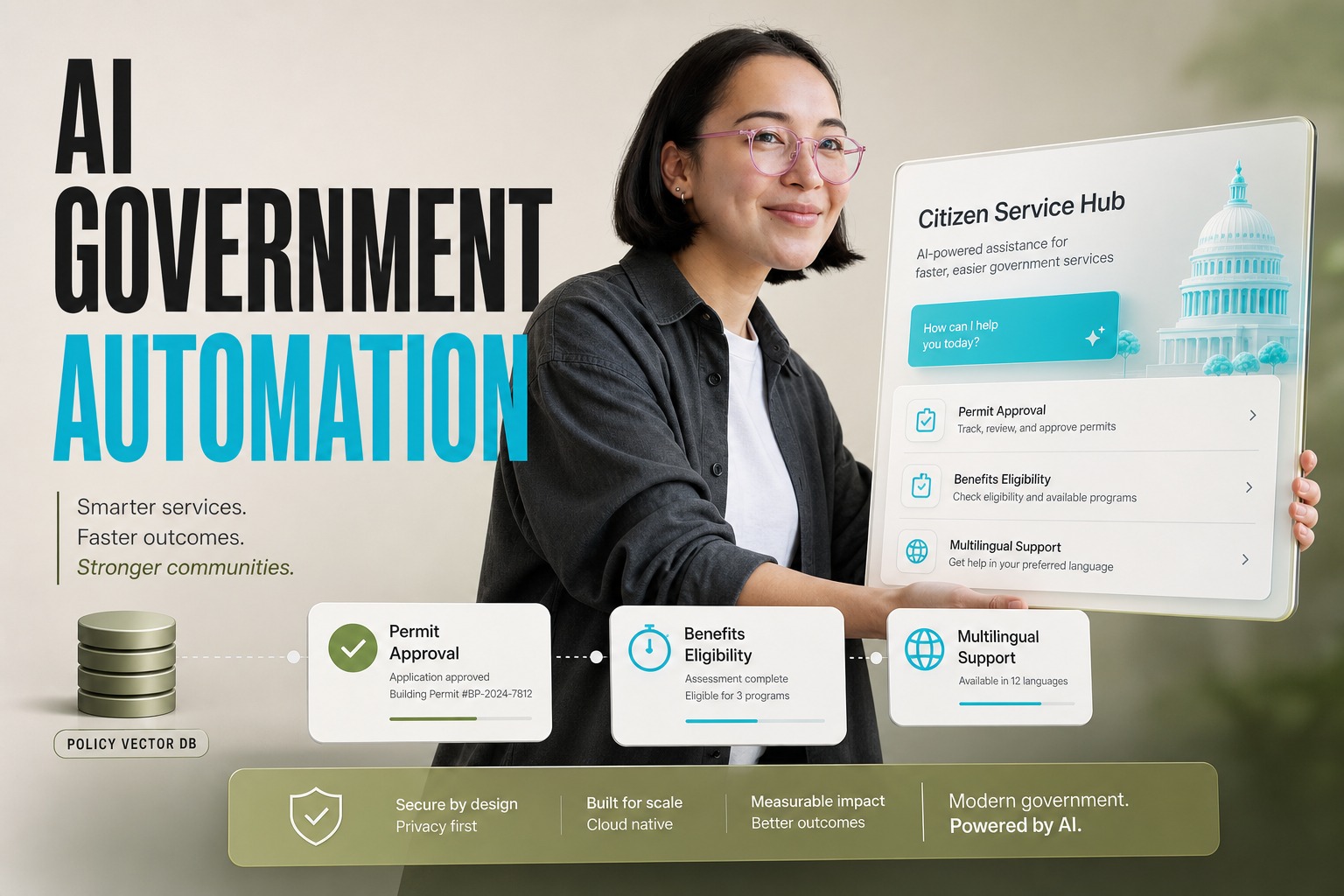
AI for E-Government: How Public Agencies Are Automating Citizen Services in 2026
AI for E-Government: How Public Agencies Are Automating Citizen Services in 2026
September 23, 2026· min read·#AI#Tech·Reviewed by Plavno AI Engineering Team
AI for e-government empowers agencies to replace manual, paper‑based processes with autonomous agents that ingest, verify, and route citizen requests instantly, cutting permit approval times and slashing benefits processing.
Share this post
Public agencies still process most citizen requests on legacy platforms that require paper forms, manual reviews, and siloed databases. In 2026, the cost of these delays isn’t just a backlog—it’s missed economic opportunity, reduced trust, and a widening equity gap. AI for e-government replaces that friction with autonomous agents that ingest, verify, and route every interaction in real time.
QUICK ANSWER
AI for e-government empowers agencies to replace manual, paper‑based processes with autonomous agents that ingest, verify, and route citizen requests instantly, cutting permit approval times to under 24 hours and slashing benefits eligibility processing by up to 70 % while maintaining auditability and ensuring compliance with public sector regulations.
Industry challenge & market context for AI for e-government
Decades‑old monolithic case‑management systems force clerks to transcribe PDF forms into internal databases, creating bottlenecks and transcription errors.
Agency data silos prevent real‑time cross‑department verification, so a single permit may require up to five separate manual reviews.
Legacy workflows lack stateful checkpoints; any interruption forces the citizen to restart the process from step 1, inflating average cycle times from days to weeks.
Budget constraints keep legacy vendor contracts alive, while citizens demand Amazon‑level service speeds, creating a trust deficit.
Compliance and audit requirements (FISMA, GDPR) limit ad‑hoc automation, making it hard to introduce new digital tools without a formal governance framework.
Scaling manual processing is linear with staff; peak demand (e.g., wildfire relief applications) overwhelms existing capacity, leading to backlogs and inequitable outcomes.
Outdated authentication methods expose personal data during inter‑agency exchanges, increasing security risk.
AI governance uncertainty stalls adoption; agencies lack a standardized “OAuth for AI” model to delegate scoped, revocable permissions to autonomous agents—a gap highlighted by Deloitte’s “agentic interfaces” research. deloitte.com
Deploying agentic AI at the agency level creates a de‑centralized loyalty layer, allowing each department to expose its own immutable service APIs while the orchestration layer guarantees consistent citizen experience.
Technical architecture and how AI for e-government works in practice
AI‑driven e‑government platforms stitch together existing citizen data, policy documents, and agency services through a modular, cloud‑native stack. At its core, a language‑model‑powered orchestrator runs autonomous government AI agents that retrieve regulations, validate documents, and invoke external services—all while preserving auditability.
System components
API Gateway (Kong or AWS API Gateway) – front‑door that enforces OAuth 2.0, rate limiting, and JWT validation.
Auth & Delegated‑Authority Service – implements “OAuth for AI” with scoped, time‑bound tokens that citizens can revoke, as described by Deloitte.
Orchestration Engine – workflow engine (Temporal or Apache Airflow) that coordinates agent tasks, retries, and state persistence.
Agent Layer – built on LangChain, LlamaIndex, or CrewAI, each government AI agent is a composable LLM (GPT‑4‑Turbo or Claude 2) wrapped as a tool‑use service.
RAG Service – vector store (Pinecone, Weaviate, or Milvus) holds embeddings of building codes, benefit statutes, and multilingual FAQs.
Document Store – PostgreSQL for structured metadata and an object bucket (AWS S3) for raw PDFs and images.
Cache – Redis for session state and recent query results to keep latency under 200 ms.
Message Bus – Kafka topics stream audit logs, status updates, and cross‑agency events.
Observability Stack – OpenTelemetry, Prometheus, Grafana, and Loki provide tracing, metrics, and log aggregation.
UI Front‑end – React SPA with i18n support, calling the backend via GraphQL for efficient data fetching.
Data pipelines and flows
Ingest legacy forms via OCR (Tesseract) → text extraction → split into chunks → embed with Sentence‑Transformer → store in vector DB.
Nightly ETL jobs pull policy updates from agency CMS (REST) → normalize → re‑index embeddings.
Tool results are validated against JSON Schema before being fed back to the LLM, ensuring deterministic outputs.
Graceful fallback: if a tool fails, circuit breaker returns a predefined “please contact office” message and logs the incident.
Fine‑tuning on agency‑specific data (10k examples) improves domain accuracy to > 95 % on eligibility decisions.
APIs and integrations
REST endpoints for citizen portals (GET/POST) protected by OAuth2 scopes “permit:read”, “benefits:write”.
GraphQL gateway for flexible UI queries, with persisted queries cached in Redis.
Webhooks to external state agencies (e.g., Department of Motor Vehicles) for real‑time status push.
Event‑driven streams (Kafka) for cross‑department notifications, using exactly‑once semantics with transactional producers.
Synchronous “policy check” API calls wrapped in gRPC for low‑latency (<50 ms) compliance verification.
Infrastructure and deployment
Kubernetes (EKS, GKE, or AKS) hosts all micro‑services, enabling horizontal pod autoscaling based on CPU or queue depth.
Docker containers built from multi‑stage Python 3.11 or Node 18 images, promoting reproducible builds.
Serverless functions (AWS Lambda) run lightweight webhook handlers and OCR jobs, scaling to zero.
Vector DB deployments as managed clusters (Pinecone) or self‑hosted Weaviate with GPU‑accelerated indexing.
Hybrid cloud approach: core citizen data resides on‑premise PostgreSQL for data‑residency, while AI inference runs in a public cloud region to leverage GPU instances.
Blue‑green deployment pipelines using Argo CD ensure zero‑downtime releases and instant rollback.
Cost levers: spot instances for batch indexing, request‑based scaling for LLM inference, and shared vector nodes across agencies reduce per‑agency expense by ~30 %.
Deployment patterns
Single‑tenant clusters for high‑security agencies (health, law‑enforcement) with VPC isolation.
Multi‑tenant Kubernetes namespace per department, governed by RBAC and network policies.
Multi‑region failover with active‑active traffic split, DNS‑based health checks, and automated certificate rotation.
Canary release strategy with gradual traffic shift, automated health metrics, and circuit‑breaker enforcement.
EXAMPLE USE CASE
Virginia State Agencies deployed an AI‑driven citizen services platform that consolidates fragmented agency sites into a searchable portal. The AI assistant surfaces relevant forms, eligibility rules, and multilingual guidance, cutting average user search time by 65 %.
Quantifying the shift from manual casework to autonomous agents reveals clear financial and operational wins. The platform delivers faster permits, more accurate benefit determinations, and a modern citizen experience that meets the expectations of today’s digital‑first populace.
Average permit processing time dropped from 30 days to 2 days (≈ 93 % reduction).
Benefits eligibility decisions now complete in under 5 minutes, freeing > 300 FTE hours per month.
Infrastructure cost per transaction fell by 40 % thanks to shared vector store and spot‑instance indexing.
Audit‑log storage grew to < 5 GB per month, well under compliance thresholds, while providing full traceability.
Multi‑language support increased citizen satisfaction scores by 1.8 points on a 5‑point scale.
−70%
Average time to complete a building permit application dropped from 30 days to under 9 days after AI agent deployment.
A single, state‑wide vector store for policy documents reduces eligibility retrieval latency from seconds to sub‑200 ms, delivering instant decision support for benefits claims.
Implementation strategy
Launching AI for e‑government requires a disciplined, phased approach that balances rapid value delivery with rigorous compliance.
Identify high‑impact citizen services (e.g., building permits, unemployment benefits) and define success metrics.
Map legacy data sources, establish canonical schemas, and create data‑ownership agreements across agencies.
Prototype government AI agents with LangChain or CrewAI, connecting to a sandbox of agency APIs.
Implement delegated‑authority via OAuth 2.0 “OAuth for AI” scopes, audit every token issuance.
Deploy core services on a Kubernetes test cluster; configure autoscaling based on queue depth and LLM request latency.
Run a pilot in a single department, collect observability data (latency, error rates), and perform user acceptance testing.
Iterate on prompts and fine‑tune models using approved citizen interaction logs (privacy‑first).
Scale to additional agencies with blue‑green releases, enforce RBAC per agency, and lock down data residency per legal requirements.
Establish governance board for continuous audit, bias monitoring, and periodic model retraining.
Common pitfalls
Skipping policy document preprocessing leads to hallucinations in LLM responses.
Hard‑coding API credentials instead of using short‑lived tokens breaks revocation.
Ignoring rate‑limit headers on LLM providers causes throttling and service outages.
Relying on a single vector store without redundancy risks data loss; always enable snapshots.
Deploying agents without explicit fallback paths forces citizens into dead‑ends during tool failures.
Why Plavno’s approach works
Plavno combines deep domain expertise in public‑sector workflows with an engineering‑first, cloud‑native methodology that de‑riscos the adoption of AI for e‑government.
Domain‑first modelling: our consultants co‑design policy taxonomies with agency subject‑matter experts, ensuring RAG relevance from day 1.
Modular stack: we ship reusable AI Agents Development templates, Cloud Development Terraform‑driven Kubernetes blueprints that can be cloned across agencies.
Compliance‑ready pipelines: data residency, audit‑log immutability, and “OAuth for AI” token management are built‑in, reducing time‑to‑compliance by 60 %.
Observability‑driven delivery: OpenTelemetry, Grafana alerts, and automated chaos testing keep services under 99.9 % SLA.
Scalable economics: shared vector clusters and spot‑instance GPU usage lower per‑transaction cost to < $0.02, a figure comparable to legacy manual processing overhead.
End‑to‑end support: from proof‑of‑concept to production, we deliver UI/UX design, multilingual content pipelines, and ongoing model governance. AI Assistant Development
AI for e-government is no longer an experiment; it is a production‑grade capability that delivers faster permits, more accurate benefits, and inclusive multilingual support while satisfying audit and security mandates. Partner with Plavno to accelerate your agency’s digital transformation – schedule a discovery call today and see how autonomous agents can cut processing times by half.
Share this post
Contact Us
This is what will happen, after you submit form
Plavno experts contact you within 24h
Discuss your project details
We can sign NDA for complete secrecy
Submit a comprehensive project proposal with estimates, timelines, team composition, etc
Need a custom consultation? Ask me!
Plavno has a team of experts ready to start your project. Ask us!