AI in Education Technology: Personalized Learning Without Losing the Teachers Role
AI in Education Technology: Personalized Learning Without Losing the Teachers Role
September 28, 2026· min read·#E-com#AI·Reviewed by Plavno AI Engineering Team
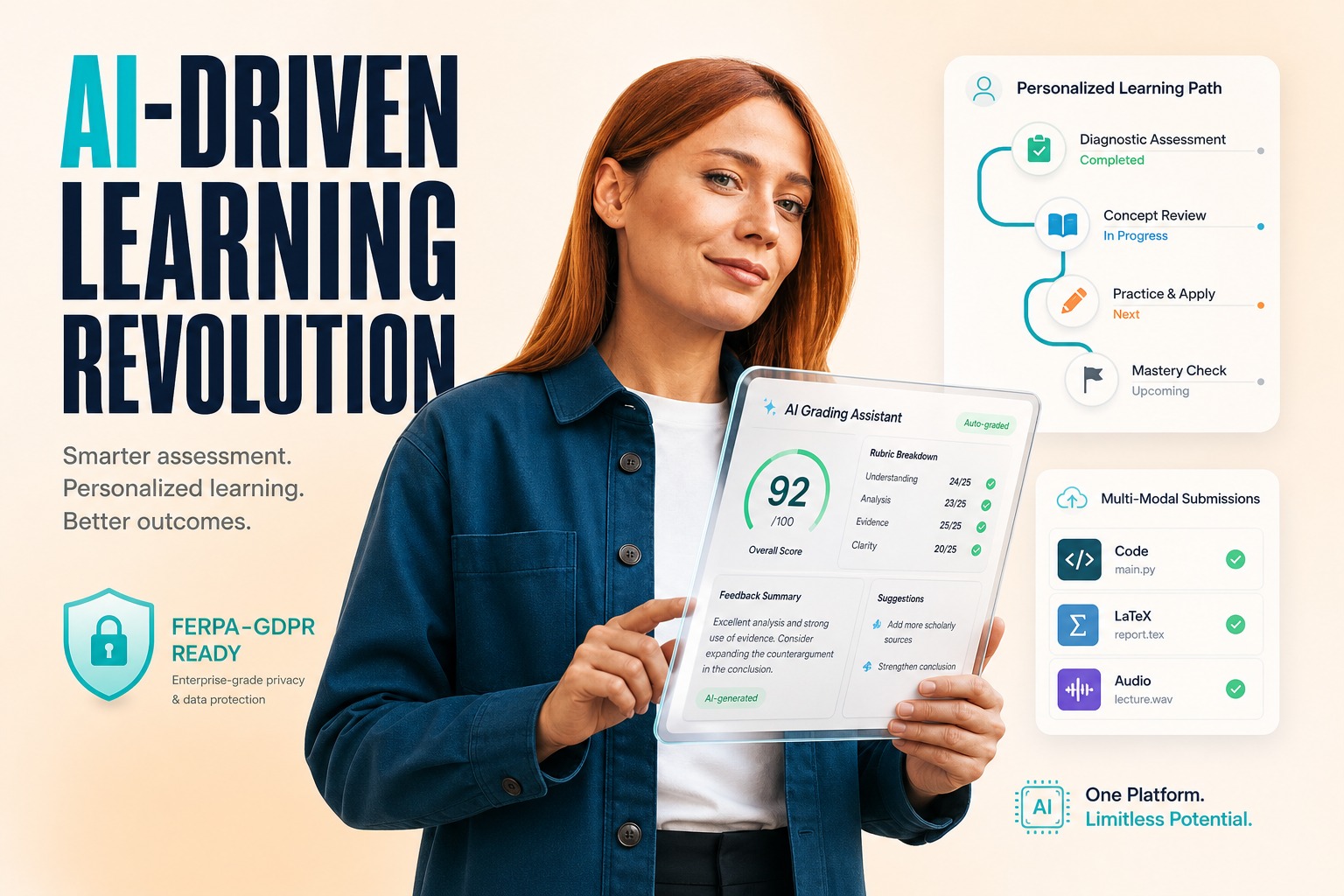
AI in education technology delivers personalized learning paths, auto‑graded feedback, and admin‑task automation while keeping teachers as the final decision‑maker.
Share this post
Universities and corporate training programs are drowning in repetitive grading, curriculum curation, and administrative overhead, while students demand instant, customized feedback. The paradox is clear: scale the learning experience without sidelining the teacher's expertise. In 2026, AI in education technology has matured enough to broker that trade-off, but only when it is architected to augment, not replace, human judgment.
QUICK ANSWER
AI in education technology delivers personalized learning paths, auto-graded feedback, and admin-task automation while keeping teachers as the final decision-maker; deployments typically cut grading turnaround by 60-80% and lift learner outcomes 10-15% when tied to institution-approved rubrics and policy engines.
Technical architecture and how AI in education technology works in practice
A production edtech platform is not one LLM call — it is a pipeline that connects to the LMS, normalizes messy submissions, scores them against an approved rubric, and routes anything uncertain to a human. The layers below keep the teacher in control while automating the repetitive 80%.
LMS integration: an LTI 1.3 connector reads assignments and writes grades back to Canvas, Moodle, or Blackboard, so instructors never leave their existing gradebook.
Submission normalization: code, LaTeX, PDFs, and audio are converted to a common representation — Whisper for speech, OCR for scans, AST parsing for code — before any model sees them.
Grading model & RAG: an LLM scores each submission against the rubric, using retrieval over course materials and exemplar answers stored in a vector DB to stay on-syllabus.
Policy & guardrail engine: a confidence threshold routes low-certainty grades to the instructor; the rubric and FERPA policies are enforced as code, not left to the model.
Data & infra: PostgreSQL for records, a vector store for embeddings, a message queue for idempotent grading jobs, all on Kubernetes with region-pinned storage for data residency.
Observability & audit: every AI decision is logged immutably with the rubric version and confidence score, giving compliance teams a full trail for FERPA and GDPR.
70%
Typical reduction in grading turnaround after deploying rubric-tied AI grading with human review.
Grading turnaround drops 60-80%, returning 5-10 instructor hours per week to mentorship and office hours.
Grade consistency improves as a single calibrated rubric replaces section-by-section variance.
Learner outcomes rise 10-15% when feedback arrives in minutes instead of days and adapts to each student.
Cost per graded submission falls sharply at scale, since only low-confidence cases consume human time.
Compliance risk decreases: audit-ready logs and enforced data residency replace ad-hoc spreadsheets and email.
The real win isn't automated grading — it's the confidence score that decides which 20% of submissions a human still must see. That single number is what makes the system safe to trust at scale.
Implementation strategy
Phase 1 – Pilot: Pick one high-volume course and one well-defined rubric. Shadow-grade in parallel with instructors to measure agreement before anything is written back to the LMS.
Phase 2 – LMS integration: Wire up LTI 1.3, map the rubric to the model's scoring schema, and set the confidence threshold conservatively so most borderline cases still reach a human.
Phase 3 – Calibration: Feed instructor overrides back weekly; tune prompts and thresholds until model-human agreement crosses the institution's bar.
Phase 4 – Scale: Expand to more courses behind a shared policy engine, add multi-modal normalization, and autoscale grading workers for exam-week peaks.
Phase 5 – Governance: Lock rubric versions, enforce FERPA data handling, and give faculty a dashboard showing what AI graded, how confidently, and what they overrode.
Common pitfalls
Treating the model as the final grader: without a human-in-the-loop threshold, one bad rubric interpretation scales across every student.
Skipping audit logs: if you can't show how a grade was produced, you can't defend it to a student appeal or a FERPA review.
Ignoring data residency: sending student work to an uncontrolled endpoint breaks compliance even if the grades are perfect.
Keep the teacher as the final approver and AI stops being a compliance risk and becomes an institutional asset — the same model, governed differently, changes from liability to leverage.
EXAMPLE USE CASE
Plavno built an AI grader for an edtech platform that scores multi-format assignments against instructor rubrics and routes uncertain cases to humans — cutting grading turnaround while keeping teachers in control of final marks.
Plavno builds engineering-first edtech systems that start with governance and a production pipeline, not a demo notebook. We design for the teacher-in-the-loop from day one, so institutions get automation they can actually defend to faculty and regulators.
Human-in-the-loop by default: confidence thresholds and override capture are built in, not bolted on.
Custom AI agents and edtech solutions that integrate with existing LMS and SIS systems via standards like LTI 1.3.
AI in education technology works when it gives teachers leverage instead of replacing them: faster feedback, consistent grading, and reclaimed hours, all under institutional policy. If you're ready to automate the repetitive 80% while keeping educators in control of the critical 20%, schedule a discovery call and let Plavno design an edtech stack your faculty and compliance team can both trust.
Share this post
Contact Us
This is what will happen, after you submit form
Plavno experts contact you within 24h
Discuss your project details
We can sign NDA for complete secrecy
Submit a comprehensive project proposal with estimates, timelines, team composition, etc
Need a custom consultation? Ask me!
Plavno has a team of experts ready to start your project. Ask us!