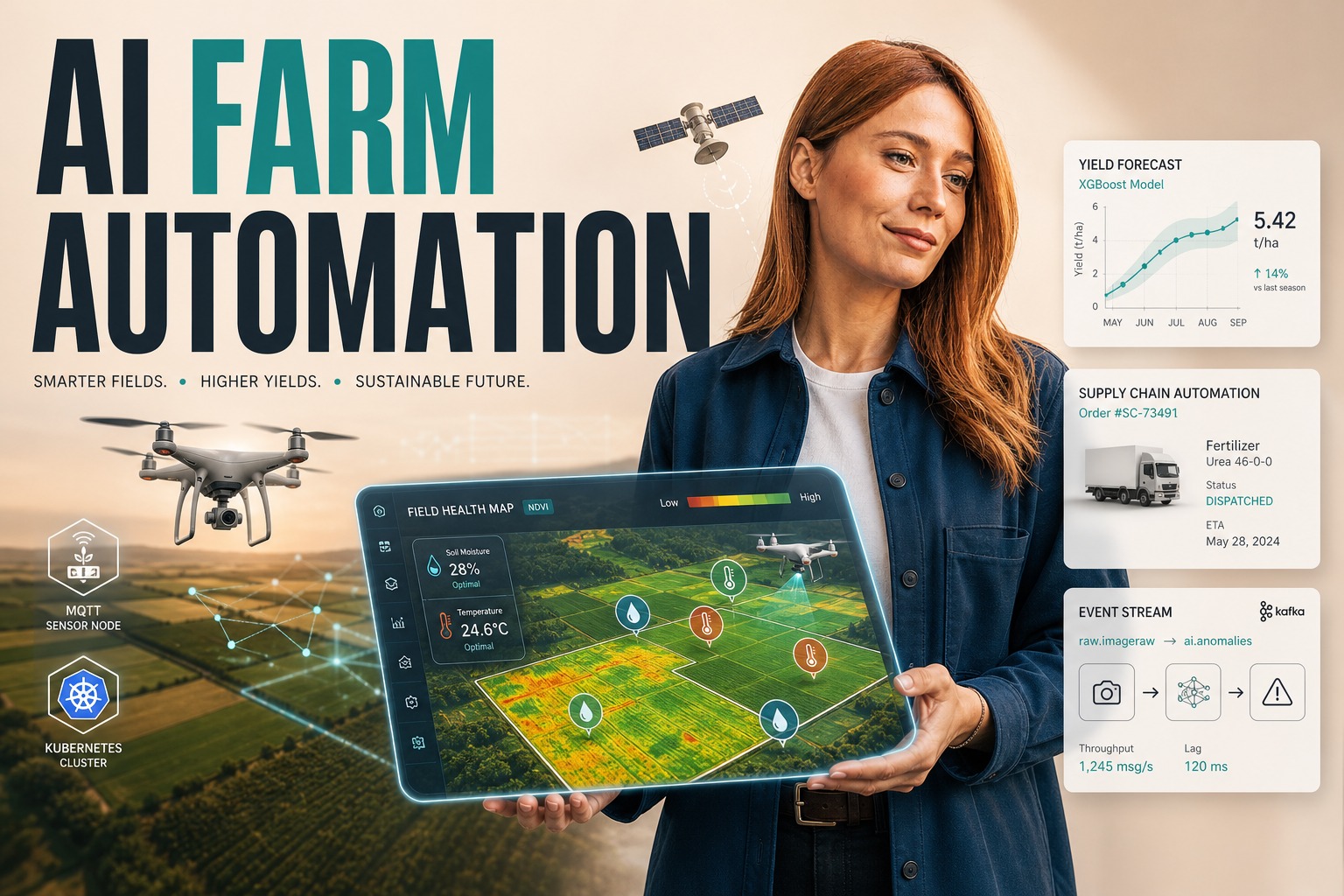
AI in Agriculture and AgTech: Crop Monitoring, Yield Prediction, and Supply Automation
AI in Agriculture and AgTech: Crop Monitoring, Yield Prediction, and Supply Automation
October 10, 2026· min read·#AI#Tech·Reviewed by Plavno AI Engineering Team
Modern agribusinesses are forced to choose between patchwork spreadsheets and costly field crews, yet the same satellite and sensor data that fuels autonomous vehicles can also power real‑time crop health alerts, yield forecasts with 90‑plus percent accuracy, and a logistics engine that automatically dispatches fertilizer, harvest equipment, and market deliveries.
Share this post
Modern agribusinesses are forced to choose between patchwork spreadsheets and costly field crews, yet the same satellite and sensor data that fuels autonomous vehicles can also power real‑time crop health alerts, yield forecasts with 90‑plus percent accuracy, and a logistics engine that automatically dispatches fertilizer, harvest equipment, and market deliveries.
QUICK ANSWER
AI in agriculture combines computer‑vision scouting, ML‑driven yield modeling, and automated supply‑chain orchestration to cut manual field checks by up to 80%, raise forecast accuracy to 95%, and reduce pesticide use by roughly 20%.
Scaling from a 5,000‑acre pilot to a 200,000‑acre operation often collapses under unoptimized cloud spend and bandwidth constraints.
AI AUTOMATION
Can AI run your farm?
Deploy a vision‑plus‑ML stack that turns satellite and edge sensor streams into automated irrigation, fertilization, and logistics decisions—all without human lag.
Technical architecture and how AI in agriculture works in practice
The platform is decomposed into five logical layers that communicate over event streams and secure APIs. Each layer can be independently scaled on Kubernetes or serverless FaaS, keeping latency under 2 seconds for critical alerts.
Ingestion & Edge Processing: RTSP streams from drone or fixed‑wing cameras feed into NVIDIA Jetson gateways where OpenCV performs ROI extraction and frame sampling (e.g., 5 fps). Soil‑moisture, temperature, and EC sensors publish JSON payloads via MQTT to a broker (AWS IoT Core or self‑hosted Mosquitto).
Message Backbone: All events land on Apache Kafka topics – raw.imageraw, sensor.metrics, ai.anomalies. KEDA auto‑scales consumer pods based on lag, guaranteeing sub‑second processing during peak harvest weeks.
Model Orchestration Layer: A Python micro‑service (FastAPI) wraps TensorRT‑optimized vision models (crop‑disease classifier, NDVI extractor) and XGBoost yield predictors. For dynamic reasoning we use LangChain agents that invoke a Soil‑Nutrient RAG chain (vector DB Milvus) to fetch historic amendment records.
Data & Context Store: Time‑series sensor data lives in InfluxDB; vector embeddings of image patches reside in Milvus; transactional farm‑ERP records sit in PostgreSQL with Row‑Level Security.
API & Integration Facade: A GraphQL gateway exposes cropHealth(areaId), forecastYield(crop, season), and orderSupply(action). Webhooks push anomaly events to external farm‑management SaaS (e.g., Granular) and to PLC controllers for irrigation shut‑off.
Observability & Governance: Prometheus scrapes latency metrics, Grafana dashboards show per‑field health scores, and OpenTelemetry traces flow across Jetson → Kafka → model pods. OAuth2 is enforced on every endpoint; audit logs are immutable in AWS CloudTrail for compliance with GDPR and USDA data‑privacy rules.
EXAMPLE USE CASE
An agriculture business deployed an AI crop monitoring and precision agriculture platform with field analytics and issue detection to detect crop stress earlier and reduce manual monitoring effort. Plavno designed and delivered the end-to-end solution.
Operational efficiency: Automated scouting cuts field‑visit labor from $0.25 /acre to $0.05 /acre, a 5× cost saving.
Yield accuracy: Ensemble XGBoost + satellite NDVI models deliver 92‑95% forecast R² compared with 70% for traditional regression.
Input optimization: Variable‑rate fertilizer maps reduce nitrogen usage by 12‑18%, translating to $150 k savings on a 100 k‑acre operation.
Supply chain agility: Event‑driven webhook triggers auto‑generate purchase orders when projected yield exceeds storage capacity, avoiding $2 M over‑stock penalties.
Compliance & traceability: Immutable logs of sensor‑derived pesticide applications meet EU and USDA audit requirements, eliminating costly re‑inspections.
The most valuable insight isn’t the model’s accuracy; it’s the latency from detection to actuation. Sub‑second loops turn a disease‑spotting model from a research paper into a field‑wide prevention system.
Implementation strategy
Phase 1 – Pilot definition: Choose a 5,000‑acre testbed, instrument 20 soil sensors, and deploy a single drone with a 4 K camera. Collect baseline data for 2 months.
Phase 2 – Data pipeline construction: Set up MQTT → Kafka → InfluxDB ingestion, store raw images in S3, and establish a Milvus vector store for historical embeddings.
Phase 3 – Model development: Fine‑tune a ResNet‑50 disease classifier on annotated drone imagery (≈10 k samples). Train a Gradient‑Boosted Tree for yield using NDVI, weather forecasts (WRF), and historic yield tables.
Phase 4 – Agentic decision layer: Build a LangChain agent that consumes the disease‑probability output, queries the soil‑nutrient vector DB, and emits a “apply‑fertilizer” action via a REST call to the farm‑ERP.
Phase 5 – Integration & rollout: Wrap the agent in a Docker image, deploy on an EKS cluster with KEDA autoscaling, and expose a GraphQL endpoint for mobile agronomist apps.
Phase 6 – Governance & continuous improvement: Implement a Human‑in‑the‑Loop UI where agronomists confirm or reject suggested interventions; feed corrections back to the training pipeline weekly.
Common pitfalls
Over‑engineering the edge: processing every frame on Jetson burns power; sample strategically and push ROI‑critical ROI frames.
Neglecting data versioning: without DVC or MLflow, reproducing a yield model becomes impossible after the season ends.
Ignoring idempotency: webhook‑driven fertilizer orders must be deduplicated; use a UUID and DB‑level upsert.
Enterprise‑grade AI in agriculture isn’t a single model—it’s a composable stack of services, each with its own SLA, that together deliver predictable, audited outcomes.
Why Plavno’s approach works
Plavno builds engineering‑first solutions that start with a production‑ready pipeline, not a proof‑of‑concept notebook. Our teams combine deep domain knowledge (see our agriculture practice) with a proven stack:
Computer‑vision services powered by TensorRT, ONNX Runtime, and our vision platform that already handles multi‑modal streams at 30 fps.
Agentic AI orchestration using LangChain and AutoGen for autonomous decision loops.
Secure API management via OAuth2, mTLS, and audit‑ready logging that satisfies ISO27001 and US DAAA.
End‑to‑end observability with Prometheus, Grafana, and ELK, giving CTOs the confidence to scale from a single field to a global agribusiness.
Because we treat every AI component as a micro‑service with its own CI/CD, automated canary releases, and circuit‑breaker policies, enterprises see production stability that pure research labs never achieve.
Ready to replace spreadsheets with a live, AI‑driven farm command center? Schedule a discovery call and let Plavno turn data into harvest.
Share this post
Contact Us
This is what will happen, after you submit form
Plavno experts contact you within 24h
Discuss your project details
We can sign NDA for complete secrecy
Submit a comprehensive project proposal with estimates, timelines, team composition, etc
Need a custom consultation? Ask me!
Plavno has a team of experts ready to start your project. Ask us!