Is the latest LLM model the biggest risk for production deployments? → No, the integration layer is.
Do retrieval‑augmented generation (RAG) solve all hallucination problems? → Only if the ranking logic is solid.
Can a single LLM replace complex workflow engines? → Rarely; orchestration adds essential reliability.
Should we prioritize model size over API latency? → Latency at orchestration boundaries often outweighs raw model speed.
Orchestration Failures Surface Before Model Errors
In recent weeks, major cloud providers announced upgraded LLM APIs promising lower latency and higher token limits. The headline draws attention, yet engineers who have moved these models into production quickly discover that the real bottleneck lies in how calls are coordinated, state is managed, and responses are validated. When an LLM is wrapped in a micro‑service, a failure to handle retries, timeouts, or context stitching creates outages that no amount of model scaling can fix. This reality forces CTOs to rethink budgeting: spending on a larger model is less urgent than investing in robust orchestration patterns.
- Retry‑aware wrappers – ensure idempotent calls and exponential back‑off.
- Context stitching services – maintain conversation state across stateless LLM invocations.
- Result validation layers – filter hallucinations before downstream systems consume output.
- Observability hooks – capture latency spikes and error codes at the API gateway.
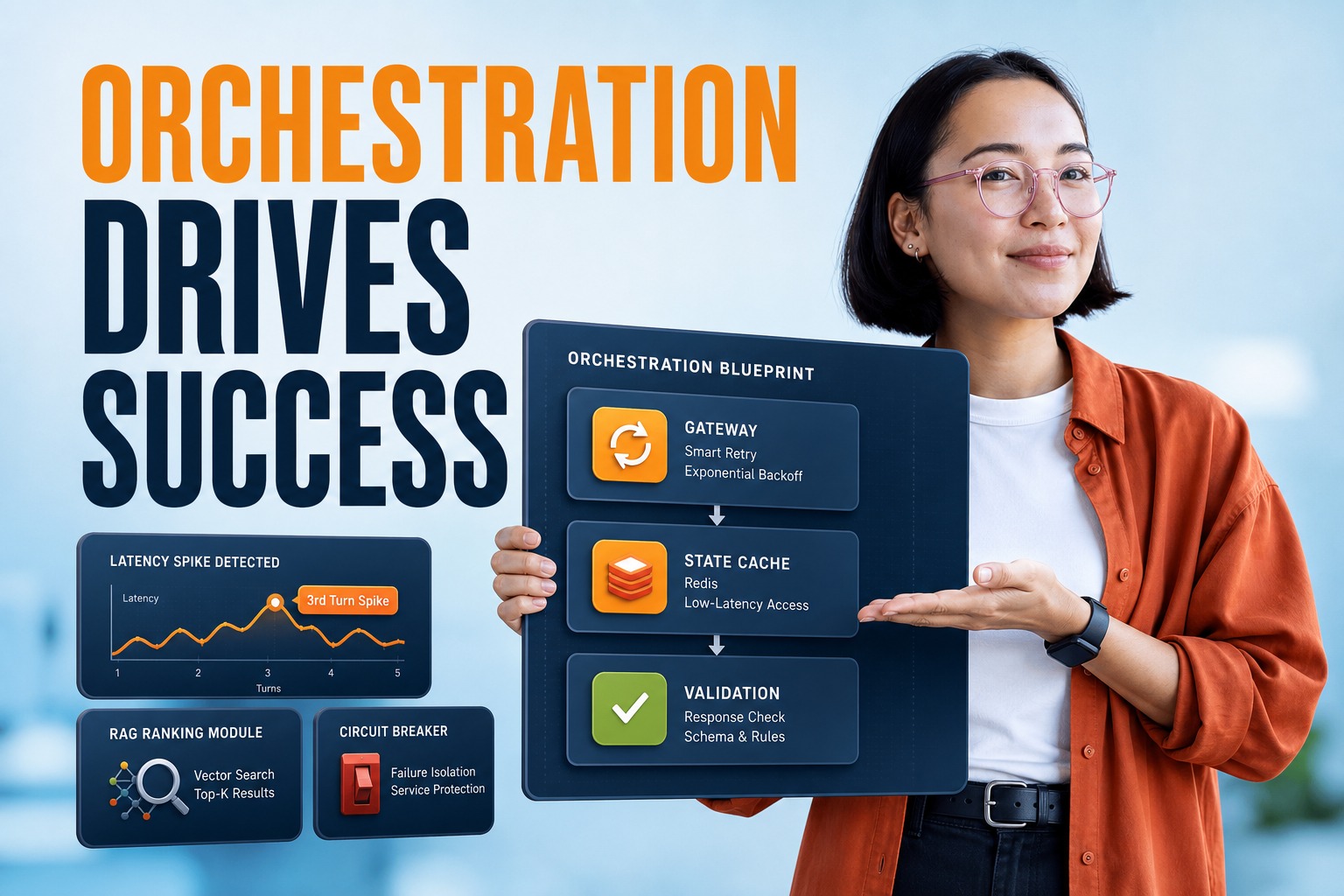
- Circuit‑breaker patterns – protect downstream services from cascading failures.
The Hidden Cost of RAG Ranking Logic
Retrieval‑augmented generation (RAG) has become a buzzword for improving factuality. Vendors highlight vector stores, similarity search, and chunking strategies. However, most enterprises discover that the ranking function—how retrieved passages are scored and selected—determines end‑user accuracy far more than the raw retrieval quality. A poorly tuned ranking model can surface irrelevant chunks, leading to hallucinations that downstream validation must catch. Consequently, the engineering effort shifts from building larger vector indexes to fine‑tuning lightweight ranking classifiers that operate within milliseconds.
| Component | Primary Risk | Typical Mitigation |
|---|---|---|
| Retrieval Engine | Low recall on niche queries | Hybrid dense‑sparse search |
| Ranking Layer | Mis‑ranking leading to hallucination | Supervised fine‑tuning on domain data |
| LLM Prompting | Prompt drift over turns | Template versioning |
Why Latency Spikes After Three Turns Matter
A pattern emerges in voice‑assistant deployments: after the third conversational turn, latency often doubles. The cause is not the LLM itself but the cumulative cost of re‑fetching context, re‑ranking, and re‑validating. Each turn adds another round of API calls, and without a shared state cache, the system repeats expensive operations. Engineers who ignore this pattern see degraded user experience and higher abandonment rates, prompting costly over‑provisioning of compute resources.
- State cache at the edge – store recent turns for rapid reuse.
- Incremental ranking – only re‑score new chunks, not the entire set.
- Batch validation – aggregate checks to reduce per‑turn overhead.
- Adaptive timeout – loosen limits after detecting stable context.
- Load‑aware scaling – trigger extra pods only when turn count exceeds a threshold.
Balancing Model Choice with Orchestration Overhead
When evaluating whether to adopt a newer 100B‑parameter model versus a 30B variant, the decision matrix must include orchestration costs. A larger model may increase inference latency by 30 % but could reduce the number of required validation passes if it produces more coherent output. Conversely, a smaller model paired with aggressive validation may double the overall request latency. The optimal point often lies where the marginal gain from model size is outweighed by the extra orchestration complexity.
- Cost per token – larger models charge higher per‑token rates.
- Inference latency – measure end‑to‑end latency, not just raw model time.
- Validation depth – estimate how many post‑processing steps are needed.
- Scalability of orchestration – assess whether your service mesh can handle added traffic.
- Team expertise – factor in the learning curve for advanced orchestration patterns.
The Real Engineering Trade‑off: Simplicity vs. Control
Enterprises often choose turnkey LLM SaaS solutions to avoid building orchestration layers. While this reduces immediate engineering effort, it also relinquishes control over retry policies, context management, and validation pipelines. Organizations that retain orchestration control can tailor latency budgets, enforce stricter compliance checks, and integrate with existing security frameworks. The trade‑off is higher upfront development cost versus long‑term operational resilience.
Key principle: Orchestration architecture determines production reliability more than raw model performance.
Plavno’s Orchestration Blueprint for Enterprise LLMs
At Plavno we have codified a three‑tier orchestration model that separates concerns: a gateway layer handling API throttling and retries, a state‑management layer persisting conversational context in a low‑latency cache, and a validation layer applying domain‑specific rules before surfacing results. This blueprint aligns with our AI‑agents development services and integrates seamlessly with our cloud‑software development practice. By deploying this pattern, clients have reported up to 40 % reduction in end‑to‑end latency and a 60 % drop in hallucination‑related tickets. Our AI consulting team can help you design the right orchestration strategy.
Takeaway: Adopt a modular orchestration stack before scaling model size.
How to Audit Your Current LLM Pipeline
Begin with a black‑box test: measure raw LLM latency, then add a single orchestration call (e.g., a retry wrapper) and re‑measure. The delta reveals hidden overhead. Next, instrument each stage—retrieval, ranking, validation—to capture per‑stage latency. Compare these numbers against SLA targets. If any stage exceeds 30 % of the total budget, prioritize refactoring that component before considering a larger model.
When to Replace a Model vs. Refactor Orchestration
If validation failures consistently exceed 15 % of requests, refactoring the validation layer yields immediate quality gains. Only when validation is near‑perfect should you evaluate a higher‑capacity model to improve nuanced generation.
| Decision Trigger | Recommended Action |
|---|---|
| Validation error >15 % | Refactor validation pipeline |
| End‑to‑end latency >2× target | Optimize orchestration cache |
| Cost per token unsustainable | Downsize model, keep orchestration |
Scaling Orchestration for Multi‑Tenant SaaS
Multi‑tenant environments amplify orchestration challenges. Isolating tenant state, enforcing per‑tenant rate limits, and providing tenant‑specific validation rules require a service mesh that can dynamically route traffic. Investing in a mesh like Istio or Linkerd early prevents costly rewrites when tenant count grows. Our AI voice‑assistant development services illustrate these patterns.
Rule: Multi‑tenant LLM services must embed tenant‑aware orchestration from day one.
The Role of Observability in Orchestration Success
Without granular metrics, orchestration failures remain invisible. Deploy distributed tracing (e.g., OpenTelemetry) across the gateway, state, and validation layers. Correlate trace IDs with downstream error logs to pinpoint the exact stage where latency spikes or errors originate.
- Trace spans per API call – capture start and end timestamps.
- Error tagging – label failures by type (timeout, validation, ranking).
- Latency heatmaps – visualize turn‑by‑turn latency growth.
- Alert thresholds – trigger alerts when orchestration latency exceeds 200 ms.
- Dashboard integration – feed metrics into existing ops dashboards.
Real‑World Example: Financial Voice Assistant
A leading fintech firm integrated a GPT‑4‑Turbo model for its voice‑assistant. Initial deployments suffered from 3‑turn latency spikes, causing user drop‑off. By applying Plavno’s three‑tier orchestration—adding a Redis‑based context cache, a lightweight ranking model, and a compliance validation service—the firm reduced average call latency from 1.8 seconds to 1.1 seconds and cut compliance‑related false positives by 70 %.
Our experience in AI healthcare and medtech also shows similar gains.
Insight: Orchestration upgrades can deliver ROI comparable to a model upgrade.
Risks of Over‑Engineering Orchestration
While robust orchestration is essential, adding unnecessary layers can introduce complexity that outweighs benefits. Excessive caching can lead to stale context, and overly aggressive circuit‑breakers may block legitimate traffic bursts. Engineers must balance resilience with simplicity, continuously measuring the impact of each added component.
Next Steps for CTOs This Quarter
1. Audit your current LLM pipeline using the latency‑by‑stage method described.
2. Prioritize refactoring any orchestration component that consumes more than 30 % of the latency budget.
3. Implement a pilot of Plavno’s orchestration blueprint on a low‑risk internal use case.
4. Measure post‑deployment improvements and decide whether a model upgrade is still justified.
 Chat GPT
 Perplexity
 Claude
 Gemini