What’s the dominant signal this week? → Accel raised a new $550 million India fund as part of a coordinated $3.5 billion global fundraising effort, explicitly framing AI as a horizontal layer that will underpin multiple sectors rather than a standalone category.
What’s the real engineering decision hiding inside that news? → Whether your team should spend this quarter on model-building R&D or on application-layer architecture that makes existing models safe, measurable, and operable inside real workflows.
What is the primary search question we’re answering? → How do we build an enterprise AI application on top of existing LLMs in a way that holds up under compliance, uptime expectations, and human oversight?
Why does it matter now, not later? → Accel expects to begin deploying capital from the new fund in 2027, but the application-layer race is already happening as OpenAI and Anthropic cite India as their largest market outside the U.S. and Cursor calls India one of its fastest-growing developer markets.
What’s Plavno’s angle? → We believe failures won’t come from picking the ‘wrong’ LLM; they’ll come from shipping an AI feature without a production-grade workflow boundary, evaluation discipline, and governance model.
Quick Answer: build on existing LLMs, but treat the workflow as the product
For most enterprise teams this quarter, the correct move is to build AI applications on top of existing models (via APIs or managed platforms) and invest engineering time in workflow design, guardrails, evaluation, and observability, not in training a new foundation model. The fund flows and comments in the market point in the same direction: the opportunity is in the application layer, where human oversight and domain constraints decide outcomes. At Plavno, we typically start with AI consulting to map where the model’s responsibility ends and where your system must enforce correctness.
If you cannot explain which subsystem is accountable for correctness when the model is wrong, you do not yet have an enterprise AI architecture—you have a demo.
Accel’s India raise is a forcing function: AI is now infrastructure, not a category
Accel closing a new $550 million India fund—while still having more than 55% of its previous $650 million India fund available—matters less as venture gossip and more as a signal about how teams should allocate engineering effort. Accel is explicitly betting that the next wave is driven by AI plus consumer internet, fintech, and advanced manufacturing, with AI acting as a horizontal layer rather than a separate ‘AI company’ box. That framing lines up with how enterprise roadmaps look in practice: the model is a dependency, but the product is the workflow.
The reasonable disagreement here is whether ‘horizontal AI’ implies commoditization that makes LLM choice irrelevant. We disagree with the simplistic version. LLM choice still affects latency, cost structure, and failure modes. But the claim we’re willing to defend is sharper: once you build on third-party or existing models, engineering advantage shifts from model weights to the orchestration boundary, where you route requests, constrain actions, record evidence, and decide what a human must sign off on.
- Funding is following app-layer leverage: Accel’s partners are on-record that India’s opportunity is in AI applications, infrastructure, and software built on top of existing models, which implies the market rewards teams who can turn model outputs into reliable enterprise outcomes.
- Human oversight is the differentiator, not a compromise: Accel’s framing highlights sectors where human oversight remains critical; technically, that means your system must support review loops, provenance, and auditable state—not just a chat UI.
- Developer adoption is turning into platform pressure: With Cursor describing India as a fast-growing developer market and a large market for power users, internal engineering teams will increasingly expect AI-assisted workflows, increasing demand for secure integration patterns.
- The ‘LLM layer’ is becoming a vendor surface: If you rely on OpenAI, Anthropic, or comparable providers, your risk concentrates in API contracts, data handling, and outage/fallback behavior, which must be engineered intentionally.
- Enterprise buyers will pay for confidence, not cleverness: RapidClaims is cited for achieving about 95% coding accuracy by combining AI with domain expertise; that’s a product promise built on process and validation, not on proclaiming a better model.
Central claim we’re proving
AI is becoming a horizontal dependency, which breaks the old engineering instinct to ‘differentiate at the model’; the correct response is to differentiate at the workflow boundary by building an application-layer system that enforces constraints, captures evidence, and routes uncertainty to humans.
The search intent behind the hype
When a CTO searches ‘build AI app on top of LLM’ or ‘should we train our own model,’ they’re not looking for definitions. They’re trying to avoid two costly mistakes: shipping an ungoverned AI feature that creates operational risk, or over-investing in model training when their bottleneck is actually integration into business processes.
Most enterprise AI incidents are not ‘model hallucinations’ as an abstract concept; they are unhandled states in the surrounding system—missing approvals, missing fallbacks, and missing audit trails.
The application layer is where globally competitive teams can win
A core point in Accel’s thesis is that India ‘largely missed the first wave of foundation model companies,’ yet still has a significant opportunity in the application layer. For engineering leaders, that’s not a geographic story; it’s a product strategy story. The world has mature model providers, and many enterprises will never be allowed—by risk, cost, or talent constraints—to compete head-on with OpenAI or Anthropic. The leverage is in building software that wraps model capabilities into constrained outcomes.
| Decision axis | Training a foundation model | Building an AI application on existing models |
|---|---|---|
| Differentiation | Comes from model capability and data advantage | Comes from workflow integration, domain constraints, and UX |
| Operational risk | Concentrated in training, deployment, and safety tuning | Concentrated in orchestration, governance, and vendor dependencies |
| Time-to-value | Usually longer because you must build the model layer | Usually faster because you start at the product layer |
| Talent profile | Research-heavy with specialized infrastructure needs | Product engineering + platform engineering + domain expertise |
If your buyer cares about compliance and accuracy, your moat is not ‘a smarter model,’ it is a system that can prove what happened and why.
Why ‘AI as horizontal tech’ changes how we scope systems
When AI is treated as horizontal, it stops being a single feature owned by one team and becomes an enterprise capability that touches identity, data, and operational controls. That shift breaks the usual product pattern where a team can ship an ML feature behind a microservice and call it done. In practice, horizontal AI requires a platform mindset: shared policy enforcement, shared evaluation harnesses, and shared telemetry.
This is where many organizations create invisible architecture debt. They prototype with a single provider API and a prompt, then gradually bolt on retrieval, tool calls, and agent-like loops as requirements show up. The result is a brittle system with unclear boundaries: which part is allowed to take an action, which part is allowed to store data, and which part is allowed to override a human. The technical response is to design the workflow boundary early, even if your ‘workflow’ is initially just one business transaction.
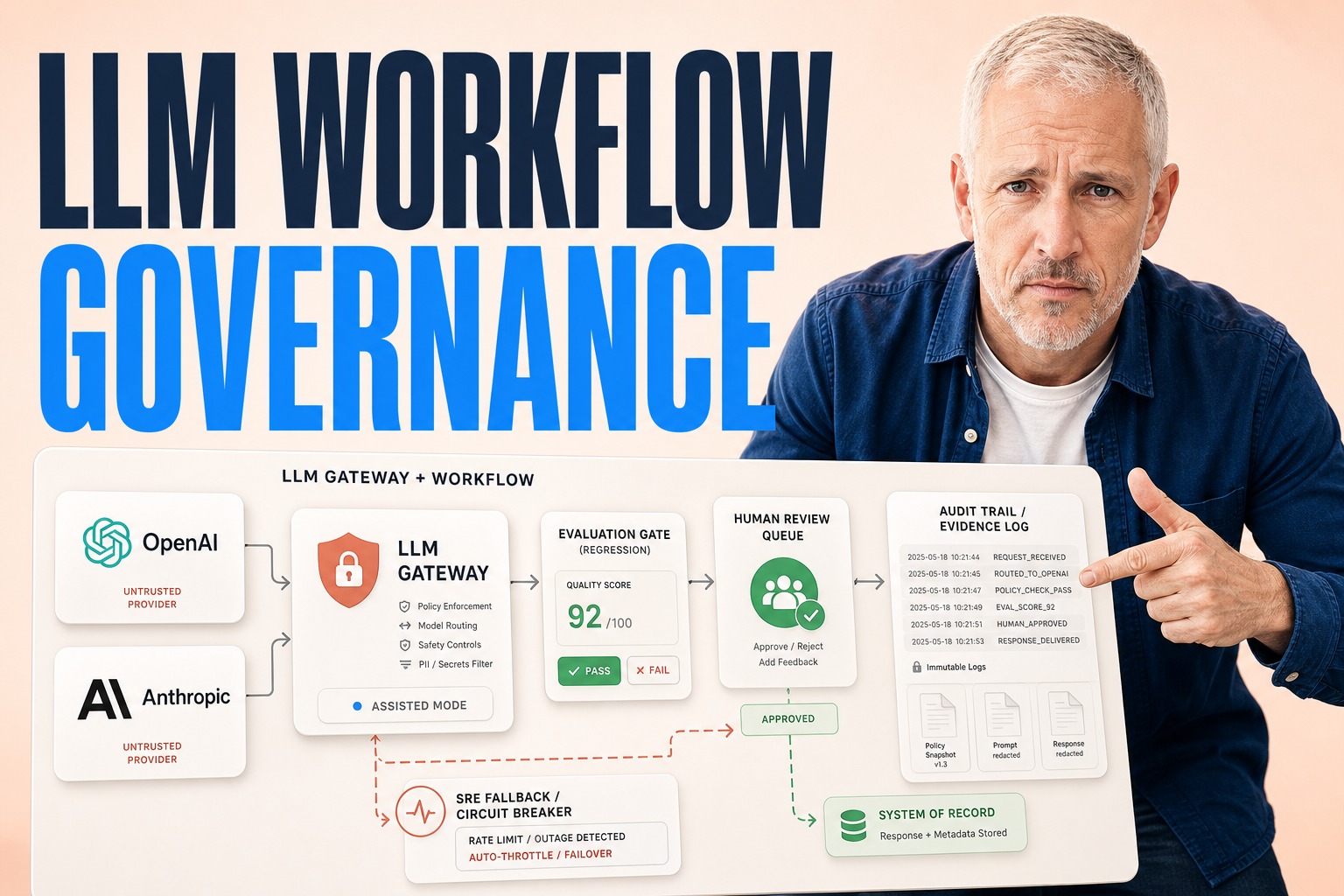
- LLM gateway discipline: Put one owned service in front of model providers (OpenAI, Anthropic, or others) so you can standardize auth, logging, routing, and safe defaults across products.
- Stateful workflow engine choices: If the AI feature spans steps, approvals, or retries, treat it as a workflow problem first; agent loops without explicit state create failure modes you can’t debug.
- Evidence-first data handling: Store what the model saw (inputs, retrieved documents, and decisions) in a way that supports audits, without assuming the model’s text output is reliable.
- Human-in-the-loop as a first-class API: Build explicit queues and review UIs for uncertain cases; ‘human oversight’ is not an email notification, it’s a controlled system state.
- Vendor abstraction without fantasy: Abstract providers enough to swap or mix models, but don’t pretend providers are identical; differences in policy, latency, and cost will shape behavior.
Treat the model like an untrusted dependency: useful, powerful, and sometimes wrong in ways that look plausible.
RapidClaims is the pattern: accuracy comes from system design, not model pride
Accel called out RapidClaims, which automates medical coding for U.S. healthcare providers and combines AI with domain expertise to deliver coding accuracy of about 95%. The important engineering lesson is not the exact number; it’s the mechanism. In regulated workflows like medical coding, a model alone does not create a shippable product. The product is the controlled pipeline: ingestion of clinical notes, structured extraction, mapping to code systems, and a review process for edge cases.
When we build similar systems, we assume every step can fail independently. Retrieval can fetch the wrong policy document, the model can produce a plausible but incorrect code, and the downstream billing system can reject the submission. The architecture that survives production is one that can isolate failures, route them to the right human role, and learn from corrections without leaking protected information. ‘AI plus domain expertise’ is a polite way of saying ‘AI wrapped in a workflow that enforces responsibility.’
Define the unit of work: In healthcare coding it’s a claim or encounter; in fintech it might be a dispute or underwriting packet. Your AI feature must produce or update a concrete object, not just a chat transcript.
Assign responsibility per step: Decide what the model is allowed to propose versus what the system must validate, and what requires human approval. This is where many teams avoid hard decisions and later pay for it.
Capture evidence with every decision: Store the source documents and any retrieved references used to justify the recommendation so you can audit and appeal outcomes.
Design an escalation path: Build explicit ‘uncertain’ and ‘blocked’ states that route to domain experts, rather than silently outputting best-effort answers.
Close the loop with corrections: Treat human edits as training signals for prompts, retrieval, or policy rules, but keep them within governance boundaries.
Your ‘AI accuracy’ is often your review workflow quality expressed as a number.
The architecture that holds up: workflow boundary, not chat boundary
Enterprise buyers don’t buy ‘a chat.’ They buy a capability that fits into systems of record. That’s why the most reliable AI applications we see are built around a workflow boundary: a defined start state, a defined end state, and explicit transitions. Models can be used at multiple points, but the workflow is what enforces correctness, permissions, and auditability.
In practice, this means anchoring your AI feature to a real system boundary such as a CRM object, a claim record, a manufacturing job ticket, or a fintech case file. You integrate with identity providers for role-based access, you integrate with data warehouses or document stores for evidence, and you integrate with queues for human review. The model is invoked as a worker that proposes changes, summarizes, or extracts fields, but it never becomes the system of record.
The hidden cost layer: vendor dependence becomes an SRE problem
Once OpenAI and Anthropic are treated as infrastructure dependencies, your application inherits their outage patterns, policy changes, and rate limits. The input story highlights that both providers identify India as their largest market outside the U.S.; rising demand tends to translate into platform pressure, and platform pressure always shows up operationally in the consuming systems.
Engineering leadership should treat ‘LLM provider’ like any other critical SaaS dependency: build timeouts, fallbacks, circuit breakers, and graceful degradation paths. ‘Fallback’ does not always mean a second model; sometimes it means switching from automation to assisted mode, or routing to human review. The deeper point is that reliability is now a product feature for AI apps, not an afterthought.
- Provider outage and throttling: Your user experience must remain coherent when calls fail, slow down, or are rate-limited; this is where queueing, retries, and user messaging become part of the design.
- Policy and behavior drift: Providers can change safety filters and output behavior; you need regression evaluation tied to business outcomes so you notice breaking changes before customers do.
- Data residency and privacy constraints: Enterprises will ask where data goes and how it is stored; your architecture must make those answers explicit at the gateway and storage layers.
- Multi-model routing trade-offs: Routing some tasks to smaller or cheaper models can reduce cost, but increases complexity in evaluation and monitoring because behavior differs by model.
- Tool/action risk: If you allow the model to trigger actions (tickets, refunds, updates), the risk shifts from ‘bad text’ to ‘bad state changes,’ which requires stronger controls.
Plavno’s perspective: the application-layer advantage is an engineering discipline
At Plavno, we agree with Accel’s application-layer bet because it matches what we see in enterprise delivery: the team that wins is the one that can ship a governed workflow faster than competitors can debate model choices. That doesn’t mean rushing. It means being deliberate about boundaries: defining what the model can propose, defining what humans must confirm, and defining what evidence must be stored.
When clients ask us to ‘build an AI agent,’ we translate that request into architecture terms: an orchestrated workflow with tool integrations, policies, and observability. If the goal is automation, we design the automation as a product, not as a clever chain of model calls. That’s why we focus on AI agents development when the business outcome requires multi-step execution and why we prefer simpler assistant patterns when the risk profile demands tighter control.
Start with the irreversible action inventory: Identify which operations cannot be safely automated (payments, deletions, regulatory submissions) and require human confirmation.
Build the ‘truth layer’ first: Decide where the authoritative data lives (CRM, billing system, claims platform) and ensure the AI feature only proposes changes to that truth layer through controlled interfaces.
Instrument for questions you will be asked: Capture who approved what, what documents were used, and what the model recommended so compliance and operations can reconstruct incidents.
Ship assisted mode before autopilot: For high-risk domains, launch with human confirmation, then expand automation as evaluation proves stability.
Make evaluation a release gate: Treat changes to prompts, retrieval, routing, or providers as release-worthy changes that must pass regression checks.
How to evaluate ‘build on LLMs’ in practice without guessing
The decision is not ‘LLM API versus custom model’ in the abstract. The decision is whether your product’s risk and differentiation require owning the model layer. Accel’s partners explicitly argue that startups should build on top of existing models rather than competing with OpenAI or Anthropic; that’s a market signal that your customers will accept third-party models if you can guarantee outcomes.
We evaluate this by looking at the workflow and asking what must be true for the system to be valuable. If value comes from domain mapping, process automation, and human oversight, building on existing models is usually correct. If value depends on owning a unique generative capability that cannot be bought, then model ownership might matter—but that is rarer than teams assume, and it creates heavy operational obligations.
| Evaluation question | If ‘yes,’ application-layer first is favored | If ‘yes,’ model ownership may be justified |
|---|---|---|
| Can humans review uncertain cases? | You can ship assisted workflows quickly | You may still need review, but model advantages shrink |
| Is differentiation in domain workflow and UX? | Existing LLMs are sufficient as a dependency | Model ownership does not guarantee product fit |
| Do buyers require auditability? | You must invest in evidence and governance | Owning the model does not solve audits by itself |
| Is provider dependence unacceptable? | Multi-provider strategies can mitigate risk | Ownership may be needed, but increases burden |
Business impact: enterprise AI budgets will move from pilots to platforms
A coordinated $3.5 billion global fundraising effort and renewed India-focused commitments from multiple firms (including Peak XV Partners raising $1.3 billion and General Catalyst committing to deploy $5 billion in India over five years) are signals that the next cycle is about scaling, not experimenting. As capital and competition increase, enterprises will see more AI-native vendors offering specific outcomes rather than generic assistants.
For engineering leaders inside enterprises, that changes procurement and internal build-versus-buy conversations. The ‘AI pilot’ era often tolerated fragile integrations because the goal was learning. The platform era asks for guarantees: who owns incidents, how data is handled, what happens during provider outages, and how humans remain accountable. The teams that respond by building internal AI platforms—LLM gateways, evaluation harnesses, policy enforcement—will ship faster and safer across many departments than teams that repeatedly reinvent one-off chatbots.
| What the business asks for | What engineering must actually build | Common failure when missed |
|---|---|---|
| Faster operations with fewer errors | Workflow + review queues + audit logs | Automation without traceability creates risk |
| Consistent AI behavior across teams | Centralized gateway and shared policies | Each team ships different prompts and controls |
| Predictable cost and performance | Routing, caching strategy, and rate-limit handling | Surprise bills and latency spikes break adoption |
| Security posture that passes audits | Data classification, access control, and retention rules | Projects stall at security review |
Delivery model reality: talent advantage matters more than headquarters
Accel’s thesis references India’s engineering talent and services expertise combining with AI to solve enterprise problems. For U.S. companies, the practical implication is that execution capacity is now a competitive lever: teams that can ship and iterate quickly on app-layer systems will outpace teams that treat AI as an R&D island.
In delivery terms, that often means mixing internal ownership with augmented engineering capacity. We see success when a client keeps product and risk ownership internal—workflow definition, compliance requirements, and incident accountability—while scaling implementation with a dedicated team that has shipped similar integrations before. This is where outstaffing can work well: it preserves your architectural control while expanding velocity in integration, data engineering, and platform work.
| Resourcing option | Strength when building app-layer AI | Risk to manage |
|---|---|---|
| Fully in-house | Tight domain alignment and ownership | Slower staffing for specialized platform skills |
| Outstaffed team integrated into yours | Fast scaling while keeping architecture decisions internal | Requires strong tech leadership and clear standards |
| Fully outsourced delivery | Clear contract scope for well-defined workflows | Risk of misaligned incentives on quality and governance |
| Hybrid (platform in-house, product features external) | Balances control and speed | Needs disciplined interfaces and release processes |
Real-world application patterns that map to Accel’s thesis
Accel expects India’s next wave across AI, consumer, fintech, and advanced manufacturing, and frames AI as the horizontal layer underpinning them. Those domains share a technical truth: the winning AI application is the one that attaches to an existing high-volume workflow and improves it without breaking accountability. That is why you see emphasis on enterprise and consumer use cases rather than foundation-model rivalry.
In practice, we see repeated patterns. In fintech, the AI layer often supports document understanding, case triage, and customer communication, but must respect audit and approvals. In consumer internet, it can personalize and assist, but must defend against abuse and privacy risks. In manufacturing and deep tech, AI often augments planning or quality workflows, but the system must integrate with operational tooling and tolerate imperfect data. Across all of these, the architecture problem is the same: build a reliable workflow wrapper around a probabilistic engine.
Risks and limitations: where application-layer teams still fail
Building on existing models does not remove technical risk; it relocates it. The biggest failure mode we see is mistaking a model call for a business decision. When an AI system produces a recommendation and the software treats it as truth, you get silent data corruption: bad codes, wrong customer states, incorrect compliance artifacts. That is much harder to unwind than a visible error.
Another failure mode is believing that ‘human oversight’ is a checkbox. Accel’s partners point to domains where oversight remains critical; that implies that oversight must be engineered. Review bandwidth, queue design, SLA expectations, and escalation policies become part of your system. If you do not design those, your AI feature will either slow the business down (because everything goes to review) or bypass review in the name of speed.
What to build this quarter if you accept the claim
If we accept that AI is horizontal and that application-layer execution is the advantage, the quarterly plan becomes concrete. We prioritize the owned gateway, the workflow boundary, and the evaluation discipline before we chase broader agent autonomy. That is how you avoid getting stuck in the middle: too risky for production, too complex to iterate.
This is also where infrastructure choices become business choices. If your AI feature is central to operations, you need predictable deployment and monitoring. In many teams, that means treating the AI layer as a cloud platform component alongside other services, with clear environments, release processes, and audit logging. At Plavno we typically align this with cloud software development practices so the AI dependency behaves like any other production dependency.
Closing insight: the market is paying for accountable automation
Accel’s raise and its explicit application-layer emphasis are a reminder that the industry is moving to accountable automation. RapidClaims is cited as combining AI with domain expertise to achieve about 95% coding accuracy, and Accel writes the first institutional check in roughly 80% of the companies it backs—signals that early execution on real workflows is being rewarded.
At Plavno, we don’t treat this as a bet on any single model provider or geography. We treat it as an architectural mandate: build systems where probabilistic outputs are contained by deterministic controls, with humans in the loop where the business cannot tolerate error.
Author: Plavno team. Last updated: August 2026.
| If your current state is… | The next concrete move | Why it aligns with app-layer reality |
|---|---|---|
| A prompt-based prototype | Introduce a gateway and structured inputs/outputs | You need control points before scaling usage |
| A chatbot in one department | Attach to a system of record and add review states | The workflow is where accountability lives |
| A multi-step ‘agent’ demo | Replace implicit loops with explicit workflow states | Debuggability and auditability become possible |
| A production assistant with incidents | Add evaluation gates and incident forensics | You can’t improve what you can’t measure |
CTA: when you need an AI workflow that can pass audits and stay online
If you’re building on top of OpenAI or Anthropic and your next milestone involves production rollouts, the fastest path is usually to harden the application layer: gateway, workflow states, evaluation, and human review. We can help you design and deliver that end-to-end as custom software development with the governance and operational rigor enterprises expect.
 Chat GPT
 Perplexity
 Claude
 Gemini