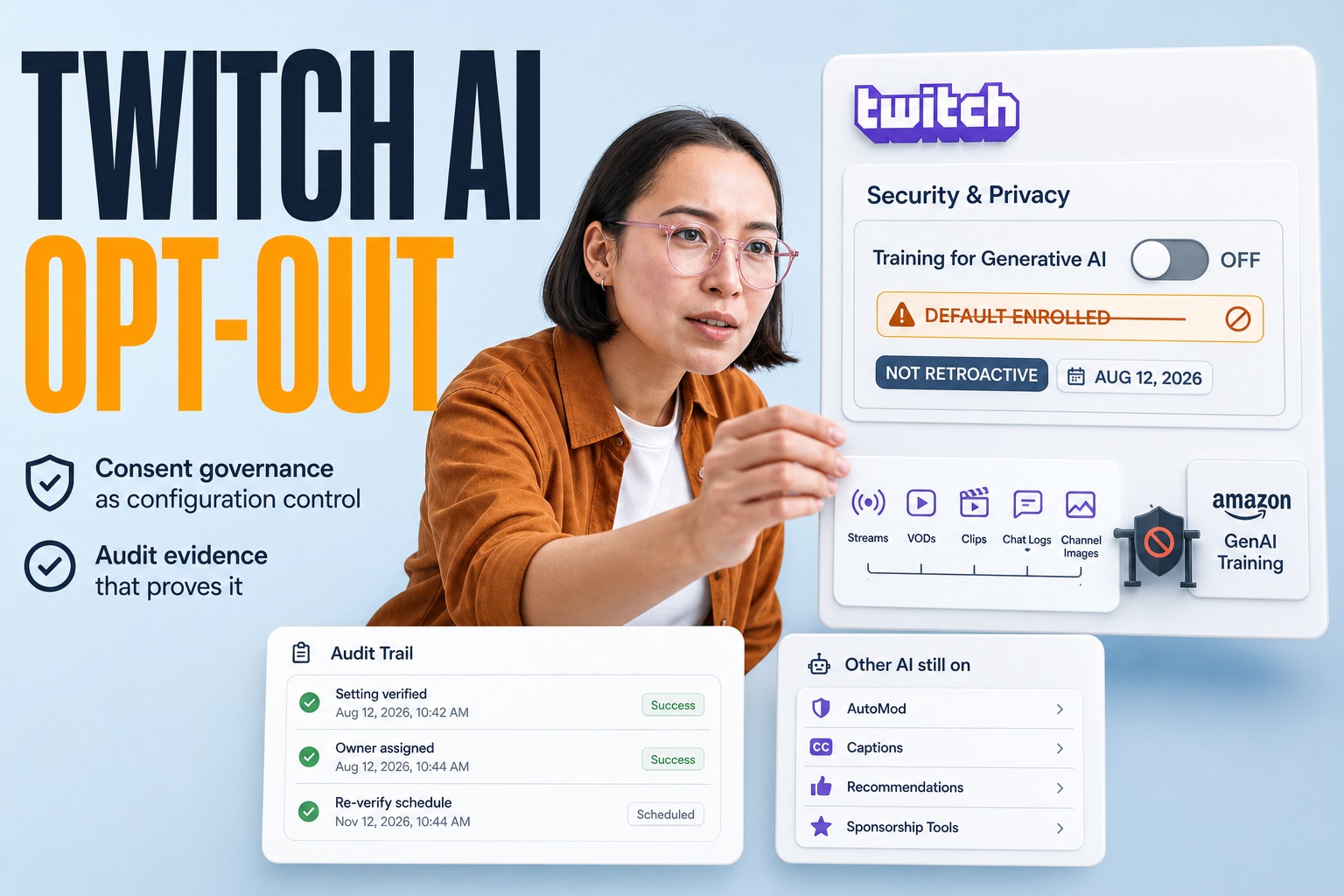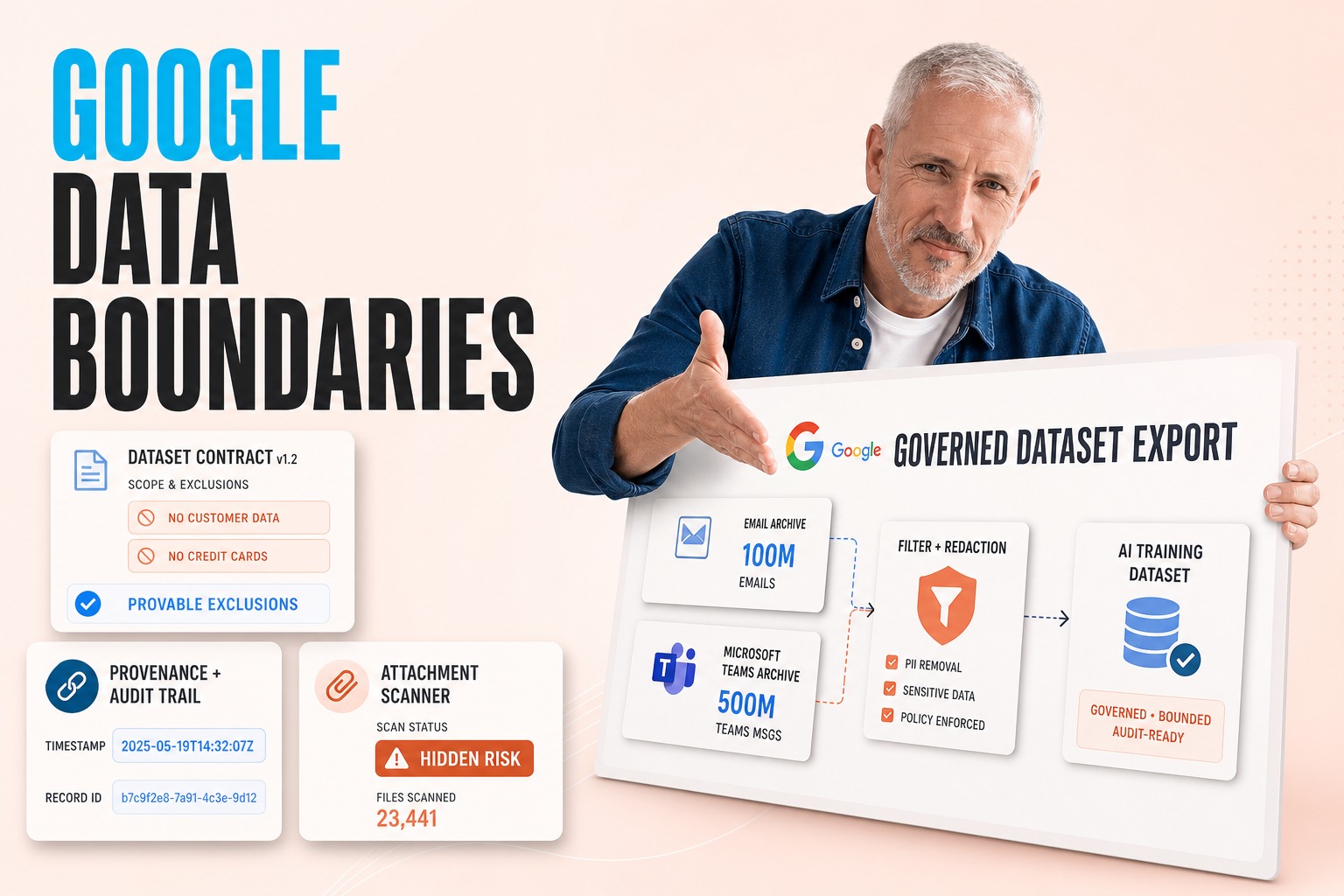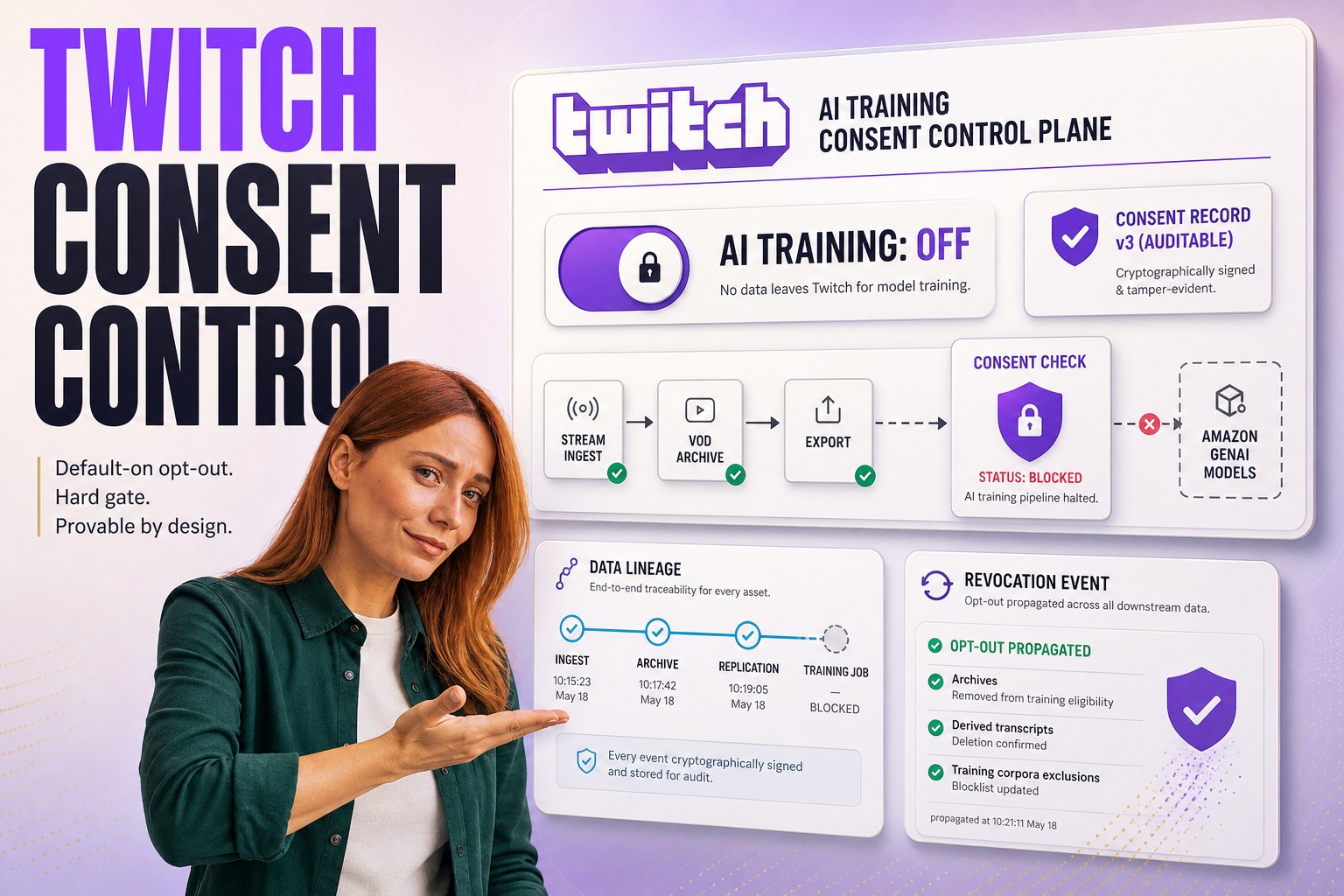
What changed this week that forces an engineering decision now? → Twitch began sending creator streams to generative AI models built by Amazon, with channels automatically opted in unless creators toggle a buried setting.
What is the real search question behind the controversy? → How do we implement AI training consent and opt-out so it is enforceable in data pipelines, not just a UI promise.
Why should CTOs care if they do not run a creator platform? → The same pattern is spreading across products where user content is valuable training data, and it exposes a governance gap between privacy settings and actual data routing.
Where will teams get burned in production? → At the handoff between product settings, logging/archival storage, and downstream model-training workflows where data can be copied or reused without a deterministic consent signal.
What is the opinionated angle we take at Plavno? → Default-on training breaks the assumption that consent lives in policy; the only credible response is to treat consent as an auditable, versioned control plane that gates every replication path.
Twitch’s default-on AI training is a data-pipeline problem, not a PR problem
Twitch has begun sending creator streams to generative AI models built by its parent company Amazon, and all channels are opt-in automatically unless creators navigate account settings to turn it off. In a live Q&A, Twitch’s product chief admitted the reason it is not opt-in is that nobody would opt in. For engineers, the signal is straightforward: “training use” is becoming a first-class downstream consumer of user-generated content, and consent must be engineered like a routing rule, not treated like a sentiment.
If your product can export or replicate user content to any internal or parent-company workflow, a buried opt-out toggle is not a control; it is a liability unless it deterministically blocks every downstream data path, including historical copies.
Primary search question: how do we stop a platform from using our content to train generative AI?
The practical query we see from creators, brands, and B2B product teams is not whether generative AI is good or bad; it is how to prevent a platform from using content to train models when the default is participation and the off-switch is hidden. Twitch’s own framing makes the engineering problem sharper: there is an opt-out setting, but it lives three steps into privacy settings, and even leadership could not clearly answer whether content had already been used by Amazon for model training. When certainty is missing, the only defensible approach is to design systems where consent is provable.
- Start from data flows, not UI labels. A setting named training for generative AI is only meaningful if it gates every pipeline that receives audio/video, including asynchronous exports to parent-company systems, archival storage, and derived datasets that training teams typically request.
- Assume defaults will be chosen for adoption, not user intent. Twitch’s product chief explicitly stated opt-in would fail because nobody would opt in; teams should treat that as a market signal that product strategy will pressure engineering to make training consumption frictionless.
- Treat uncertainty as an incident, not a footnote. When an executive says they do not know what has been used for model training, it implies missing lineage between source content and training workflows; in production this becomes an audit and trust failure.
- Design opt-out as a revocation event. Opt-out cannot just change future behavior; it must propagate as a state change that downstream systems can honor, including deletions or exclusions from future training corpora.
Central claim: consent fails at orchestration boundaries, so build consent as a data control plane
Default-on AI training is not primarily an ethics debate; it breaks a specific engineering practice: relying on policy text and settings pages as the “source of truth” for data usage. When channels are automatically opted in and the opt-out is buried, the real system of record becomes the training pipeline’s copies, exports, and derived datasets. The right response is to implement consent as a versioned, auditable control plane that is enforced at every data boundary, not as a toggle that only the web app knows about.
The hidden architecture behind a “training for generative AI” setting
In the Twitch case, creators stream faces and voices for hours every week, which implies an enormous library of audio and video available to Amazon. Even without knowing anything about Amazon’s internal training stack, we can reason about the typical engineering reality: a platform’s video pipeline already produces multiple artifacts, such as live streams, recorded VODs, clips, transcripts, moderation signals, and analytics. Each artifact can become “training data” the moment it is shared with a generative AI workflow.
The uncomfortable detail in Twitch’s Q&A is not the existence of an opt-out. It is the admission that leadership could not answer whether videos were used for training and what was used and not used. That gap almost always comes from orchestration boundaries: content enters storage and replication systems that were built for delivery, compliance, and analytics, and then AI training consumption is added as a new downstream consumer. If consent is not embedded at the point of replication, copies become indistinguishable from authorized data.
- Capture boundary: ingestion versus training eligibility. The stream ingest path is optimized for reliability and distribution, but training eligibility is a policy decision; if the ingest pipeline stores raw media before consent is evaluated, training teams can later access material that should have been excluded.
- Storage boundary: archives become de facto datasets. Video archives built for playback or safety reviews can be queried for other purposes; if the opt-out signal is not stored with the object metadata and enforced by access layers, the archive becomes a training lake by default.
- Replication boundary: parent-company sharing. Twitch’s setting describes training models across Amazon; that implies cross-organization transfer where enforcement is harder, because data leaves the immediate product’s access model.
- Derivative boundary: transcripts, embeddings, and labels. Even if raw video is blocked, derived artifacts can leak; if a transcript or moderation label is generated before opt-out is applied, you have a training-ready representation that may persist independently.
Why a buried toggle is an anti-pattern for engineers, not just users
The opt-out sits three steps into privacy settings and is not in the creator dashboard. That choice is a product pattern: reduce friction for the new data consumer. But in engineering terms, buried toggles often correspond to buried enforcement. The UI can flip a flag, yet nothing guarantees that historical exports, cached datasets, or partner systems see the flag in time, or at all. If we cannot point to a single authoritative consent record that every consumer must check, we are not implementing consent; we are implementing a preference screen.
- UI toggles do not propagate by themselves. A setting changed in account settings must travel to object metadata, access-control decisions, and downstream job scheduling; without explicit propagation, training jobs will keep reading what they already copied.
- Default-on invites silent backfills. When a feature is introduced without an announcement and with automatic inclusion, downstream consumers may backfill on existing archives; if opt-out is added later as a reaction, the system needs a retroactive exclusion mechanism.
- Consent must be time-scoped. A creator may accept training today and revoke tomorrow; if training corpora do not record time windows and consent versions, teams cannot answer what was eligible when it was consumed.
The leadership “we don’t know” moment usually means lineage is missing
When asked whether Amazon had used viewer videos, Twitch’s product chief responded that he did not know what Amazon had done in terms of model training and what they used and not used. We should read this as a technical symptom: data lineage between source content and training workflows is either not implemented, not visible to product leadership, or not centralized. In practice, the absence of lineage is what makes opt-out hard to honor, because you cannot reliably locate and exclude every copy and derivative.
- Without lineage, you cannot prove non-use. Even if the intent is to respect opt-out, you cannot demonstrate it if you cannot trace which assets entered which training pipeline and when.
- Without lineage, opt-out becomes best-effort. Teams can stop future exports, but past exports remain ambiguous; engineering ends up relying on informal agreements rather than deterministic controls.
- Without lineage, trust erosion is predictable. Users will assume the worst when leadership cannot answer; engineering should anticipate that trust is a system property, built through verifiable controls.
Build consent like a routing rule: one record, many enforcement points
If you operate any platform where user-generated content is valuable, the Twitch shift implies that “training usage” is now a default downstream consumer. The only scalable pattern is to create one authoritative consent record per user or channel and treat it as an input to every pipeline that touches content. That record must be available to ingestion, storage, export, and training schedulers, so enforcement is consistent. Otherwise, the opt-out is just a UX artifact while the data plane continues to behave as if everything is eligible.
| Design choice | What it optimizes for | What breaks when AI training is a downstream consumer |
|---|---|---|
| Buried opt-out toggle in settings | Adoption and low friction for training usage | Enforcement gaps across archives, exports, and derivatives; inability to answer whether data was used |
| Explicit opt-in by default | Clear user intent and defensible consent | Lower training data volume; requires product incentives or alternative data strategies |
| Central consent record enforced at every boundary | Deterministic governance across services | Requires integration work across storage, replication, and job orchestration; raises engineering ownership expectations |
Default-on training changes vendor risk: your data may be “shared” without a clear moment of consent
Twitch never announced that Amazon would start training on user content, and framed the change as adding a setting to opt out of having channel content used to train generative AI models across Amazon. For CTOs, the key risk is that “across a parent company” introduces ambiguous scope: your product may follow one set of practices while the broader organization’s training workflows follow another. Even if the platform is acting in good faith, engineering cannot rely on assumptions when the only user control is buried.
When AI training is a cross-organization consumer, the minimum technical bar is to make consent and revocation portable: every system that can receive the data must be able to ingest the consent state as a hard constraint.
How we evaluate this quarter: can you enforce opt-out on both future and past data?
The Twitch situation is not unique. The input explicitly notes Meta trains on public Facebook and Instagram posts, and that LinkedIn in 2025 planned to train generative AI on member profiles, posts, and resumes in several regions, with a buried toggle under Data for Generative AI Improvement to opt out. The pattern is market-driven: if training data is strategic, default participation is attractive. That is precisely why engineering evaluation must move from policy review to operational proof.
At Plavno, when we assess whether an opt-out is real, we look for two properties. First, future enforcement: once a user opts out, are new artifacts blocked from being exported into training workflows across the organization. Second, historical enforcement: can you identify and exclude content that was already stored, processed, or shared prior to opt-out being offered or activated. If a platform cannot answer those questions confidently, the toggle is not a protection mechanism; it is a user interface.
- Future enforcement requires a hard gate at export and scheduling. Even if content must be stored for core product functionality, the step that hands content to training pipelines should be an explicit, auditable action that checks the consent record every time.
- Historical enforcement requires discoverability of copies. If any team can query archives and assemble datasets, you need a way to locate content linked to an account and apply revocation rules, or you will never be able to explain what happened.
- Cross-organization sharing requires consistent semantics. Twitch’s setting references models across Amazon; that only works if every receiving system interprets the same consent state and cannot bypass it via direct storage access.
- Buried toggles are a signal to test, not trust. The more steps it takes to opt out, the more likely enforcement is an afterthought; the technical response is to demand evidence of end-to-end gating and lineage.
Real-world scenarios where this matters beyond streaming platforms
Even if you do not run a creator platform, the Twitch change is a preview of how user content in many products can become default training fuel. If your company ships collaboration software, customer support tooling, telehealth video, or any product that captures voice and face, you may depend on third-party platforms for hosting, analytics, or distribution. The risk is not only that those platforms train models; it is that consent is implemented in ways that are hard to audit and easy to miss.
When accepting training is rational, and how to negotiate it like an engineering leader
Some organizations will decide that allowing training on certain content is acceptable, especially when the content is intended to be public or when the platform relationship is strategic. The Twitch case still changes the engineering posture: you cannot treat consent as binary and permanent. You need to decide what classes of content you will allow to be used for training, what you will exclude, and how you will detect drift when platform defaults change. This is an engineering negotiation, not a marketing choice.
- Public-by-design content still needs scope control. Even if content is public, training across a parent company broadens the set of downstream uses; engineering should assume that scope expands over time unless explicitly constrained.
- Voice and face are high-sensitivity modalities in practice. Twitch creators stream faces and voices for hours every week; for many businesses, those modalities implicate brand risk and user expectations even when the content is public.
- Revocation is a requirement, not a courtesy. Twitch said offering an opt-out at all was reacting to the community’s voice; engineering should treat revocation as a baseline capability that is planned from the start, not added after backlash.
- Unknown past use is the cost of missing lineage. If an organization cannot answer whether training already happened, you should assume you will not get clean remediation later; design your integration and contractual posture accordingly.
The risk you cannot paper over: nobody can tell you what was already used
The most operationally dangerous detail in the input is the uncertainty about whether content had already gone to Amazon for training, combined with the soft framing and lack of announcement that training would start. Once data has moved into model-training workflows, the user’s mental model of “turn it off” no longer matches reality unless the system is built for revocation and exclusion. That gap turns into support incidents, partner escalations, and long-term trust loss.
Map every artifact that can become training data. Start with raw media, then include derived artifacts such as transcripts and labels, because training workflows often use representations rather than originals.
Identify every boundary where content is copied. Look for exports to parent-company systems, shared storage, analytics pipelines, and ad hoc dataset creation, because those are where consent is typically bypassed.
Define what opt-out means operationally. Decide whether it blocks only future training consumption or also triggers exclusion of previously stored artifacts, and make that definition enforceable across systems.
Demand lineage answers you can verify. If leadership or vendors cannot answer what was used and not used, treat it as a technical debt item: you need traceability to prove compliance with your own promises.
Plavno’s position: treat “AI training consent” as an infrastructure product
We advise teams to stop treating training consent as a privacy UI element and start treating it as a shared infrastructure product with owners, SLAs, and auditability. Twitch’s opt-out being three steps into settings is a product choice; the deeper issue is whether the data plane respects the choice at every hop, especially when training spans a parent-company ecosystem. This is exactly the kind of cross-service governance problem we address in AI consulting engagements: aligning product intent with enforceable architecture.
Closing insight: the default will keep shifting, so design for provable restraint
Meta trains on public Facebook and Instagram posts, Twitch is sending creator streams to Amazon’s generative AI models with automatic opt-in and a buried opt-out, and LinkedIn planned training on profiles, posts, and resumes with an opt-out toggle under Data for Generative AI Improvement. The market signal is that training consumption is becoming a default use of user content. Engineering leaders should assume more platforms will follow this path and respond by building consent and revocation as enforceable data routing, with lineage that can answer hard questions.
Author: Plavno team
Last updated: August 2026
 Chat GPT
 Perplexity
 Claude
 Gemini