A modern, accessible website for a small Vermont town with board publishing workflows, searchable public documents, online forms, and long-term support.
Overview
This case is based on a small incorporated Vermont town with approximately 2,000 residents, a Select Board governance model, six full-time town office staff members, and multiple volunteer boards and commissions. The project included redesigning the information architecture, migrating 47 pages and roughly 280 PDF documents, implementing a WordPress-based multi-role permissions model, launching online forms, enabling PDF-aware site search, and providing hosting, security, backups, monitoring, training, and ongoing support.
Migrated 47 pages and around 280 PDF documents from the legacy website.
Trained 3 town staff members and 6 volunteer content managers to manage the site independently.
Reached Lighthouse scores of 94 Performance, 100 Accessibility, 100 Best Practices, and 98 SEO.
Achieved 99.98% uptime in 2025.
Enabled 340 online zoning permit applications in 2025, compared with zero online applications in 2023.
The town's previous website was built in 2015 on an outdated proprietary SaaS platform. It was not mobile responsive, failed key accessibility requirements, and made content updates difficult for both staff and volunteers. Because the town had no in-house IT team, the website also needed to be easy to manage without relying on developers for routine publishing.
The municipality needed a better digital foundation for public information, board communications, document publishing, and online service access, while still matching the realities of a small-town operating model with limited internal resources.

The project needed to redesign the information architecture for a small town government, migrate pages and a large PDF archive, implement role-based permissions for staff and volunteers, support online forms for zoning permits, records requests, and event submissions, add site-wide search with PDF indexing, provide secure hosting, monitoring, backups, and support, and align the publishing model with Vermont Open Meeting Law workflows.
There were also practical constraints. Volunteer board members needed a simplified editing experience, while the Town Clerk still needed final moderation and publication control. Accessibility could not be treated as a launch-only checkbox — it had to be part of the ongoing operating model.

Solution
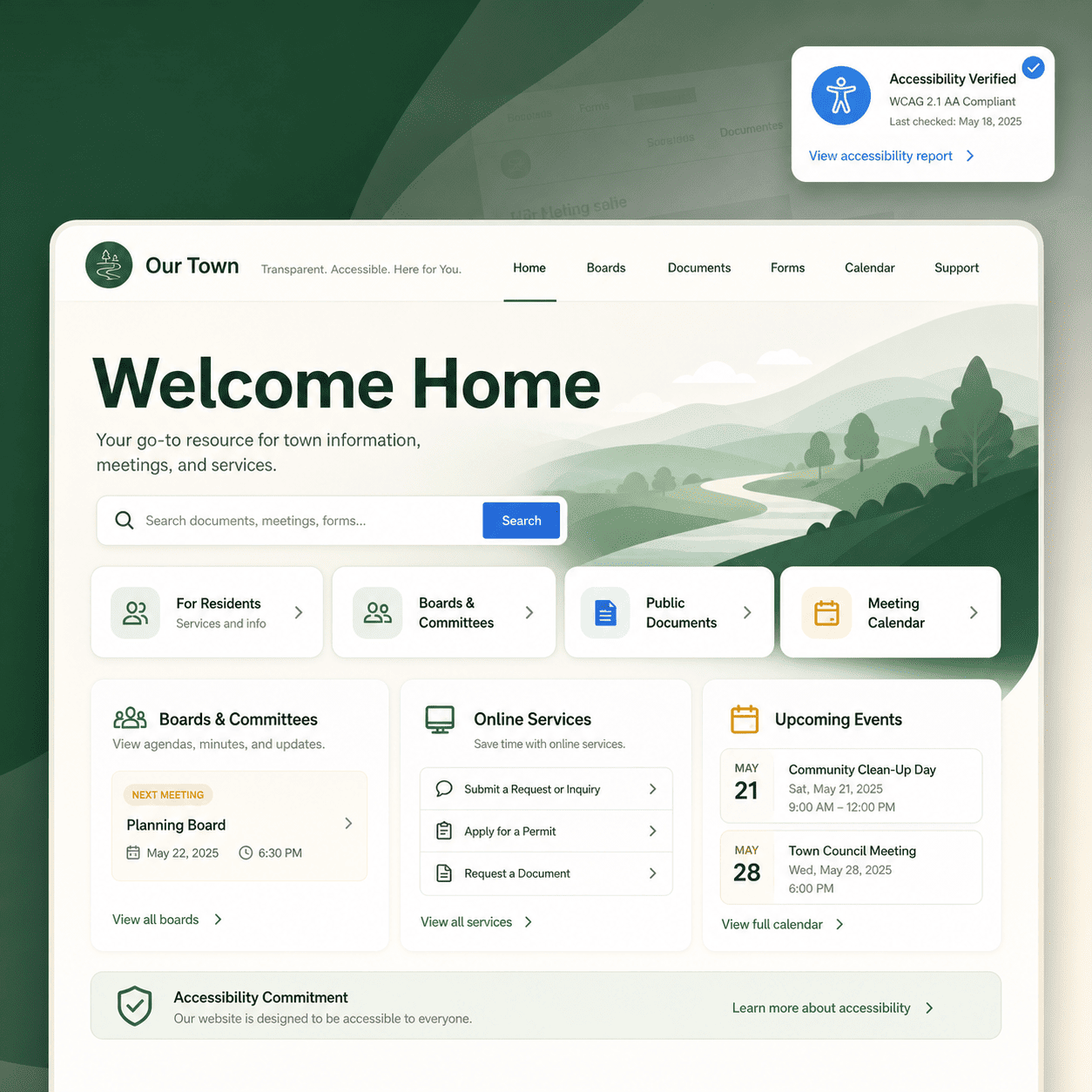
A custom WordPress build with structured board workflows, reusable templates, online forms, moderated calendar, PDF-indexed search, and full compliance support – all wrapped in a managed hosting and ongoing care model.
WordPress municipal platform with custom templates for boards and commissions.
Role-based editing model for town staff, board chairs, contributors, and calendar submitters.
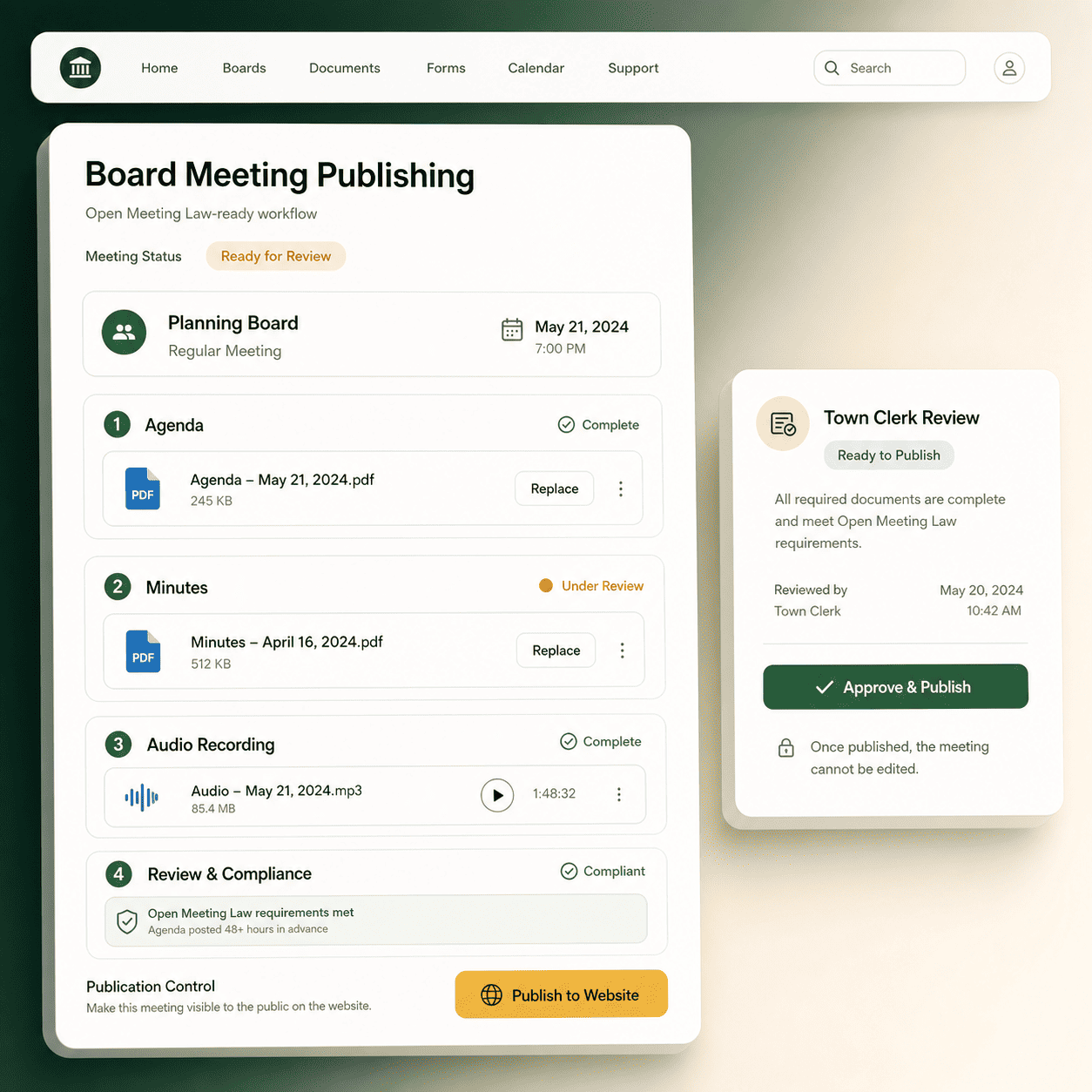
Open Meeting Law-ready publishing workflow for agendas, minutes, and recordings.
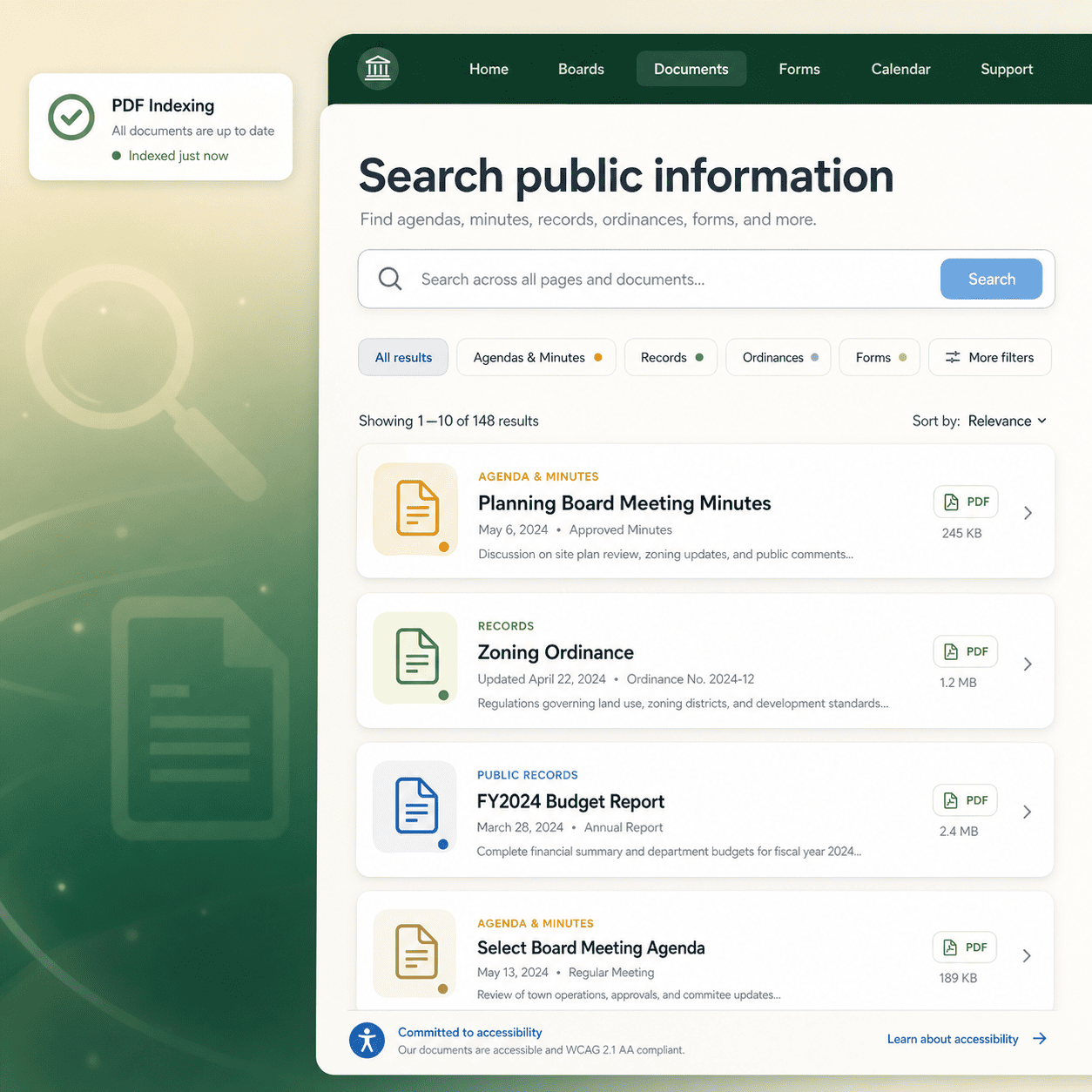
Search with PDF indexing for public documents.
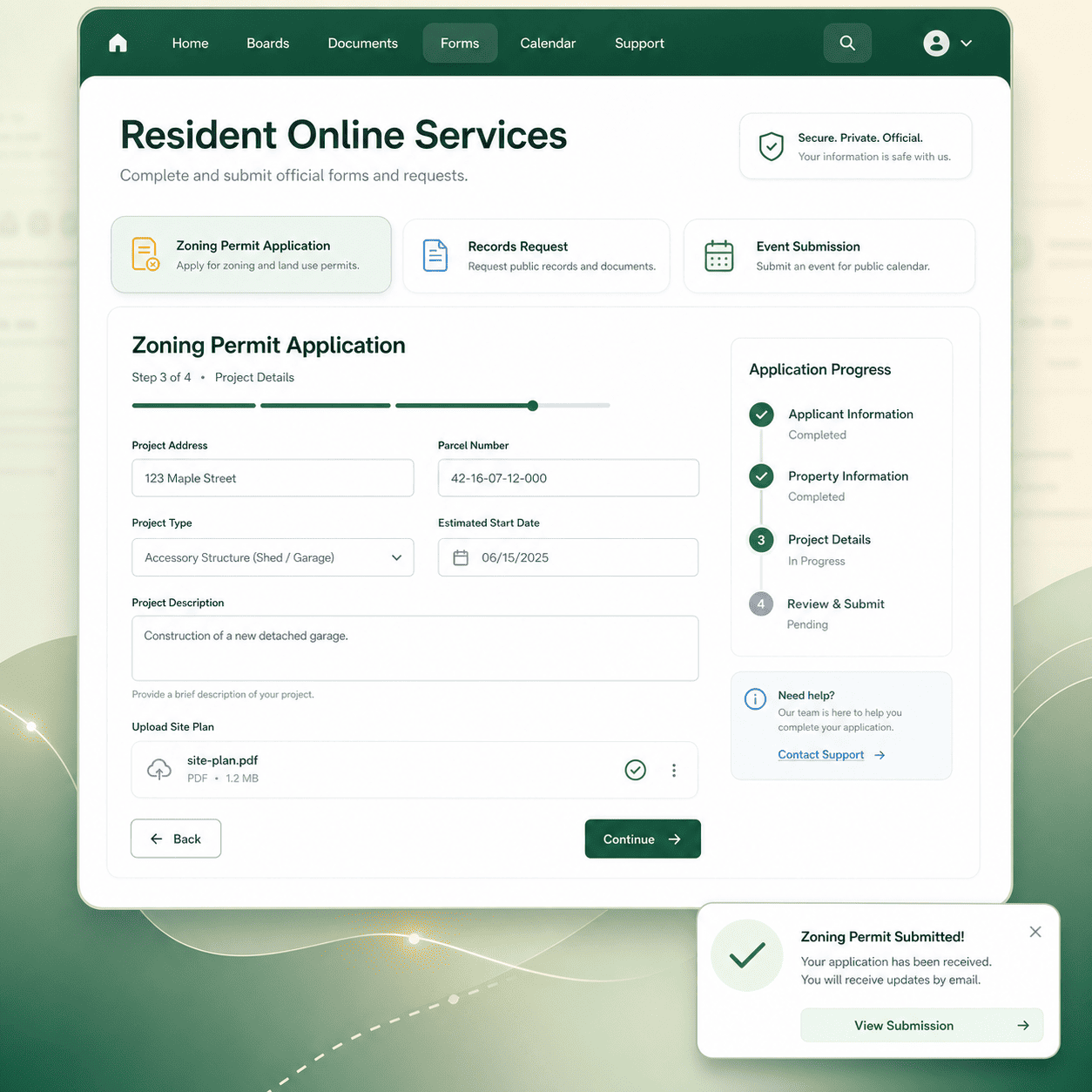
Online forms for zoning permits, records requests, and event submissions.
Ongoing hosting, backups, monitoring, and SLA-based support (see Web Development for how Plavno structures long-term site support).
Publish Board Meetings: Board volunteers upload agenda materials through a simplified interface, and the Town Clerk reviews and publishes final meeting content with the required compliance fields.
Submit Town Forms: Residents use online forms for zoning permits, records requests, and local event submissions instead of paper-only workflows.
Search Public Information: Visitors search across both web pages and PDF documents from one site-wide search experience.
Manage Content by Role: Town staff and volunteer editors maintain only the sections they are responsible for, without receiving full administrative access.
Designed for a small Vermont town with limited internal IT capacity.
Supports Select Board governance plus approximately eight volunteer boards and commissions.
Works as a sustainable operating model for staff plus trained volunteer content managers.
Includes ongoing support from 2024 through the present.
Architecture Overview
CMS Layer: WordPress 6.x with a custom Timber/Twig-based theme.
Accessibility Layer: The accessibility stack included axe DevTools, WAVE, Lighthouse, NVDA, VoiceOver, and quarterly automated auditing. A third-party audit and VPAT documentation were also included.
Search & Forms Layer: SearchWP with PDF indexing, Gravity Forms with custom validation, and The Events Calendar Pro for event workflows.
Permissions Layer: PublishPress Capabilities supported custom roles and page-level permission controls.
Hosting & Security Layer: Pantheon hosting, Cloudflare CDN, daily off-site backups, UptimeRobot, and Sentry.

Value
The improvements that made a real difference for residents, staff, and volunteers
The site included third-party accessibility auditing, VPAT documentation, monthly automated scans, and quarterly manual reviews.
The Town Clerk and volunteer boards can work inside clearly defined publishing and approval workflows.
Residents can submit important forms online and find documents faster.
Town staff and volunteers continue to manage content independently after training.
Benchmarks
Performance metrics and uptime numbers that held up in real-world operation
The site achieved 99.98% uptime in 2025.
Critical incidents had a two-hour response target and averaged 47 minutes in actual response time.
The migration included 301 redirects and zero broken links at launch.
The site operated without any security incidents over 22 months.
Data Protection
Meeting Vermont Open Meeting Law, WCAG accessibility standards, and operational security requirements
Meeting workflows were explicitly structured to match Vermont legal requirements.
The project combined technical remediation, tooling, audits, and editor training.
The platform included WAF, CDN, backups, uptime monitoring, and issue tracking.
Innovative Experience
Where this municipal website model fits best — and who benefits from it
Delivery Crew
High-performing developers for growing companies

Eugene Katovich
Sales Manager
Plavno helps municipalities modernize outdated websites, improve public access, support board workflows, and give staff a platform they can actually run.
Talk to an ExpertCompetitive Ability
Demonstrating how Plavno transforms a legacy small-town website into an accessible public information platform with ongoing support
Migrate legacy content
Move pages, public documents, and archived materials from the outdated website into the new platform.
Apply role-based publishing
Set up permissions for Town Admin, Town Clerk, Board Chair, Contributor, and Event Submitter roles.
Launch accessible public services
Enable searchable documents, online forms, event publishing, and Open Meeting Law workflows.
Support ongoing operations
Maintain uptime, security, accessibility monitoring, and SLA-based support for the town.
WordPress custom theme with Timber/Twig-based architecture
Reusable page templates for boards and commissions
Online forms with custom validation (zoning permits, records requests, event submissions)
Moderated events calendar with submission workflows
Custom Meeting content type for Open Meeting Law (board name, date, agenda, minutes, audio)
Simplified volunteer submission interface with Town Clerk notification and moderation
Site-wide search with PDF indexing (SearchWP)
301 redirects with zero broken links at launch
47 pages migrated from legacy SaaS platform
~280 PDF documents migrated and indexed
Supports Select Board + ~8 volunteer boards and commissions
3 town staff + 6 volunteer editors trained for independent content management
99.98% uptime achieved in 2025
340 online zoning permit applications in 2025 (up from 0 in 2023)
22 months of security-incident-free operation
SLA: 2-hour response target for critical incidents (averaged 47 minutes)
WCAG 2.1 AA compliance with third-party audit and VPAT documentation
Lighthouse Accessibility score of 100
Lighthouse Performance 94, Best Practices 100, SEO 98
Monthly automated accessibility scans (axe DevTools, WAVE)
Quarterly manual accessibility reviews (NVDA, VoiceOver)
Vermont Open Meeting Law–ready publishing workflow
Editor training on accessible content creation
Public accessibility feedback mechanisms included in support model
The numbers that show how the town moved from paper to digital
The website reached a Lighthouse Accessibility score of 100.
The town went from zero online zoning applications to 340 in 2025.
Town staff and volunteers continue to run the site after training.
The town stayed on an ongoing support relationship from 2024 onward.
Town staff no longer handle paper-based permit submissions, manual document uploads, or routine publishing requests from volunteers.
Tools We Used
Project Estimator
The estimated time to launch the product
Clear vision of functionality you need
15% discount on your first sprint

Frequently Asked Questions
Find answers to your common concerns
Yes. The town had about 2,000 residents and a small office staff.
Yes. Accessibility was a core project requirement and part of the ongoing support model.
Yes. The site included a role model specifically designed for staff and volunteer boards.
Yes. Ongoing support started in 2024 and continues.
Related Projects
About Plavno

Senior engineers + proven AI components to accelerate time-to-value.

From MVPs to enterprise platforms at global scale.

From extension UX to GPU pipelines and global scale.
Testimonials
Contact Us
Plavno experts contact you within 24h
Discuss your project details
We can sign NDA for complete secrecy
Submit a comprehensive project proposal with estimates, timelines, team composition, etc
Plavno has a team of experts ready to start your project. Ask us!

Vitaly Kovalev
Sales Manager

Fill in the form
to access the case study.