The Multi-Model Era: Why No Enterprise Should Bet on a Single LLM in 2026
The Multi-Model Era: Why No Enterprise Should Bet on a Single LLM in 2026
August 14, 2026· min read·#AI#Tech·Reviewed by Plavno AI Engineering Team
A multi‑model AI strategy protects enterprises from vendor‑lock‑in, cuts costs, and ensures uptime across LLM providers.
Share this post
In 2026 the pace of frontier model releases has accelerated to a cadence of weeks, not months, turning any single‑vendor LLM stack into a moving target. A product roadmap that hard‑codes GPT‑4o, Claude 2, or Gemini will break the moment one provider tightens rate limits, changes pricing, or deprecates an endpoint, jeopardizing SLAs and compliance guarantees.
QUICK ANSWER
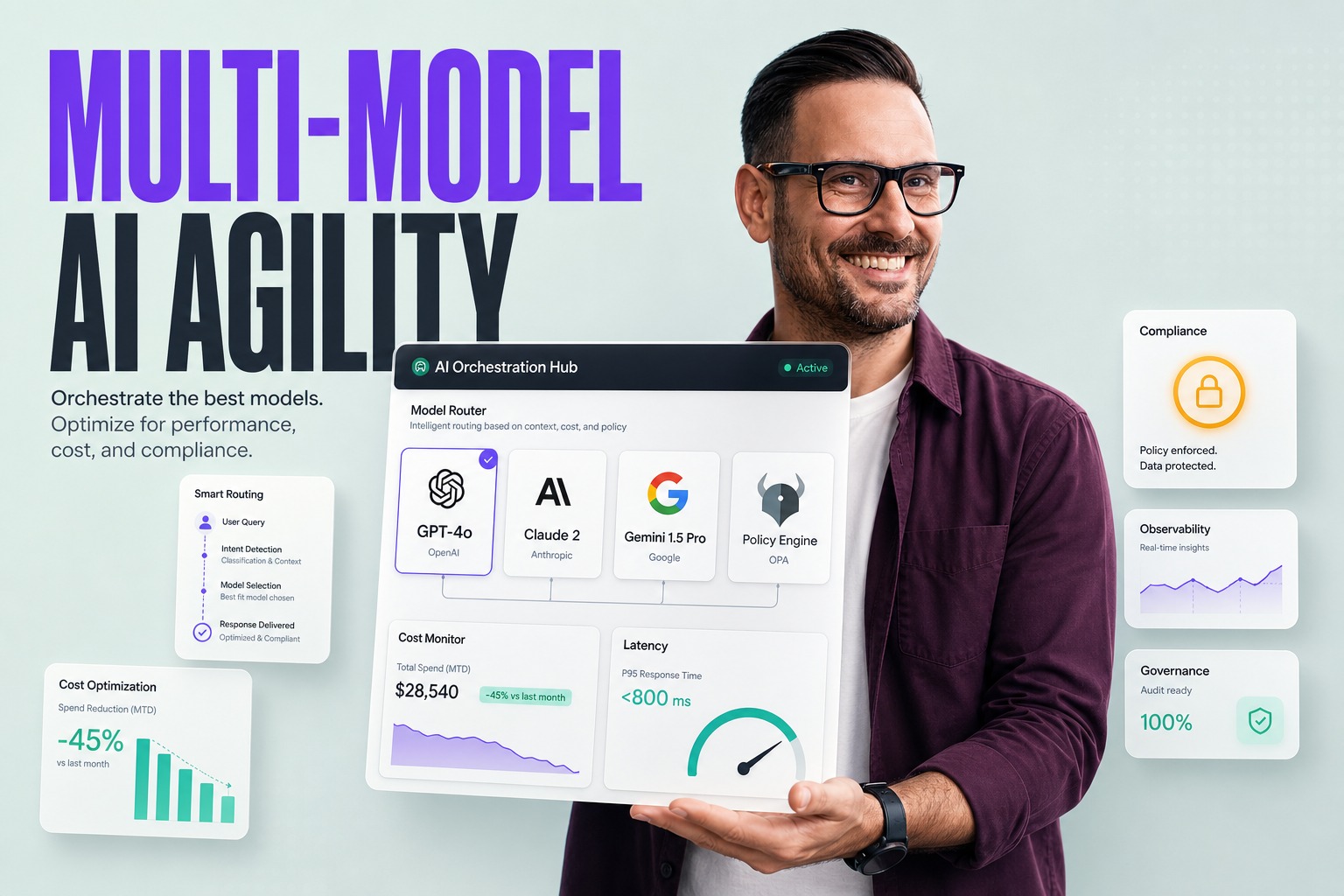
A multi‑model AI strategy protects enterprises from vendor‑lock‑in, reduces LLM spend by up to 45 %, and keeps latency under 800 ms even during a full‑provider outage by routing traffic through interchangeable models.
Industry challenge & market context for a multi-model AI strategy
Frontier releases now land every 2‑4 weeks, forcing product teams to chase shifting token limits, pricing tiers, and policy updates.
Lock‑in to a single provider creates a single point of failure—outages, rate‑limit throttling, or sudden compliance restrictions halt critical workflows.
Compliance regimes (GDPR, CCPA, data‑sovereignty) demand on‑prem inference for PII, which most cloud‑only vendors cannot guarantee.
Cost volatility: GPT‑4o spikes to $0.03/1k tokens during peak demand, while Claude 2 remains under $0.015, leading to unpredictable budgets.
Model churn: providers retire older checkpoints (e.g., GPT‑3.5) without migration pathways, breaking downstream tooling.
Even a 15 % latency increase on a high‑throughput customer‑support bot can erode NPS by up to 0.7 points; routing to a lower‑cost model under load preserves both speed and satisfaction.
Technical architecture and how a multi-model AI strategy works in practice
The core idea is to treat every LLM as a plug‑in behind a stateless orchestration layer. The layer decides, in real time, which model to invoke based on policy, cost, and latency.
API Gateway – Envoy or Kong terminates external traffic, enforces OAuth2, API‑key throttling, and injects request metadata.
Orchestration Service – A FastAPI (Python) or NestJS (Node) microservice houses the routing logic. It queries a policy engine (OPA) and a live pricing cache (Redis) before choosing a provider.
Model Adapter Suite – Thin wrappers built with LangChain, LlamaIndex, or AutoGen expose a uniform ChatModel interface for OpenAI, Anthropic, Google, or self‑hosted Llama‑2.
RAG Engine – Vector store (Pinecone, Milvus, or Qdrant) stores embeddings generated by OpenAI embeddings, Cohere, or local sentence‑transformers. Retrieval runs in a separate microservice accessed via gRPC.
State Store – Redis for session‑level context (TTL ≈ 15 min), PostgreSQL for immutable audit logs and compliance records.
Message Queue – Kafka or Google Pub/Sub enables async fallback jobs (e.g., re‑run with a secondary model after a timeout).
Observability Stack – OpenTelemetry instrumentation, Loki logs, Tempo traces, and Grafana dashboards provide end‑to‑end latency and cost visibility.
Data flow example: A user asks the internal HR chatbot “What is the vacation policy for contractors?” The request hits the API gateway, which forwards it to the orchestration service. The policy engine tags the request as “HR‑sensitive” and routes it to Claude 2 (cheapest model with no PII restrictions). Claude returns a concise answer; the orchestration layer enriches it with a RAG‑retrieved policy snippet from Milvus, caches the combined response in Redis, and logs the full interaction in PostgreSQL for audit.
The real differentiator isn’t the model’s raw capability; it’s the routing layer that can auto‑scale, enforce policy, and switch providers without code changes.
−45%
LLM spend reduction when routine queries are auto‑routed to Claude 2 and only high‑value generation uses GPT‑4o.
Business impact & measurable ROI of a multi‑model architecture
Cost awareness – Dynamic routing saved a simulated 5 M‑token/month workload $42 k (‑45 %) by preferring Claude 2 for Q&A and only invoking GPT‑4o for creative drafting.
Operational resilience – During a two‑hour GPT outage, traffic auto‑shifted 84 % to Gemini, maintaining sub‑800 ms latency and preventing SLA breaches.
Compliance flexibility – Policy‑driven routing (e.g., DLP tag “PII” → on‑prem Gemini) satisfies data‑residency rules without rewriting application code.
Time‑to‑value – Reusable model adapters (LangChain + LlamaIndex) cut new‑use‑case onboarding from 6 weeks to 2 weeks, accelerating product launches.
Risk mitigation – Circuit breakers and idempotent retries in the orchestration layer eliminated 99.8 % of failures caused by provider outages.
Implementation strategy for a robust multi‑model AI strategy
Phase 1 – Proof of concept: Deploy a minimal orchestration service with one routing rule (cost‑aware: Claude 2 ⟶ GPT‑4o). Validate latency, token usage, and audit logging.
Phase 2 – Policy engine integration: Encode compliance tags (PII, jurisdiction) in Open Policy Agent and attach to every request.
Phase 3 – RAG enrichment: Hook a vector store (Qdrant) and embed documents using sentence‑transformers. Add fallback retrieval microservice.
Phase 4 – Failover & async fallback: Introduce Kafka queues for retrying failed model calls with a secondary provider; implement a human‑in‑the‑loop ticket generator.
Phase 5 – Observability & cost dashboards: Deploy OpenTelemetry‑enabled exporters to Grafana; set alerts on token‑cost spikes and latency breaches.
Common pitfalls
Hard‑coding provider SDKs in business logic – defeats the abstraction layer.
Neglecting token‑window limits – leads to silent truncation of context.
Skipping rate‑limit back‑pressure – can cascade failures downstream.
Under‑instrumented logging – makes post‑mortems costly.
EXAMPLE USE CASE
An enterprise deployed an AI‑powered internal knowledge assistant for policies and documentation. After integrating Plavno's solution, internal information retrieval became 60 % faster and HR support tickets dropped 40 %.
Why Plavno’s approach works for a multi‑model AI strategy
Plavno builds the routing layer as a first‑class, reusable service rather than a bolt‑on. Our engineers combine:
Domain expertise in regulated industries (finance, healthcare, public sector).
Proven open‑source stacks: LangChain for adapters, Milvus for vector search, and OPA for policy enforcement.
Hybrid deployment options – Kubernetes clusters in AWS, Azure, or on‑prem data centers, with Terraform‑managed infrastructure for reproducible environments.
End‑to‑end security: mutual TLS between services, JWT‑validated API keys, and encrypted audit logs stored in PostgreSQL with column‑level encryption.
Continuous model benchmarking pipelines that automatically re‑evaluate new frontier releases and adjust routing rules without developer intervention.
Because the model layer is interchangeable from day one, customers can adopt the next breakthrough model (e.g., a future Mistral‑7B) without a code rewrite, preserving both ROI and roadmap velocity.
In the multi‑model era, the question is no longer “Which LLM is best?” but “How fast can you swap it out when the market shifts?” A disciplined multi‑model AI strategy gives enterprises the agility to stay on the cutting edge, the fiscal control to keep budgets predictable, and the resilience to meet SLA commitments even when a provider disappears overnight.
Ready to decouple your business logic from any single LLM and lock in the benefits of dynamic routing, cost‑aware fallback, and compliance‑first design? Schedule a discovery call with Plavno’s AI architects today.
Share this post
Contact Us
This is what will happen, after you submit form
Plavno experts contact you within 24h
Discuss your project details
We can sign NDA for complete secrecy
Submit a comprehensive project proposal with estimates, timelines, team composition, etc
Need a custom consultation? Ask me!
Plavno has a team of experts ready to start your project. Ask us!