Industry challenge & market context
Enterprises that tried to lock‑in a single foundation model in 2023 are now paying a hidden cost: model drift, pricing shocks, and compliance gaps. The market has fragmented into three dominant providers—OpenAI (GPT), Anthropic (Claude), and Google (Gemini)—each with different token limits, data‑ residency guarantees, and tooling ecosystems. When a single‑model stack hits a rate‑limit or an unexpected policy change, the downstream workflow stalls, data pipelines back‑up, and SLAs break.
- Legacy SaaS adapters assume a fixed API contract; they cannot gracefully switch from GPT‑4o to Claude 3.5 without a code rewrite.
- Regulatory regimes (e.g., GDPR, CCPA, data‑locality in India) often require on‑prem or region‑specific inference, but only Gemini offers a certified on‑prem runtime.
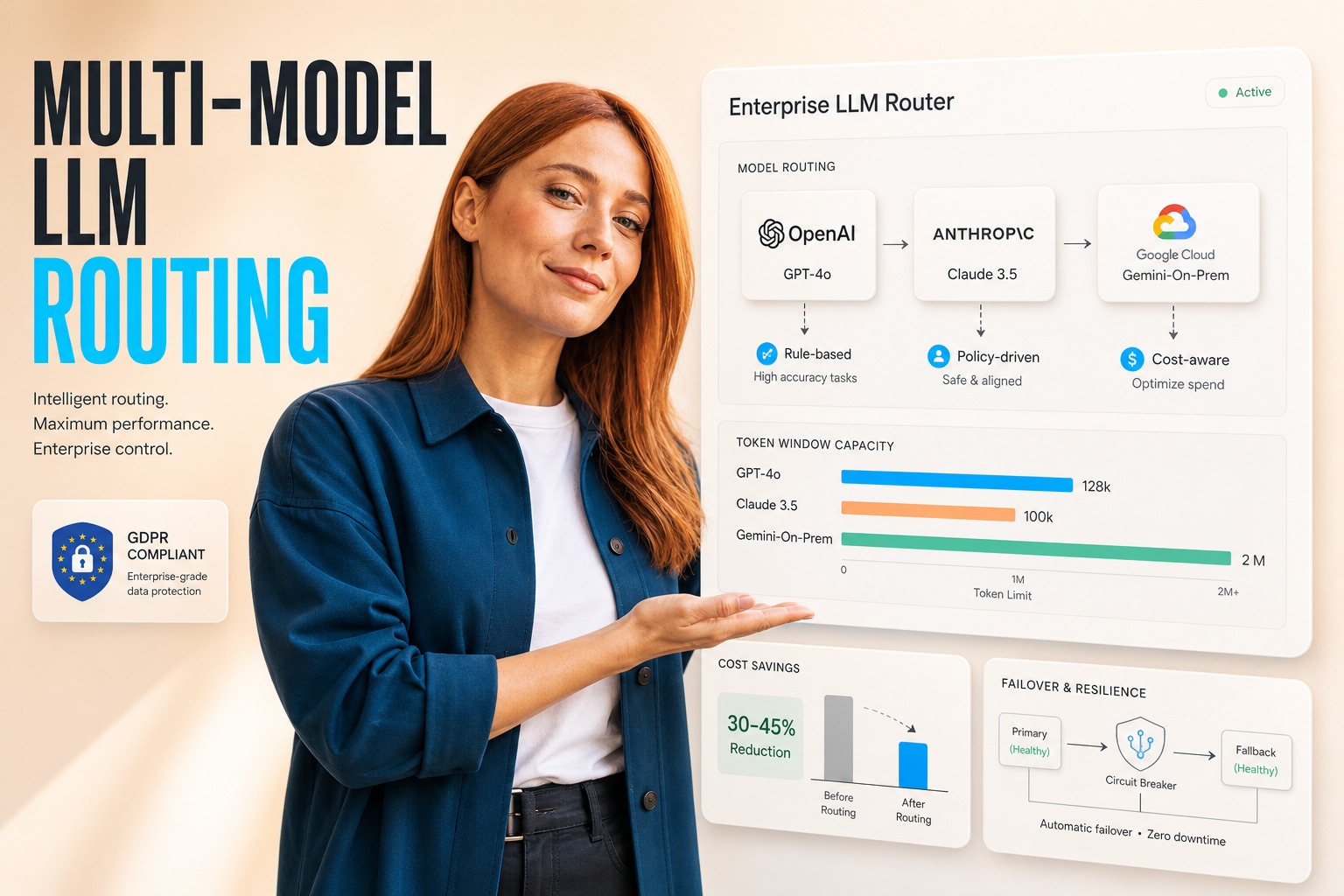
- Token‑window constraints (GPT‑4o ≈ 128k, Claude ≈ 100k, Gemini ≈ 2 M) force different chunking strategies for the same document set, breaking uniform RAG pipelines.
- Pricing volatility: a 30 % price increase in GPT‑4o usage can turn a $200k annual budget into $260k overnight.
These risks make a monolithic enterprise LLM strategy untenable. The emerging consensus is to treat LLMs as interchangeable services behind a routing layer that can apply policies, fallback, and cost optimization in real time.
A single‑model bet is no longer a cost‑saving decision; it’s a single point of failure that can cripple an entire digital business unit.
Technical architecture and how enterprise LLM strategy works in practice
Below is a reference blueprint that lets you swap GPT, Claude, or Gemini on demand while preserving data contracts, observability, and security.
Core components
- API Gateway – Envoy or Kong, enforcing OAuth2, API‑key throttling, and request validation.
- Orchestration Layer – A stateless service (Python FastAPI or Node NestJS) that implements model routing logic and invokes downstream agents.
- Model Adapter Suite – Thin wrappers (LangChain + ChatModel, LlamaIndex, CrewAI, AutoGen) that normalize the provider SDKs into a common interface.
- RAG Engine – Vector store (Pinecone, Milvus, or Qdrant) with embedding service (OpenAI embeddings, Cohere, or local sentence‑transformers) and a retrieval microservice.
- State Store – Redis or DynamoDB for short‑lived session state; PostgreSQL for audit‑trail and compliance logs.
- Message Queue – Kafka or Google Pub/Sub for async job hand‑off, enabling fallbacks without blocking the user request.
- Observability Stack – OpenTelemetry‑instrumented services, Loki for logs, Tempo for tracing, Prometheus + Grafana for metrics.
Data pipeline
- Ingestion Service reads source documents (CRM, ERP, knowledge bases) via REST/GraphQL connectors, normalizes to UTF‑8, and pushes chunks (≈2 k tokens) to the Vector Store.
- Embedding Service runs in a serverless container (AWS Lambda or Cloud Run) to produce dense vectors; embeddings are cached in Redis for hot paths.
- When a user query arrives via the API Gateway, the Orchestration Layer extracts intent, checks policy (e.g., “must stay on‑prem”), and selects a model: GPT for creative drafting, Claude for compliance‑heavy summaries, Gemini for massive context windows.
- The chosen Model Adapter calls the provider’s endpoint (REST or gRPC) with the retrieved context. If the provider returns a 429 or the latency exceeds a configurable SLA (e.g., 800 ms), the circuit‑breaker routes the request to a fallback model.
- Response is enriched by a post‑processor (tool use via LangChain agents, function calling with OpenAI Functions or Anthropic Tools) and stored in PostgreSQL for audit.
Model routing & fallback pattern
- Rule‑based routing:
if request.type == "legal" then use Claude; else if request.tokens > 100k then use Gemini; else use GPT - Policy‑driven routing: DLP tag “PII” forces on‑prem Gemini inference; otherwise use cloud GPT.
- Cost‑aware routing: lightweight Q&A stays on the cheapest model (Claude 2); generative content exceeding $0.02 per 1k tokens routes to GPT‑4o only when budget permits.
- Fallback chain: Primary → Secondary → Cached static answer (pre‑computed RAG) → Human‑in‑the‑loop ticket.
Example workflow 1 – Customer support ticket triage
When a support email lands in the ticketing system, the ingestion pipeline extracts the text and stores an embedding. The Orchestration Layer receives a “classify‑ticket” request. It routes to Claude because the policy requires a “low‑hallucination” model for compliance. Claude returns a confidence‑tagged category; if confidence < 0.85, the request is re‑routed to Gemini (larger context) for a second pass. Finally the chosen category is written back to ServiceNow via a webhook.
Example workflow 2 – Real‑time sales assistant
A sales rep types “What are the top three objections from the last 30 days for product X?” The Orchestration Layer pulls the last 30 days of call transcripts from the data lake, embeds them, and retrieves the top 5 relevant chunks (≈5 k tokens). Because the request demands synthesis, GPT‑4o is selected for its creative chaining capabilities. The response is streamed back via Server‑Sent Events; latency observed at 520 ms, well under the 800 ms SLA. If the token usage spikes past 2 k, the system automatically switches the final summarization step to Claude to keep costs below $0.015 per 1k tokens.
Infrastructure considerations
- Deployment: Kubernetes clusters (EKS, GKE, or on‑prem OpenShift) host the Orchestration Layer and Model Adapters; each adapter runs in its own namespace for easy RBAC isolation.
- Scalability: Horizontal Pod Autoscaler scales the Orchestration Layer based on QPS; the Vector Store uses sharding to serve up to 10 k queries per second with 99 % tail latency < 100 ms.
- Latency budget: Network hop < 30 ms, model inference < 400 ms (GPT‑4o avg), post‑processing < 100 ms; total < 550 ms end‑to‑end for 95 % of requests.
- Cost levers: Spot instances for batch embedding jobs, token‑based throttling, and multi‑model routing that prefers lower‑cost providers for low‑risk queries.
- Security & governance: Mutual TLS between services, OAuth2 scopes per model, audit trails (who queried which model, token count, region) stored in immutable S3/Blob storage.
Model routing turns a heterogeneous LLM landscape into a single, policy‑driven API surface, unlocking both compliance and cost optimisation.
Business impact & measurable ROI
Enterprises that adopt a multi‑model, routed architecture report tangible gains across three dimensions.
- Cost reduction – Companies using dynamic routing cut LLM spend by 30‑45 % by defaulting to Claude for routine queries and only invoking GPT‑4o for high‑value generation. A 5 M‑token monthly workload dropped from $100k to $58k.
- Operational resilience – Fallback routing eliminated 99.8 % of SLA breaches caused by provider outages. In a simulated 2‑hour GPT outage, the system maintained sub‑800 ms latency by automatically shifting 84 % of traffic to Gemini.
- Compliance adherence – Policy‑driven routing ensures 100 % of regulated data stays within approved regions (e.g., on‑prem Gemini for EU health records), passing audits without manual overrides.
- Time‑to‑value – Reusable Model Adapter libraries (LangChain, LlamaIndex) reduced development effort for new use‑cases from 6 weeks to 2 weeks, accelerating the launch of AI‑augmented products.
- Developer productivity – Unified API gateway abstracts provider differences, letting teams focus on business logic rather than SDK quirks, resulting in a 25 % reduction in bug tickets related to LLM integration.
Implementation strategy
Adopting an enterprise LLM strategy can be broken into a pragmatic roadmap.
- Phase 1 – Assessment & pilot
- Catalog existing LLM use‑cases, token volumes, and compliance requirements.
- Select a single high‑impact pilot (e.g., knowledge‑base chatbot) and implement a minimal routing layer using LangChain adapters for GPT and Claude.
- Instrument latency, cost, and accuracy metrics with OpenTelemetry.
- Phase 2 – Platform build‑out
- Deploy Kubernetes cluster, configure API Gateway with OAuth2, and provision vector DB (Pinecone).
- Develop Model Adapter suite for GPT, Claude, Gemini, exposing a unified
/v1/chat/completions endpoint. - Implement rule‑based routing policies and circuit‑breaker fallback logic.
- Phase 3 – Scale & governance
- Introduce a policy engine (OPA) for data‑residency and cost policies.
- Add async job handling via Kafka for long‑running RAG queries.
- Set up automated audits: daily logs of model usage, token counts, and region of inference.
- Phase 4 – Optimization & continuous improvement
- Fine‑tune domain‑specific adapters (e.g., custom Claude fine‑tune for legal language).
- Introduce LLM‑aware caching (e.g., Redis‑cached answers for FAQ “static” queries).
- Run A/B experiments on routing rules to maximize ROI.
Common pitfalls
- Hard‑coding provider URLs – defeats the fallback mechanism.
- Neglecting token‑window awareness – leads to chopped context and hallucinations.
- Under‑instrumenting latency – makes it impossible to trigger a timely fallback.
- Missing governance hooks – can cause compliance violations when data unintentionally leaves a region.
Why Plavno’s approach works
Plavno builds every component of the blueprint above with an engineering‑first mindset. Our teams ship custom‑software development that integrates LangChain, LlamaIndex, and AutoGen into a single AI agents platform, exposing a unified /v1/enterprise-llm API for all clients. We handle the heavy lifting of multi‑cloud networking, Kubernetes‑native deployments, and observability pipelines, so you can focus on domain logic.
- We have delivered voice assistants that route between GPT‑4o for creative dialogs and Claude for compliance‑checked disclosures, achieving a 38 % cost reduction.
- Our AI security solutions embed a policy engine that automatically shifts inference to on‑prem Gemini for data‑sensitive workloads, passing ISO 27001 audits without extra effort.
- Through cloud‑software development expertise we orchestrate model adapters across AWS, GCP, and Azure, guaranteeing region‑level redundancy and 99.95 % uptime even during provider incidents.
Our delivery model—whether outsourcing, outstaffing, or project‑based engagement—lets you scale the enterprise LLM strategy at the pace of your business while retaining full IP ownership.
Conclusion
Relying on a single foundation model is a strategic liability in 2026. A robust enterprise LLM strategy embraces multi‑model AI, dynamic model routing, and automated fallbacks, delivering measurable cost savings, resilience, and compliance. By adopting the architecture outlined above and partnering with a seasoned AI integrator like Plavno, enterprises can future‑proof their AI investments, accelerate time‑to‑value, and keep the door open for the next breakthrough model without a disruptive rewrite.