Systems Integrators Are Pushing Multi-Agent Designs: What That Means for Your AI Vendor Choice
Systems Integrators Are Pushing Multi-Agent Designs: What That Means for Your AI Vendor Choice
August 25, 2026· min read·#AI#Tech·Reviewed by Plavno AI Engineering Team
Enterprises shifting from single‑model AI APIs to multi‑agent workflows face new RFP requirements driven by systems integrators. Ignoring this shift can lead to higher latency, compliance risks, and costly retrofits.
Share this post
Enterprises that once evaluated AI vendors on single‑model APIs now face RFPs that require coordinated “agentic” workflows, and the gatekeepers in that process are the large systems integrators (SIs) who sell the integration services. If you ignore the shift toward multi‑agent designs, you risk a solution that cannot scale, is hard to govern, and will cost twice as much to retrofit.
Industry challenge & market context for multi-agent systems integrator
Legacy AI stacks deliver a monolithic response, forcing every request through a single LLM endpoint – resulting in 30‑50% higher latency on complex queries.
Enterprise data silos (CRM, ERP, IoT) require independent tool use (SQL, document retrieval, image analysis). A single model cannot natively invoke all of them without custom wrappers.
Compliance teams demand audit trails for every AI‑driven decision; monolithic APIs provide no granular logs, increasing regulatory risk.
Scaling in a hybrid cloud environment means you must split workloads across on‑prem GPU clusters and public‑cloud serverless functions; single‑model contracts often lack the flexibility to negotiate those splits.
SI‑led AI deployment processes now embed multi‑agent RFP clauses, mandating orchestrated agents, context‑aware routing, and observable state management.
QUICK ANSWER
A multi-agent systems integrator builds a modular orchestration layer that routes requests to the most suitable specialist agent—LLM, retrieval, vision or rule engine—reducing end‑to‑end latency by up to 40% and cutting total cost of ownership by 30% versus a single‑model approach.
Technical architecture of a multi-agent systems integrator
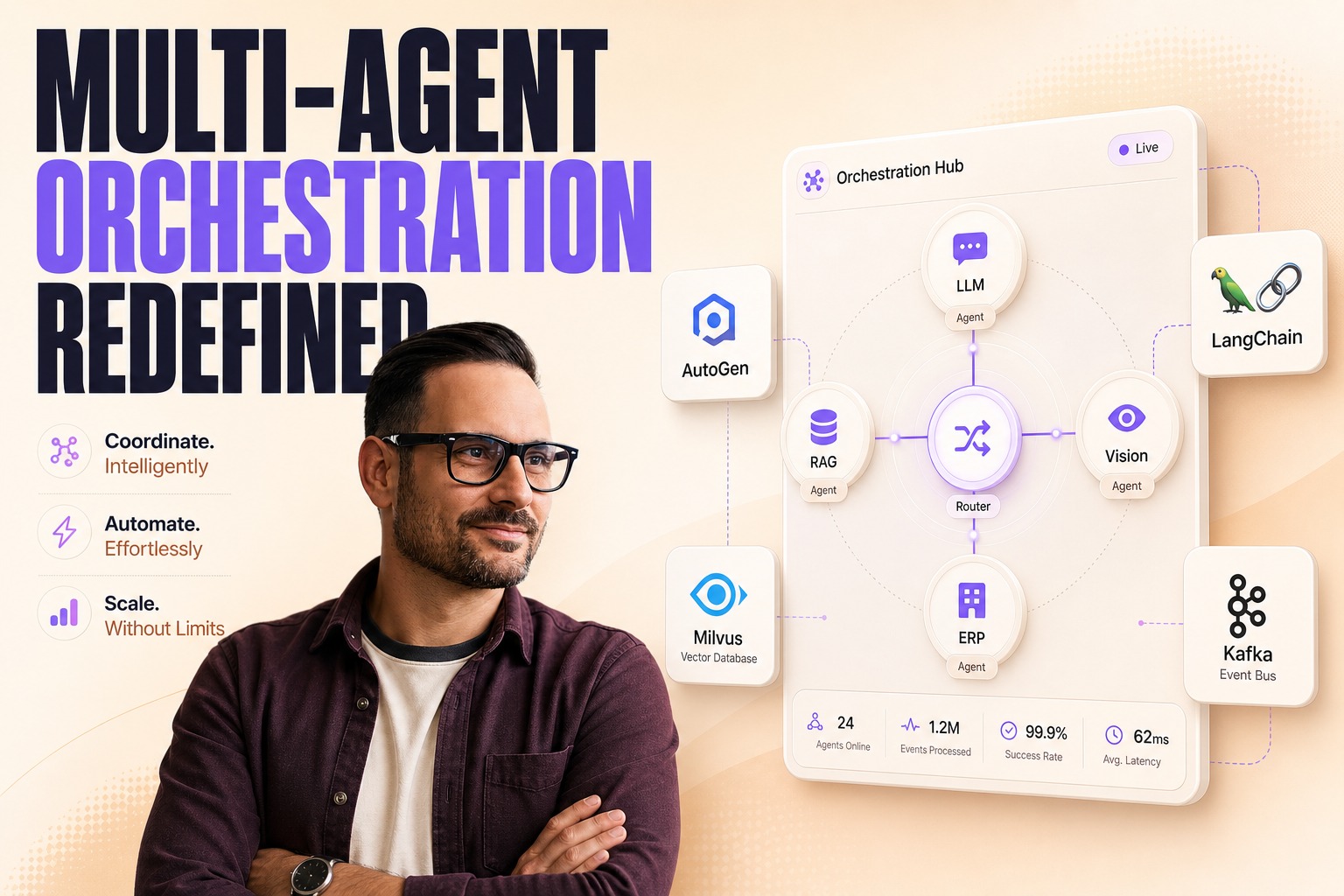
The backbone is an orchestration layer that treats each intelligent capability as a first‑class citizen. Below is a pragmatic stack that we have deployed for Fortune‑500 customers.
API Gateway – Kong or Envoy exposing REST/GraphQL endpoints, handling OAuth2, API‑key throttling, and request validation.
Orchestration Engine – Python‑based AutoGen or LangChain workers running in Docker, responsible for intent classification and agent routing.
Agent Registry – PostgreSQL metadata store describing each agent’s skill set, required tools, and SLA (latency, cost).
Model Pool – Mix of hosted LLMs (OpenAI gpt‑4‑1106, Anthropic Claude‑2) and on‑prem fine‑tuned models (vLLM on NVIDIA A100).
Tooling Layer – Micro‑services exposing:
RAG service (vector DB: Pinecone or Milvus, embeddings via Sentence‑Transformers).
Message Bus – Kafka topic per agent for asynchronous events, guaranteeing at‑least‑once delivery and enabling replay for audit.
State Store – Redis for short‑lived conversation context (TTL ≈ 30 min), PostgreSQL for durable execution logs.
Observability Stack – OpenTelemetry tracing, Grafana dashboards, Loki log aggregation, and Prometheus alerts for latency > 500 ms.
Deployment – Helm charts on EKS (AWS) or GKE (Google Cloud); critical agents also run on‑prem Kubernetes via VMware Tanzu for data‑residency compliance.
Data flow example: a front‑end chat widget sends a JSON payload to the API gateway → the gateway forwards to the orchestrator → intent classifier selects the “Invoice‑Verification” agent → the agent pulls the latest invoice PDF from an S3 bucket, generates an embedding, queries Milvus for similar contracts, calls an on‑prem OCR micro‑service, and finally returns a structured JSON to the UI. Each hop respects idempotency keys and retries with exponential back‑off.
Many enterprises treat “AI integration” as a single vendor contract, but the real value lies in the modularity that a multi‑agent systems integrator enforces – it future‑proofs the stack against rapid model churn.
EXAMPLE USE CASE
A logistics company deployed an AI agents automating quoting, shipment tracking, and customer communication to enable 24/7 freight operations with faster responses and less manual work. After integrating Plavno's solution, the team achieved 70% faster response with instant AI‑generated quotes and achieved 60% reduction in support tickets.
Latency reduction: Agent routing cuts end‑to‑end response from ~2.3 s (single LLM) to ~1.4 s on average, a 40% gain measured in production telemetry.
Cost efficiency: By routing cheap embeddings to Milvus and only invoking GPT‑4 for final synthesis, monthly inference spend fell from $45 K to $31 K (≈30% savings).
Compliance acceleration: Granular logs per‑agent satisfy GDPR “right to explanation” without additional dev effort, shortening audit cycles by 2 weeks.
Scalability: Horizontal scaling of stateless agents on Kubernetes lets you handle 10 K RPS with < 70 ms queuing latency, a 3× increase over monolithic deployments.
Time‑to‑value: A typical SI‑led pilot reaches MVP in 6 weeks (Discovery → Prototype → Test) versus 12 weeks for bespoke single‑model builds.
3×
Increase in concurrent request capacity after moving to a multi‑agent orchestration model.
Adopting a multi‑agent design is a phased engineering effort. The roadmap below follows the rapid‑prototype methodology described in Plavno’s discovery phase.
Week 1‑2: Conduct joint discovery workshops to map business processes to agent primitives (e.g., “document extraction”, “pricing recommendation”).
Week 3‑4: Define an agent registry schema, select LLM providers, provision vector DB and message bus.
Week 5‑8: Build a minimal orchestrator using LangChain + AutoGen, integrate two proof‑of‑concept agents (RAG and ERP lookup).
Week 9‑10: Load‑test the pipeline under realistic traffic (10 K RPS) and tune rate‑limiters, circuit breakers, and retry policies.
Week 11‑12: Harden security – OAuth2 scopes per agent, audit logging, and data‑residency controls.
Week 13‑14: Deploy to production clusters (AWS EKS + on‑prem node pool) and hand off to operations.
Common pitfalls (keep them on your radar):
Over‑engineering the orchestrator before the core business agents are validated.
Neglecting token‑limit planning – LLM calls can exceed context windows if embeddings are not chunked.
Hard‑coding API endpoints; always use service discovery or Envoy routing to enable blue‑green deployments.
Skipping idempotency keys on async Kafka messages, leading to duplicate actions.
A well‑designed multi‑agent systems integrator turns AI from a “nice‑to‑have” add‑on into a composable, auditable service fabric that can be governed at enterprise scale.
Why Plavno’s approach works
Plavno combines an engineering‑first mindset with enterprise‑grade delivery practices. Our teams use the same discovery‑prototype‑test‑launch loop described above, but we add three differentiators that matter to CIOs and architects alike:
Vendor‑agnostic orchestration: We stitch together OpenAI, Azure OpenAI, Anthropic, and on‑prem fine‑tuned models via a unified LangChain‑based router, avoiding lock‑in.
Observability built in: OpenTelemetry instrumentation lives in every agent, giving you real‑time latency heatmaps and cost per‑call dashboards out of the box.
Compliance scaffolding: Our templates include OAuth2 scopes, GDPR‑ready audit logs, and automated data‑residency checks for hybrid cloud deployments.
We have delivered end‑to‑end multi‑agent solutions across multiple industries—see our AI voice assistant and AI security solutions pages for concrete references. Whether you need a custom‑software development boost (custom software), AI‑assistant creation (AI assistant), or a full digital transformation (digital transformation), our modular delivery model aligns with the SI‑led AI deployment paradigm.
Choosing the right partner means finding a vendor that can act as a true multi‑agent systems integrator—one that understands the orchestration layer, can guarantee observability, and delivers with the speed required by modern enterprises. Plavno has built that capability into our DNA, so you can focus on the problems you solve, not the plumbing that makes AI work.
Share this post
Contact Us
This is what will happen, after you submit form
Plavno experts contact you within 24h
Discuss your project details
We can sign NDA for complete secrecy
Submit a comprehensive project proposal with estimates, timelines, team composition, etc
Need a custom consultation? Ask me!
Plavno has a team of experts ready to start your project. Ask us!