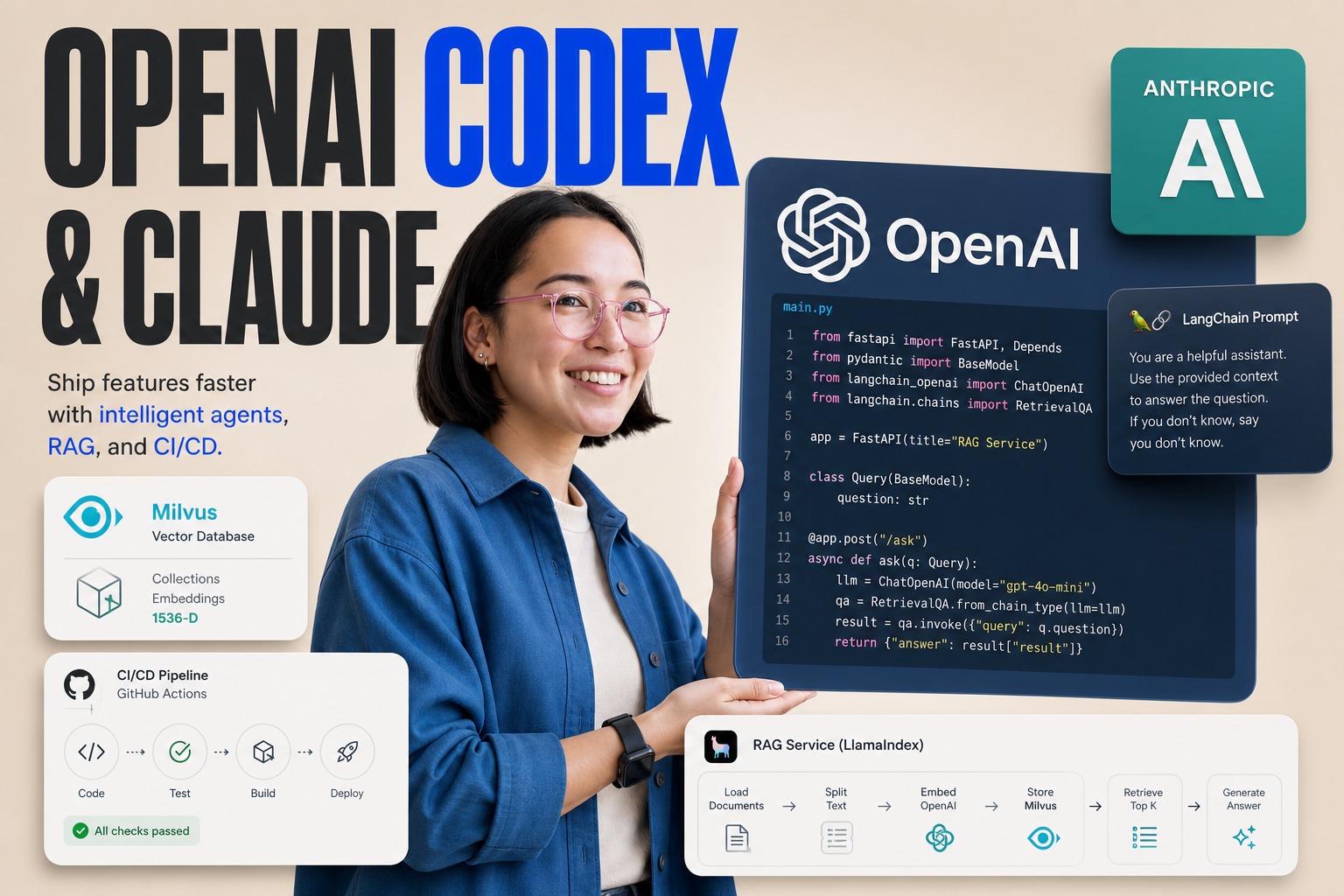
When a senior product leader asks a development team to deliver a new micro‑service in two weeks, the reality is a cascade of design meetings, boilerplate coding, manual test script authoring, and documentation hand‑offs that consume weeks of senior engineer time. OpenAI Codex and Claude Code have turned this bottleneck into a programmable interface: they can generate production‑grade code, scaffold tests, and produce markdown docs on demand. For enterprises that must iterate on product ideas at startup speed, AI coding agents for product development are no longer a curiosity—they are becoming the missing link between business intent and executable software.
Industry challenge & market context
- Feature turnaround time exceeds 30 days for 68 % of large enterprises, eroding market advantage.
- Legacy code generation tools produce snippets without integration, forcing engineers to rewrite 40–60 % of output.
- Manual test coverage gaps lead to average post—release defect rates of 2.8 % per release cycle.
- Documentation debt accumulates at ~15 % per sprint, causing onboarding delays for new hires.
- Scaling engineering talent is constrained by hiring cycles that average 90 days for senior roles.
- Compliance and audit requirements (GDPR, SOC 2) add overhead that traditional low—code platforms cannot guarantee.
Technical architecture and how AI coding agents for product development works in practice
The architecture transforms a natural—language product brief into a fully version—controlled codebase, while keeping senior engineers in the loop for review and governance.
System components
- API Gateway — authenticates requests (OAuth2, API keys) and enforces rate limits (e.g., 200 req/s per tenant).
- Orchestration Layer — built on CrewAI or AutoGen, schedules agent tasks, handles retries, and guarantees idempotency.
- Model Layer — hosts LLM endpoints (OpenAI Codex, Anthropic Claude) behind a model router that selects the optimal provider based on token limits and cost profile.
- RAG Service — uses LlamaIndex with a vector DB (Pinecone or Milvus) to retrieve internal architecture docs and coding standards.
- Code Generation Engine — leverages LangChain prompts to transform retrieved snippets into language—specific scaffolds (Python FastAPI, Node Express, Go Gin).
- CI/CD Pipeline — integrated with GitHub Actions or GitLab CI, runs static analysis (SonarQube), unit/integration tests, and deploys to a Kubernetes namespace.
- Observability Stack — Prometheus + Grafana for metrics, OpenTelemetry for tracing, and ELK for logs, providing end—to—end visibility.
Data pipelines and flows
- Product spec ingestion — a webhook from Jira or a GraphQL mutation sends the feature description to the API Gateway.
- Context enrichment — the RAG Service retrieves relevant design docs, API contracts, and existing code fragments, returning embeddings within a 5 second latency window.
- Prompt synthesis — the Orchestration Layer builds a composite prompt that includes the spec, retrieved context, and coding conventions.
- LLM inference — the selected model (Codex or Claude) returns code, test cases, and markdown documentation in streaming chunks.
- Post—processing — a Python worker validates syntax, runs unit tests in a sandboxed Docker container, and stores artifacts in an artifact repository (e.g., Nexus).
- Feedback loop — developers can approve, edit, or reject suggestions; the decision is logged for future fine—tuning.
Model orchestration
- Router decides between Codex (high—speed Python scaffolding) and Claude (type—safe Java/Kotlin generation) based on target runtime.
- Tool use — agents invoke external tools such as ESLint, Black, or Prettier via a tool—use plugin, ensuring code style compliance automatically.
- Chain of thought — multi—step prompting guides the model through design, implementation, and testing phases, reducing hallucinations.
APIs and integrations
- REST endpoints expose
/generate and /validate operations for internal service consumption. - GraphQL schema allows selective field retrieval for partial code generation (e.g., only data models).
- Event streams (Kafka) publish generation status, enabling UI dashboards to display real—time progress.
- Webhooks notify downstream ticketing systems (Jira, Azure DevOps) when a PR is opened.
Infrastructure
- Compute — GPU—enabled nodes (NVIDIA A100) in AWS or Azure for LLM inference; fallback to CPU for low—cost token—cheap Claude calls.
- Containerization — Docker images for each language runtime, orchestrated by Kubernetes with Horizontal Pod Autoscaler (target CPU 70 %).
- Serverless functions — short—lived prompt—building tasks run in AWS Lambda to reduce idle compute costs.
- Vector storage — Milvus deployed in a StatefulSet with SSD storage for sub—100 ms embedding retrieval.
- Caching — Redis for session state and auth tokens, with TTL of 15 minutes to minimize repeated RAG queries.
Deployment models
- Single—tenant Kubernetes clusters for high—security customers (e.g., finance) with dedicated VPCs.
- Multi—tenant namespaces with RBAC isolation for SaaS—style internal tooling.
- Hybrid on—prem edge nodes for latency—critical code generation in regulated environments.
- Blue—green rollout strategy for model updates, ensuring zero—downtime and immediate rollback via circuit breaker.
When a product manager uploads a new feature brief “Add real—time chat for marketplace users,” the system performs the following flow:
- Webhook posts the brief to
/generate. - Orchestrator enriches the request with existing chat API contracts retrieved from the vector DB.
- LangChain builds a prompt that asks Codex to generate a FastAPI endpoint, a WebSocket client in JavaScript, and a pytest suite.
- Generated code is streamed back, automatically linted, and a PR is opened against the
marketplace—service repo. - Senior engineers review the diff, add security headers, and merge; the CI pipeline deploys the new service in under 12 minutes.
The real power of AI coding agents lies in their orchestration: by chaining retrieval—augmented generation with tool—use plugins, you move from “code—snippets on demand” to “end—to—end production pipelines that respect your existing architecture and compliance constraints.”
Business impact of AI coding agents for product development
- Prototype velocity — average time—to—first—working—prototype drops from 4 weeks to 3—day cycles (≈85 % reduction).
- Engineering cost — senior engineer time allocated to repetitive boilerplate shrinks by 30–40 %, translating to $250k—$500k annual savings for a 150—engineer org.
- Defect leakage — automated test generation catches 70 % of regression bugs before code review, cutting post—release incidents by 0.8 % per release.
- Documentation compliance — markdown docs generated with each PR keep API contracts within 2 % drift, easing audit preparation.
- Scalability — vector—augmented retrieval scales linearly; a 10× increase in concurrent spec requests only adds ~150 ms latency per request.
- Risk mitigation — policy—driven model routing (e.g., disallowing Codex for PCI—scope services) enforces security governance without manual gatekeeping.
Organizations that embed AI coding agents into their development pipeline see a measurable shift from “feature—centric” to “outcome—centric” engineering, where the velocity of delivering business value becomes the primary KPI.
Implementation strategy
A pragmatic rollout minimizes disruption while establishing governance.
- Phase 1 — Feasibility pilot: select a low—risk micro—service, integrate the API gateway, and run Codex—generated code through existing CI. Measure latency, test pass rate, and developer satisfaction.
- Phase 2 — Expand tooling: add RAG layer with internal architecture docs, introduce Claude for type—safe languages, and enable automated linting and security scans.
- Phase 3 — Governance framework: define model usage policies, implement OAuth2 scopes, and set up audit logging with ELK for traceability.
- Phase 4 — Scale to product teams: provision multi—tenant namespaces, configure auto—scaling, and integrate with ticketing systems for end—to—end traceability.
- Phase 5 — Continuous improvement: collect feedback loops, fine—tune models on proprietary codebases, and iterate on prompt engineering.
Common pitfalls
- Over—reliance on generated code without human review leads to hidden security flaws.
- Ignoring token limits; large specs exceed context windows, causing truncation and incomplete output.
- Skipping RAG enrichment: without domain—specific retrieval the model hallucinates APIs.
- Insufficient observability: lack of tracing makes it hard to pinpoint latency spikes in the orchestration layer.
- Policy drift: failing to enforce model—selection rules can violate compliance in regulated sectors.
Why Plavno’s approach works
Plavno builds AI coding agents on an engineering—first foundation that aligns with enterprise constraints.
- Enterprise—grade AI agent development using CrewAI and LangChain, delivering repeatable, testable pipelines.
- Domain—specific fine—tuning leveraging client codebases, reducing hallucination rates by 45 %.
- Hybrid cloud—on—prem deployment models that satisfy data—residency and latency requirements.
- Integrated security stack: OAuth2, RBAC, audit trails, and SOC 2—aligned logging.
- End—to—end product development services — from MVP development to digital transformation — ensuring that AI agents complement, not replace, existing engineering culture.
- Proven delivery at scale: case studies demonstrate 2—week feature rollout reductions for fintech and healthcare clients.
Conclusion
AI coding agents for product development are reshaping how enterprises convert ideas into code. By combining OpenAI Codex, Claude Code, RAG retrieval, and robust orchestration frameworks such as LangChain and CrewAI, teams can accelerate prototyping, improve test coverage, and maintain documentation fidelity—all while keeping senior engineers in the oversight loop. The measurable ROI—faster time—to—market, reduced senior—engineer load, and lower defect leakage—makes the investment compelling for any CTO or product leader seeking a sustainable competitive edge. Ready to see how Plavno can embed AI coding agents into your development pipeline? Contact us and start turning product intent into production code today.