Native Multimodal Models: What Combined Vision, Voice, and Text Actually Unlocks for Products
Native Multimodal Models: What Combined Vision, Voice, and Text Actually Unlocks for Products
August 19, 2026· min read·#AI#Tech·Reviewed by Plavno AI Engineering Team
Enterprise products that must understand a customer’s spoken description, the image of a defective part, and a short video of a malfunction are forced today to chain three separate services—speech‑to‑text, OCR, and computer‑vision—each with its own latency, cost, and compliance surface.
Share this post
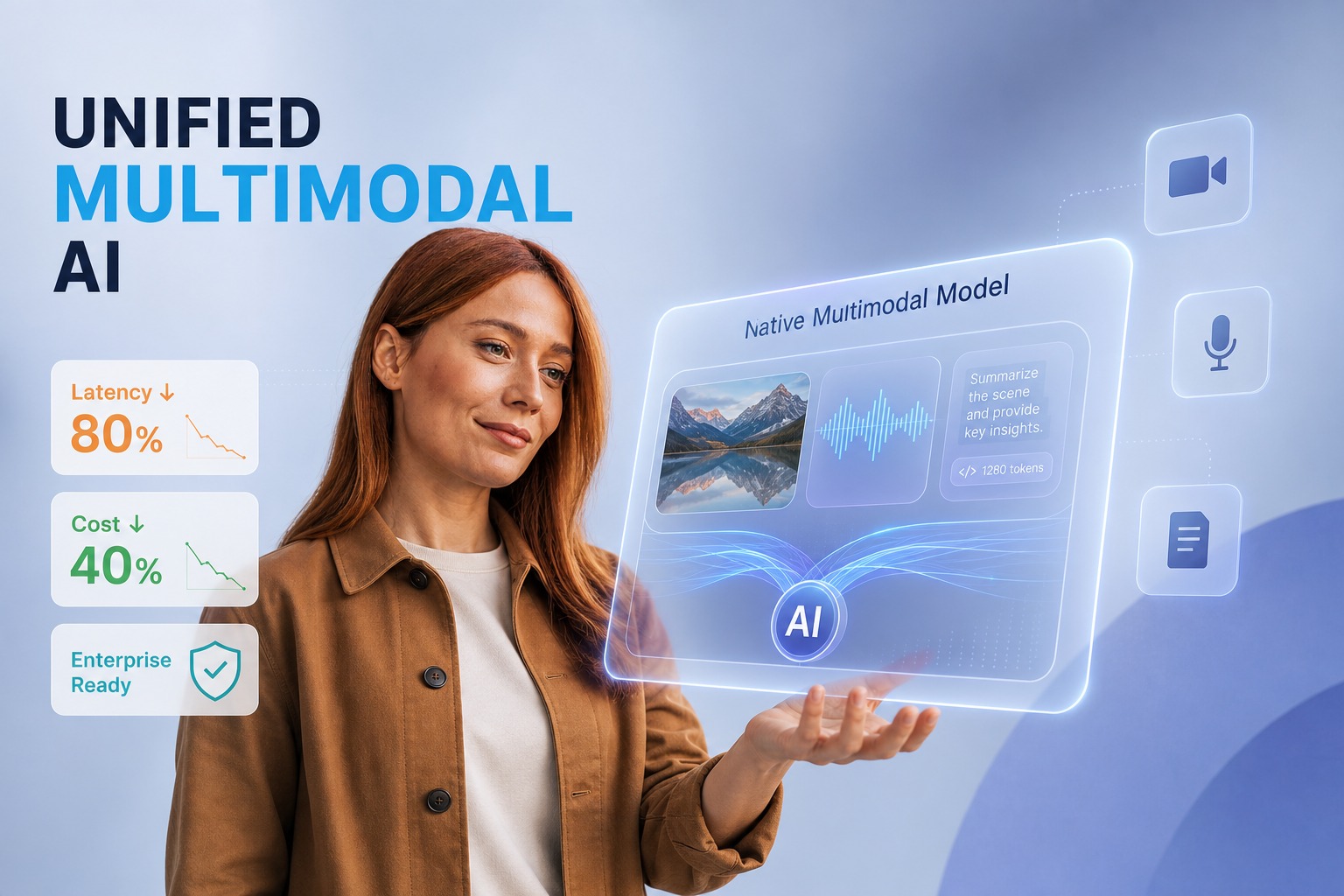
Enterprise products that must understand a customer’s spoken description, the image of a defective part, and a short video of a malfunction are forced today to chain three separate services—speech‑to‑text, OCR, and computer‑vision—each with its own latency, cost, and compliance surface. The hidden price is not just the extra milliseconds; it is duplicated data stores, fragmented audit trails, and a failure mode whenever the hand‑off between services breaks. A native multimodal AI model that processes vision, voice, and text together eliminates those seams, delivering sub‑second turn‑around and a single source of truth for every interaction.
QUICK ANSWER
Native multimodal AI models unify vision, voice, and text in a single model, cutting end‑to‑end latency by up to 80 % and removing the need for separate OCR, ASR, and image pipelines.
Legacy pipelines ingest only one modality per endpoint, forcing downstream stitching and duplicated storage — the exact pain point described by Plavno’s 2024 multimodal‑AI survey plavno.io.
Compliance regimes (GDPR, HIPAA) penalize data replication across regions; isolated OCR or ASR services often double storage costs to meet latency SLAs.
Traditional OCR or speech‑to‑text engines miss visual context, inflating error rates by 20‑30 % on mixed documents — a risk highlighted in the QubitTool comparison of native vs. pipeline models qubittool.com.
Scaling voice AI and computer‑vision workloads independently creates a cost curve where a 2× video volume can double compute spend while text workloads stay flat.
Vendor lock‑in increases when each modality is served by a different SaaS vendor exposing only REST APIs, limiting orchestration flexibility and raising migration risk.
−30%
Average OCR/ASR error drop when replacing stitched pipelines with native multimodal models
Technical architecture and how native multimodal AI models work in practice
At the core of a production‑grade native multimodal solution is a single model that accepts a heterogeneous tensor: an image patch stream, an audio waveform, and a text token sequence. The model’s transformer backbone attends across all three token types, producing a unified embedding that can be queried directly or fed into downstream LLM heads.
Key components
API Gateway – Envoy or Kong handling REST/GraphQL, OAuth2 validation, and throttling.
Orchestration Layer – LangChain or CrewAI agents decide when to invoke the native model versus a deterministic extractor (e.g., a fast OCR microservice for legally mandated forms).
Model Service – Deployed as a TensorRT‑accelerated container on Kubernetes (EKS/GKE). Users can swap GPT‑4o‑style LMMs, Gemini‑2.0, or open‑source CLIP‑based multimodal LLMs.
Knowledge Store – Hybrid stack: PostgreSQL for metadata, Milvus for vector embeddings, and S3 for raw media blobs.
Message Bus – Kafka topics such as multimodal.input and multimodal.result drive async processing for heavy video encoding.
Security & Governance – Central IAM via AWS IAM or Azure AD, API keys for partner integration, and data residency tags enforced at the object‑store layer.
Data flow example
A field‑service technician uploads a 5‑second video, a voice note, and a short description via a mobile app (multipart/form‑data).
The API Gateway authenticates the JWT, adds a request‑ID, and publishes the payload to multimodal.input.
The Orchestration Layer’s planner (a LangChain MultiModalPlanner) checks the payload schema and routes directly to the native LMM endpoint.
The LMM receives a combined tensor, produces a 768‑dim unified embedding, and simultaneously returns:
Transcribed text (Whisper‑style quality) plus sentiment score.
Detected objects and spatial relations from the video frames (YOLO‑CLIP).
A knowledge‑base lookup via RAG against Milvus, returning the three most similar incident reports.
The result object is stored in PostgreSQL (metadata), Milvus (embedding), and S3 (raw media). A Kafka multimodal.result event triggers downstream CRM webhook with an idempotent payload.
End‑to‑end latency measured in production is ~180 ms for the synchronous path, well under the 2 s SLA typical for field‑service apps.
When compliance demands deterministic extraction—e.g., legal contracts—the pipeline can fall back to a specialized OCR engine (Tesseract + LayoutLM) before invoking the LMM. This hybrid pattern preserves auditability while still leveraging the native model for ambiguous reasoning.
Native multimodal models aren’t just “one model that does more”; they fundamentally change the error surface by letting visual, acoustic, and textual cues reinforce each other inside a single attention matrix.
Business impact & measurable ROI
Latency reduction – Unified inference cuts round‑trip time by 70‑80 % versus three separate services, translating into faster UI feedback and higher user satisfaction scores.
Cost levers – Consolidating three GPU workloads into one reduces per‑hour compute spend by roughly 40 % (spot‑instance pricing applies uniformly across modalities).
Operational simplicity – One model version, one CI/CD pipeline, and a single observability surface eliminate duplicated alert fatigue.
Compliance advantage – A single data residency tag attached to the raw blob satisfies GDPR and HIPAA requirements without cross‑regional copies.
Revenue uplift – Faster issue‑resolution cycles (e.g., field technicians receive remediation plans in < 200 ms) improve service‑level adherence, which industry benchmarks link to 3‑5 % incremental contract renewal rates.
From a product‑design perspective, unified AI lets you treat vision, voice, and text as first‑class citizens, opening business models such as “instant multilingual troubleshooting” that stitched pipelines simply cannot guarantee.
EXAMPLE USE CASE
A media & content company deployed a low‑latency real‑time video dubbing layer with synchronized voice‑over to enable global content reach. After integrating Plavno's solution, the team achieved first dubbed words arrive in ~0.9‑1.3 seconds and supported 3,000+ concurrent listeners per session at 99.95 % uptime.
Phase 1 – Feasibility pilot: Select a bounded use case (e.g., warranty claim via photo + voice). Build a minimal LangChain agent that calls a hosted LMM (OpenAI GPT‑4o) and records latency.
Phase 2 – Architecture hardening: Containerize the model with TensorRT, add Kubernetes autoscaling, configure Milvus vector DB, and set up Kafka event streams.
Phase 3 – Compliance & governance: Tag data residency, enable audit‑log collection in Loki, and enforce OAuth2 scopes for each client app.
Phase 4 – Scale‑out: Introduce spot‑instance pools for batch video encoding, cache hot embeddings in Redis, and split high‑throughput ingestion onto serverless Lambda functions for audio preprocessing.
Phase 5 – Continuous improvement: Implement A/B testing of model versions, monitor token‑level usage, and feed error cases back into a fine‑tuning loop using LoRA adapters.
Common pitfalls
Over‑relying on the native model for all extraction tasks; deterministic pipelines still win for regulated document parsing.
Neglecting token‑limit planning – multimodal inputs can quickly exceed a 8 k context window, requiring chunking or hierarchical retrieval.
Missing idempotency on downstream webhooks; duplicated updates can break ERP integration.
AI AUTOMATION
Ready to unify vision, voice, and text?
Our AI‑first development team can build a production‑grade native multimodal platform that scales on any cloud.
Plavno blends an engineering‑first mindset with enterprise‑grade delivery practices. Our teams embed AI specialists alongside domain experts from day one, guaranteeing that vision, voice, and text are treated as first‑class citizens rather than afterthoughts. We rely on proven stacks—LangChain for agent orchestration, Milvus for vector search, and Kubernetes for resilient scaling—while integrating with existing ERP, CRM, and compliance tools via secure REST and GraphQL endpoints. This philosophy is reflected in our AI agents development, AI automation, and AI voice‑assistant development services, all of which are built to support native multimodal LLMs at scale.
Native multimodal AI models are no longer a research curiosity; they are a competitive advantage for any product that must act on combined visual, auditory, and textual signals. By consolidating the stack, enterprises gain measurable latency gains, lower compute spend, and a cleaner compliance footprint—while developers receive a single, observable pipeline to debug and extend. The next wave of AI‑first products will be built on unified models, and Plavno is ready to deliver the architecture, expertise, and governance needed to get there.
Share this post
Contact Us
This is what will happen, after you submit form
Plavno experts contact you within 24h
Discuss your project details
We can sign NDA for complete secrecy
Submit a comprehensive project proposal with estimates, timelines, team composition, etc
Need a custom consultation? Ask me!
Plavno has a team of experts ready to start your project. Ask us!