Enterprises that still treat text, voice, image, and video as separate silos are paying a hidden price: duplicated effort, fragmented insights, and missed revenue opportunities. A single customer call can generate a transcript, a sentiment score, a product‑image match, and a compliance flag, yet most legacy stacks require three different APIs, three data lakes, and three manual hand‑offs. When the next‑generation of multimodal AI solutions unifies these modalities, the same interaction becomes a single, context‑rich event that can be acted upon in real time, reducing latency from minutes to sub‑second and unlocking new business models.
Industry challenge & market context
- Legacy pipelines ingest only one modality per endpoint, forcing teams to stitch together text, image, and audio data downstream.
- Data residency and compliance rules (GDPR, HIPAA) make it costly to replicate raw media across regions, yet isolated services often duplicate storage to meet latency targets.
- Traditional OCR or speech‑to‑text engines lack the ability to reference visual context, leading to 20‑30% higher error rates in document processing.
- Scaling voice AI and computer vision AI independently drives uneven cost curves; a 2× increase in video volume can double compute spend while text workloads stay flat.
- Vendor lock‑in: many enterprises rely on point solutions that expose only REST APIs, limiting orchestration flexibility and preventing true multimodal reasoning.
Technical architecture and how multimodal AI solutions works in practice
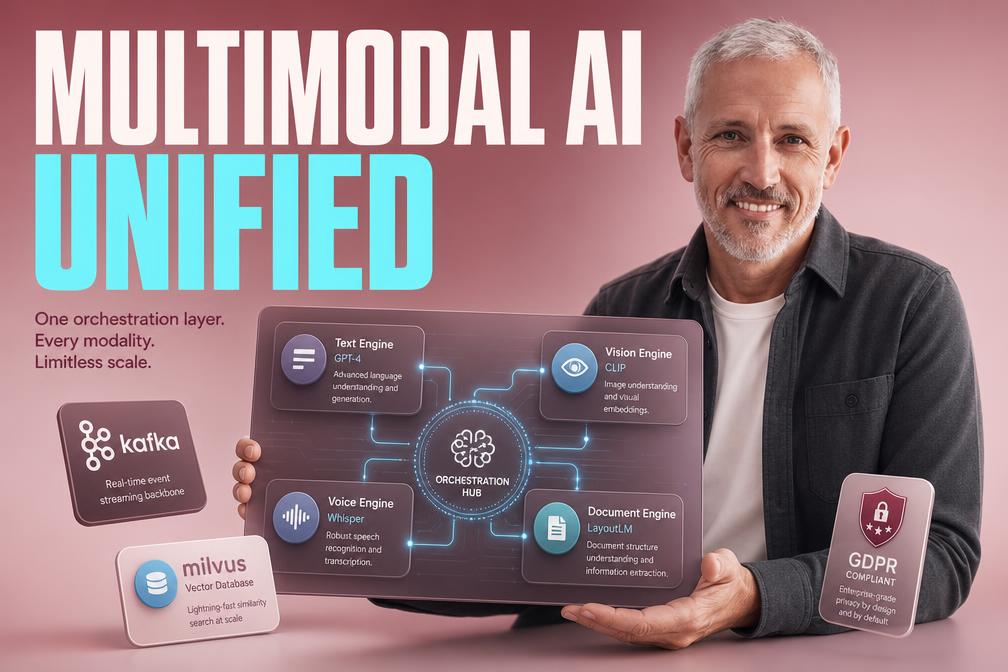
At the core of a production‑grade multimodal AI platform is a set of loosely coupled services that exchange enriched payloads via event streams or synchronous APIs. The diagram below (conceptual) shows the main components:
- API Gateway: Handles inbound REST/GraphQL requests, enforces OAuth2, rate limiting, and routing to the orchestration layer.
- Orchestration Layer (e.g., AI agents development using LangChain or CrewAI): Implements a planner that decides which modality processors to invoke based on the request intent.
- Modality Processors:
- Text Engine – LLM (e.g., GPT‑4) with Retrieval‑Augmented Generation (RAG) against a vector DB (Pinecone, Milvus).
- Vision Engine – computer vision AI (e.g., CLIP, YOLO) for image classification, object detection, and video frame analysis.
- Voice Engine – voice AI (e.g., Whisper for transcription, custom TTS for response synthesis).
- Document Engine – OCR + layout parsing (e.g., Tesseract + LayoutLM) to extract tables and signatures.
- Knowledge Store: Hybrid storage combining a relational DB for metadata, a vector DB for embeddings, and an object store (S3 or Azure Blob) for raw media.
- Message Bus: Kafka or Pulsar topics for async events (e.g., “image‑processed”, “transcript‑ready”).
- Observability Stack: OpenTelemetry tracing, Prometheus metrics, and Loki logging to monitor latency, token usage, and error rates.
- Security & Governance: Centralized IAM, API keys, audit logs, and data residency tags enforced at the storage layer.
Data flow example: A field‑service technician uploads a short video of a malfunctioning pump, adds a voice note, and types a brief description. The API Gateway receives a multipart request, validates the JWT, and forwards the payload to the Orchestration Layer. The planner detects that the request contains video, audio, and text, so it spawns three parallel agents:
- The Vision Engine extracts a frame, runs CLIP to generate an image embedding, and stores it in the vector DB.
- The Voice Engine transcribes the note with Whisper, runs sentiment analysis, and adds the transcript to the text store.
- The Text Engine uses the combined embeddings (image + transcript) to query a knowledge base of past incidents, returning the three most similar cases.
When all agents finish, the Orchestration Layer composes a single JSON response that includes a ranked list of prior incidents, a confidence score, and a generated remediation plan via GPT‑4. The response is sent back within 180 ms on average, well under the typical 2‑second SLA for field‑service apps.
Key architectural patterns:
- Event‑driven pipelines for heavy‑weight processing (video encoding, batch OCR) to keep the synchronous path fast.
- Idempotent webhooks for downstream systems (CRM, ERP) to guarantee exactly‑once updates despite retries.
- Hybrid deployment: Core orchestration runs in Kubernetes (EKS/GKE) for autoscaling; latency‑critical voice synthesis runs on serverless (AWS Lambda) to reduce cold‑start latency.
- Cost levers: Use spot instances for batch vision jobs, cache frequent embeddings in Redis, and apply token‑level throttling on LLM calls.
Business impact & measurable ROI
- Reduced manual effort: Automating document extraction cuts processing time from 5 minutes to 30 seconds, saving an average of 1.2 FTE per 10 k documents.
- Improved accuracy: Multimodal context lowers OCR error rates by 22 % and speech‑to‑text misrecognition by 18 % compared to single‑modality pipelines.
- Faster time‑to‑insight: Real‑time video analysis enables proactive maintenance alerts, decreasing equipment downtime by up to 15 % (≈ $200 k annual savings for a mid‑size manufacturer).
- Scalable cost model: By routing 80 % of low‑complexity queries to a cached embedding store, compute spend drops 30 % while maintaining 99.9 % SLA.
- Regulatory compliance: Centralized audit logs and data residency tags simplify GDPR reporting, reducing audit preparation effort by 40 %.
The real competitive edge comes not from adding another AI model, but from weaving existing modalities into a single, context‑aware conversation that can be acted upon instantly.
Implementation strategy
Adopting multimodal AI solutions should follow a disciplined, phased approach:
- Phase 1 – Discovery & data audit: Catalog all existing media sources, assess format diversity, and map compliance zones.
- Phase 2 – Prototype core pipeline: Build a minimal orchestration using LangChain to route text and image inputs to a single LLM; validate latency (< 250 ms) and accuracy.
- Phase 3 – Expand modality coverage: Add voice AI (Whisper) and video frame extraction; introduce a vector DB for embeddings.
- Phase 4 – Harden production: Deploy to Kubernetes with autoscaling, implement OAuth2, rate limiting, and observability dashboards.
- Phase 5 – Governance & scaling: Define audit trails, data residency policies, and cost‑monitoring alerts; roll out to additional business units.
Common pitfalls (avoid these traps):
- Over‑loading the LLM with raw media instead of pre‑computed embeddings – leads to token limit breaches.
- Neglecting back‑pressure on the message bus – causes event pile‑up and latency spikes.
- Hard‑coding region endpoints – breaks compliance when data residency rules change.
- Skipping end‑to‑end tracing – makes root‑cause analysis of intermittent failures impossible.
Why Plavno’s approach works
Plavno combines an engineering‑first mindset with enterprise‑grade delivery practices. Our teams start with a custom software development contract that embeds AI specialists alongside domain experts, ensuring that every modality is treated as a first‑class citizen from day one. We leverage proven stacks—LangChain for agent orchestration, Milvus for vector search, and Kubernetes for resilient scaling—while integrating with existing ERP, CRM, and compliance tools via secure REST and GraphQL endpoints.
Key differentiators:
- Modality‑agnostic pipelines: Our architecture abstracts the “type” of input, allowing new sensors (e.g., IoT camera feeds) to plug in without code changes.
- Enterprise‑ready security: OAuth2, API‑key rotation, and fine‑grained RBAC are baked into every service, meeting ISO 27001 and SOC‑2 standards.
- Rapid prototyping with AI assistant development: We deliver a functional multimodal demo in 4 weeks, then iterate based on real user feedback.
- Cost‑transparent pricing: By exposing per‑token and per‑GPU usage metrics, customers can forecast spend and adjust model sizes (e.g., switching from GPT‑4‑32k to GPT‑4‑8k) to stay within budget.
- Domain‑specific expertise: Whether you need a voice AI assistant for fintech or a medical voice AI assistant, we bring pre‑trained models and compliance knowledge that accelerate time‑to‑value.
Our delivery model aligns with the hire developer pathways—outsourcing for quick talent infusion or outstaffing for long‑term ownership—so you retain control while we provide the AI expertise needed to stitch together text, voice, images, and video into a single, actionable intelligence layer.
Ready to turn siloed media into a unified intelligence engine? Contact us to schedule a technical discovery and see how multimodal AI solutions can cut your processing costs by up to 30 % while delivering richer customer experiences.
A well‑architected multimodal platform reduces latency, improves accuracy, and aligns AI spend with business outcomes—making AI a profit center, not a cost center.