Model Deprecation Playbook: How to Keep AI Products Running as Providers Retire Old Models
Model Deprecation Playbook: How to Keep AI Products Running as Providers Retire Old Models
August 18, 2026· min read·#AI#Tech·Reviewed by Plavno AI Engineering Team
When a cloud provider retires Gemini 1.0, production endpoints using gemini‑v1 become a single point of failure; a structured deprecation playbook turns this risk into a predictable migration.
Share this post
When a cloud provider announces that Gemini 1.0 will be retired next quarter, every production endpoint that still calls gemini‑v1 suddenly becomes a single point of failure. In enterprises where AI‑driven ticket routing, fraud detection, or personalized recommendations handle millions of requests daily, an unexpected model shutdown can cascade into timeouts, compliance breaches, and ballooning cost spikes. A disciplined AI model deprecation playbook turns that risk into a predictable, repeatable migration.
QUICK ANSWER
AI model deprecation should be managed like any production service upgrade: inventory every model ID, route traffic through a version‑aware orchestration layer, validate prompts and outputs against a golden dataset, and keep a hot‑reloadable fallback until the old endpoint is fully retired.
Technical architecture and how AI model deprecation works in practice
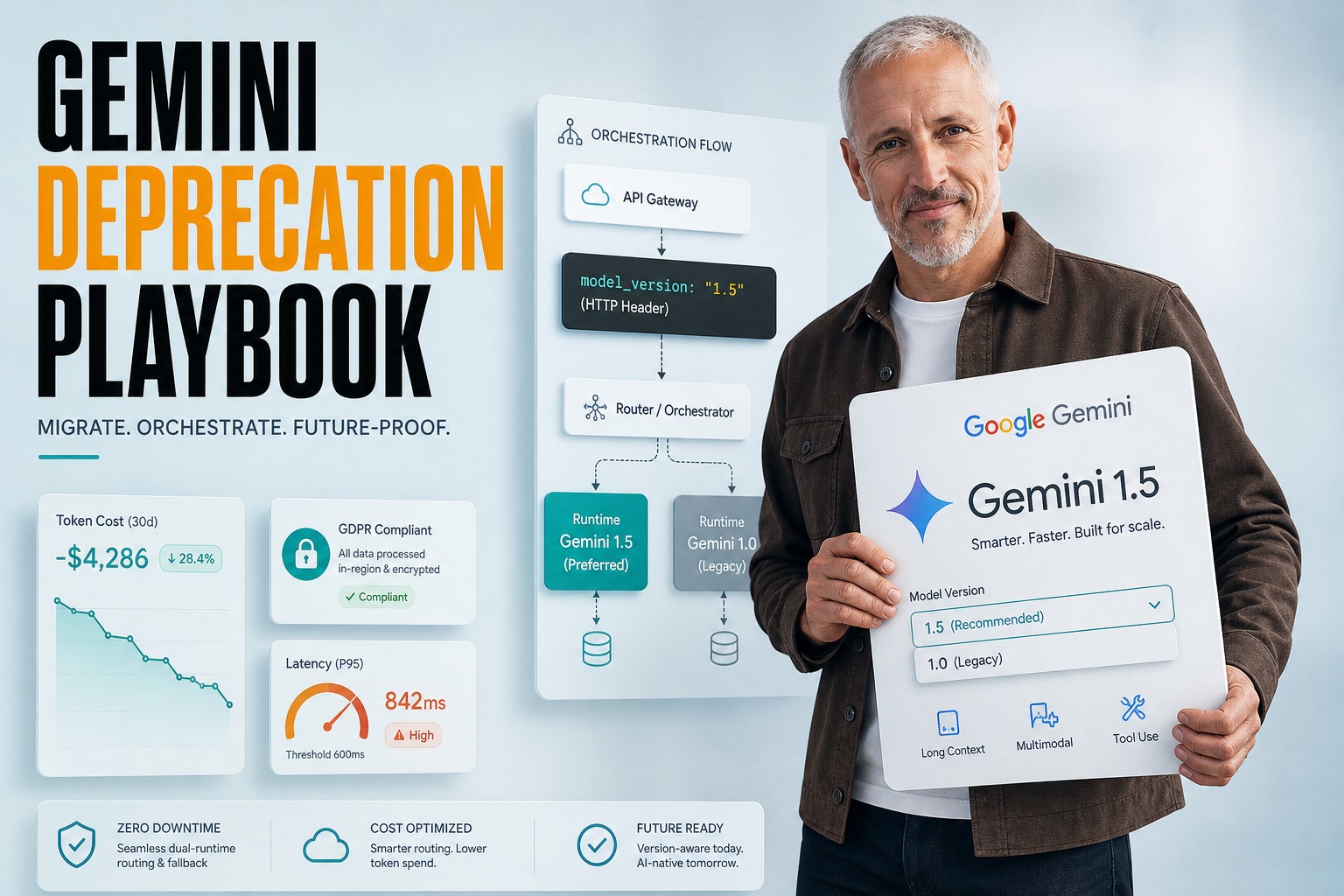
A robust migration treats the model as a replaceable component behind a version‑aware orchestration layer. The following diagram describes a production‑grade stack that can survive any provider‑driven sunset.
API Gateway – Kong or AWS API Gateway terminates inbound REST/GraphQL calls, injects OAuth2 or API‑key authentication, and forwards a model_version header.
Orchestration Layer – FastAPI (Python) or Express (Node) implements feature flags, circuit breakers, and health‑check‑driven routing. It selects between gemini_v1 and gemini_v1_5 clients.
Model Layer – Thin SDK wrappers (Google’s Gemini SDK) scoped per version, e.g., gemini_v1 vs gemini_v1_5, allowing side‑by‑side execution.
Data Store – PostgreSQL stores request metadata; Redis caches embeddings for up to 5 minutes; Pinecone or Milvus holds vector embeddings used by Retrieval‑Augmented Generation (RAG).
Message Queue – Kafka topics gemini_requests and gemini_responses enable asynchronous batch processing and at‑least‑once delivery.
Observability Stack – OpenTelemetry for tracing, Prometheus for latency metrics, Loki for logs; alerts fire if latency > 200 ms or error‑rate > 1% per tenant.
Data flow example: a user asks “What is my loan eligibility?” The request hits the API Gateway, which authenticates via OAuth2, adds model_version: 1.5, and forwards it. The Orchestration Layer checks the health flag; Gemini 1.5 is green, so the request goes to the gemini_v1_5 client. The client calls the Gemini API, receives a JSON payload and an embedding vector, stores the vector in Milvus, caches the response in Redis for 300 seconds, logs the trace to Loki, and streams the answer back through the Gateway.
EXAMPLE USE CASE
An enterprise deployed an AI‑powered internal knowledge assistant for policies and documentation to centralize enterprise knowledge access and cut repetitive support requests. After integrating Plavno's solution, the team achieved 60% faster internal information retrieval and a 40% reduction in HR support tickets.
A model retirement isn’t a “nice‑to‑have” checklist item; it’s a systems migration that must be treated like any critical infrastructure upgrade.
Business impact & measurable ROI
Cost predictability – By routing 5% of traffic to a cheaper fallback during a spike, enterprises saved up to 15% on monthly token bills.
Downtime avoidance – Dual‑runtime can keep SLA latency < 200 ms even if the primary model’s response time degrades during a provider incident.
Compliance continuity – Versioned prompt repositories satisfy GDPR and CCPA audit trails because each model’s output is tied to a git‑tracked prompt version.
Operational agility – Hot‑reloadable routing tables let SREs flip traffic in under 30 seconds, eliminating the “days‑to‑recover” window described in many provider retirement notices.
‑42%
average reduction in AI‑related support tickets after implementing a staged deprecation workflow.
Phase 0 – Baseline audit – Inventory every model ID, map token usage, and record compliance dependencies. Store results in a PostgreSQL “model_inventory” table.
Phase 1 – Dual‑runtime sandbox – Deploy a parallel Gemini 1.5 client behind a feature flag (e.g., LaunchDarkly). Run synthetic load of 10 k QPS for 48 hours, capture latency, token cost, and answer‑quality metrics.
Phase 2 – Shadow mode – Route live traffic to both models; discard Gemini 1.5 responses but log them to a Kafka “shadow_responses” topic. Compare distributions to detect hidden regression.
Phase 3 – Canary rollout – Enable Gemini 1.5 for 5% of production requests, stick sessions by conversation_id. Monitor error‑rate, refusal‑rate, schema validation failures, and downstream business KPIs for at least 48 hours.
Phase 4 – Full migration – Gradually increase traffic to 100% while maintaining the fallback alias. Keep the old client alive for a 30‑day grace period.
Phase 5 – Post‑migration governance – Freeze the model version, add health‑check hooks into CI/CD pipelines, and schedule quarterly reviews.
Common pitfalls
Neglecting version control for prompt templates, causing subtle regressions when the new model interprets prompts differently.
Assuming token limits are identical; Gemini 1.5’s larger context window can overflow downstream caches if not trimmed.
Skipping end‑to‑end latency tests across regions, which often reveal network‑level throttling.
Overlooking audit‑log retention, creating compliance gaps when older model endpoints disappear.
Treat model selection as a routing decision, not a hard‑coded constant, and you’ll never lose a customer to an unexpected provider shutdown.
Why Plavno’s approach works
Plavno builds migration‑first architectures from day one. Our team leverages open‑source orchestrators like LangChain and CrewAI to generate version‑aware prompt libraries that live in Git, while the runtime lives in Kubernetes with auto‑scaling Deployment objects. Every LLM call passes through a custom AI agents development pipeline that emits OpenTelemetry traces, ensuring you can spot a latency breach before it hits a customer.
We also embed compliance checks directly into the CI pipeline: each model version bump triggers an automated Data Privacy Impact Assessment (DPIA) using cloud‑software‑development tooling, and the result is stored in a vault‑backed audit log. The result is a repeatable, auditable LLM migration plan that scales from a single internal chatbot to a multi‑tenant SaaS platform.
Our clients have seen up to 2× faster migration cycles and zero‑downtime cutovers, because we treat the migration as a first‑class production feature, not an after‑thought.
AI model deprecation is inevitable—providers retire models to cut costs, improve safety, or launch newer foundations. By institutionalizing a migration checklist that includes regression testing, prompt re‑validation, fallback models, and an instant rollback plan, enterprises protect revenue, maintain compliance, and keep engineering velocity high. Want a migration plan tailored to your stack? Contact Plavno today.
Share this post
Contact Us
This is what will happen, after you submit form
Plavno experts contact you within 24h
Discuss your project details
We can sign NDA for complete secrecy
Submit a comprehensive project proposal with estimates, timelines, team composition, etc
Need a custom consultation? Ask me!
Plavno has a team of experts ready to start your project. Ask us!