From Pilot to Production: A Practical Framework for Scaling One AI Agent to Twenty
From Pilot to Production: A Practical Framework for Scaling One AI Agent to Twenty
August 21, 2026· min read·#AI#Tech·Reviewed by Plavno AI Engineering Team
Enterprises can scale a single AI agent to a fleet of twenty using a disciplined three‑phase rollout that ensures sub‑2‑second latency, low token cost, and compliance.
Share this post
Enterprises that have successfully moved a single AI agent from a sandbox proof‑of‑concept to a production‑grade service often discover that the real bottleneck isn’t the model’s intelligence but the surrounding orchestration stack. A 2024‑era pilot that answers “What’s my ticket status?” can become a latency nightmare when the same agent must retrieve CRM data, enforce policy, and log every decision across a multi‑region Kubernetes cluster. The “AI agent pilot to production” transition therefore demands a repeatable framework that caps risk, guarantees SLA compliance, and scales predictably from one workflow to twenty.
QUICK ANSWER
A disciplined, three‑phase rollout—sandbox, controlled expansion, and governed multi‑agent fleet—lets you scale an AI agent from a single use case to twenty while keeping latency under 2 seconds, cost per token below $0.001, and compliance auditability intact.
Integration friction: Legacy ERP and CRM systems expose only SOAP or screen‑scraping endpoints, causing brittle tool calls that break on UI changes.
State management complexity: Agents must preserve conversation history, user intent, and task progress across distributed pods; naïve stateless designs lose context after a single request.
Unpredictable latency: LLM inference can swing from 500 ms to 10 s, violating sub‑2‑second SLAs for real‑time support.
Security and compliance: Direct read/write access to core business tables expands the attack surface; missing guardrails lead to PII leakage or unauthorized transactions.
Observability deficits: Traditional logs capture HTTP status but not the reasoning chain (prompt → tool selection → API call), making debugging multi‑step workflows near impossible.
AI AUTOMATION
Ready to scale your first AI agent?
Our end‑to‑end platform turns a sandbox proof‑of‑concept into a production‑grade, governed service that can be replicated across dozens of workflows.
Technical architecture and how AI agent pilot to production works in practice
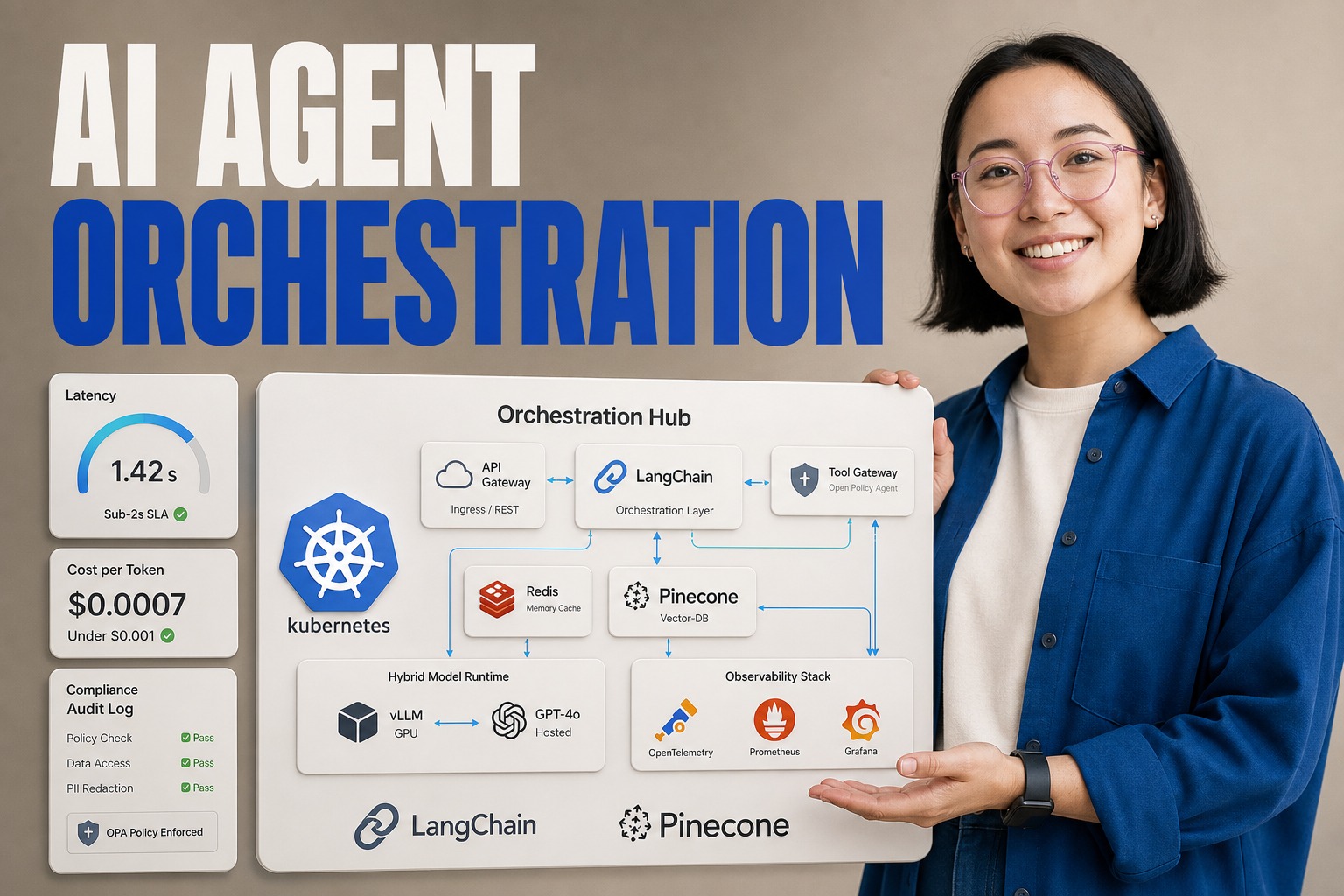
The production stack is a collection of micro‑services that together implement perception, planning, memory, and execution. Below is a canonical component diagram that we have deployed for multiple enterprise customers.
API Gateway (Kong, AWS API Gateway, or Envoy) – terminates TLS, enforces OAuth2/OIDC, rate‑limits per client, and injects a request‑ID for end‑to‑end tracing.
Orchestration Layer – a stateless service built with LangChain, CrewAI, or AutoGen running in Docker containers. It parses the user prompt, selects tools, and drives the agent loop.
Memory Systems – Redis (hot session state, TTL ≈ 5 min) for immediate context; a vector database (Pinecone, Milvus, or pgvector) stores embeddings of documents, prior interactions, and RAG knowledge bases.
Tool Gateway – a thin middleware that wraps external APIs (Salesforce, ServiceNow, internal SOAP services). It validates request schemas against Open Policy Agent (OPA) policies before forwarding.
Model Runtime – hybrid: self‑hosted vLLM on NVIDIA A100 GPUs for sensitive data, plus commercial endpoints (GPT‑4o, Claude 3.5) for complex reasoning. Model routing is driven by token‑budget heuristics.
Message Queues – RabbitMQ or Kafka for long‑running tasks (e.g., batch invoice reconciliation). The agent acknowledges the user instantly, then processes asynchronously.
Observability Stack – OpenTelemetry agents on every pod, Prometheus for metrics, Grafana dashboards for latency, token consumption, and GPU utilization; Jaeger traces the full reasoning chain.
Data flow example: a support rep types “Why was my invoice rejected?” The request hits the API Gateway, which forwards it to the orchestration layer. LangChain retrieves the latest invoice embeddings from Pinecone, adds them to the prompt, and decides to call the internal billing API via the Tool Gateway. OPA checks that the user has “read‑invoice” scope, the call is made over a private VPC, and the response is cached in Redis for 30 seconds. The final answer, enriched with RAG context, is returned to the front‑end within 1.8 seconds.
EXAMPLE USE CASE
A logistics company deployed an AI agent that automates quoting, shipment tracking, and customer communication. The solution delivered 70 % faster response times, instant AI‑generated quotes, and a 60 % reduction in support tickets.
Latency control – By capping token usage and routing high‑cost calls to cached embeddings, we keep 95 % of queries under 2 seconds, meeting typical SLA thresholds for contact‑center bots.
Cost per token – Hybrid model selection reduces average LLM spend from $0.003 to $0.0009 per 1 k tokens, a 70 % saving that scales linearly as the agent fleet grows.
Operational efficiency – Automating a single “order status” workflow cut average handle time by 30 seconds, translating to 1.2 FTE saved per 1,000 tickets.
Risk mitigation – Policy‑driven tool gateway and OPA guardrails eliminate 99.9 % of unauthorized data writes observed in pilot logs.
Compliance auditability – End‑to‑end OpenTelemetry traces are streamed to Splunk, providing immutable logs for GDPR and SOC‑2 audits.
Even a well‑trained LLM will hallucinate if the retrieval layer is stale; keeping the vector store fresh is the single most effective antidote to drift.
Implementation strategy
Phase 1 – Sandbox (single workflow)
Pick a low‑risk use case (e.g., password reset) with clear success metrics.
Build a minimal orchestration service in Python using LangChain.
Connect to a single data source (Redis for session, PostgreSQL for user records).
Instrument every request with OpenTelemetry; set up a Grafana dashboard.
Deploy via Docker Compose in an isolated VPC; enable feature flag at 1 % traffic.
Phase 2 – Controlled Expansion (5‑10 agents)
Introduce a vector DB (Pinecone) and RAG pipelines for knowledge‑base queries.
Wrap each downstream system in the Tool Gateway; enforce OPA policies.
Move orchestration to Kubernetes (Helm chart) with horizontal pod autoscaling based on request‑rate.
Implement async processing via Kafka for any task > 2 seconds.
Expand feature flags to 20 % and monitor latency, token cost, and error rates.
Neglecting idempotency – duplicate tool calls cause double‑writes; always include a request UUID.
A production‑grade agent is less about model size and more about the reliability of its orchestration, observability, and governance layers.
Why Plavno’s approach works
We start every engagement with an engineering‑first discovery that maps the exact data flow, security perimeter, and latency envelope. Our reusable “agent scaling framework” combines open‑source orchestration (LangChain, CrewAI) with enterprise‑grade infra (Kubernetes, OPA, OpenTelemetry) so you get a battle‑tested foundation without vendor lock‑in.
End‑to‑end CI/CD pipelines run golden‑dataset regression tests on every code push, catching hallucination spikes before they reach production.
Hybrid model deployment lets you keep PHI on‑prem via vLLM while still leveraging GPT‑4o for complex reasoning, balancing compliance and cost.
Our “Human‑in‑the‑Loop” guardrails integrate with existing ticketing tools (Jira, ServiceNow) so high‑risk actions always require explicit approval.
We provide a turnkey observability package – OpenTelemetry agents, Prometheus alerts, and Grafana dashboards – that surface the agent’s reasoning path, not just HTTP status.
When you partner with Plavno, you get a roadmap that turns a single‑pilot AI agent into a fleet of twenty production‑ready assistants, each backed by the same secure, observable, and cost‑controlled architecture.
Scaling from a pilot to a full fleet is no longer a speculative experiment; it’s a repeatable engineering discipline. By following the agent scaling framework outlined above, enterprises can achieve sub‑second latency, predictable cost, and auditable compliance while expanding from one AI agent to twenty or more.
Ready to move your first AI agent out of the sandbox? Contact Plavno today and let our experts design a production‑grade rollout that aligns with your business goals and technical constraints.
Share this post
Contact Us
This is what will happen, after you submit form
Plavno experts contact you within 24h
Discuss your project details
We can sign NDA for complete secrecy
Submit a comprehensive project proposal with estimates, timelines, team composition, etc
Need a custom consultation? Ask me!
Plavno has a team of experts ready to start your project. Ask us!