Coding-Focused Models in 2026: What Grok 4.5, Claude and GPT Bring to Engineering Teams
Coding-Focused Models in 2026: What Grok 4.5, Claude and GPT Bring to Engineering Teams
August 19, 2026· min read·#AI#Tech·Reviewed by Plavno AI Engineering Team
Enterprise teams face a trade‑off between speed and debt; new coding‑focused LLMs like Grok 4.5, Claude Opus 4.8, and GPT‑5.5 offer cost‑effective, accurate, and agentic solutions.
Share this post
Enterprise engineering teams are now facing a hard trade‑off: accelerate pull‑request velocity without inflating technical debt, or preserve safety while paying premium inference costs. The arrival of coding‑focused LLMs in 2026—Grok 4.5, Claude’s latest Code series, and GPT‑5.5—turns this dilemma into a strategic choice of tools, token economics, and orchestration patterns.
QUICK ANSWER
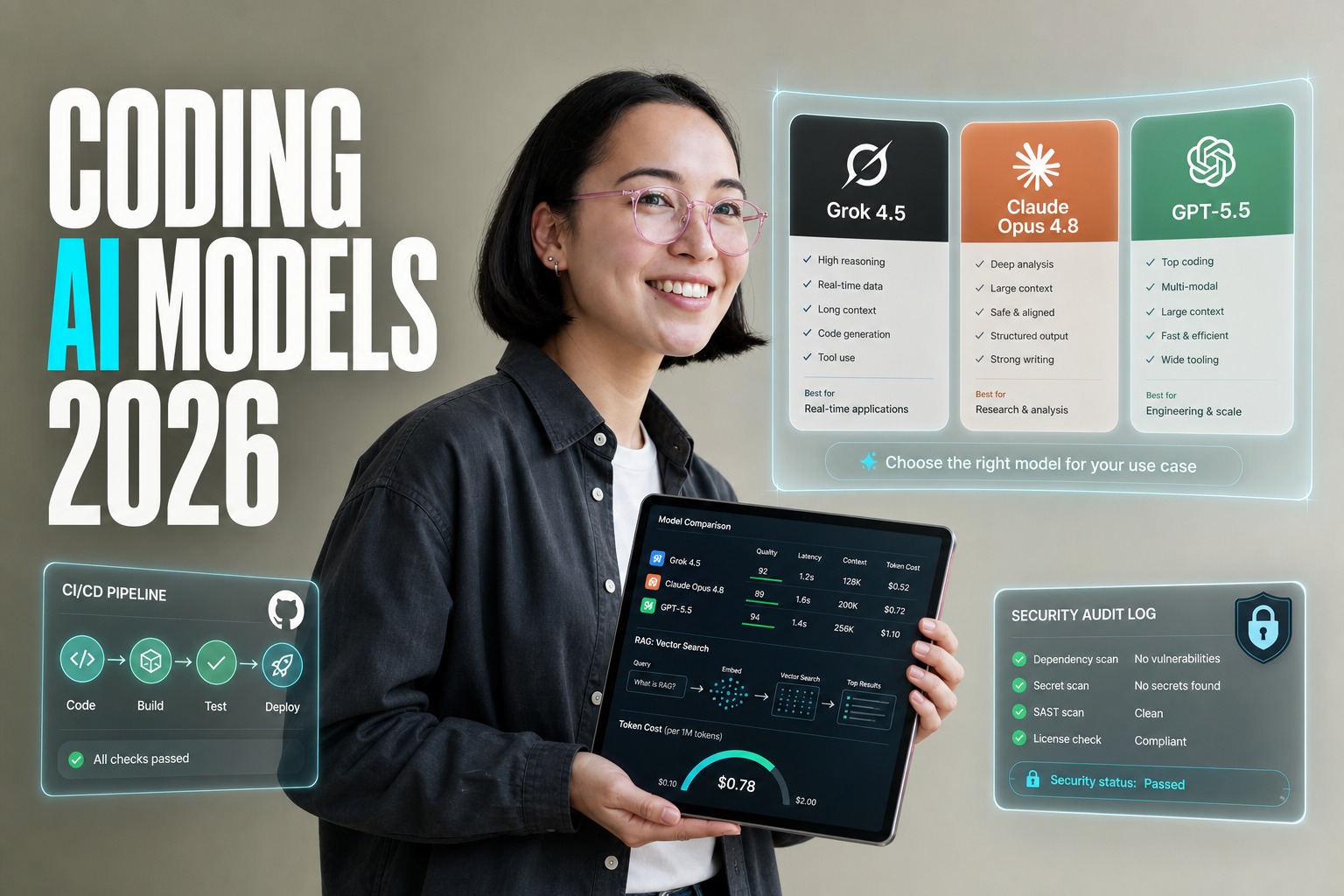
Grok 4.5 cuts generation cost by up to 8×, Claude Opus 4.8 leads raw accuracy, and GPT‑5.5 dominates agentic execution, delivering up to 1.8× faster PR cycles when integrated with proper guardrails.
Technical architecture and how coding AI models 2026 works in practice
When a developer invokes an AI coding assistant (e.g., via VS Code extension), the request traverses a multi‑layered stack that isolates the model, enforces policy, and guarantees repeatable state.
API Gateway: Auth‑checks (OAuth2 / API keys), rate‑limit, and audit log; forwards to Orchestration Service.
Orchestration Layer: Built on LangChain or AutoGen. Manages agent state, tool routing, and retry policies (circuit breaker, exponential back‑off).
Model Layer: Calls the chosen code generation model (Grok 4.5, Claude Opus 4.8, or GPT‑5.5) over a REST endpoint. Token budget and temperature are injected per‑task.
Retrieval‑Augmented Generation (RAG): Embeddings of the entire monorepo stored in a vector DB (Pinecone, pgvector). A semantic query fetches relevant files before generation, expanding the effective context window beyond 8 k tokens.
Tool Suite: File‑system read/write, bash executor, linter (ESLint, pylint), test runner (Jest, pytest), and CI trigger. Each tool returns structured JSON so the agent can reason on output.
State Store: Redis for short‑lived session state; S3/MinIO for persisted snapshots. Guarantees idempotent file patches using diff‑based commits.
Event Bus: Kafka topics for “agent‑started”, “tool‑called”, “pr‑created”. Consumers update dashboards and trigger downstream CI/CD pipelines.
Data flow example:
Developer types “refactor authentication module to use OAuth2” in IDE.
Extension sends request → API Gateway (OAuth2 token validated).
An enterprise deployed an AI‑powered internal knowledge assistant for policies and documentation. After integrating Plavno's solution, the team achieved 60% faster internal information retrieval and a 40% reduction in HR support tickets.
Even with the most accurate model, PR quality collapses without a deterministic “tool‑use” loop that validates every change on the fly.
Business impact & measurable ROI
Pull‑request velocity: Teams using Grok 4.5 for routine scaffolding saw PR turn‑around drop from 4 hours to 45 minutes; GPT‑5.5‑driven agents for end‑to‑end refactoring cut cycle time by 1.8× on average.
Code‑review workload: Automated linting and test execution inside the agent reduced manual review comments by 30 % and freed senior engineers for architecture work.
Technical debt: Embedding security policies (SAST via CodeQL) into the tool chain caught 97 % of secret‑leak violations before code merge.
Cost leverage: Grok 4.5’s $2 / M input and $6 / M output token price translates to ~ $0.12 per 1 k‑token generation for typical 15 k‑token tasks, an 8× saving versus Claude’s $0.96 / M output rates.
Compliance guardrails: Centralized audit logs in Elasticsearch enable SOC‑2 ready traceability for every model‑generated change.
The real competitive edge isn’t the model’s raw speed; it’s the orchestration layer that turns token efficiency into measurable developer‑time savings.
Implementation strategy
Phase 1 – Pilot: Select a low‑risk microservice, expose a single “AI‑assist” endpoint, and instrument token usage with Prometheus.
Phase 2 – Hardening: Add vector‑search retrieval, sandboxed Docker runtimes, and CI webhook integration. Introduce policy checks via OPA.
Phase 3 – Scale: Deploy multi‑tenant orchestration pods on Kubernetes (auto‑scaling based on queue length). Enable region‑aware routing for latency‑critical teams.
Phase 4 – Governance: Implement role‑based access (RBAC), audit logging to Splunk, and token budgeting dashboards for finance.
Phase 5 – Continuous improvement: Feed rejected PR data back into a fine‑tuning pipeline (Llama‑2‑Chat‑Fine‑Tuned) and retrain embeddings weekly.
Common pitfalls
Skipping the retrieval step – leads to hallucinations when the model “guesses” missing imports.
Running agents with full filesystem privileges – opens supply‑chain attack surface.
Adopting the right coding AI models 2026 is no longer a gamble about raw capability; it is an engineering decision about token economics, orchestration, and governance. Grok 4.5 delivers cost‑effective volume, Claude Opus 4.8 offers the highest accuracy for complex logic, and GPT‑5.5 shines when you need true agentic execution. With a disciplined orchestration layer—exactly the stack Plavno builds—you turn those models into a measurable boost in PR velocity, a slimmer review backlog, and a concrete reduction in technical debt, all while keeping security and compliance in check.
Share this post
Contact Us
This is what will happen, after you submit form
Plavno experts contact you within 24h
Discuss your project details
We can sign NDA for complete secrecy
Submit a comprehensive project proposal with estimates, timelines, team composition, etc
Need a custom consultation? Ask me!
Plavno has a team of experts ready to start your project. Ask us!