Claude Opus 5 vs GPT-5.6 vs Gemini 3.6 Flash: Which Model Fits Your Business in 2026
Claude Opus 5 vs GPT-5.6 vs Gemini 3.6 Flash: Which Model Fits Your Business in 2026
August 13, 2026· min read·#AI#Tech·Reviewed by Plavno AI Engineering Team
Enterprises are racing to embed large language models (LLMs) into every line of code, but choosing the right model—Claude Opus 5, GPT‑5.6, or Gemini 3.6 Flash—impacts ROI, latency, and compliance.
Share this post
Enterprises are racing to embed large language models (LLMs) into every line of code, but the choice between Claude Opus 5, GPT‑5.6, and Gemini 3.6 Flash can make or break a project’s ROI, latency budget, and compliance posture.
QUICK ANSWER
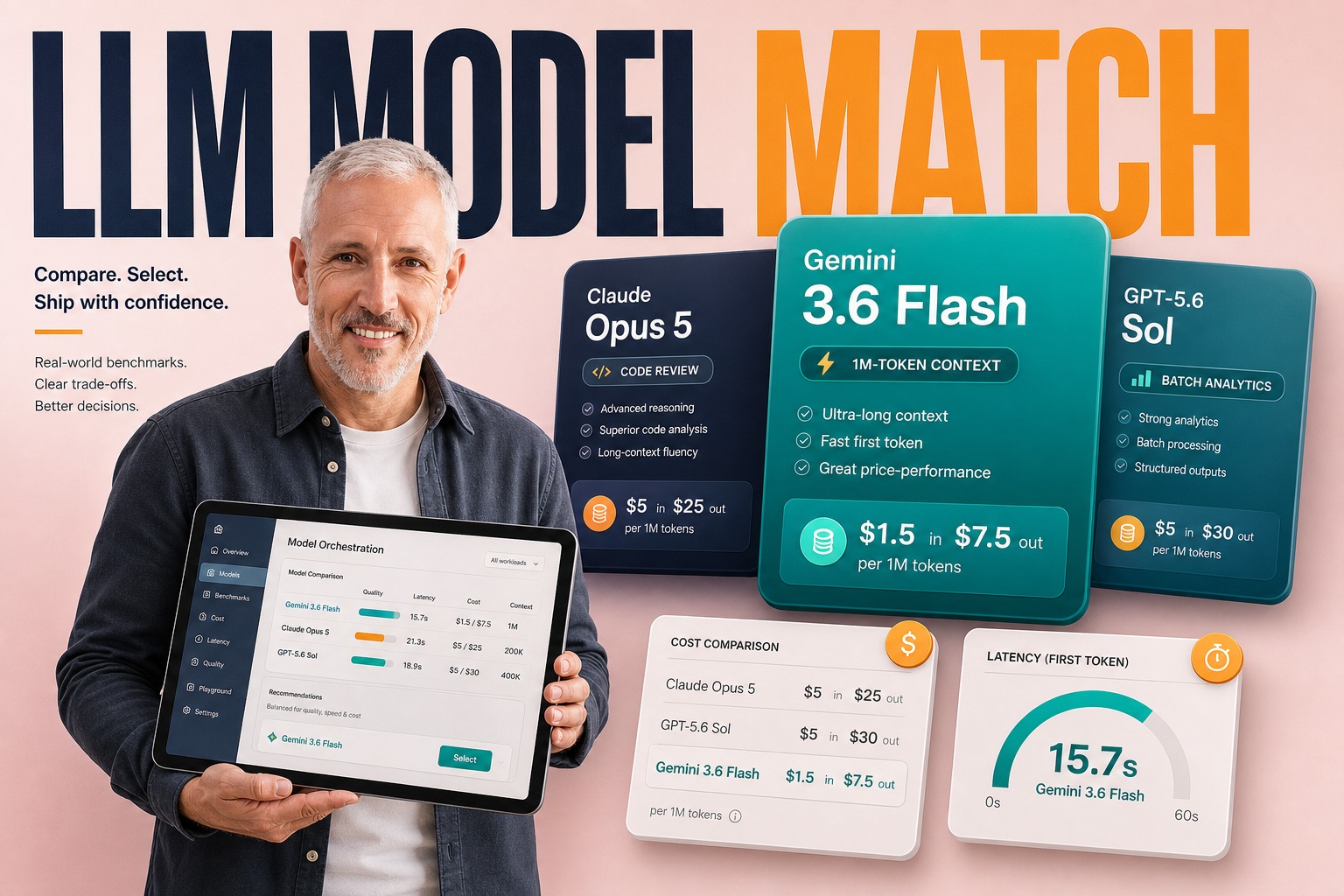
Claude Opus 5 delivers the highest reasoning quality for complex code review at a $5 / $25 per MTok price, while Gemini 3.6 Flash provides sub‑15‑second first‑token latency and 1 M‑token context for high‑throughput, multimodal pipelines; GPT‑5.6 sits between them, excelling at hard‑core reasoning and large‑scale batch jobs.
Claude Opus 5 vs GPT-5.6: Technical architecture and how they work in practice
All three models sit behind an API Gateway that terminates TLS, validates OAuth2 scopes, and routes requests to an orchestration layer (Python FastAPI or Node Express). The orchestration layer decides which model layer to invoke, assembles context, and adds retries with exponential back‑off.
Typical data flow for a code‑review agent:
Webhook from the IDE posts a pull_request event to the gateway.
Orchestrator extracts the diff, stores a 768‑dimensional embedding in a Milvus vector store.
Top‑k embeddings are retrieved, concatenated with the diff, and sent to the chosen LLM.
LLM streams back suggestions; broker (Kafka) logs each token to Elastic for audit.
Redis cache holds the last 100 responses to guarantee idempotent retries.
Model‑specific routing rules:
Claude Opus 5 – used for “hard reasoning” branches: complex refactoring judgments, security audits, and documentation synthesis. It runs in a “job” queue with a progress endpoint because its time‑to‑first‑token averages 52 seconds (beri.net).
GPT‑5.6 Sol – chosen for large‑scale batch analytics, scientific code generation, and multi‑modal data extraction. Its output speed is 69 tok/s, but first‑token latency is 143 seconds, making it unsuitable for interactive UIs.
Gemini 3.6 Flash – the “Flash” class for rapid coding loops, UI automation, and multimodal inputs (image‑plus‑text). It delivers 212 tok/s and a 15.7 second first‑token latency, ideal for high‑volume pipelines.
EXAMPLE USE CASE
An enterprise deployed an AI‑powered internal knowledge assistant for policies and documentation to centralize enterprise knowledge access and cut repetitive support requests. After integrating Plavno's solution, the team achieved 60% faster internal information retrieval and achieved 40% reduction in HR support tickets.
Claude Opus 5 vs GPT-5.6: Business impact & measurable ROI
Choosing the right model directly influences three financial levers: compute cost, developer productivity, and risk exposure.
Compute cost per MTok – Claude Opus 5 costs $5 in, $25 out; GPT‑5.6 Sol costs $5 in, $30 out; Gemini 3.6 Flash costs $1.5 in, $7.5 out (iMini.com). For a 300 k‑request/month workload (8 k input tokens, 600 output tokens) the monthly bill is ≈ $9,165 on Opus 5, $7,950 on GPT‑5.6, and $2,120 on Flash.
Productivity boost – Claude Opus 5’s superior code‑review accuracy reduces rework cycles by up to 30 % in a CI pipeline, while Gemini 3.6 Flash’s 1 M‑token context cuts manual document stitching effort by 45 %.
Latency, not price, dictates model selection for interactive enterprise workflows.
Claude Opus 5 vs GPT-5.6: Implementation strategy
Deploying a multi‑model stack follows a disciplined roadmap:
Run a 5 % traffic pilot that routes requests through a feature flag to each model.
Instrument the pipeline with OpenTelemetry traces, Prometheus metrics, and Elastic logs.
Collect latency, token‑usage, and error‑rate per model; compare against SLA targets (< 400 ms for UI, < $0.01 per request).
Iterate on prompt templates (LangChain / LlamaIndex) and tool‑use definitions (AutoGen or CrewAI).
Scale the winning model on Kubernetes with Horizontal Pod Autoscaler, using Pod‑disruption‑budgets for zero‑downtime.
Finalize governance: OAuth2 scopes, API‑key rotation, and immutable audit trails stored in a GovCloud S3 bucket.
Common pitfalls:
Hard‑coding model endpoints instead of an indirection layer – makes future swaps painful.
Ignoring token‑limit awareness; a 2 k‑context request can truncate critical policy text.
Skipping circuit‑breaker patterns; a latency spike cascades into downstream services.
Claude Opus 5 excels at complex code review, while Gemini 3.6 Flash wins at high‑throughput, multimodal pipelines.
Why Plavno’s approach works
Plavno builds an engineering‑first, enterprise‑grade AI stack that isolates model risk while maximizing ROI:
We provision a **model‑agnostic orchestration service** that abstracts Claude, GPT, and Gemini behind a uniform JSON API, enabling rapid A/B testing.
Our **vector‑store layer** (Milvus or Pinecone) is deployed in a private VPC, satisfying data‑residency mandates.
We implement **event‑driven pipelines** with Kafka, guaranteeing at‑least‑once delivery and automatic back‑pressure handling.
Security is baked in: OAuth2, rotating API keys, and end‑to‑end TLS, with audit logs streamed to Elastic for SOC‑2 compliance.
Scalable deployment patterns include **multi‑region Kubernetes** for low latency and **serverless Cloud Run** for bursty workloads, all managed via Terraform and Argo CD.
Choosing the optimal model is less about headline scores and more about aligning latency, cost, and security with your product’s SLAs. When you need fast, multimodal loops, Gemini 3.6 Flash is the clear winner. For deep reasoning, code‑audit, and regulated document generation, Claude Opus 5 offers the best ROI. GPT‑5.6 provides a middle ground for massive batch workloads that can tolerate higher latency.
At Plavno, we translate this strategic analysis into production‑ready pipelines that give you measurable performance gains, predictable spend, and compliance‑ready audit trails.
Ready to let your enterprise leverage the right LLM for every use case? Schedule a discovery call and let our architects design a multi‑model strategy that scales with your business.
Share this post
Contact Us
This is what will happen, after you submit form
Plavno experts contact you within 24h
Discuss your project details
We can sign NDA for complete secrecy
Submit a comprehensive project proposal with estimates, timelines, team composition, etc
Need a custom consultation? Ask me!
Plavno has a team of experts ready to start your project. Ask us!