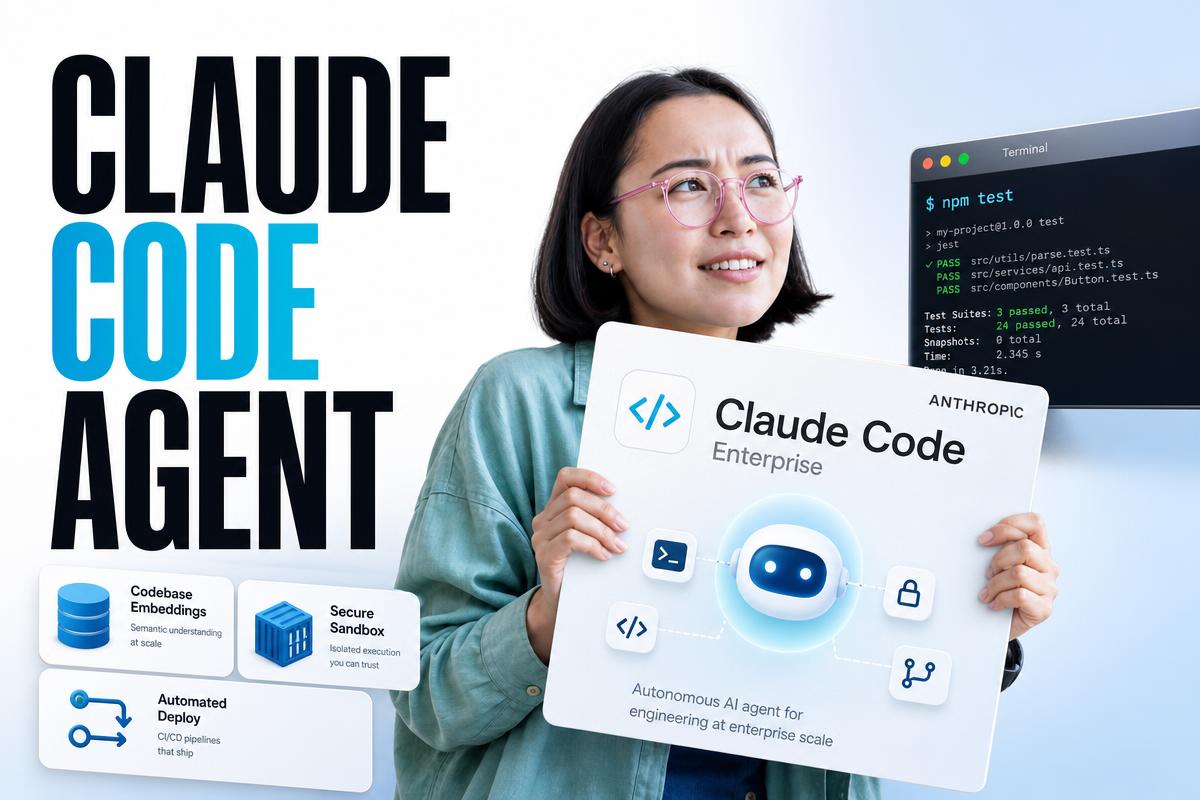
The era of the "autocomplete" engineer is ending, and the era of the autonomous agent is beginning. For years, software teams have relied on Large Language Models (LLMs) as sophisticated parrots—tools capable of suggesting the next line of code but unable to understand the broader context of a running system. Anthropic’s release of Claude Code changes this dynamic fundamentally. It is not merely a chat interface attached to an IDE; it is an agentic workflow engine capable of reading, writing, executing, and debugging code with minimal human intervention. For enterprise CTOs and engineering leads, this represents a shift from "AI-assisted coding" to "AI-driven software development automation," demanding a reevaluation of architecture, security, and team structure.
Industry challenge & market context
Enterprise software delivery is currently bottlenecked by cognitive load and context switching. While tools like GitHub Copilot accelerated individual typing speed, they did little to address the systemic friction in complex development lifecycles. Legacy approaches to AI integration fail because they treat code generation as an isolated text prediction problem rather than a system state manipulation problem. The market is facing specific bottlenecks that simple autocomplete cannot solve.
- Context window limitations in legacy tools prevent the AI from "seeing" the entire monorepo, leading to hallucinations or code that breaks existing dependencies.
- Inability to execute terminal commands means previous AI models could not verify their own code, forcing developers to constantly context-switch between the IDE and the terminal to run tests or linting.
- Multi-file refactoring is notoriously difficult for standard LLMs; changing a function signature often requires updates across dozens of files, a task that breaks most non-agentic models.
- Security risks arise when AI models suggest code that introduces vulnerabilities or inadvertently expose API keys and secrets in the generation process.
- Integration friction occurs when AI tools fail to mesh with existing CI/CD pipelines, requiring manual intervention to push code from the "suggestion" phase to the "deployment" phase.
The competitive advantage for enterprises will not come from the model itself, but from the orchestration layer that governs how that model interacts with your proprietary codebase, infrastructure, and compliance protocols.
Technical architecture and how Claude Code enterprise works in practice
Implementing Claude Code enterprise requires moving beyond the simple API wrapper. It necessitates a robust architecture where the LLM acts as the reasoning engine within a deterministic system. At Plavno, we view this as a multi-layered stack involving an orchestration layer, a secure sandbox environment, and a retrieval-augmented generation (RAG) pipeline specifically tuned for code.
In a typical enterprise deployment, the architecture begins with the IDE extension or CLI acting as the client. This client communicates not directly with the raw Anthropic API, but through an internal API Gateway. This gateway handles authentication (via OAuth2 or SAML), rate limiting, and audit logging—critical for compliance. Behind the gateway sits the Agent Orchestrator, often built using frameworks like LangChain or CrewAI, which manages the state of the coding session.
The core innovation is the "Tool Use" capability. The model is granted access to specific tools: a file system reader/writer, a bash terminal, a linter, and a test runner. When a user prompts the system to "refactor the authentication module," the agent does not generate text blindly. It queries a Vector Database (like Pinecone or pgvector) containing embeddings of the codebase to understand the current implementation. It then formulates a plan, executes a series of tool calls to read files, writes the changes, and runs the test suite. If tests fail, it reads the error logs, iterates on the code, and retries.
- Agent Orchestrator: The brain managing the loop, using frameworks like LangGraph or AutoGen to handle multi-step reasoning and state persistence.
- Sandboxed Runtime: Docker containers or Firecracker microVMs that isolate the agent's execution environment to prevent it from modifying system files or accessing unauthorized resources during code execution.
- Vector Database: Stores embeddings of your code, documentation, and Jira tickets to allow the model to retrieve relevant context via semantic search, overcoming the context window limit for massive repos.
- Tool Layer: A defined set of APIs allowing the LLM to interact with the environment (e.g., running
npm test, executing Docker builds, querying a PostgreSQL schema). - Event Bus: Uses message queues like RabbitMQ or Kafka to handle asynchronous tasks such as triggering CI/CD pipelines or notifying team members when a significant code change is successfully deployed.
Data flow in this architecture is strictly unidirectional and secure. The user's prompt and the relevant code snippets are sent to the model. The model responds with tool calls rather than raw text. The orchestration layer executes these tools (e.g., editing a file in Git) and returns the output (stdout/stderr) back to the model. This loop continues until the task is complete. This "agentic loop" allows for complex behaviors like self-healing code—where the agent writes a script, runs it, sees a syntax error, and fixes it without human input.
Infrastructure-wise, this requires high availability and low latency. We recommend deploying the orchestration layer on Kubernetes, allowing for horizontal scaling based on the number of active coding sessions. State must be managed carefully; if a session crashes, the agent should be able to resume from the last checkpoint. This involves persisting the conversation history and the current state of the workspace in a durable object store like Amazon S3 or MinIO.
Claude Code transforms the IDE from a static text editor into a dynamic execution environment where the AI operates as a peer engineer with read/write access to your source control and build systems.
Business impact & measurable ROI
Adopting an agentic approach to coding yields tangible benefits that go beyond simple productivity metrics. The shift from "suggestion" to "execution" fundamentally alters the economics of software development. For enterprises, the ROI of Claude Code enterprise is measured in delivery velocity, defect reduction, and optimized resource allocation.
The most immediate impact is the reduction of "drudgery work." Tasks such as writing boilerplate code, migrating unit tests between frameworks, or updating documentation across multiple files can be offloaded entirely to the agent. In our benchmarks, this can reduce the time spent on maintenance tasks by up to 40%, freeing senior engineers to focus on architecture and complex feature logic. Furthermore, because the agent can run tests and linting automatically, the feedback loop for developers tightens significantly. Instead of waiting for a CI/CD pipeline to fail twenty minutes after a commit, the agent catches syntax errors and type mismatches locally before the code is even pushed.
- Velocity: Reduction in cycle time for feature development; complex refactors that previously took days can be completed in hours through automated multi-file editing.
- Quality Assurance: Agents can be configured to enforce coding standards automatically, reducing technical debt and ensuring consistency across large teams.
- Onboarding: New hires can query the codebase via the agent to understand architectural patterns and data flows, drastically reducing the ramp-up period from months to weeks.
- Cost Efficiency: By automating routine maintenance, enterprises can defer headcount growth for junior roles and focus hiring on high-impact architectural and engineering talent.
However, the business case also depends on managing costs effectively. Agentic workflows consume significantly more tokens than simple chat interfaces due to the iterative loop of reading and writing files. Enterprises must implement caching strategies and token optimization to keep operational costs predictable. Despite the increased compute cost, the total cost of ownership typically drops because the cost of developer time—especially for senior engineers—is far higher than the cost of inference.
Implementation strategy
Deploying Claude Code enterprise effectively requires a phased approach that balances speed of adoption with security and governance. A "big bang" rollout is rarely successful; instead, we recommend a pilot program that gradually expands scope as governance frameworks mature.
- Phase 1: Infrastructure & Security Audit: Set up the secure API gateway, define OAuth2 scopes, and establish the sandboxed Docker environments. Ensure no secrets are injected into the model context.
- Phase 2: The Greenfield Pilot: Introduce the tool to a single senior squad working on a new, isolated service. This limits the blast radius of errors and allows the team to fine-tune prompts and tool configurations.
- Phase 3: Brownfield Expansion: Gradually enable access to legacy codebases, utilizing RAG to help the agent navigate complex, undocumented legacy systems.
- Phase 4: CI/CD Integration: Configure the agent to interact with your GitLab or GitHub pipelines, allowing it to automatically fix failing builds or update changelogs.
During implementation, be wary of common pitfalls. One frequent issue is "over-trusting" the agent; human-in-the-loop review remains mandatory for code merging. Another pitfall is neglecting the context window; failing to implement a robust retrieval strategy for large monorepos will result in the agent losing context and generating irrelevant code. Finally, ensure your observability stack (Prometheus, Grafana, ELK) is configured to monitor agent behavior, tracking metrics such as "number of self-corrections per session" or "token consumption per task."
Why Plavno’s approach works
At Plavno, we do not simply plug in an API key and hope for the best. We engineer AI solutions that are enterprise-grade, secure, and tailored to your specific stack. Our experience in custom software development allows us to integrate agentic coding workflows into complex architectures without disrupting existing operations. We understand that for an enterprise, reliability is as important as innovation.
Our approach focuses on building a resilient orchestration layer around the AI agents. We design custom retrieval pipelines that ensure the model understands your specific business logic and architectural constraints. Whether you are working in Python, Node.js, or Go, we configure the tooling to match your engineering standards. Furthermore, our expertise in AI consulting ensures that your governance policies are embedded directly into the agent's instructions, enforcing compliance and security protocols automatically.
We also help you navigate the human side of this transition. Through our hiring models, we can provide engineers who are already proficient in AI-augmented workflows, ensuring your team is ready to leverage these tools from day one. From AI automation of routine tasks to the development of sophisticated AI assistants for your internal teams, Plavno provides the end-to-end expertise necessary to turn a promising technology into a production-grade asset.
The transition to agentic coding is inevitable, but the path to success requires technical precision. By combining Anthropic’s powerful models with Plavno’s architectural rigor, enterprises can unlock a new level of software development efficiency.
The future of software engineering is not just about writing code; it is about orchestrating intelligence. Claude Code enterprise provides the raw intelligence, but it takes a disciplined engineering approach to channel that intelligence into reliable, secure, and valuable software products. As these tools mature, the gap between teams that adopt agentic workflows and those that rely on manual coding will widen, creating a decisive competitive advantage for early adopters.