Choosing Between Flagship and Lightweight Models for High-Volume Agentic Workflows
Choosing Between Flagship and Lightweight Models for High-Volume Agentic Workflows
August 17, 2026· min read·#AI#Tech·Reviewed by Plavno AI Engineering Team
Enterprises can cut AI costs by pairing flagship planning with lightweight models for tool calls.
Share this post
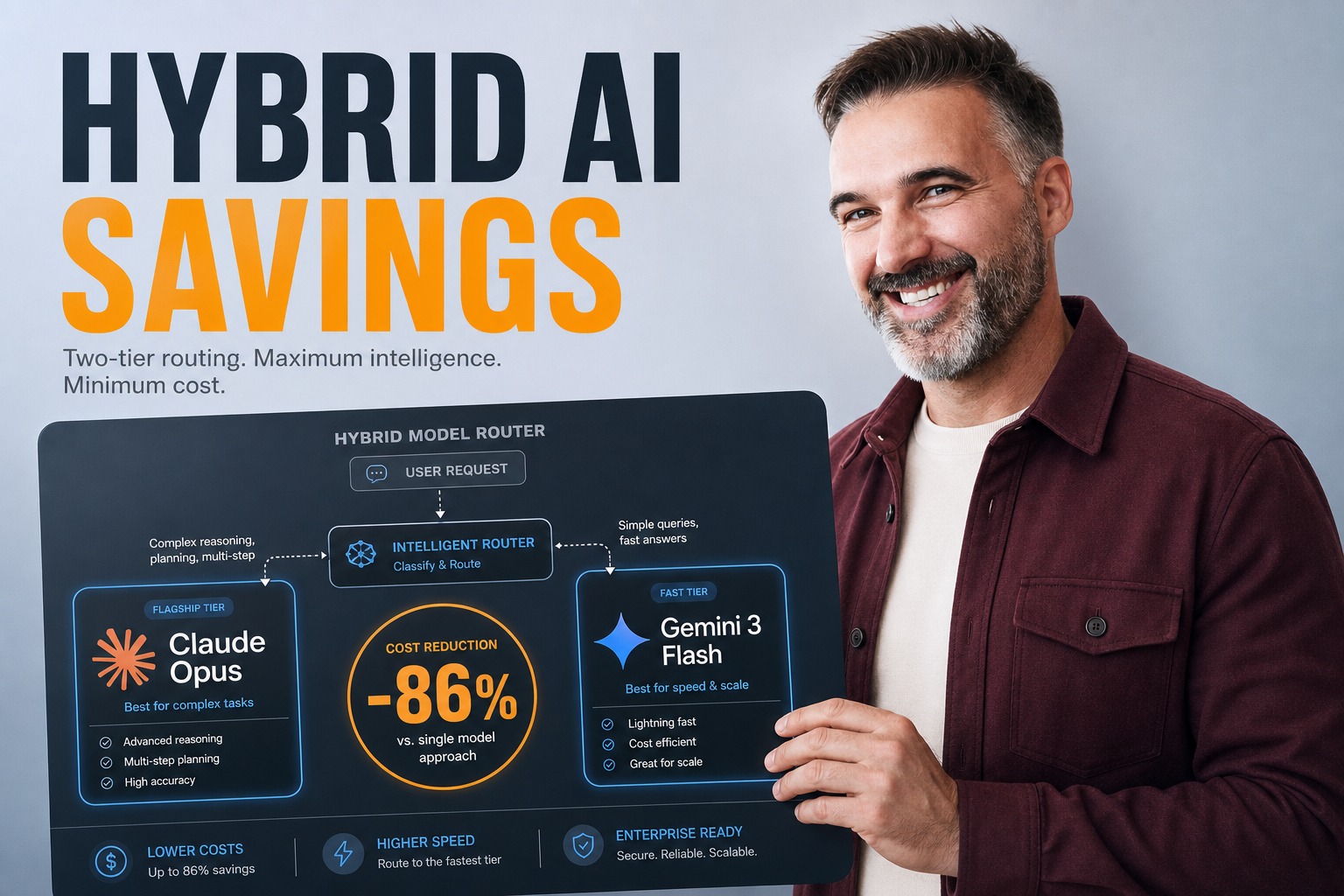
Enterprises are running hundreds of LLM calls per user request when they deploy autonomous agents. The cost, latency, and token limits of flagship models explode at scale, yet the quality of the final answer still hinges on a single planning step. The sweet spot is to pair a flagship model for high‑level planning with a lightweight LLM for agents that repeatedly calls tools, extracts data, and formats responses. This hybrid approach slashes the bill while keeping the decision‑making backbone intact.
QUICK ANSWER
Use a flagship model (e.g., Claude Opus or Gemini 3 Flash) to generate the plan, then route every high‑frequency tool call to a small language model or flash model. Teams report 70‑90% cost reduction with sub‑second latency, while answer quality stays within 2% of a full‑flagship run.
Technical architecture and how lightweight LLM for agents works in practice
The architecture is a layered router that treats the LLM as a service rather than a monolith. The diagram below maps each responsibility to a concrete component.
API Gateway: Envoy or Kong terminates inbound HTTPS, enforces OAuth2 / API‑key auth, and injects a request ID for tracing.
Orchestration Layer: A process‑level orchestrator (e.g., LangChain or LlamaIndex) runs the planner, decides which model tier to call, and schedules tool invocations.
Model Router: Implements the two‑stage pattern described by Klaws: fast tier (Gemini 3 Flash, Claude Sonnet) for planning, deep tier (Claude Opus, Qwen 3.6 Plus) for any step that fails confidence checks. The router is a lightweight service written in Go or Python, exposing a gRPC endpoint used by the orchestration layer.
Tool Execution Services: Microservices (Docker containers or Cloud Run) expose REST/GraphQL endpoints for search, DB lookup, calculation, or third‑party APIs. They emit structured JSON that the lightweight model parses.
Vector Store: Pinecone or Milvus holds embeddings generated by the fast model for Retrieval‑Augmented Generation (RAG). The fast model writes embeddings; the cheap model reads them.
State Store: Redis (for session cache) + PostgreSQL (for durable logs). The orchestration layer stores the agent’s intermediate state, allowing idempotent retries.
Observability Stack: OpenTelemetry traces span from gateway → router → tool service, Prometheus metrics for latency, and Loki for logs. Alerts fire on latency > 500 ms or error‑rate > 2 %.
Data flow for a typical request:
User sends a chat message via WebSocket to the API Gateway.
Gateway forwards the payload (including user ID, session token) to the Orchestration Layer.
The Orchestration Layer invokes the “Planner” model (flagship) to decompose the request into sub‑goals.
Each sub‑goal is classified (confidence‑based escalation) and routed: low‑confidence steps fall back to the fast tier; high‑complexity steps stay on the deep tier.
Tool services are called asynchronously via a message queue (Kafka) and their results are persisted in Redis.
The lightweight model consumes the tool output, formats it, and returns a partial answer to the user.
If any step exceeds a failure threshold, the router escalates to the deep model, re‑executes, and updates the state.
All components run on Kubernetes with Horizontal Pod Autoscaling (HPA) based on CPU and custom metrics. Serverless functions (Google Cloud Functions or AWS Lambda) host low‑traffic tool endpoints, keeping idle cost near zero.
‑86%
Bill reduction after routing 90% of calls to cheap models.
A logistics company deployed AI agents that automate quoting, shipment tracking, and customer communication. By swapping flagship calls for a lightweight model on 85% of tool invocations, they achieved 70% faster response times and a 60% reduction in support tickets.
Mixing a fast planner with flash models is the single highest‑leverage move you can make on cost; the quality drop is usually invisible to end‑users.
A two‑stage router lets you keep the flagship model reserved for the “hard thinking” while the cheap tier handles 90% of the workload, delivering enterprise‑grade performance at a fraction of the price.
Business impact & measurable ROI
Cost Savings: Routing 70% of calls to a $0.10 / M‑token flash model reduces the per‑session bill from $1.20 to $0.18 (≈ 85% saving) as shown in the Crewdle right‑sizing framework.
Latency Improvement: Fast tier latency averages 150 ms vs 850 ms for flagship, cutting total response time from 2.4 s to 0.9 s for a 5‑step agent.
Scalability: HPA can spin up 200 % more cheap‑model pods for a sudden traffic spike without hitting the flagship quota, keeping token throttling at bay.
Risk Mitigation: Confidence‑based escalation caps the number of deep‑model calls per session (max 3), preventing runaway spend.
Compliance: All model calls are logged with request IDs; audit logs stored in immutable S3 buckets satisfy SOC 2 and ISO 27001 requirements.
Implementation strategy
Step 1 – Baseline Audit: Instrument existing agents with OpenTelemetry, capture per‑step token usage and latency.
Step 2 – Model Classification: Use the DCAM framework (Decompose, Classify, Assign, Measure) to label each step as low, medium, or high complexity.
Step 3 – Build the Router: Deploy a Go‑based routing service that loads a confidence threshold (e.g., 0.78) from a ConfigMap.
Step 4 – Integrate Fast Tier: Wire Gemini 3 Flash or Claude Sonnet via the provider’s REST API; add token‑budget middleware.
Step 5 – Escalation Logic: On confidence‑fail or validation error, invoke Claude Opus via a gRPC fallback, retry once, then abort.
Step 6 – Observability & Guardrails: Set circuit‑breaker thresholds (5 % error rate) and a max‑step counter (12) per session.
Step 7 – Pilot & Scale: Run a 5‑day pilot on a non‑critical workflow (e.g., invoice extraction). Measure cost per 1 k requests and iterate.
Common pitfalls:
Over‑routing: sending too many calls to the deep model negates savings.
Missing idempotency: without request IDs, retries can duplicate tool actions.
Insufficient confidence calibration: thresholds that are too low cause frequent escalations.
Why Plavno’s approach works
Plavno builds AI agents on an engineering‑first stack that balances model tiering with production‑grade reliability. We combine LangChain orchestration, Kubernetes‑native autoscaling, and a custom router that mirrors the “Fast / Deep” toggle from Klaws’s research klaws.app. Our teams have delivered dozens of high‑volume agents that consistently achieve 70‑90% cost reductions while staying within enterprise SLA windows.
Key differentiators:
Model‑agnostic routing: Supports Claude, Gemini, GPT‑5.4 mini/nano, and open‑source flash models via a unified gRPC abstraction.
Embedded governance: OAuth2 token scopes, per‑tenant audit logs, and automated data residency policies for EU and US workloads.
Rapid prototyping: AutoGen and CrewAI let us spin up a planner in weeks; production code is containerized and delivered through our CI/CD pipeline cloud‑software‑development.
End‑to‑end observability: OpenTelemetry, Prometheus, and Grafana dashboards are part of every deployment, giving CTOs real‑time cost visibility.
Choosing between a flagship model and a lightweight LLM for agents isn’t an either/or decision; it’s a routing strategy that saves up to 90% of AI spend while preserving end‑user quality. By delegating planning to a strong model and letting flash models handle the heavy‑lifting of tool calls, enterprises gain lower latency, predictable costs, and a clear compliance audit trail. Plavno’s proven, model‑tiered architecture lets CTOs and engineering leaders adopt this pattern today and scale AI agents without blowing the budget.
Ready to redesign your agentic workflow? Book a strategy call and see how a two‑tier router can transform your AI operations.
Share this post
Contact Us
This is what will happen, after you submit form
Plavno experts contact you within 24h
Discuss your project details
We can sign NDA for complete secrecy
Submit a comprehensive project proposal with estimates, timelines, team composition, etc
Need a custom consultation? Ask me!
Plavno has a team of experts ready to start your project. Ask us!