Enterprises are racing to embed generative AI into core products, yet 78% of AI pilots stall before reaching production. The bottleneck isn’t the model—it’s the lack of a disciplined AI product development lifecycle that aligns data, engineering, and compliance from day 1. This article walks through every stage, from AI discovery to AI deployment, and shows how a rigorously engineered pipeline turns a prototype into a revenue‑generating service at scale.
Industry challenge & market context
- Data silos and poor lineage cause regulatory exposure and model drift after launch.
- Legacy CI/CD pipelines assume static code; they cannot orchestrate large language model (LLM) inference, vector retrieval, and tool‑calling in a single workflow.
- Cost overruns stem from unchecked token usage, missing rate‑limit guards, and under‑utilized GPU resources.
- Security teams reject AI pilots that lack OAuth2 scopes, audit‑trail logging, or data‑residency guarantees.
- Time‑to‑value is eroded by ad‑hoc proof‑of‑concepts that skip UX validation and scalability tests.
Technical architecture and how AI product development lifecycle works in practice
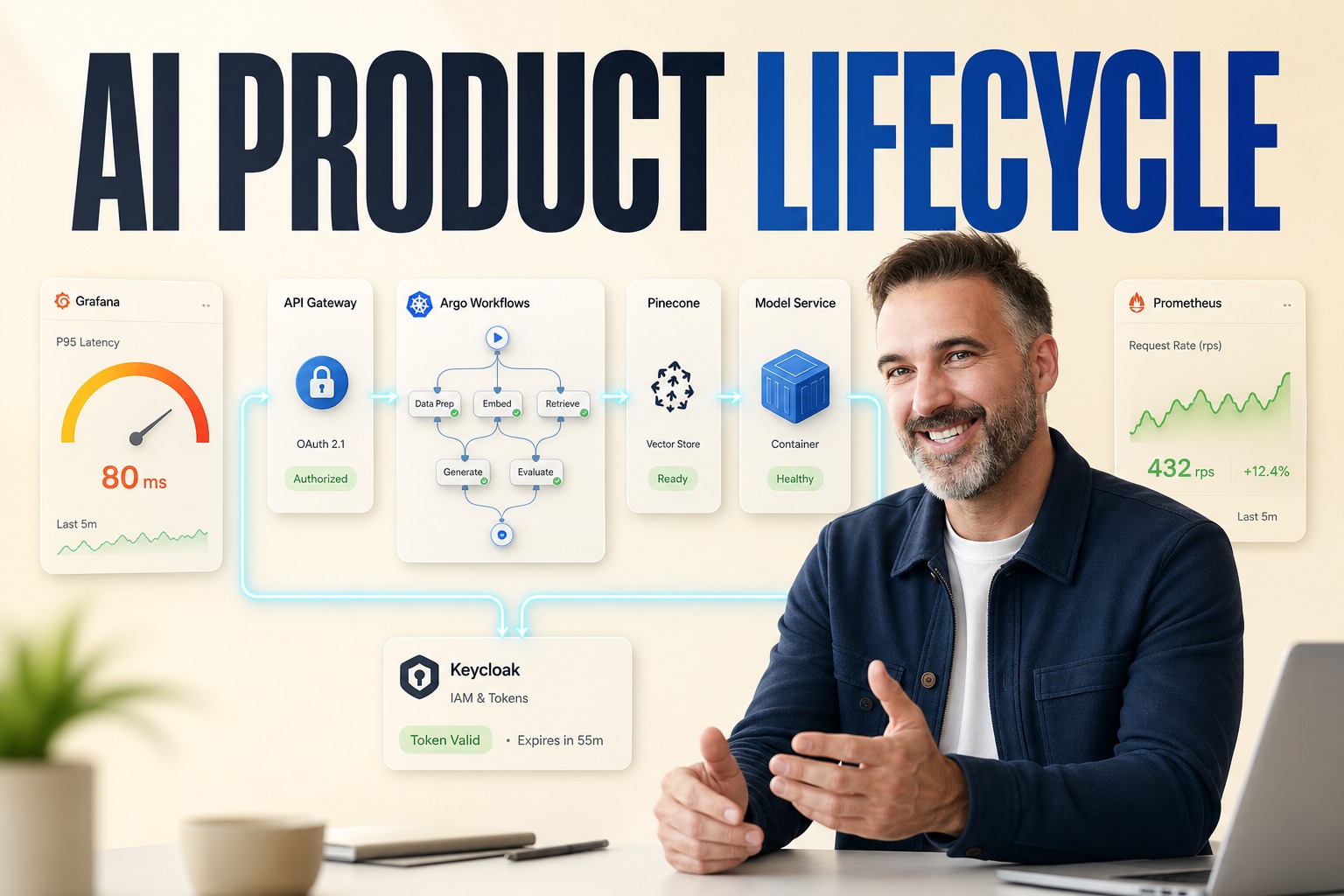
A production‑grade AI system is a collection of interoperable services rather than a monolith. Below is the canonical component diagram that Plavno implements for every AI product.
- API Gateway: Handles inbound REST/GraphQL traffic, enforces OAuth2, rate limits, and request‑level idempotency keys.
- Orchestration Layer: A Kubernetes‑native workflow engine (e.g., Argo Workflows) that coordinates data preprocessing, embedding generation, and model routing. For agent‑centric products we embed AI agents development frameworks such as LangChain, CrewAI, or AutoGen.
- Model Service: Containerized inference servers (FastAPI in Python or NestJS in Node) exposing LLM APIs (OpenAI, Anthropic, or self‑hosted Mistral). Supports multiple versions for A/B testing and fine‑tuning rollouts.
- Vector Store: High‑dimensional similarity index (Pinecone, Qdrant, or Milvus) stores document embeddings generated during AI discovery.
- Data Lake & ETL: Snowflake or BigQuery holds raw logs, transaction records, and annotated training sets. Airflow jobs extract, cleanse, and write to the vector store.
- Cache & Message Queue: Redis caches recent retrievals; Kafka streams event‑driven updates for incremental indexing.
- Observability Stack: Prometheus scrapes metrics, Grafana dashboards visualize latency (target < 150 ms for RAG retrieval), and OpenTelemetry traces cross‑service calls.
- Security & Governance: Centralized IAM (Keycloak) issues JWTs, audit logs are shipped to Splunk, and data residency policies enforce storage region tags.
Data flow during a typical request:
- User sends a query via the mobile/web front‑end (Node.js SPA) to the API Gateway.
- Gateway validates the OAuth token, applies a circuit breaker, and forwards the payload to the orchestration layer.
- Orchestrator extracts keywords, calls the ETL‑managed Embedding Service (Python, huggingface‑transformers) to create a 1536‑dim vector.
- The vector is looked up in the Vector Store; top‑k documents (< 10) are retrieved within 80 ms.
- Context (retrieved docs + user prompt) is assembled and routed to the Model Service, which may invoke an LLM or a specialized tool (e.g., a calculator agent built with AutoGen).
- Model response is post‑processed, cached, and returned through the gateway to the front‑end.
- All steps emit structured logs and trace spans for end‑to‑end monitoring.
Deployment patterns differ by product strategy:
- Single‑tenant SaaS: Dedicated namespace per client, isolated vector DB, and per‑tenant OAuth scopes.
- Multi‑tenant SaaS: Shared inference pods, tenant‑level sharding in the vector store, and RBAC policies enforced at the gateway.
- Hybrid on‑prem / cloud: Edge containers (Docker) run inference locally for latency‑critical use cases, synchronizing model weights nightly from the cloud registry.
Business impact & measurable ROI
- Time‑to‑market shrinks from six months (traditional development) to 8‑12 weeks using an AI MVP that re‑uses LangChain pipelines and pre‑built vector stores.
- Operational cost drops 30% when token‑level throttling and caching reduce LLM usage from 1.2 M to 0.8 M tokens per month (≈ $16 K → $10 K at $0.02 per 1 000 tokens).
- Customer satisfaction gains 15‑20 pp NPS because AI‑driven assistants resolve queries in sub‑2‑second intervals versus the previous 6‑second average.
- Compliance risk is mitigated by audit‑trail integration: 100% of data‑access events are logged, satisfying GDPR and CCPA audits without extra tooling.
- Scalability: Kafka‑backed event pipelines sustain 5 000 QPS with auto‑scaling Kubernetes HPA, keeping latency under the service‑level objective of 250 ms.
Enterprise AI success hinges less on model size and more on orchestrating data, governance, and observability as a single, repeatable product development lifecycle.
Implementation strategy
The AI product development lifecycle can be rolled out in four cadence‑driven phases. Each phase delivers a tangible artifact that feeds the next step, ensuring no “black‑box” hand‑off.
- 1️⃣ AI Discovery & Feasibility – Conduct domain workshops, map data sources, and prototype a retrieval‑augmented generation (RAG) flow with LangChain. Outcome: data inventory, proof‑of‑concept notebook, and success criteria.
- 2️⃣ AI MVP Engineering – Build a minimal viable product using the MVP development stack: FastAPI, Docker, Kubernetes helm chart, and a Pinecone vector index. Include basic auth, logging, and a simple UI.
- 3️⃣ Production‑grade Scaling – Refactor the MVP into microservices, add Kafka event streams, implement auto‑scaling, introduce multi‑tenant tenancy isolation, and integrate OAuth2‑protected gateways.
- 4️⃣ Continuous AI Deployment & Monitoring – Deploy via GitOps (Argo CD), establish CI pipelines that run model tests (prompt regression, token cost), and set up SLO dashboards in Grafana.
Common pitfalls
- Skipping data provenance checks leads to silent drift when source tables change.
- Hard‑coding model endpoints prevents A/B testing of newer LLM versions.
- Neglecting idempotency on webhook retries results in duplicate state changes.
- Under‑estimating token cost without a budget guard can explode cloud spend within weeks.
Why Plavno’s approach works
Plavno treats AI as a first‑class product line, not an afterthought. Our engineering‑first methodology blends enterprise‑grade architecture with rapid‑iteration frameworks:
- We embed AI agents development patterns (LangChain, CrewAI, AutoGen) from day one, so teams avoid retrofitting agent logic later.
- Our AI assistant development practice provides reusable UI kits, reducing front‑end time by 40%.
- Through AI automation pipelines we automate data lineage, model versioning, and compliance checks, guaranteeing audit readiness.
- Our expertise spans computer vision, recommendation systems, and AIoT, enabling cross‑domain solutions that unlock new revenue streams.
- We offer flexible engagement models—outsourcing, outstaffing, and dedicated product teams—so enterprises can scale talent on demand while retaining IP.
Our track record includes a 3‑month AI‑driven underwriting engine for a major insurer (insurance software development) that cut processing time from 12 hours to under 2 minutes, and a multilingual legal‑assistant (legaltech) that achieved 92% accuracy on contract clause extraction after only two fine‑tuning cycles.
A disciplined AI product development lifecycle turns experimental models into repeatable revenue engines, delivering measurable ROI while staying compliant.
Ready to accelerate your AI initiatives? Contact us to design a bespoke AI product development lifecycle that aligns with your business goals and technical constraints.
The AI product development lifecycle isn’t a one‑off project; it’s a continuous, governed process that delivers predictable value at scale. By adopting the architecture, governance, and execution model described here, enterprises can move from a fragile prototype to a resilient, cost‑effective AI service—fast.