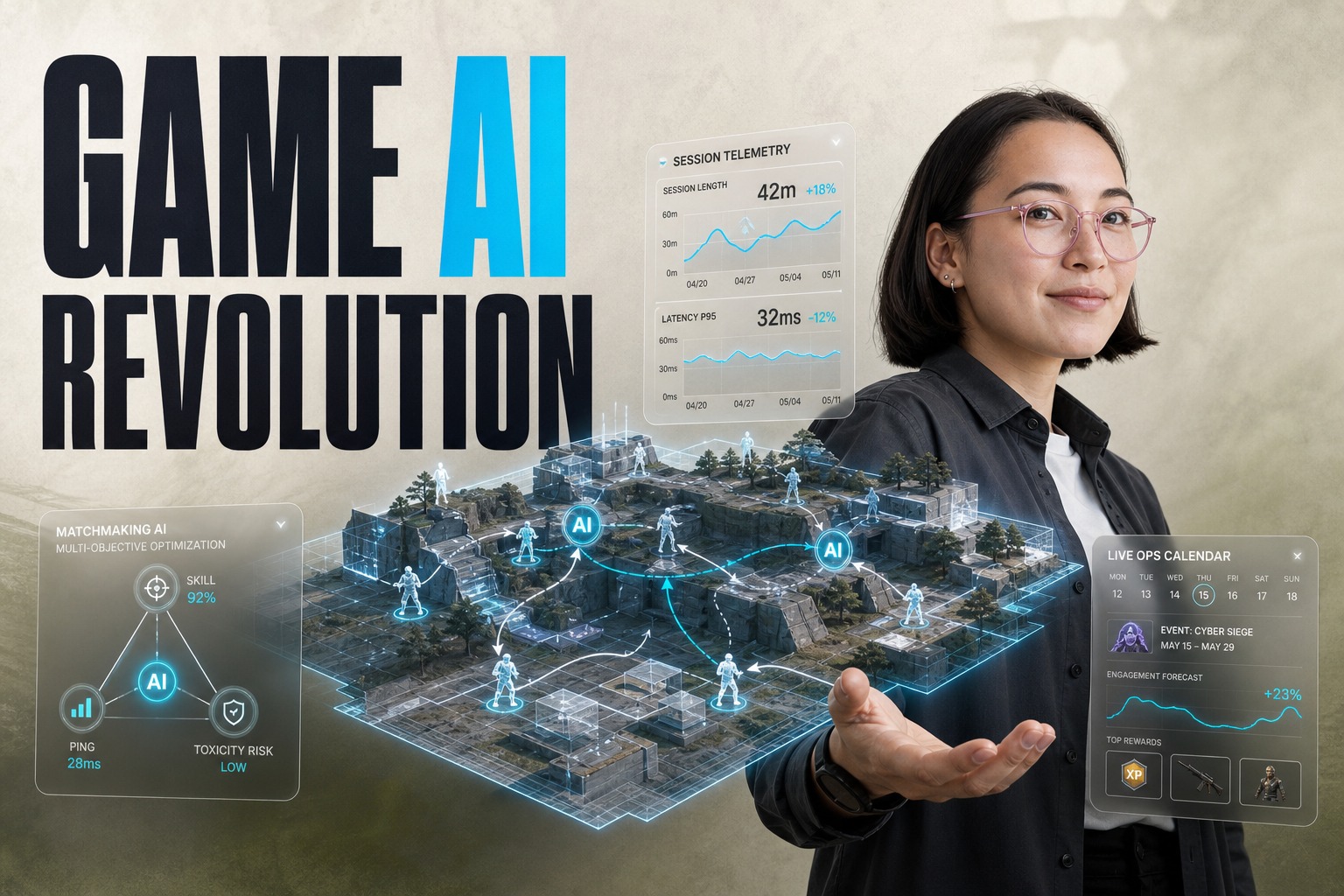
AI in Gaming and Interactive Media: NPC Behavior, Personalization, and Live-Ops Automation
AI in Gaming and Interactive Media: NPC Behavior, Personalization, and Live-Ops Automation
October 14, 2026· min read·#AI#Tech·Reviewed by Plavno AI Engineering Team
AI in gaming works by combining telemetry, decision services, models, and bounded agents to adapt NPCs, personalize player journeys, and automate live operations. The most practical systems separate low-latency gameplay decisions from auditable workflows for events, matchmaking, moderation, and economy tuning.
Share this post
AI in gaming is moving from scripted difficulty curves to agentic systems that observe player state, reason over game context, and trigger the next best action in milliseconds. For studios, publishers, esports platforms, and interactive media companies, the opportunity is not “smarter bots” in isolation. It is a runtime intelligence layer that improves retention, reduces content fatigue, automates live operations, and gives designers controllable tools instead of brittle rule trees. The pressure is real: players expect worlds that react, matchmaking that feels fair, events that arrive at the right moment, and content that adapts without breaking balance. Legacy systems can still ship great games, but they struggle when player segments, economies, toxicity signals, and content catalogs change daily. The winning architecture combines game AI agents, telemetry, experimentation, guardrails, and human creative control.
QUICK ANSWER
AI in gaming uses models, agents, telemetry, and decision services to make NPCs adaptive, personalize content, and automate live-ops decisions. The practical target is not full autonomy; it is 10–100 ms inference paths for gameplay and slower, auditable workflows for events, matchmaking, moderation, and economy tuning.
Industry challenge and market context for interactive media teams
Modern games behave like real-time digital economies. A single title may include PvP matchmaking, user-generated content, regional compliance, fraud detection, creator tools, and monetization experiments running across PC, console, mobile, and cloud streaming.
Static NPC logic becomes predictable. Behavior trees and finite-state machines are explainable, but they rarely adapt to a player’s tactics, frustration level, or narrative history.
Personalization is often batch-based. Segments updated once per day miss short sessions, churn signals, and intent changes during onboarding.
Live operations are overloaded. Teams manually plan events, balance rewards, tune offers, and monitor anomalies across millions of sessions.
Matchmaking optimizes too few variables. Skill rating alone ignores latency, toxicity risk, party composition, queue time, role scarcity, and monetization fairness.
Content production is a bottleneck. Localization, dialogue variants, quest text, tutorials, and creator moderation scale faster than editorial teams.
Risk increases with automation. Poorly governed models can create unfair difficulty, unsafe dialogue, economy inflation, or platform policy violations.
That is why game teams need AI game solutions built as controlled product systems, not isolated demos. The useful question is not what is AI game technology in theory, but which decisions should be automated, which should be assisted, and which must remain designer-owned.
How AI in gaming works in practice: agents, data flows, and runtime architecture
A production system separates gameplay-critical inference from operational intelligence. The first path must be deterministic enough for players to trust it. The second can use richer models, RAG, analytics, and human approval because it controls events, offers, moderation, and content pipelines.
Core components
Telemetry layer: captures events such as deaths, aim accuracy, quest abandonment, chat toxicity, purchases, session length, ping, and party status.
Feature store: maintains player, cohort, economy, and session features with streaming updates through Kafka, Flink, or Spark Structured Streaming.
Decision service: exposes REST, gRPC, or WebSocket APIs to Unity, Unreal Engine, backend services, and live-ops dashboards.
Model orchestration: routes tasks between reinforcement learning policies, ranking models, LLM agents, vector search, rules, and fallback logic.
Governance layer: logs prompts, model versions, decisions, confidence, experiments, safety filters, and rollback triggers for auditability.
NPC AI and agent orchestration
NPC AI typically combines classic control with learned decision policies. A behavior tree still owns animation transitions, navigation mesh constraints, cooldowns, and combat legality. The agent adds context: player style, squad intent, available cover, narrative state, and emotional tone.
Game AI agents work best when they receive bounded tools. For example, an enemy commander can request “flank,” “retreat,” or “suppress” actions, but cannot violate level geometry, spawn impossible items, or change damage rules. This keeps gameplay fair and debuggable.
The best agentic game systems do not replace designers; they turn design intent into a policy that can react to millions of player contexts without rewriting quest logic every week.
Infrastructure for low-latency decisions
Hot path: ONNX Runtime, TensorRT, or lightweight PyTorch models deployed near game servers with Redis caching and 10–50 ms latency budgets.
Warm path: personalization, recommendations, matchmaking, and fraud scoring deployed on Kubernetes with autoscaling and model canaries.
Cold path: training, simulations, economy analysis, and A/B testing on cloud GPUs, data lakes, and MLflow model registries.
RAG path: vector DBs such as Pinecone, Weaviate, or pgvector retrieve lore, policy, support articles, localization memory, and event rules.
For enterprise studios, game and esports software development services should include these boundaries from day one. Retrofitting observability, safety, and rollout control after launch is more expensive than shipping with them.
AI AUTOMATION
Need adaptive game systems?
Plavno designs agentic gameplay, personalization, and live-ops automation pipelines with measurable product and engineering controls.
Business value appears when technical levers connect to product metrics. The strongest use cases optimize retention, fairness, content throughput, support cost, and lifetime value without damaging player trust.
$187B
global games market forecast makes retention improvements commercially meaningful
Dynamic NPC behavior: agents adapt enemy tactics, companion dialogue, crowd reactions, and tutorial pacing while preserving balance constraints.
Player personalization AI: ranking models recommend quests, skins, modes, challenges, bundles, difficulty settings, and reactivation messages.
Live-ops automation: systems propose event timing, reward curves, battle-pass missions, tournament brackets, and regional campaigns based on telemetry.
Matchmaking intelligence: multi-objective models balance MMR, ping, churn risk, toxicity probability, queue time, and role distribution.
In practice, a one-point increase in day-7 retention can outperform a cosmetic content drop if the model targets a high-volume onboarding failure. The engineering priority is therefore measurement: holdouts, uplift modeling, guardrail metrics, and rollback automation.
How to implement ai game systems: roadmap, team, and cost drivers
Implementation should start with one decision loop, not a platform rewrite. Good candidates have frequent decisions, measurable outcomes, enough data, and safe fallback behavior.
Step 1 — define the loop: choose one use case such as adaptive tutorials, bot behavior, event recommendations, or matchmaking quality.
Step 2 — instrument telemetry: standardize events, identifiers, consent, retention windows, and data quality checks before modeling.
Step 3 — build a baseline: compare rules, heuristics, gradient-boosted models, and neural models against the same offline and online metrics.
Step 4 — deploy behind flags: use feature flags, shadow mode, canary cohorts, A/B tests, and automated kill switches.
Step 5 — add agent tools: expose bounded APIs for quests, dialogue, offers, matchmaking, moderation, and analytics queries.
Step 6 — scale governance: version prompts, policies, datasets, models, experiments, and designer approvals in one traceable workflow.
A typical team includes a gameplay engineer, backend engineer, ML engineer, data engineer, game designer, QA automation engineer, and product owner. For regulated esports betting, youth audiences, or healthcare-adjacent interactive media, add privacy and compliance expertise for GDPR, COPPA, SOC 2, and platform policy reviews.
Common pitfalls:
Starting with an LLM agent when a ranking model or rules engine would be faster, cheaper, and safer.
Training on noisy events without validating bot traffic, smurfing, crashes, disconnects, and economy exploits.
Optimizing monetization without fairness constraints, which can damage trust and increase churn.
Ignoring cost controls such as prompt caching, batching, quantization, token limits, and GPU autoscaling.
EXAMPLE USE CASE
Interactive media teams can apply similar AI pipelines to localization and real-time dubbing. Plavno built an AI-driven workflow for multilingual content delivery, reducing manual translation effort and accelerating release readiness across markets.
Risks and mistakes to avoid with NPC AI, personalization, and automation
AI failures in games are visible, social, and hard to explain after the fact. A model that feels unfair becomes a community issue, not just an engineering ticket.
Unbounded agency: agents must not change core rules, grant unauthorized rewards, leak lore, or generate unsafe dialogue.
Latency spikes: gameplay decisions need strict budgets, local fallbacks, circuit breakers, and graceful degradation when model endpoints fail.
Data leakage: support chats, minors’ data, payment data, and private party communications need segregation and retention policies.
Reward hacking: optimization systems may learn to increase sessions by frustrating players, delaying rewards, or creating artificial scarcity.
Opaque balancing: designers need dashboards showing why difficulty, matchmaking, offers, or missions changed for a cohort.
Model drift: patches, metas, streamer behavior, holidays, and exploits change data distributions quickly.
A live model is part of the game economy. Treat it like payment, inventory, or anti-cheat infrastructure: observable, reversible, tested, and owned.
The safest pattern is layered control. Rules define hard limits, models rank options, agents explain and coordinate actions, and humans approve high-impact campaigns. This architecture keeps automation useful without turning production into a black box.
Why Plavno’s approach to AI in gaming works
Plavno approaches game intelligence as software engineering first. We design systems around latency, observability, player experience, and measurable business outcomes, then choose the right models for each decision loop.
For studios and platforms, that means combining agent engineering expertise, AI automation pipelines, and cloud-native backend delivery. We build with production constraints: Kubernetes deployments, CI/CD, API contracts, model registries, feature flags, monitoring, and rollback plans.
Our experience in media and entertainment platforms also matters. Games increasingly overlap with streaming, creator economies, virtual events, and real-time localization. The same architecture that powers personalization and agents can support dubbing, moderation, recommendations, and fan engagement.
Plavno also understands that gaming software development cost depends on scope, integration complexity, asset pipelines, data readiness, compliance, and performance budgets. A focused pilot can validate uplift before a full agent platform rollout, keeping investment tied to evidence rather than hype.
FAQ
How is AI used in gaming? Game teams use 4 main AI patterns: adaptive NPCs, player personalization, live operations, and content automation. Models classify player state, rank next actions, control agent behavior, and recommend events or offers. The best systems combine rules, telemetry, ML models, and human approvals.
How much does it cost to implement AI in gaming? A focused pilot usually takes 8–12 weeks and costs less than a full platform rebuild. Cost depends on telemetry readiness, model type, engine integration, latency targets, compliance, and number of decision loops. Real-time gameplay AI costs more than batch analytics.
What are AI agents for gaming? AI agents for gaming are software actors that perceive game state, select goals, call approved tools, and execute bounded actions. They can coordinate NPC squads, generate dialogue variants, assist live-ops managers, summarize telemetry, or recommend balance changes while respecting designer constraints.
What are the most valuable ai game use cases? The top 5 use cases are adaptive NPC behavior, matchmaking quality, personalized quests or offers, automated events, and content operations. Value comes from measurable improvement in retention, session quality, moderation speed, localization throughput, or live-ops productivity.
The next generation of interactive media will not be defined by one large model inside a game client. It will be defined by reliable decision systems that adapt NPCs, personalize journeys, and automate operations while preserving creative control. AI in gaming delivers value when it is observable, measurable, and integrated with the production stack. Start with one high-frequency decision loop, prove uplift, and scale the architecture across gameplay and live operations.
AI DELIVERY
Ready to ship smarter gameplay?
Build adaptive NPCs, personalization, and live-ops workflows with production-grade AI engineering.