When a new enterprise client signs up for a SaaS platform, the first 30 minutes of the experience often predict whether the relationship will survive. High‑friction onboarding – manual documentation, disconnected help desks, and generic tutorials – costs $1,500 to $3,000 per lost seat and extends the sales‑to‑revenue cycle by weeks. Leveraging AI customer onboarding transforms that precarious hand‑off into a data‑driven, personalized journey that activates users faster, reduces support tickets, and fuels downstream revenue.
Industry challenge & market context
- Enterprise bottlenecks: fragmented CRM, legacy ticketing, and siloed learning management systems force users to repeat information across portals.
- Legacy approaches fail because static checklists cannot adapt to wildly different user roles, integration landscapes, or compliance requirements.
- Risks: churn spikes in the first 90 days, high support‑staff headcount, and missed upsell windows due to delayed product value realization.
Technical architecture and how AI customer onboarding works in practice
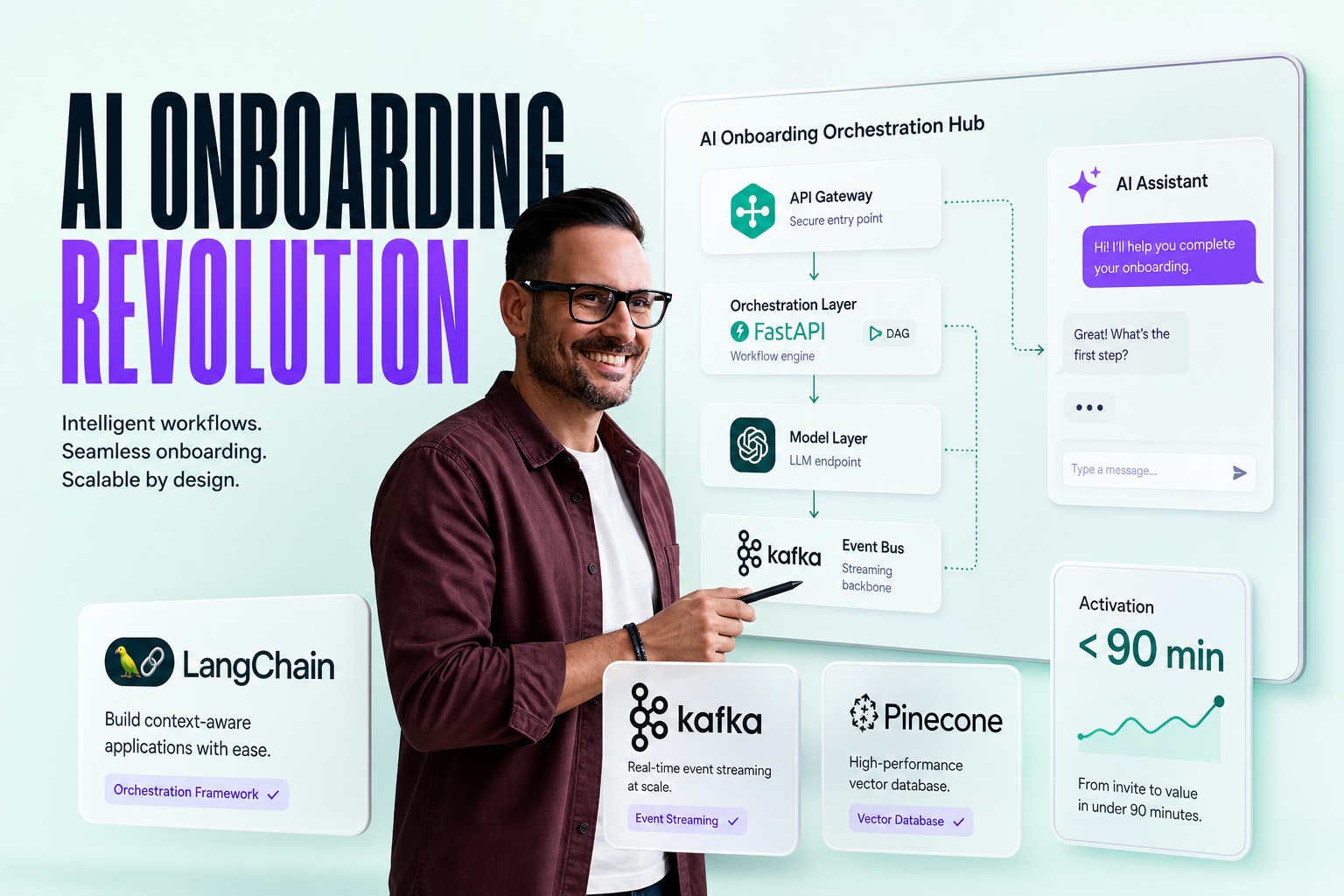
The core of an AI customer onboarding engine is a composition of reusable services that route context, execute LLM agents, and persist state across async events. Below is a reference architecture that balances real‑time responsiveness with enterprise‑grade reliability.
- API Gateway: Terminates TLS, enforces OAuth2 scopes, and provides rate‑limiting and circuit‑breaker policies. Implementations include Amazon API Gateway or Kong.
- Orchestration Layer: A lightweight service (Python FastAPI or Node.js NestJS) that materializes a workflow as a Directed Acyclic Graph (DAG) using AI automation tools like
LangChain or CrewAI. It schedules agents, tracks progress in Redis, and emits events to a Kafka topic. - Model Layer: Hosts LLMs (OpenAI gpt‑4‑turbo, Anthropic Claude) behind a private inference endpoint (e.g., SageMaker or Azure OpenAI). For retrieval‑augmented generation (RAG), embeddings are stored in a vector DB such as Pinecone or Qdrant, and the query pipeline runs under a 2‑second latency SLA.
- Data Store: PostgreSQL for relational metadata (user roles, onboarding steps) and a separate NoSQL store (MongoDB) for unstructured interaction logs. All writes are idempotent; CDC streams feed the event bus.
- Event Bus: Kafka or RabbitMQ to decouple state changes (step completion, confidence score) from downstream actions (email, in‑app notification, ticket creation). Consumers respect at‑least‑once delivery and maintain replay safety.
- AI Assistant Integration: A chat UI built with React and
AutoGen agents that can invoke external tools – e.g., create a sandbox environment via a Terraform‑as‑code service, fetch a PDF from S3, or call an internal GraphQL compliance API. The assistant lives behind the same OAuth2 token, ensuring single‑sign‑on.
Data pipeline example: When a new user clicks “Start Tour,” the front‑end posts a /onboarding/start event to the gateway. The orchestration layer creates a session ID, writes a row in PostgreSQL, and fires a session_started Kafka message. A “Guide Agent” (LangChain + RAG) consumes the message, pulls the user’s role‑specific docs from the vector store, and returns a personalized script to the UI within 850 ms. As the user completes each step, a webhook updates the progress store and triggers a “Success Score” microservice that aggregates confidence metrics and, if below threshold, pushes a ticket to ServiceNow via a secure REST call.
All services expose OpenAPI contracts; internal calls use gRPC where latency is critical (e.g., embedding generation). The architecture is fully containerized with Docker and deployed on a Kubernetes cluster (EKS, GKE, or AKS). Autoscaling policies are based on CPU < 70 % and Kafka lag < 200 messages, keeping cost per active onboarding session under $0.12.
Security and governance are baked in:
- OAuth2 + JWT for every request, scoped per tenant.
- Audit trails logged to Elastic Stack with immutable S3 storage for compliance (GDPR, SOC‑2).
- Data residency flags enforce that vector embeddings for EU customers reside in EU‑west‑1.
- Rate limits per tenant (max 10 RPS) protect LLM quota exhaustion.
Deployment options:
- Multi‑tenant SaaS: Shared model endpoints, per‑tenant namespace isolation in PostgreSQL, and vector DB partitions keyed by tenant ID.
- Single‑tenant / On‑prem: Dedicated inference VM (GPU) behind a private VPC, helm‑based rollout, and externalized storage via on‑prem Ceph.
- Failover across two regions using Istio traffic‑mirror and cross‑region Kafka replication.
Business impact & measurable ROI
- Activation time reduced from an average of 5 days to under 90 minutes (≈ 70 % improvement) for enterprise accounts.
- Support ticket volume during onboarding drops 38 % because the AI assistant resolves 4/5 routine queries instantly.
- Customer success teams reallocate 1.5 FTE per 100 new users to proactive health checks, increasing upsell conversion by 12 %.
- LLM‑driven RAG cuts content‑authoring costs by 45 % – the system automatically stitches existing knowledge‑base articles instead of requiring new hand‑crafted guides.
- Operational cost per onboarding session stays under $0.12, a 5‑fold reduction versus legacy video‑training pipelines that cost $0.60 per user.
The hidden ROI of AI onboarding isn’t just faster clicks – it’s the downstream lift in product‑adoption metrics that only a data‑driven coach can quantify.
Implementation strategy
- Phase 1 – Discovery & KPI definition: Map existing onboarding flow, identify role‑specific milestones, and establish baseline activation metrics.
- Phase 2 – Prototype core agents: Build a LangChain RAG pipeline that answers the top 20 FAQs using existing documentation; validate latency < 1 s.
- Phase 3 – Orchestration and event bus: Deploy a minimal FastAPI orchestrator, connect Kafka, and instrument idempotent state stores.
- Phase 4 – AI assistant UI: Integrate AutoGen chat widget, enable tool calling for sandbox provisioning, and embed analytics (segment‑level funnel).
- Phase 5 – Security hardening: Apply OAuth2 scopes, enable audit logging, and run a penetration test against the gateway.
- Phase 6 – Pilot rollout: Select 3 enterprise customers, monitor activation latency, support ticket deflection, and iterate on prompt engineering.
- Phase 7 – Scale & Optimize: Autoscale model endpoints, fine‑tune LLMs on domain‑specific data (cost $0.02 per 1 K tokens), and add multilingual RAG for global accounts.
Common pitfalls (avoid these traps):
- Hard‑coding prompts: leads to drift when product UI changes.
- Neglecting rate‑limit back‑off: can exhaust LLM quota and cause user‑visible latency spikes.
- Storing session state only in memory: loses data on pod restart, breaks idempotency.
- Skipping compliance tagging for EU data: results in GDPR breach penalties.
- Over‑engineering the workflow DAG before a pilot: adds unnecessary complexity and slows feedback.
Why Plavno’s approach works
- Engineering‑first mindset: we build reusable AI agents with LangChain, LlamaIndex, and CrewAI, then compose them into market‑ready pipelines.
- Enterprise‑grade architecture: Kubernetes‑native, multi‑region, zero‑downtime deployments with full observability via OpenTelemetry.
- End‑to‑end security: OAuth2, audit trails, and compliance‑by‑design across all data flows.
- Rapid prototyping platform: Plavno Nova lets us spin up a PoC in < 2 weeks, integrate with existing CRMs (Salesforce, HubSpot) via GraphQL adapters, and iterate on prompts with A/B testing.
- Domain expertise: Our teams have delivered customer‑success AI for fintech, health‑tech, and e‑commerce, translating industry‑specific compliance into reusable components.
- Scalable talent model: We provide outstaffed engineers (outstaffing) and project‑based teams (outsourcing) that can augment your internal product groups without the hiring lag.
By coupling a robust technical foundation with a clear ROI narrative, Plavno enables enterprises to replace brittle onboarding checklists with an AI customer onboarding experience that scales, complies, and drives revenue.
Ready to cut activation friction and boost customer lifetime value? Contact our AI specialists today to schedule a discovery sprint and see how a tailored AI onboarding pipeline can transform your SaaS business.